
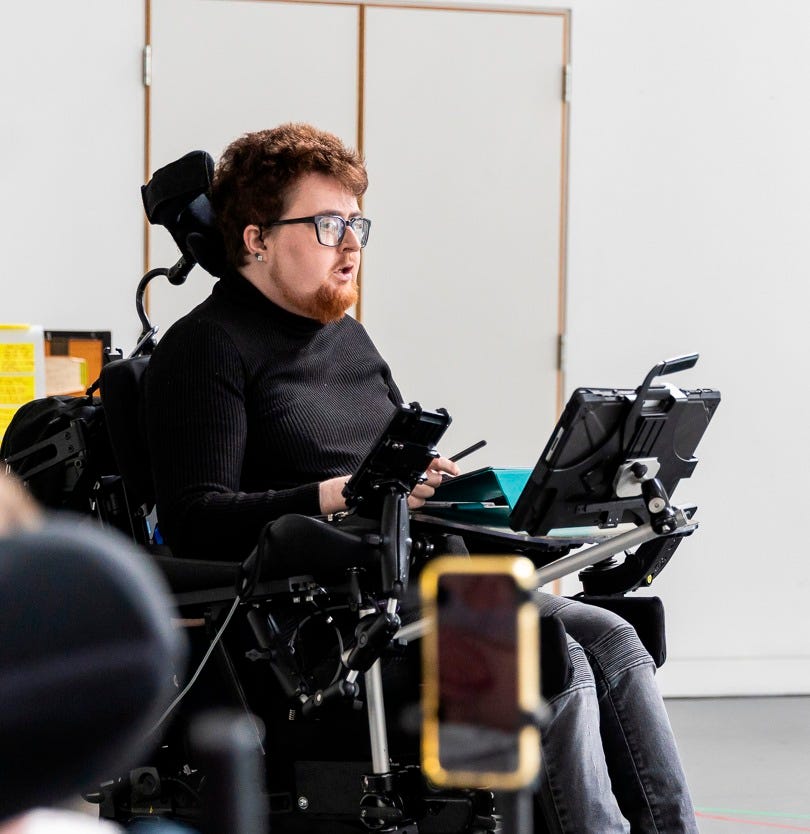
I love my job.
I love being a theatre director, and I’m proud of being disabled, so I suppose that makes me the disabled director. Or at least, that’s how I’m introduced by others - as an interviewee, a panellist, a feature, a speaker. Sometimes even as a person - “this is the disabled director, Jamie Hale”, as if that’s the summary of who I am, the only thing that needs to be said to define me.
Applying labels
When it happens, I am inevitably surprised, because I feel like there are so many things that could be said about me - even call me “the queer director”, or “the trans director” - but people never do that; it’s always “the disabled director”. If it were only occasional, I’d probably shrug it off, but over time it starts to feel more and more like a category I’ve been filed into, against my preferences.
The structure of it is telling, the terms that are marked and unmarked. We don’t talk about “the straight director”, or “the cis director” or “the non-disabled director” - and so the modifier tells us what the default is - that while 24% of the working-age population are disabled, we’re still rare enough as directors for that to be notable. This isn’t about describing me; it’s about telling us what the “norm” is, and highlighting my deviation from it. And interestingly, it’s never other disabled people that do it. It’s always non-disabled people who classify me as a disabled director specifically.
Sometimes it’s because they want a token. I feel this when asked to do a piece of work I am unqualified to do, or to speak on a topic I do not know about, when at the end of an event I am in countless photos - far more than other participants who don’t come equipped with large wheelchairs. I am wanted for the visual effect I give, not necessarily for my presence. It’s hard to know when I’ve been offered something for my talent, and when I’ve been offered it for less altruistic or creative reasons. It leads to me questioning every opportunity I’m offered in my head, a constant sense of imposter syndrome, of “would I be here if I wasn’t the disabled director?”
Reaping the benefits
And the answer is no, probably not. I am probably here in my career partly because I am the disabled director. I recognise that it doesn’t give me a unique selling point, that when I started CRIPtic I caught the timing just right to build something by and for disabled people, that culture was funding us, giving us opportunities, and that some of what I get results from that. I don’t know if I would have had these opportunities were I not disabled - and I don’t know if I would have had them were I not visible as a disabled person.
But then, I realise, I would have had other opportunities. So many other opportunities that fundamentally exclude wheelchair users with the constant refrain of inaccessible venues, and “we’re very sorry”. Would my career have gotten this far? Would it in fact have gotten further? It’s hard to know.
What does it mean that I’m a disabled director - because it’s not just a label imposed upon me from the outside - a descriptor with which I feel uncomfortable - it’s also something more, a descriptor of the ways I work, not just the ways my bodymind exists in the world. When it’s used to dissolve me into a flat being, the disabled director, I resent that. Still, when it recognises my craft - in the tradition of people like Jenny Sealey and Nickie Miles-Wildin - then I have more comfort with being described that way, because there is a craft. Maybe that descriptor recognises it as well as hiding it.
The deviant director
The assumed director is mobile. They come from the table across the space, they stand in, physically demonstrate a line or movement, and take over the stage. My body is seated, fixed, larger and less mobile. It can’t demonstrate a movement or line with the fluidity of an ambulant body or the lung capacity of most actors. I see the stage differently; I cannot leap around the auditorium, I have a fixed perspective seated in my chair in the one space that exists for wheelchairs, and from that, I see detail. I work in partnership with Assistant Directors to have that fluidity of movement I lack, to step in, to demonstrate, to dart around the auditorium and watch a scene from different angles. Being a disabled director gives me permission to remain outside the piece, to watch and shape the movement without ever trying to provide it.
The director’s body also inhabits a position of authority. It moves and commands space; other people part or pause for it. I dislike that hierarchy, feeling my role to be far more collaborative for that, but I watch it happening for my chair regardless. But I do not stand or move or speak like a traditional avatar of authority, and perhaps that opens something in my relationships with performers and crew that I remain outside those toxic, hierarchical signifiers. I admit that this has the power to disconcert some people - who are looking for a director to embody the structure and rules they are used to in theatre, but for me it also allows me to rebuild hierarchies and power structures that work for me, and hopefully for others in the room.
My body can be a slow one, unpredictable. The director is assumed to be the core of the play, always switched on, always ready on demand, and I can’t operate that way - fatigue, pain, brain fog, medication effects - all of these mean I work in a way that might appear unreliable. I make adaptations for this - trying to have an Assistant or Associate Director I can trust to step in if I can’t, tracing the most important notes, building a rehearsal day around my own reserves. If I can’t memorise, track and give ten notes, then maybe the actors also cannot receive ten notes, and maybe one good note is far more worthwhile. The assumptions placed on directors are harmful - this expectation of endlessness. I feel like we face it more than any other role I’ve experienced, at least in disability arts, because it is my responsibility to find ways of bending over backwards tio meet the needs of everyone else in the team, and therefore, often, absorbing the work in ways I cannot fairly do. We need to find ways of meeting everyone’s needs.
Being a disabled director
But being a disabled director brings a lot into the room. It’s not just about disability as something I cope with, but also about what I do as a disabled director. I am very alert to the way my body moves, and so I attend to that in others, looking at the detail of how tension and space are held. I think of access as compositional from the beginning - I never want to bolt it on, when it shapes what interests me in a design, a sound world, and in blocking and movement. I read the interactions between bodies on stage through a crip gaze - rather than assuming a body can do what is asked - and seeing deviation from that as a problem, I try to start by noticing the effort, range, and cost, recognising the labour of a movement, and working out whether it is worthwhile. I read pacing through a sense of crip time that puts value on finding meaningful time to rest, outside the normative pace that keeps driving forward. Overall, a crip eye as a director means examining the room, and the barriers within it, understanding whose energy will be low, who might struggle, what the day demands of everyone and how they can offer it, understanding what we all need to overcome the barriers we face and find ourselves as a community that can hold and uphold each other.
Being called a disabled director also recognises the craft of aesthetics of access - that I am part of a creative lineage of disabled directors for whom access is part of what we do - where it’s seen as creative material instead of service obligation. And this craft is invisible to the wider sector, who see the presence of an interpreter, or hear audio-description and think of this only as cost and compliance, not part of our tradition as directors. Being a disabled director could name this as a methodology, if used precisely.
Claiming ‘disabled’
So do I want to claim this more? It’s not enough to feel like being called a disabled director is a wound, because that makes being disabled into a loss, instead of recognising it as a methodology, a politics, an aesthetic, and a sense of commitments to the artists and creatives and team and audiences around me. Claiming it makes me legible, and names my practice, making it easier to transmit to other upcoming artists, and forcing institutions to reckon with the resources and work that come with this methodology, but its absolute validity.
Maybe the difference is who’s holding the pen. When I’m being talked about in ways that I didn’t consent to, calling me a disabled director feels minimising, as if I do not deserve the full epithet without a qualifier, but when I’m talking about my practice, and others are, then the adjective becomes a proper account of my work. I don’t think I want it to disappear, but I want it to be used with balance - recognising that it speaks to my expertise and tradition as a director, not just my position as someone who faces disableism. And if the wider sector wants to call me the disabled director, it needs to be commissioning and resourcing work in which I am able to be all the things being a disabled director means being, and in which I can work in the tradition of disabled directing that I want to be working in. Perhaps in categorising me that way, they’ve actually allowed me to identify that way, and to build into a tradition I might otherwise not have found the same degree of identification with.
Comments
Nothing yet. Say the first thing.
Sign in to join the conversation.