
Jane Schoenbrun is one of the greatest directors working today, and something I find consistently fascinating in their films is the way they depict media obsession. It was a clear trend in their first two feature films, We’re All Going to the World’s Fair and I Saw the TV Glow, and I’m glad to report that it has just as strong a presence in their newest film, Teenage Sex and Death at Camp Miasma. And what I find especially interesting is the way each film seems to delve deeper and deeper into the idea of media obsession. In their own ways, each protagonist is challenged to not only appreciate, but to fully enter the fictional worlds they obsess over, each seeing it as some form of self-realisation. And with this third entry, I feel that all three have come to form a kind of trilogy representing three different stages of this process.
World’s Fair follows Casey, a young girl whom we actually know very little about. What we can tell is that she’s dissatisfied with her real life, which appears dull and isolating. The closest we come to seeing any friends or family is the furious voice of her father from the next room. In this state, Casey turns to the online world for an escape, delving deep into the ‘World’s Fair’ challenge. After repeating the phrase ‘we’re all going to the world’s fair’, several strangers online have documented themselves losing control of their own bodies, from off-putting vlogs to fully fledged artistic short films, videos which Casey becomes heavily engrossed in. This challenge presents her a chance for self-expression, to become liberated from her miserable life and become something greater, something that is fictional but which can feel real to her and to the audience. But this potential is always limited.
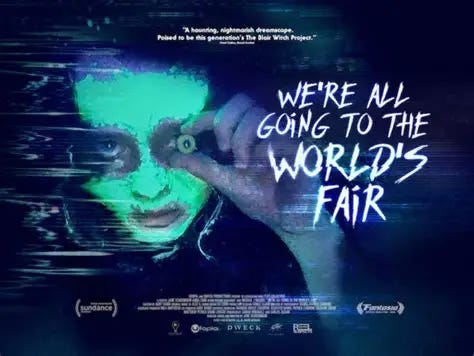
As Casey delves further into this creative online world, the viewer becomes increasingly concerned for her wellbeing. Her videos typically fail to be creepy in the way she intends, but occasional moments stand out. For example, she films herself sleeping in a room that is dark except for a bedside lamp. For a while we wonder why we’re watching nothing happening, until eventually, Casey leans forwards into the harsh lamplight and her face contorts into an unnatural toothy grin.
Scenes like this make us fear that Casey is suffering from something genuinely supernatural, but more often the fear comes from something more grounded. Through her videos, she is contacted by a lonely adult man named JLB, who contacts her initially through a distorted video of her face projected huge onto her wall.
![We’re All Going to the World’s Fair – [FILMGRAB]](https://substackcdn.com/image/fetch/$s_!Tcwv!,f_auto,q_auto:good,fl_progressive:steep/https%3A%2F%2Fsubstack-post-media.s3.amazonaws.com%2Fpublic%2Fimages%2F09a04894-a20b-4d2f-b6d8-76f9b90769f3_1152x894.jpeg "We’re All Going to the World’s Fair – [FILMGRAB]")
Whilst the ending suggests he never really meant any harm, there is genuine fear in the audience that JLB is some kind of predator, and his unmonitored calls with Casey are worrying if mostly harmless. And the concern for Casey’s wellbeing reaches its peak when she starts recording herself walking out in public, talking about how she might kill her father or herself, and wouldn’t be able to stop herself.
In one of the short films Casey watches, a man is literally sucked into his laptop screen, and it seems like this is what Casey wants- to escape her real life and live only in the World’s Fair challenge. She claims that the challenge is making her becomes someone else, ‘like I can feel myself leaving my body’. Later, we see a scene seemingly from Casey’s POV as she begins the challenge, staring at a flashing laptop screen as it slowly takes over the frame. Casey’s voiceover tells us that she’s going ‘Inside the video. Inside the screen.’ She is becoming fully consumed by this media landscape she has invested in, losing any sense of self outside of it.
In the end, Casey’s true liberation comes from her finally stepping away from the screen. After an argument with JLB, she hangs up and never contacts him again. JLB claims that afterwards they met up in real life and she apologised, but I don’t buy it. After their call, we never see Casey outside of a flashback, because she has finally realised that this obsession with the World’s Fair challenge is an unhealthy one. It may have provided her with an opportunity for self-expression and temporary escape, but it was doing her more harm than good. So in the end she steps away, and we as the audience are no longer allowed to see her.
In World’s Fair, Casey’s desire to partake directly in the media she consumes is ultimately harmful. But in I Saw the TV Glow, Schoenbrun begins to suggest that truly delving into your favourite media could become a path to self-actualisation.
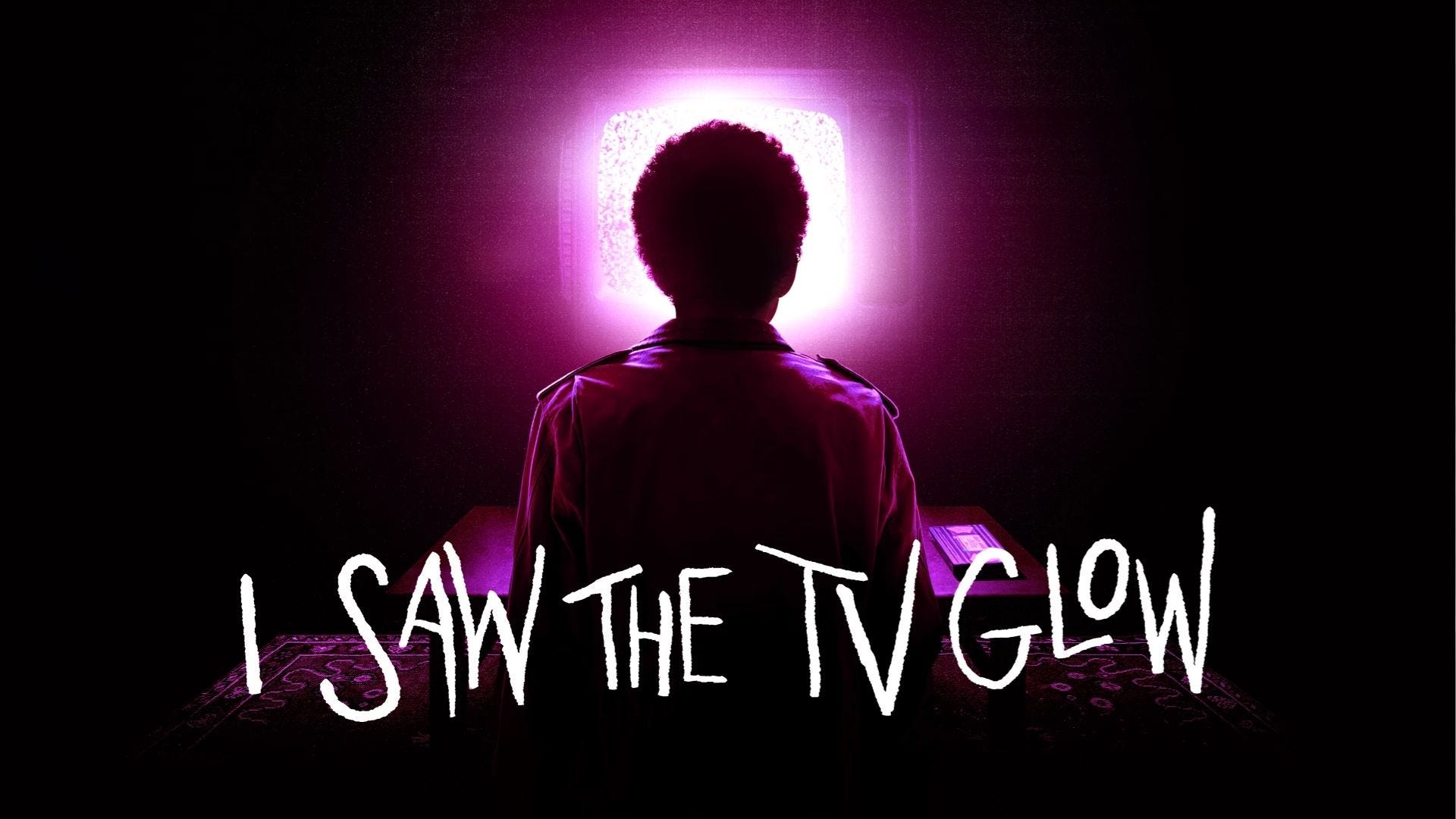
Owen is a young person heavily implied to be a trans woman. Their alienation within their own body is expressed through their surroundings, familiar settings like schools, their home, or children’s play areas become uncanny and strange. The only escape comes in scenes with their friend Maddy, whom Owen bonds with over ‘The Pink Opaque’, a young adult show heavily based on Buffy the Vampire Slayer. Every scene involving the show is granted a strange sense of transcendental meaning. When they first watch it together, Maddy immediately tells Owen to shut up and leans forwards, eyes wide. Owen is depicted in a slow zoom as their own eyes widen, their face awash in the TV glow.
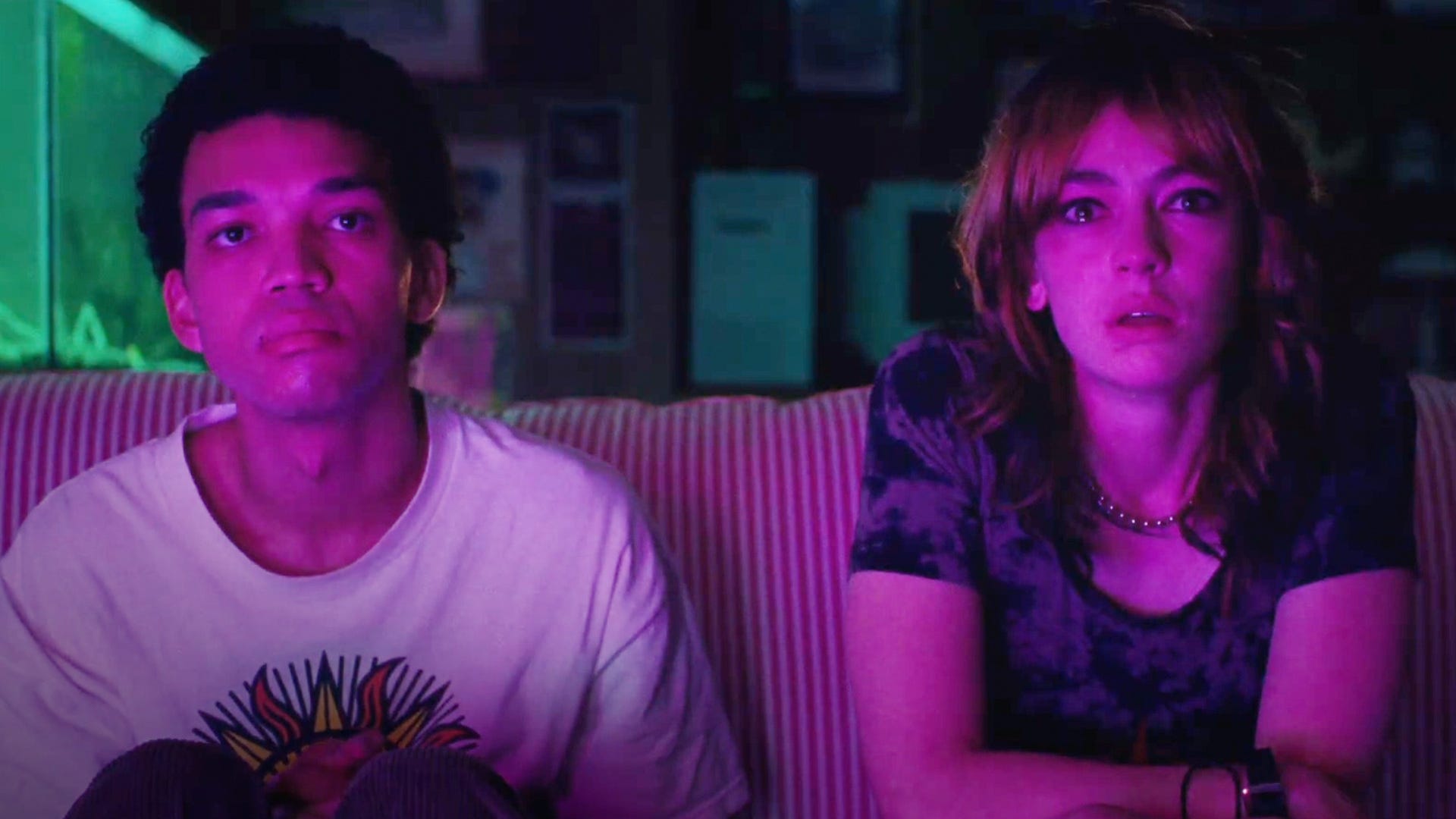
It’s clear early on that their mutual obsession comes from their identification with main characters Isabel (Owen) and Tara (Maddy). But as the film progresses, the supernatural edge only faintly hinted at in World’s Fair starts to become a real possibility. Now slightly older, Maddy and Owen reunite. Maddy asks if Owen remembers the pink opaque, that familiar obsessive look in her eye, and Owen tells her it’s their favourite show. Maddy asks if it ever felt like more than a show, and we see brief, repressed flashes of Owen dressed like Isabel, briefly embracing the female identity repressed within them.
It is then that Maddy reveals the true nature of the pink opaque. She claims that after running away from home, she buried herself alive, and after screaming and begging for help, she finally awoke as Tara from the Pink Opaque. She tells Owen that their true identity is Isabel, that this life is all just a bad dream induced by their arch-nemesis Mr Melancholy. Whilst ridiculous on the surface, this feeling does perfectly match the dreamlike, or often nightmare-esque, reality of Owen’s life. Owen embracing the pink opaque, entering the TV show they adored growing up, could be a powerful form of self-realisation. It would be a form of gender transition for Owen, who would finally become Isabel as they’ve always felt they were meant to be. Whereas Casey’s media obsession was dangerous, Owen’s could be truly liberating, as Maddy begs them to join her in the pink opaque.
But Owen doesn’t do it. Far too afraid of their own queer identity, and more literally of Maddy’s admittedly suicidal sounding plan, Owen runs away. Just like Casey, Owen often shows a desire to enter their favourite media, at one stage ramming their head into a TV set in a scene reminiscent of the short film Casey watches. But in TV Glow there is still a limit to the liberation of becoming fully immersed in media for, namely the fears of the person doing it.
In one of the film’s final scenes, we see the phrase ‘there is still time’ in huge chalk writing on the road. In its penultimate one, a fully adult Owen has a breakdown at work, and walks into the bathroom. In one of my favourite scenes ever put to film, Owen tears open their chest to reveal a bright glow deep within themselves, as Yeule’s ‘Anthem for a Seventeen Year Old Girl’ plays alongside the sounds of a TV set. Whilst Owen has pushed down the potential for liberation through media, it still exists deep within them. And this is where Camp Miasma picks up.
Camp Miasma follows young director Kris as she looks to remake her favourite slasher franchise, Camp Miasma. This is a franchise she credits for her queer awakening, and in her research for the remake she meets star of the original film, Billy Presley. But within this research trip is a clear desire to not just remake the film, but to recapture and recreate the experience of it. More specifically, Kris is obsessed with the look in the eye of Presley in one particular scene, and tells Presley that she wants to feel that sensation herself.
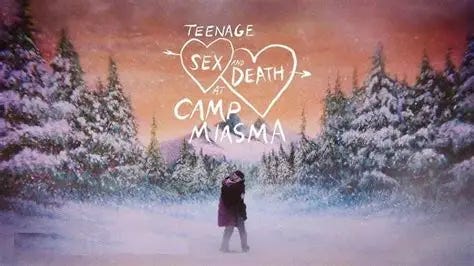
The scene in question is one in which Presley’s character both is having sex, and is in danger of being murdered by the monstrous ‘Little Death’, a kind of undead creature who now murders the residents of Camp Miasma. Throughout their interactions, a sexual tension clearly emerges between Billy and Kris, but when Kris finally tries to realise these desires, she finds herself suffering from the same mental block that has always prevented her from being sexually fulfilled.
I originally started trying to summarise the plot and explain what’s going on, btu Camp Miasma is either an intricate be or a complete mess and I haven’t decided which yet. The short version is that in order for Kris to feel sexually satisfied, she must enter the world of Camp Miasma just as Presley once did. The villain of the Camo Miasma films, Little Death, is heavily implied to be real, or at least exist in some sort of meta-real limbo. They live in the bottom of the lake where they were once drowned, and when their desire requires it, they force those outside of the lake to create a new film for them to enjoy. Presley tells Kris that she must see her sexual experience both through her own eyes, and thriyugh the eyes of Little Death as he approaches to murder them both. Little Death’s constant re-emergence and need to be fed can be read as a metaphor for both women’s sexual desire, one that can seemingly only be fulfilled by the specific sexual dynamics of a slasher film.
So, Presley takes Kris to the lake where Little Death lives in order to feed Little Death and themselves. Kris finds themselves inside Camp Miasma, fleeing Little Death as they penetrate and annihilate various characters from her life. Kris can initially hardly contain her excitement at finally entering the film, but becomes increasingly terrified as the scene progresses.
Finally, she reaches Billy Presley in her bed, and the two are able to have sex, Kris finally fulfilled for the first time in her life. She sees through her own eyes and through those of the fictional (ish) Little Death, and finally reaches the same orgasmic expression that she’s always been so obsessed with. Little Death arrives and kills them both, except it’s not really death. Presley repeatedly comforts Kris by telling her that ‘if it gets too real, you can always turn it off’, borrowing the tagline from Camp Miasma’s DVD release. And in the next scene, Presley and Kris essentially ‘turn off’ their deaths, remaining bloodied but perfectly happy and healthy,
Throughout much of the film’s last half hour or so, Kris is essentially inhabiting the Camp Miasma films. A customer service worker is transformed into a grainy, black and white image of a character from the first film, repeating lines verbatim. She lives in the sleepaway camp the films are based on, the backgrounds of several shots intentionally artificial in the style of a film set. And she and Presley remain in their bloodied dresses, although none of the regular people around them seem to notice. Kris and Presley accept that Little Death will eventually hunger again. But they do so with a smile, happy to provide for Little Death and live in his world.
Casey was forced to step away from her media obsession. Owen was too afraid to fully delve into theirs. But finally, in Camp Miasma, Kris is able to find a seemingly healthy way to fully enter the world of their favourite media. There’s plenty of interpretation and re-interpretation to be done with Camp Miasma, and I’ll have to revisit all of this on a rewatch. But for now this feels like a beautiful and satisfying conclusion to a recurring thematic concern in Schoenbrun’s films.
No posts
Comments
Nothing yet. Say the first thing.
Sign in to join the conversation.