
Conversation around Flow will always be dominated by its technical qualities. One glance at a clip or even a still from this film reveals its highly unique animation style. It was animated exclusively in the free to use Blender engine to create a style unlike anything else in mainstream animation. If you were to watch a clip of Flow with no prior knowledge, you would probably mistake it for a video game cutscene rather than a feature length film.
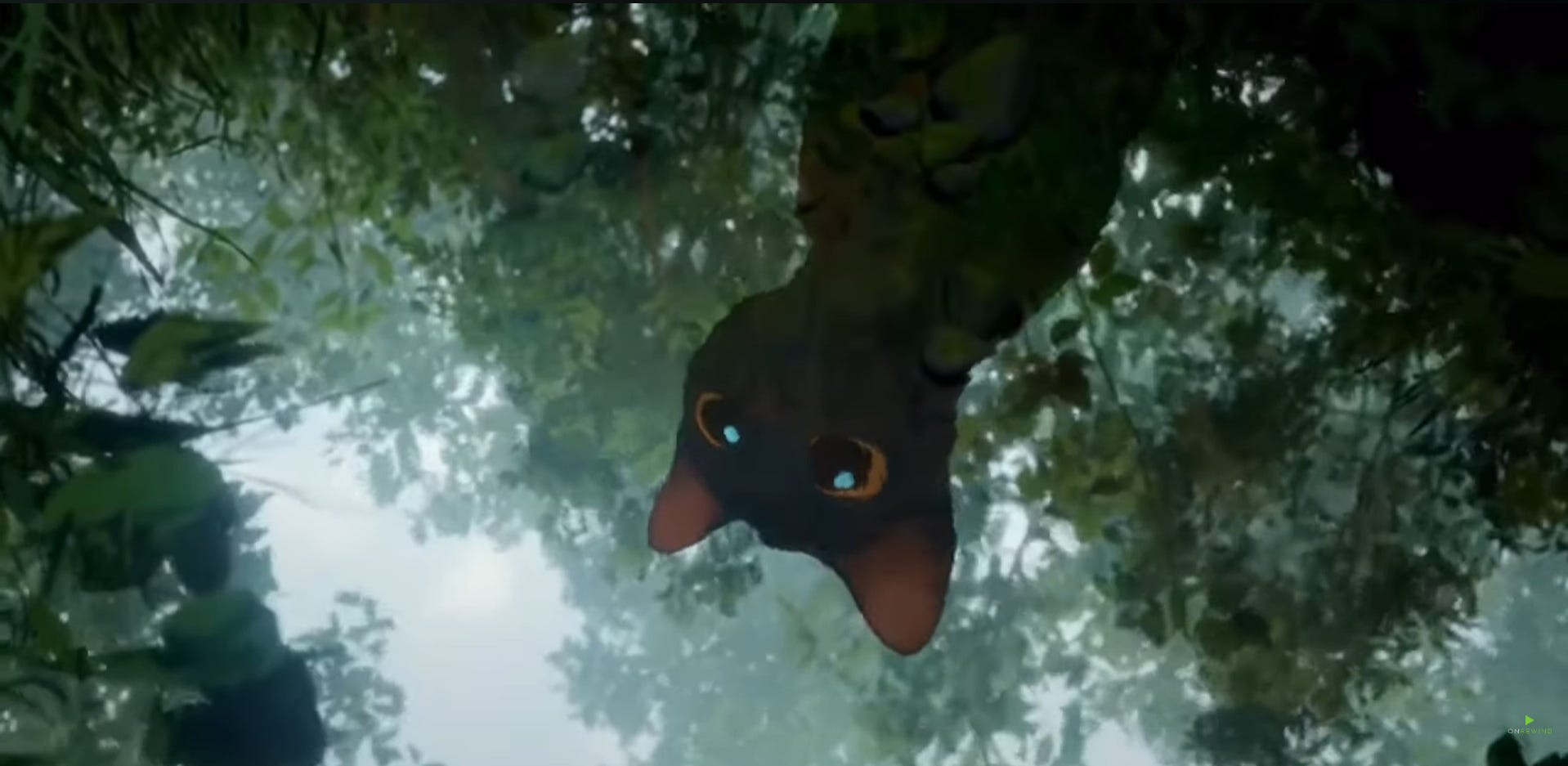
At its best, this style is genuinely majestic. There are several points in Flow which excel in visual beauty, contributing to the sense of existential wonder which becomes so powerful. It’s eager to show off its visual quality in its opening, which immediately shows us Cat, our protagonist, staring at themself in a shimmering pool of water, before dropping us into an intense and up close chase scene. I will push back slightly on the visuals, because there was once or twice when I found them a bit janky and distracting. When the dogs bark, their movements can feel overly sudden and more like an old video game than a newer one. But this is a fairly small nitpick, and does little to take away from the overall technical marvel of Flow.
Critics will often say it feels like more of a tech demo than a film, a demonstration of technical brilliance rather than a compelling narrative. Whilst the opening 5 minutes or so felt this way, for the rest of the film I couldn’t really disagree more.
One of the other most well-known traits of Flow is that it’s a film whose entire cast is animals, and not anthropomorphised ones. Most crucially, this means no speaking, giving us an entire hour and 20 minutes of dialogue free storytelling. The filmmakers were forced to communicate through sound effects, animal sounds, and most importantly, visuals. And they manage to do this spectacularly. Despite the lack of dialogue, I was fully able to understand and emotionally connect with all of these characters.
We follow Cat as a biblical level flood destroys their home, and they become part of a small group of animals fighting against the odds to survive in this new world of water. When these animals interact, they have entire conversations through glances and animalistic body language, conversations far more engaging than most films can achieve with words. This has been done before of course, but that doesn’t prevent it from being impressive.
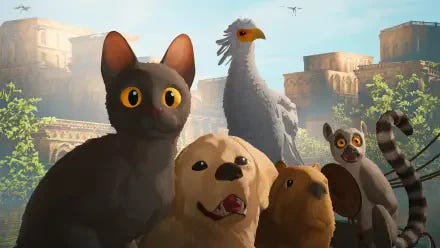
Although, once again, it’s important to say that this choice leads to far more than just technically impressive filmmaking. A key factor to making Flow work like it does is the balance it strikes between humanising the animals whilst never making them fully anthropomorphised. The lack of talking is part of this, but the script as a whole makes sure to never forget that these really are animals. The lemur spends the entire film hoarding shiny objects, and the dog still wants to chase his ball around in the middle of a natural disaster. A lot of films have animals behave fully human but retain one animalistic trait which ends up feeling like a gimmick, but here each animal’s behaviour feels consistently thought through and logical. The animation also allows the animals to move like animals, with the filmmakers studying zoo animals’ movements in preparation.
The effect of this isn’t just that I get some realism in my cat movie, but that the bond eventually created through this small group feels earnt and genuine. The Secretary Bird that later joins them is a great example of this. Cat is initially terrified of them, after being picked up and nearly killed by one earlier in the film. Even after the bird stands up for them against their flock, Cat is massively reluctant to trust them, shrinking away every time they come close. The tension between them is a consequence of the tensions of a natural food chain, and their building of trust is a very gradual process throughout the film, made all the more difficult by their inability to verbally communicate.
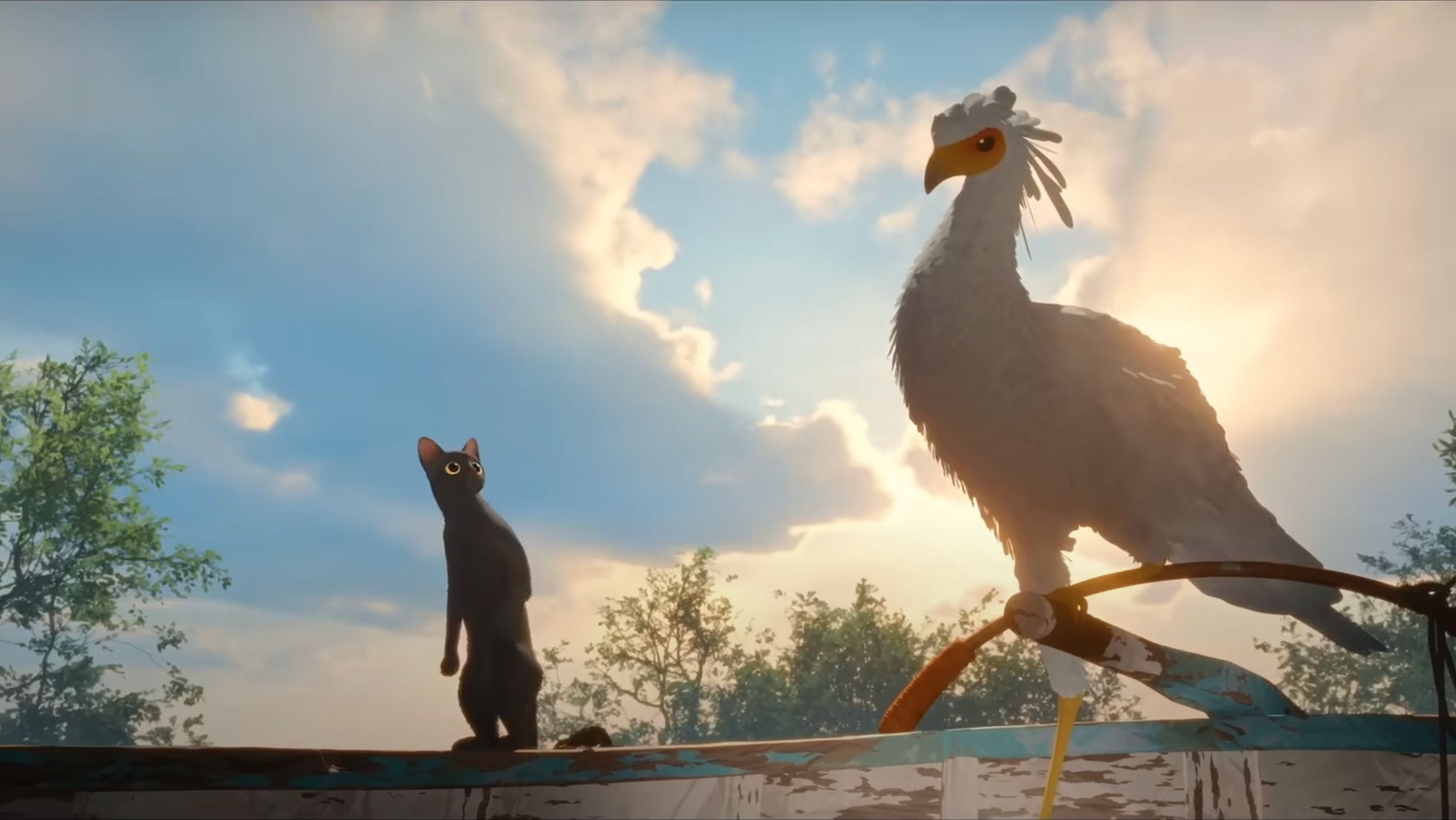
So when we reach the point at which Cat can easily wander next to the bird and drop a fish at its feet, it’s all the more touching to watch. Though this is the most extreme example, there’s a similar tale for every bond in the film. This makes the moments when the group are separated, or when their bond is threatened, far more emotionally impactful than I ever expected from this film.
It’s this bond between Cat and the Bird which leads to the most memorable moment of the film. In the middle of a maddening storm which has flung Cat away from their friends, they find the bird atop an outcropping of rocks which rise far into the clouds. These rocks have been visible throughout the whole film, distant monoliths acting as a constant wayfinder. And now, they finally stand atop them. What happens next is hard to explain, as gravity seems to become suspended, and both animals float upwards towards the clouds. They become surrounded by something akin to Aurora Borealis, or outer space, and float towards a heavenly golden glow. Richard Zalupe’s score adds to a sense of majesty, of having reached something beyond human or animal comprehension, as if in contact with some kind of higher being as they ascend towards the golden glow. Whilst cat floats, admiring this majesty, the bird seems to embrace the light, opening its wings in an embrace before using them to soar up into the unknown.
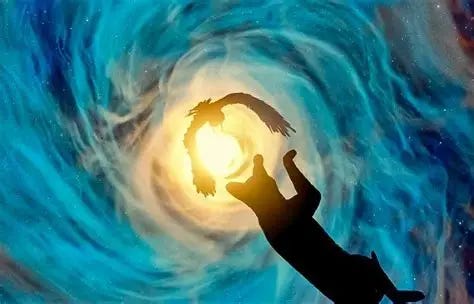
It’s the last we see of the bird, the only one of our small fellowship not to survive. It’s unclear whether this was just a beautiful way to represent the bird’s death, or something else. Not long after it, the flood suddenly reverses, as if a dam broke somewhere and returned the world to its normal state. The way its structured, it’s almost as if they were a sacrifice to some kind of God, maybe something the wise old bird understood in a way Cat doesn’t. Either way, what the scene contributes to is a sense of existentialism which comes to define the film.
We follow a tiny, unimportant cat as they navigate an ecological crisis. We have no way of knowing what caused the flood or what ended it, there is no rhyme or reason to this tragedy, but it has flung every animal into a new environment that they must fight to survive. They’re forced to rethink their interspecies bonds, form friendships where once there was competition. Throughout we’re faced with stunning vistas of epic scale, ones that dwarf our protagonists. And in the end, Cat is faced with something entirely unexplainable and incomprehensible, but must simply accept it for what it is. Oddly, this feeling of being small in a grand and confusing universe is the most humanised these animals ever become. Flow takes the existential dread or euphoria that humans have scribbled countless pages about, and shows us that animals can feel the exact same thing.
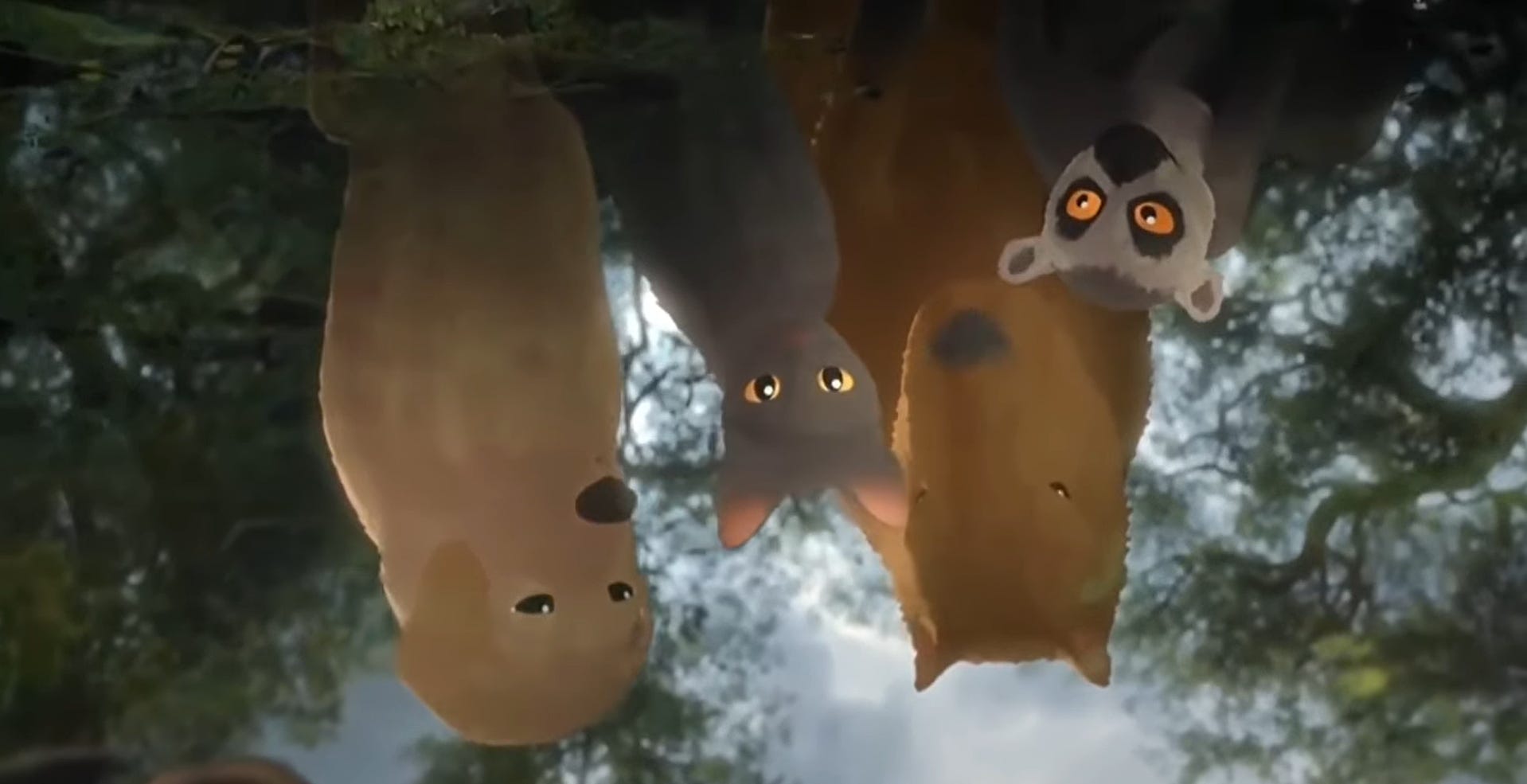
The film opens with Cat staring at themself in the water, a show of technical skill from the animators. And it ends with the same shot, only this time, Cat is joined by a capybara, a lemur and a dog, its new friends in a post-flood world. And now, this look carries a new weight to it. It’s no longer just a show of brilliance, but a small animal reflecting on itself and its place in the world. And doing so no longer alone.
No posts
Comments
Nothing yet. Say the first thing.
Sign in to join the conversation.