
Bong Joon Ho has several iconic and widely discussed films, but we tend to hear very little about his debut feature, Barking Dogs Never Bite. It’s admittedly not as good as a lot of his later work, with a pretty messy script which occasionally becomes a bit too slow, but it has some moments of characteristic Bong creative flair, and throws a lot of ideas at the wall which at least half stick.
![[Review] « Barking Dogs Never Bite » - K.OWLS](https://substackcdn.com/image/fetch/$s_!V1Ki!,f_auto,q_auto:good,fl_progressive:steep/https%3A%2F%2Fsubstack-post-media.s3.amazonaws.com%2Fpublic%2Fimages%2F3f99f404-6b1a-4ad8-9cc8-aa88c246c7b7_1920x1080.webp "[Review] « Barking Dogs Never Bite » - K.OWLS")
We follow unemployed former student Yun-ju. He lives with his pregnant girlfriend and is desperate to become a professor at his former university, but was passed over for the job in favour of another candidate, Min, who bribed the school Dean. Luckily for him, he learns early on that Min was recently decapitated by a train after a drunken escapade with the Dean. The job opens up, and by the end, the opportunistic Yun-ju gets the job with the help of his own bribe, ultimately benefiting greatly from someone else’s death. He also kidnaps and kills two dogs in between those two events, but I’ll get to that.
I imagine less of you need to hear an explanation of American Psycho. It follows Patrick Bateman, a man who works in ‘acquisitions and mergers’ from a sky high office block, and earns millions doing so. More interestingly, he’s also a mass murderer and rapist, a psychopath who takes sadistic pleasure in his violent crimes. The benefit that he receives from the deaths of others isn’t as transactional as a job, but simple pleasure.
 Typography exploration & Poster 🔪👔")
In his book Violence in Capitalism, Tyner points to the way that certain forms of violence are not considered violent due to their abstract nature. He compares the violent murder of Jessica Kate Williams in 2003 with Mark Price, a man who died in 2010 after being denied potentially life saving healthcare due to financial cuts. The point that Tyner makes is that what we consider as violent or nonviolent is little more than a social construct. To Tyner, both of these cases are equally consequential, both resulting in the unnecessary and premature death of an individual, and that both should be recognised as a form of violence. He argues that we should ‘consider violence to be any action (or inaction) that results in injury, maldevelopment, or death’ (4).
American Psycho is a film that seems very aware of the idea of abstract violence. Bateman’s relentless and brutal violence throughout can be read as a kind of expression of the violence baked into his job. Although Bateman is in many ways uniquely evil, he is also surrounded by men in suits standing in tower blocks who dress like him, talk like him, and do the same jobs as him, so much so that he is repeatedly mistaken for his colleague Marcus Halberstam. Are Bateman’s direct murders really any different to the indirect harm caused by huge corporations and the people who work for them every single day?
The film directly puns on this idea: Bateman tells a model that he’s into ‘murder and executions’, and she seamlessly mishears him as saying ‘mergers and acquisitions’. Whilst it’s one of many moments of absurdism in the film, it’s not without a point. When one company merges with or acquires another, it almost always leads hundreds or thousands of jobs lost through no fault of the employees. Hundreds or thousands suddenly unemployed, a status which can challenge their ability to eat or pay rent, for themselves and anyone who relies on them. It may not be murder, but surely unemployment due to redundancy has been one vital domino in the eventual deaths of countless innocent people. Ask yourself honestly, would you rather get punched in the face or lose your job? How far is the gap between Bateman mercilessly murdering a homeless man, and the death of someone who became homeless due to losing their job to mergers and acquisitions?
Barking Dogs deals with the concept of abstract violence in its own ways. In an abstract way, Yun-ju benefits massively from the death of his colleague, Min. We see throughout the difficulties that Yun-ju faces due to unemployment. His apartment is often very dimly lit, with a constant sickly yellow colour palette. It’s often messy, and shots of him in it have a languid feel to them, as if wading through grease. He walks around in his boxers, scratching away at himself. He clearly feels emasculated by his wife, who does have a job, and who demands that he slavishly hammers away at tens of walnuts for her to eat. And to top if all off, she’s pregnant, making his need to work even more desperate. All of this because someone else bribed the dean with $10,000, an act which within Tyner’s framework could arguably be read as violent due to the effect it’s had on Yun-ju. So, when Min dies his own violent death, it gives Yun-ju his opportunity.
![Barking Dogs Never Bite – [FILMGRAB]](https://substackcdn.com/image/fetch/$s_!OLpE!,f_auto,q_auto:good,fl_progressive:steep/https%3A%2F%2Fsubstack-post-media.s3.amazonaws.com%2Fpublic%2Fimages%2Fb7074838-8c61-4b5f-bc48-0714bd9898e7_1920x1036.jpeg "Barking Dogs Never Bite – [FILMGRAB]")
But Yun-ju doesn’t seem overly comfortable taking advantage of such an unfortunate event, and even less with participating in the same abstract violence of bribery that got him here in the first place. I see his violence towards dogs throughout the film as a way for him to grapple with and come to terms with this opportunity. A quick warning, there’s some fairly graphic description of dogs being harmed in the next two paragraphs.
Already down in the dumps about his job status, Yun-ju gets increasingly frustrated with a dog’s constant yapping. He finally decides to take action, finding the dog responsible and trying to hang it in his apartment complex’s basement. However, this act of explicit violence becomes too much for him, and he backs down. He then considers dropping the dog from the roof, but still can’t bring himself to do it. Instead, he locks the dog in a cupboard, allowing it to gradually starve to death. Despite this being a much more horrific way to die than the momentary suffering of being hanged, and ultimately ending in the same result, it is also a more abstract form of violence for Yun-ju, so one he feels much more comfortable with. He can convince himself that he didn’t really kill the dog, even though he created the conditions for its death.
Unfortunately for Yun-ju, the yapping doesn’t stop- he got the wrong dog. After some shenanigans with a janitor, a homeless man, a legendary plumber, and a ghost (3 of those are the same person), he realises that he was too late to save the innocent little dog, who has been turned into some kind of stew by the aforementioned janitor, and eaten by the aforementioned homeless plumber ghost. Perhaps it’s this realisation that he really is already a dog murderer, being faced with the brutal reality of this dog being cooked and eaten, that makes him more confident in his next exploit. Because when he finally finds the real yapping dog, he follows through with his murder, dropping the little chihuahua from a rooftop to its doom. And to make matters even worse, when the dog’s elderly owner finds her dead pet, the shock is enough to send her to the afterlife along with it.
Now, Yun-ju has inadvertently killed one dog, directly killed another, and inadvertently killed an elderly woman. And in doing so, the mental difference he seemed to initially draw between killing a dog and letting it starve seem to dissolve. He tells Hyun-nam, who has been searching for the dog murderer, that the person responsible for that woman’s death is the man who killed her dog. Although she doesn’t know that that’s him, he certainly does. Yun-ju comes to terms with the abstract ways that one action can indirectly cause violence. However, rather than this discouraging him from taking advantage of Min’s death and engaging in the same bribery that left him unemployed and suffering, it has the opposite effect. Over the course of the film, he has become a killer. Initially he remained in denial by making his violence indirect, but now the truth of what he’s done stares him straight in the face. And so he can finally accept benefiting from the suffering of others. He bribes the Dean and gets the job.
Both Bateman and Yun-ju continually get away with their violent actions, but to say that neither’s actions weigh heavy on their conscience would be a lie. Even Bateman, who shows very little mercy throughout, and who is under no illusions about his own violence, eventually crumbles under the guilt of all he’s done. After a manic and fantastical rampage through the streets filled with death and explosions, one that may an imagined manifestation of guilt, Bateman rings his lawyer and confesses to all of his crimes. Through tears and masses of sweat, he tells his lawyer that he had to do it. And yet, when he arrives to work the next day, his lawyer mistakes him for someone else.
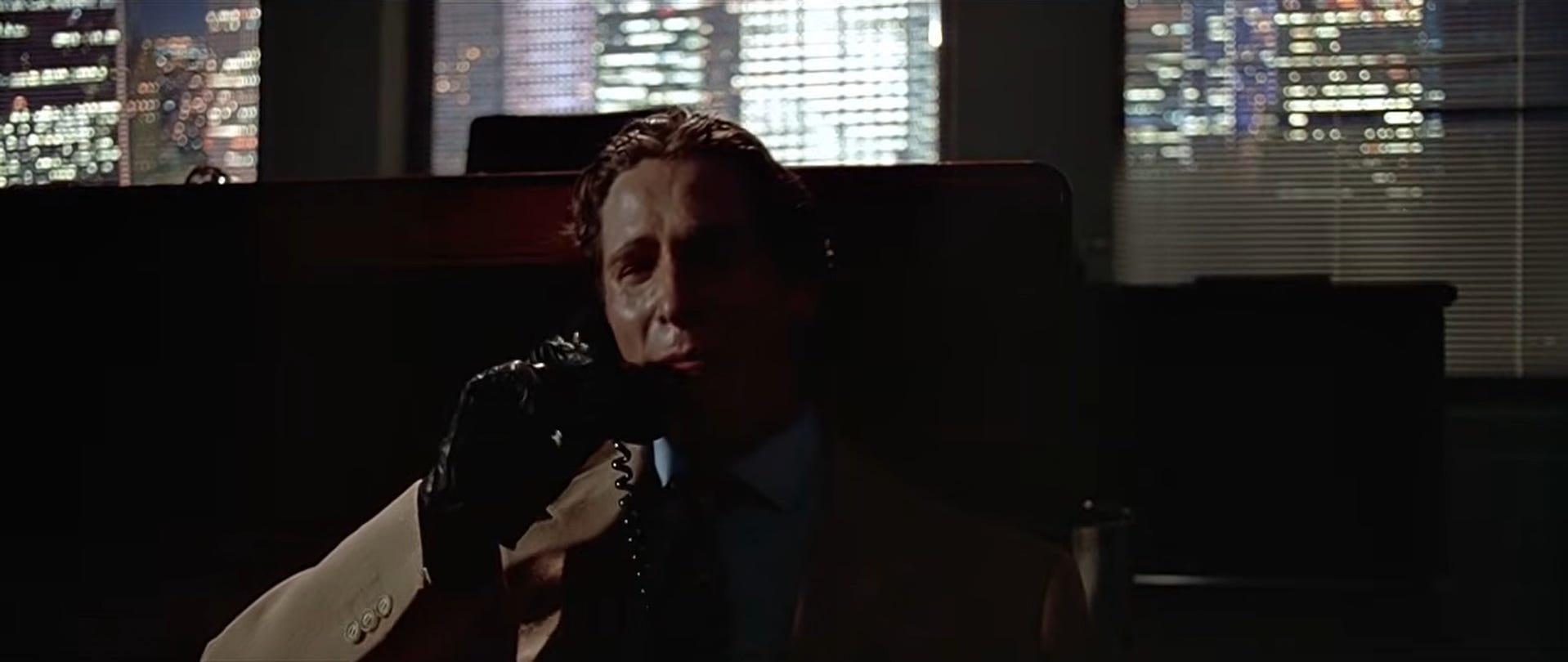
He tells him that he should have used a name other than Patrick Bateman for his joke call, because Bateman is too boring to have done anything he claimed. The lawyer continues to dismiss him, but Bateman refuses to let him change the subject. We watch Bateman in close up as he grows frustrated and then furious at his lawyer’s refusal to accept the confession. It’s like he wants to be found out, desperate to be jailed or face some repercussions for his crimes.
Whilst the following scenes suggest that Bateman could have imagined his crimes, a topic that remains a point of contention among viewers, the scene also serves another purpose. Bateman has become aware of the callousness of his crimes, the violence he’s inflicted on others either through murders and executions or mergers and acquisitions. He deserves to be punished. But the unjust world in which he lives refuses to do so. The final words of the film, spoken by Bateman himself: ‘this confession has meant nothing’.
When watching Barking Dogs for the first time, I was struck by how similar I found its ending to American Psycho. No similarities had occurred up to this point, but it was here that I found the genesis for this post. Yun-ju has now successfully bribed the Dean in a near exact repeat of the scene in which we see Min do the same. He gets the job, and has his head extended out in front of the train just like Min had, in line for the precise same karmic decapitation- but we cut away, and see him drunkenly stumbling down the street.
He reunites with Hyun-nam, who believes she has already caught the dog killer (she thought it was the homeless plumber ghost (he was also killing dogs)). Yun-ju is now on the cusp of success, having attained his dream job and gotten away with his crimes. But in his drunken state, some residual guilt hangs over him. Earlier, Hyun-nam chased Yun-ju after his dog murder. But she only got to see him from behind. Sensing the injustice he is about to get away with, Yun-ju turns his back, starts running, and asks Hyun-nam is she recognises him, practically begging her to catch him. She finally stops completely still, eyes widening, jaw dropping, all enhanced by dramatic slow motion. Yun-ju smiles, announces ‘yes, it was me’, grateful to finally face his punishment. But Hyun-nam just points to his feet, and notes that one of his shoes is missing. There is no justice for the direct violence of Patrick Bateman. And there is no justice for the abstract violence of Yun-ju.
Both films end with their main characters back to regular life. Bateman sits with his colleagues in front of a TV, his voiceover mirroring the film’s opening monologue. Yun-ju stands in a classroom, staring out of a window in a mirror of the film’s opening shot. The scene is dull, the jazzy score gone and replaced by the hum of a projector and the quiet taps of pencils on desks. Neither character faces punishment for their actions. But with the guilt they feel, and their knowledge of their world’s lack of justice, neither are happy either.
Tyner, James A. Violence in Capitalism: Devaluing Life in an Age of Responsibility. University of Nebraska Press, 2016
No posts
Comments
Nothing yet. Say the first thing.
Sign in to join the conversation.