
Buffett has used the term for decades. It runs all through his letters and interviews: circle of competence. Know what you know, stay inside it, and be honest about where the edge really is. Simple idea.
Applying it is another matter. What actually happens, and I include myself in this, is that the circle becomes a moving target. It expands conveniently to include whatever business you’re currently excited about. The circle grows to fit the opportunity, when the opportunity is supposed to be filtered by the circle. At that point you don’t have a circle anymore. You have wishful thinking with a geometric name.
Competence versus familiarity
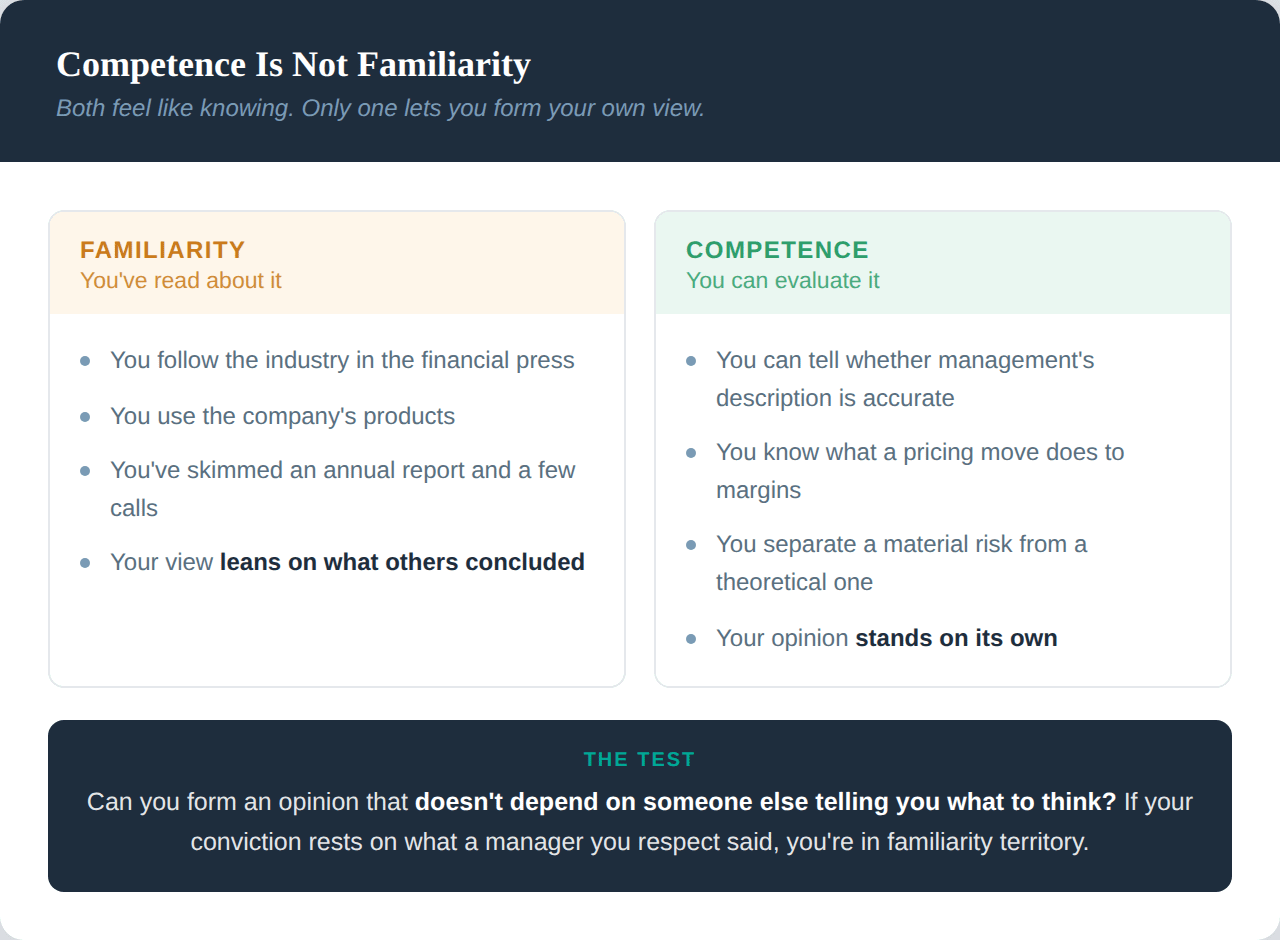
The distinction that matters most is one Buffett himself draws: competence is not familiarity.
Familiarity means you’ve read about something. You follow the industry in the financial press, you use the company’s products, you’ve heard a few earnings calls and skimmed the front of an annual report. Familiarity is useful as a starting point. It is not competence.
Competence means you can evaluate what you’re reading. When the company describes its competitive dynamics, you know whether the description is accurate. When management explains pricing strategy, you understand what it does to margins. When an analyst raises a risk, you can tell material from theoretical. Competence gives you an independent view rather than a borrowed one.
Here’s the test I use. Can you form an opinion that doesn’t depend on someone else telling you what to think? If your conviction rests mainly on what a fund manager you respect said, or what a journalist wrote, you’re in familiarity territory. Most investing mistakes live there.
How a circle actually forms
Circles get built through direct experience, not reading. The clearest version is professional knowledge. Twenty years in pharma teaches you drug development economics and regulatory dynamics in a way no stack of books can.
There’s a slower route too: sustained engagement over years. Following an industry closely for a decade, investing in it, being wrong about it, and learning why you were wrong. Mistakes you’ve paid for are worth more than conclusions you’ve borrowed.
What doesn’t build a circle: a few books on a sector, a weekend with one 10-K, or enthusiasm for a product you happen to use.
Mapping your own circle
Write down, specifically, the industries and business models where you have genuine competence. Not where you’re interested. Where you can form an independent view.
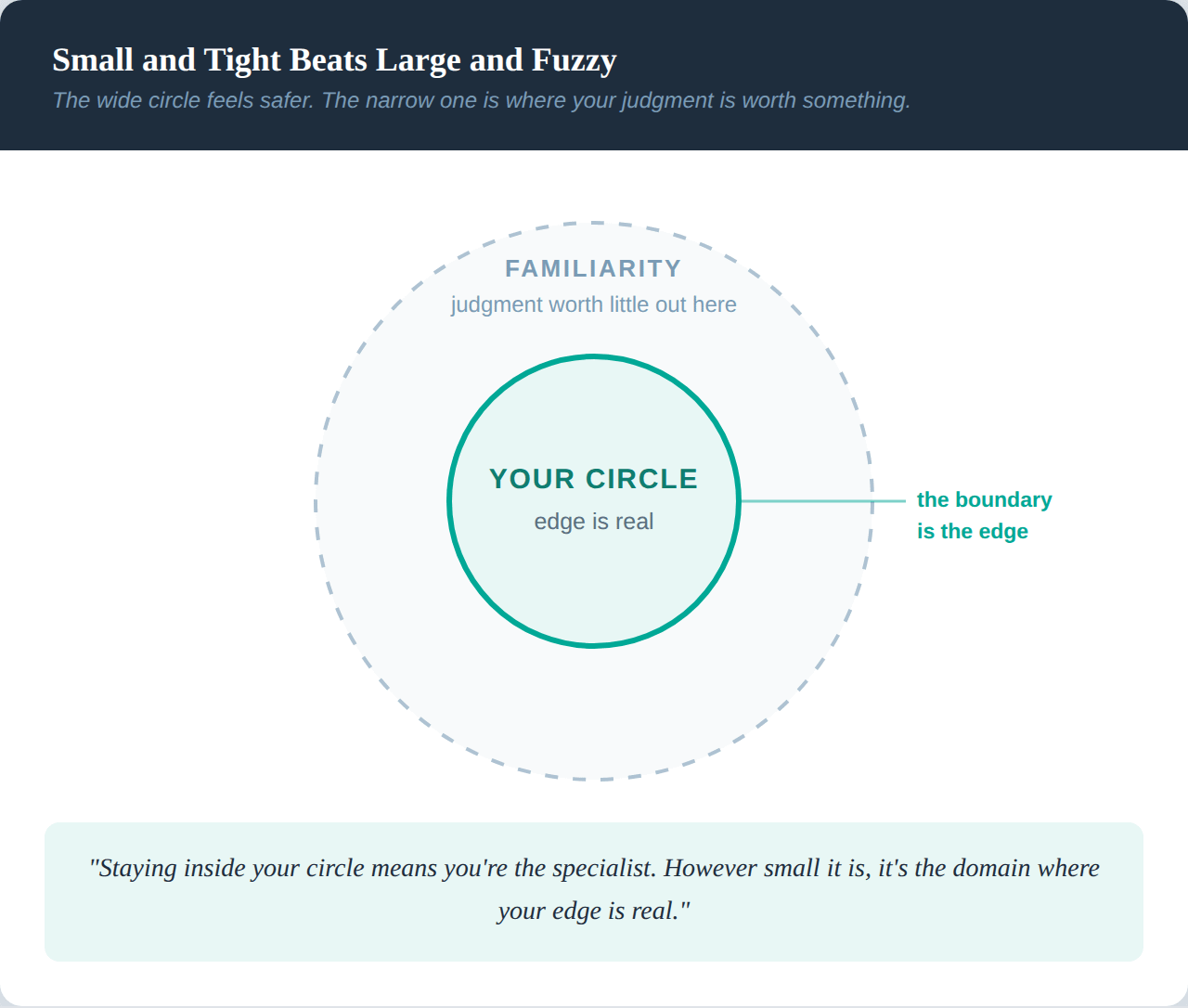
For most people the list is uncomfortably short, and that’s fine. That’s the point. A small well-defined circle beats a large fuzzy one every time, because the small one keeps you in territory where your judgment is actually worth something.
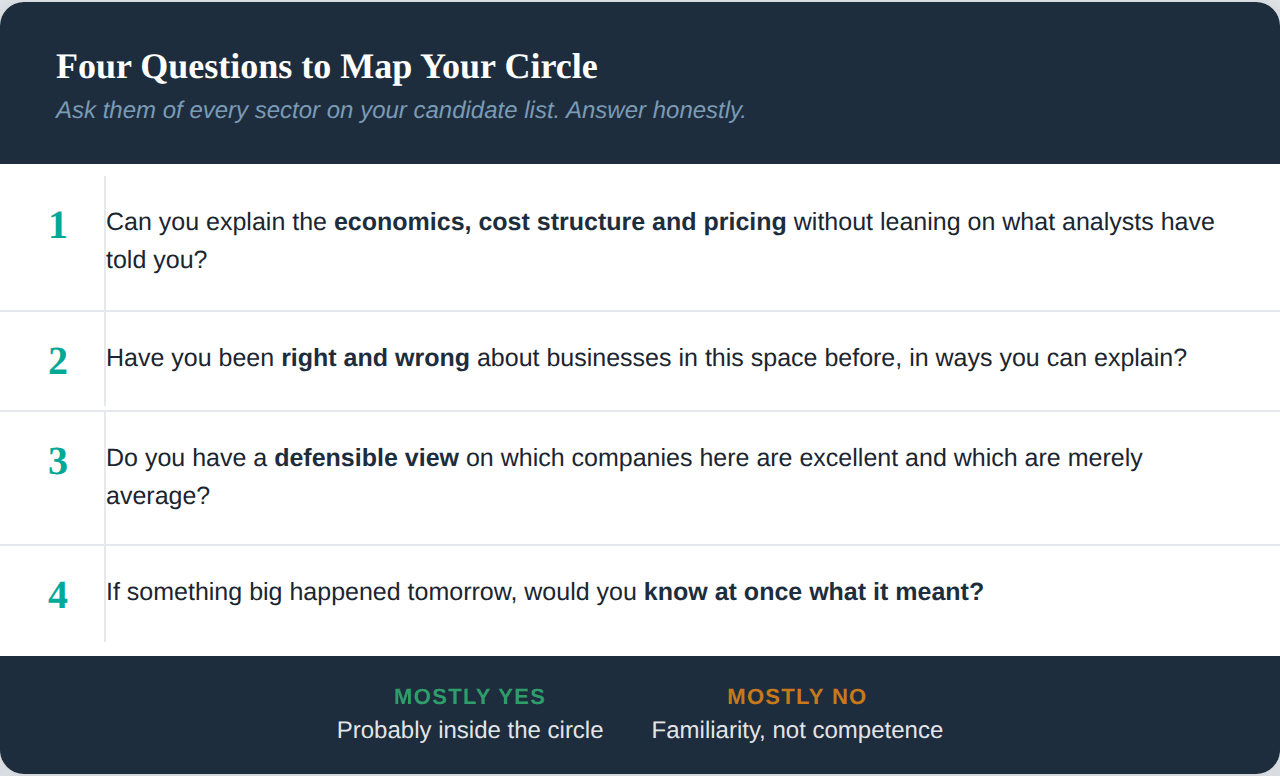
Some questions to ask about each sector on your candidate list. Can you explain the economics, the cost structure, the pricing dynamics, without leaning on what analysts have told you? Have you been right and wrong about businesses in this space before, in ways you can explain? Do you have a defensible view on which companies in the industry are excellent and which are merely average? If something big happened in this industry tomorrow, would you know immediately what it meant?
Mostly yes: you’re probably inside the circle. Mostly no: familiarity.
The boundary is an advantage
Acknowledging where your circle ends sounds like a constraint. In practice it does more for your returns than almost anything else you can admit to yourself.
Most retail investors don’t lose money for lack of intelligence or information. They lose it operating outside their competence without realizing it, making judgment calls without the judgment, against specialists who know the terrain cold. Staying inside your circle means you’re the specialist. However small the circle is, it’s the domain where your edge is real.
You can also expand the circle deliberately. The way to do it is to build real knowledge in one new area over years, well away from whatever’s hot at the moment. Follow it closely before you invest a cent. Get to know the people who understand it from the inside, and keep your early mistakes cheap. Buffett expanded his circle over sixty years and did it slowly. His late-career semiconductor discussions are a cautious extension of a circle he spent decades building. That’s the model, not the exception.
The honest version
The investors who use this idea well are the ones who can say “that’s not inside my circle” without embarrassment, and mean it. That isn’t laziness talking. Their judgment in that area simply isn’t worth much yet, and saying so out loud is what keeps them out of trouble.
Gate 1 of the Five Gates is built on exactly this. The Quick Screen asks whether your judgment is worth anything in this territory, before you sink a week of research into finding out it wasn’t. Everything else in the system stands on that answer.
Next issue
The most important document in your research toolkit: the annual report. What to read, what to skip, and how to get what you need in under two hours.
Until then: think carefully, invest systematically.
James Ward
VI Stack
New here? Start with Issue #1 , the problem most value investors don’t admit, and the system I built to fix it.
The Five Gates research process, referenced throughout this series, is also available as a free 11-page guide with a full worked example. Get The Five Gates →
No posts
Comments
Nothing yet. Say the first thing.
Sign in to join the conversation.