
The annual report is the most important document in your research toolkit, and the most underused.
Most retail investors skim it if they open it at all. The financial media summarizes the highlights, analysts parse the numbers, and the result is that most people form opinions about businesses from second-hand interpretations of documents they never read. That’s a real disadvantage. It’s also completely correctable.
A 10-K can run past two hundred pages, and no, you don’t need all of them. Reading it cover to cover is actually its own mistake, because a lot of the filing is boilerplate that eats time without producing insight. What you need is a map. Here’s mine.
Start at the back
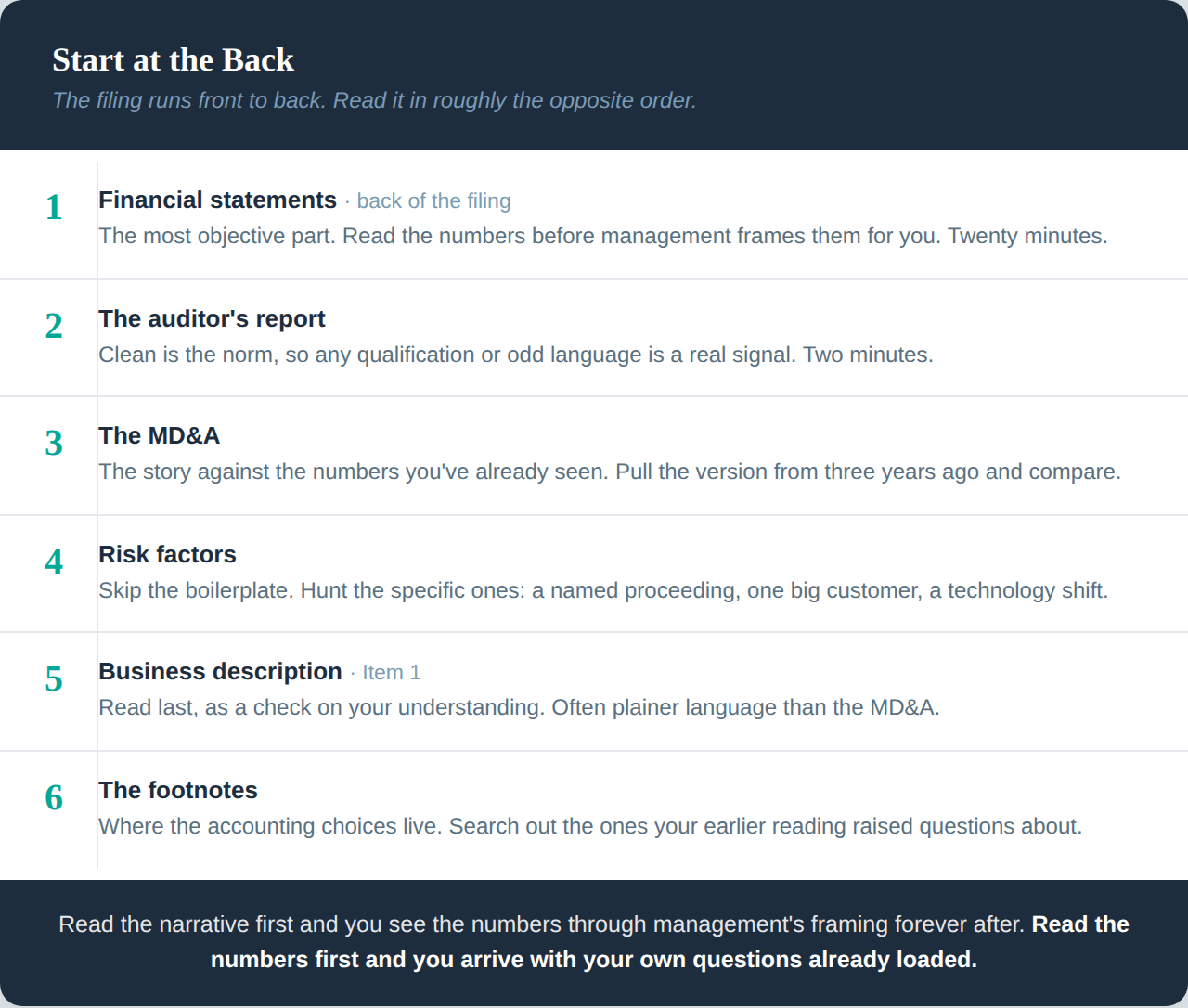
This is the counterintuitive move that separates serious readers from casual ones: go to the financial statements at the back first, not the business description at the front.
The statements are the most objective part of the filing. Audited, standardized, harder to spin. Starting there means you interpret the numbers yourself before management explains them to you, and that ordering matters more than people think. Read the narrative first and you’ll see the numbers through management’s framing forever after. Read the numbers first and you arrive at the narrative with your own questions already loaded.
Give the income statement, balance sheet, and cash flow statement twenty minutes. Revenue trend? Margins expanding or shrinking? Is net income tracking free cash flow? Is debt growing or falling relative to earnings? You’re not building a model. You’re building context.
What to read carefully
The auditor’s report. Short, usually unremarkable, and that’s exactly why you read it. Clean is the norm, so any qualification or odd language is a real signal. Takes two minutes.
The MD&A. Management’s narrative of the year, and the place where the story meets the numbers. Read it with the financials already in your head. When they explain a margin contraction, does the explanation match what you saw? Is the language precise or defensive? Are this year’s “temporary” problems the same ones that were temporary last year?
One exercise here is worth more than the rest combined: pull the MD&A from three years ago and compare. Did management deliver what they said they’d deliver? Are the same issues still being explained away? Few things tell you more about a management team.
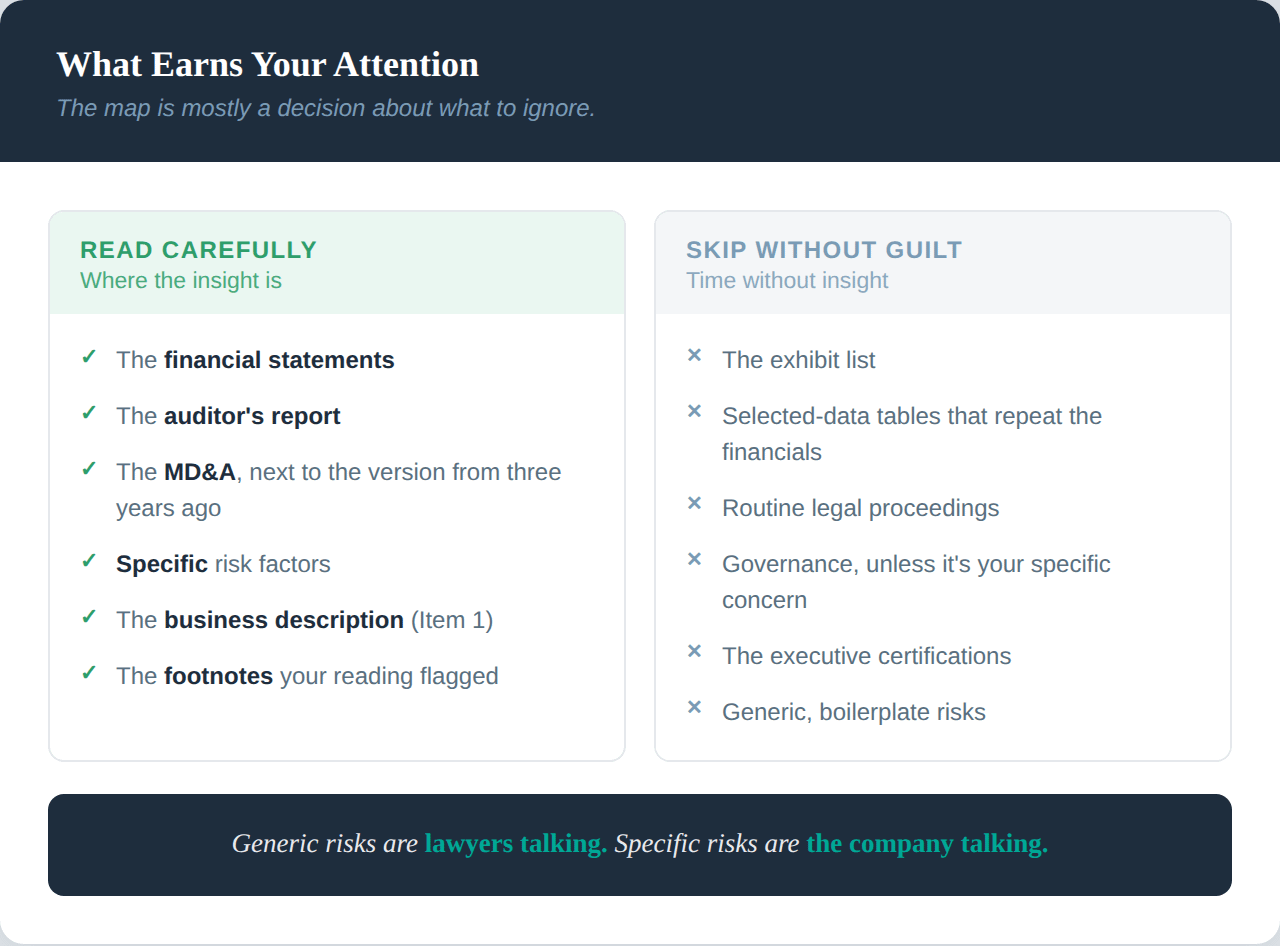
Risk factors. Legally required, so partly boilerplate. Every company “operates in a competitive industry” and “may be affected by macroeconomic conditions.” Skip past those and hunt for the specific ones: a named regulatory proceeding, dependence on one customer, a technology transition. Specificity is the tell. Generic risks are lawyers talking; specific risks are the company talking.
The business description (Item 1). Read it after the financials and MD&A, as a check on your understanding of the model. It’s less filtered than the MD&A and often gives you plainer language about revenue streams and competitive dynamics.
The footnotes. Most investors skip these entirely, and it’s a mistake. The accounting choices live here: revenue recognition, inventory, goodwill. So does the compensation detail, the option grants, pension obligations, related-party transactions. You don’t need every footnote. Search out the ones relevant to questions your earlier reading raised.
What to skip
The exhibit list, the selected-data tables that repeat the financials, routine legal proceedings, the governance section unless governance is your specific concern, the executive certifications. Skip all of it without guilt.
Read several years, not one
A single 10-K is a snapshot. Three to five are a story. Reading the filing from five years ago next to today’s is among the most informative things you can do with two hours. What did management promise then? Did it happen? What problems existed, and are they resolved?
A team that consistently delivers what its filings promised is a team worth trusting. A team that keeps revising the narrative while the numbers stall is a team worth scrutinizing.
The two-hour discipline
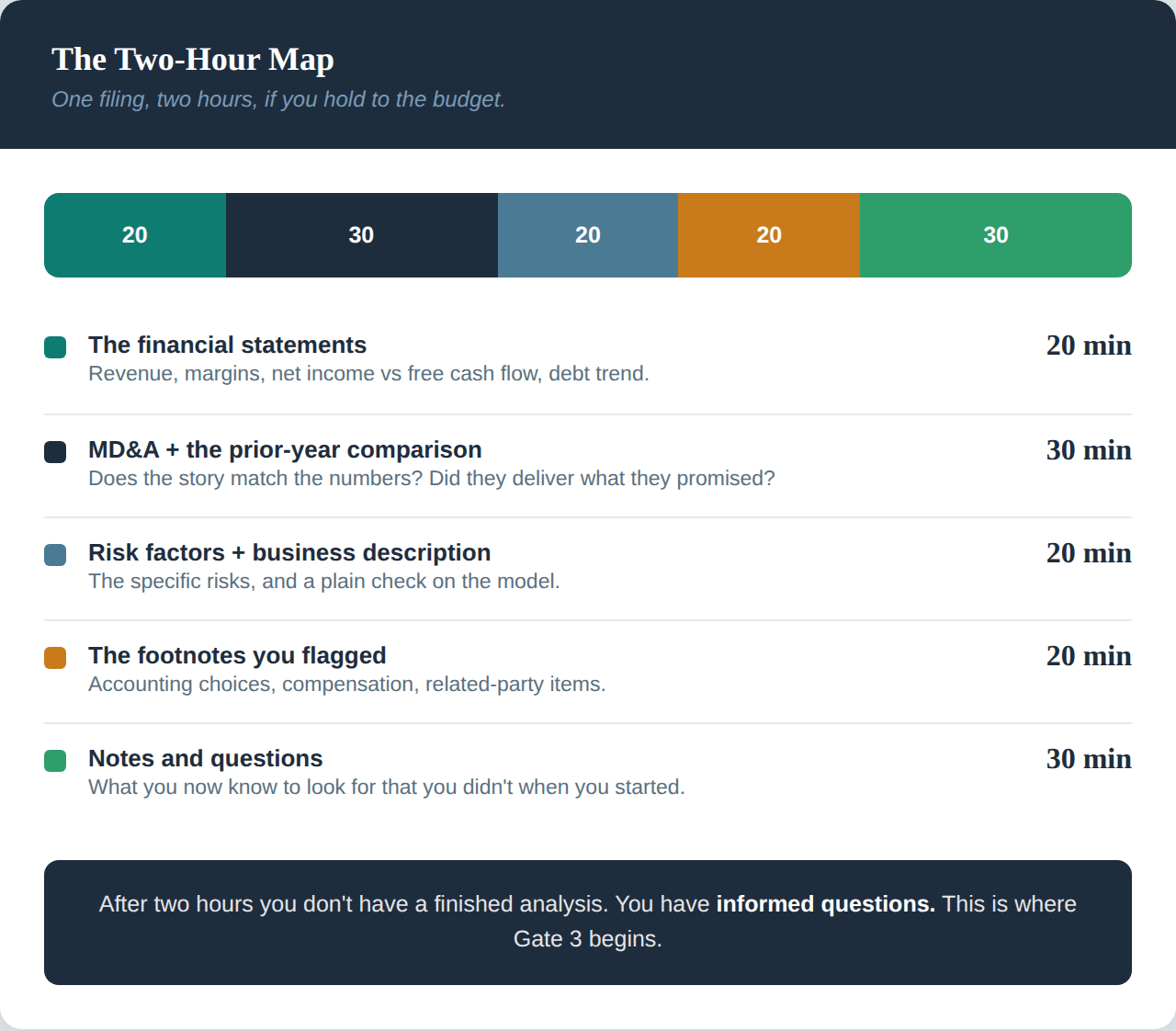
Two hours covers a 10-K if you follow the map. Twenty minutes on the financials. Thirty on the MD&A and the prior-year comparison. Twenty on risk factors and the business description. Twenty on the footnotes your reading flagged. The last half hour goes on notes and questions.
And that’s the right way to think about the output. After two hours you don’t have a completed analysis, you have informed questions: things you now know to look for that you didn’t when you started. The annual report is where Gate 3 begins, not where it ends.
Next issue
The single metric that best predicts business quality: return on invested capital. What it is, why it matters, and how to actually use it.
Until then: think carefully, invest systematically.
James Ward
VI Stack
New here? Start with Issue #1 , the problem most value investors don’t admit, and the system I built to fix it.
The Five Gates research process, referenced throughout this series, is also available as a free 11-page guide with a full worked example. Get The Five Gates →
No posts
Comments
Nothing yet. Say the first thing.
Sign in to join the conversation.