
Let me be direct about something before we go any further.
When most people hear “AI-powered investing,” they picture an algorithm predicting stock prices or a chatbot telling you what to buy. That’s not what this is. If that’s what you’re looking for, VI Stack is the wrong place.
What AI actually changes — when used properly — is not the quality of your decisions. It’s the speed and depth of your research. The judgment is still yours. The framework is still the Five Gates. AI is the research assistant that makes working through that framework faster, more thorough, and frankly, more enjoyable than it used to be.
Here’s what that actually looks like in practice.
What used to take a weekend
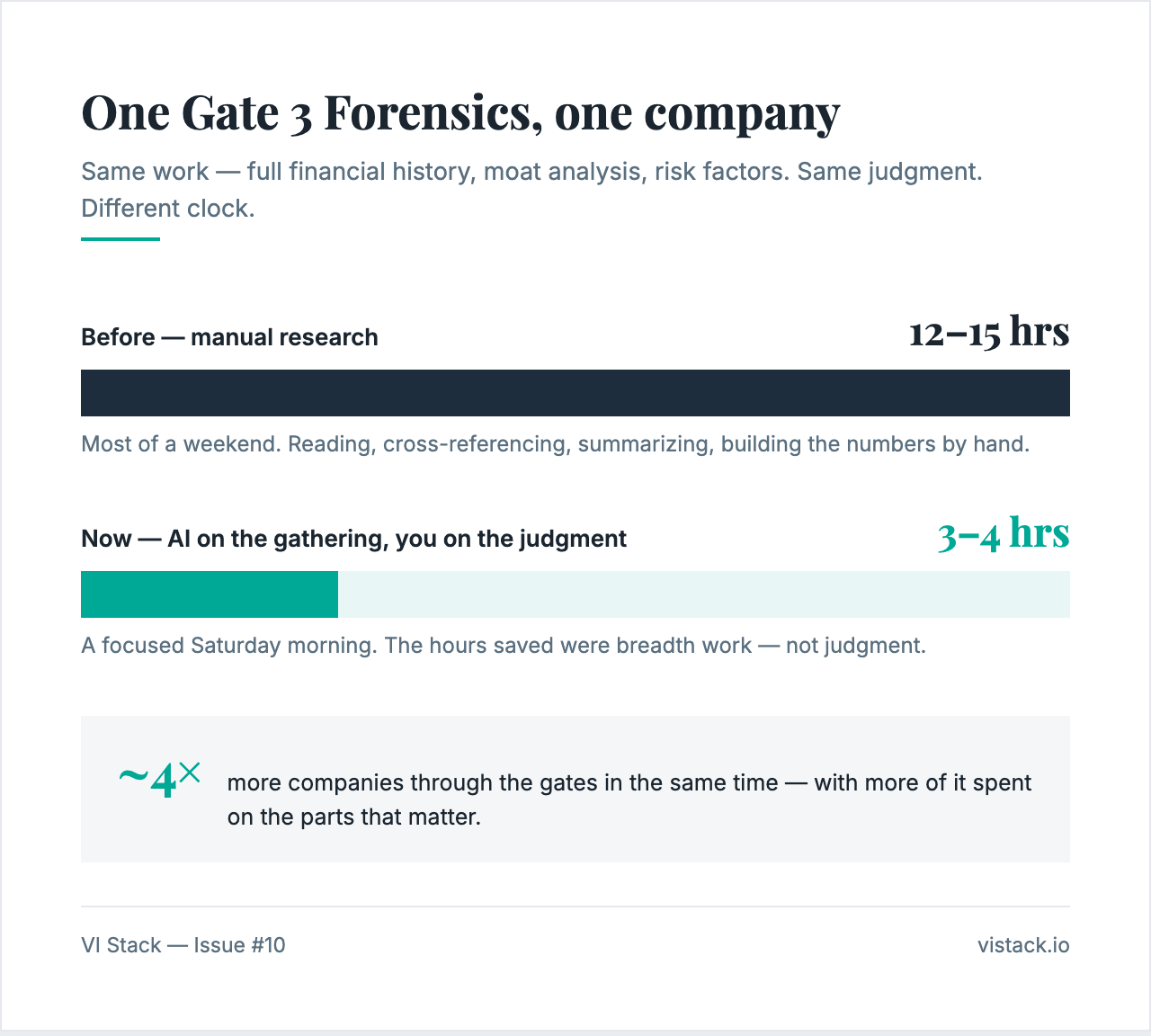
Before I started using AI tools systematically, a proper Gate 3 Forensics on a single company — the full financial history, moat analysis, risk factors, competitive positioning — would take the better part of a weekend. Reading the annual reports, cross-referencing the numbers, finding the analyst commentary, and building the financial summary. Twelve to fifteen hours of focused work for one company.
I still do all of that. The difference is that it now takes three to four hours.
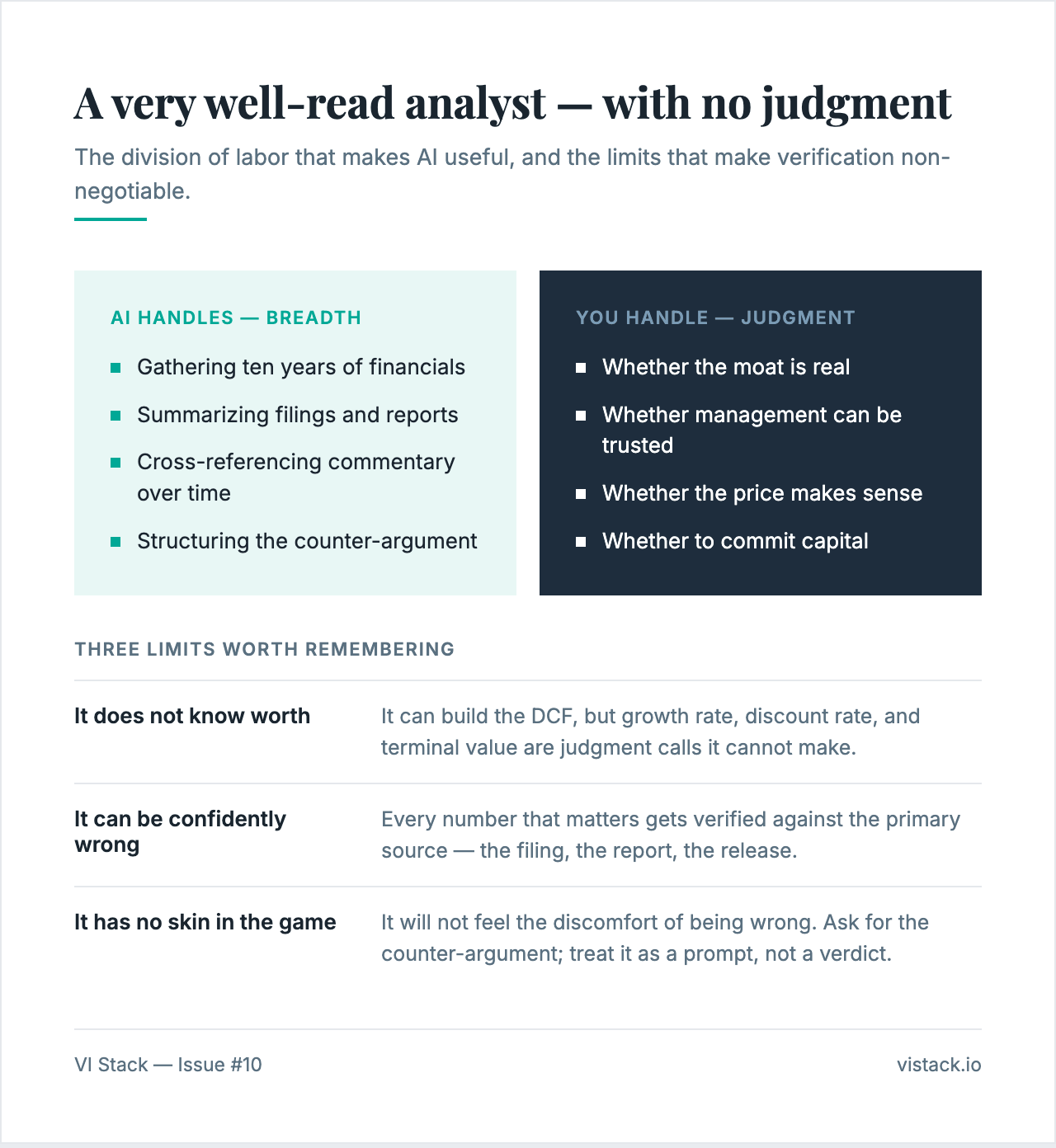
The time savings come from AI handling the parts of research that require breadth rather than judgment: gathering, organizing, summarizing, and cross-referencing. The parts that require genuine judgment (evaluating the moat, assessing management quality, deciding whether the valuation makes sense) are still mine.
The result is that I can run more companies through the gates in the same amount of time, and spend more of that time on the parts that actually matter.
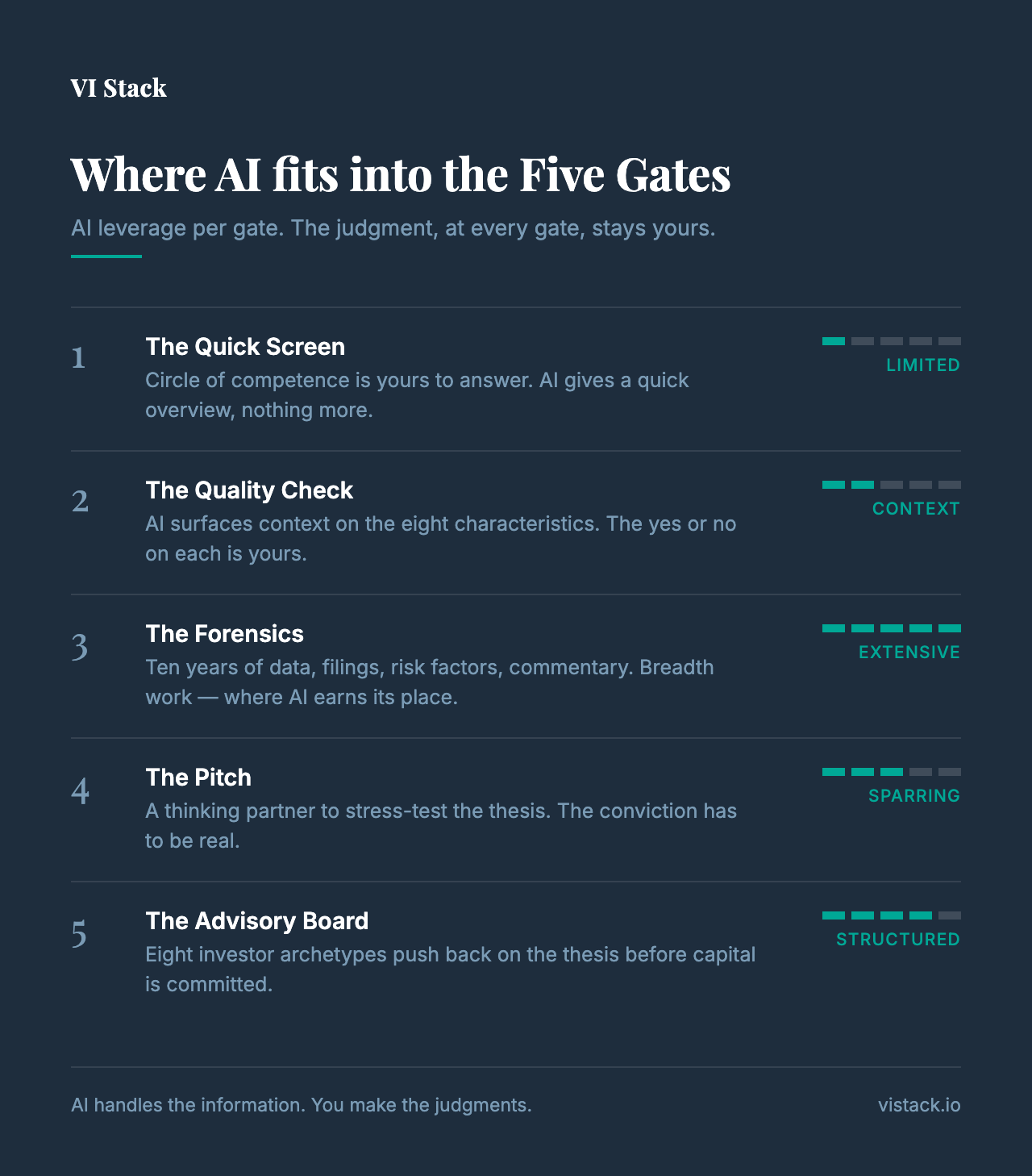
Where AI fits into the Five Gates
It’s not uniform across all five gates. Here’s an honest breakdown:
Gate 1 — The Quick Screen. Limited use. The five questions in Gate 1 require your own judgment about your own circle of competence. AI can give you a quick company overview, but the honest answer to “is this inside my circle?” has to come from you. Gate 1 stays largely manual.
Gate 2 — The Quality Check. Useful for building context. When evaluating each of the eight quality characteristics, AI can surface relevant information quickly: competitive positioning, customer concentration, and historical margin trends. But the evaluation itself, the yes or no on each characteristic, is a judgment you apply.
Gate 3 — The Forensics. This is where AI earns its place. Pulling ten years of financial data, summarizing annual report language, identifying risk factors across multiple filings, cross-referencing management commentary over time — these are exactly the tasks AI handles well. I use it extensively here, always verifying key numbers against primary sources.
Gate 4 — The Pitch. AI is a useful thinking partner here. Once you have your analysis, you can stress-test your own thesis by asking hard questions, checking for logical gaps, or getting a structured counter-argument. It doesn’t write the pitch for you — your conviction has to be real — but it helps sharpen the thinking before you commit it to seven slides.
Gate 5 — The Advisory Board. This is perhaps the most interesting application. I use AI to embody eight investor archetypes — each built from the documented principles and frameworks of the greatest value investors who ever wrote about their craft. Not to get a buy recommendation, but to ask: what does this archetype’s framework say about this thesis? Where does it push back? It’s a structured way to stress-test conviction before capital is committed.
What AI is not good at
The limits matter because the hype runs well ahead of the reality.
AI does not know what a business is worth. It can help you build a discounted cash flow model, but the assumptions that drive that model — growth rate, discount rate, terminal value — are judgment calls that AI cannot make for you. Garbage in, garbage out, faster than ever.
AI can be confidently wrong. It will sometimes state financial figures incorrectly, confuse companies, or present outdated information as current. Every number that matters needs to be verified against the primary source — the annual report, the filing, the earnings release.
And AI has no skin in the game. It doesn’t feel the discomfort of being wrong. It won’t push back when your thesis has a real flaw because you’ve phrased the question in a way that leads it toward agreement. You have to actively ask for the counterargument, and even then, treat it as a prompt for your own thinking rather than a verdict.
The right mental model
Think of AI as a very fast, very well-read research analyst who has no judgment. They can read every document, summarize every filing, and brief you on any company in any sector — but they cannot tell you whether the moat is real, whether the management can be trusted, or whether the price makes sense given the risk. That’s your job.
Used that way, the difference is real. The Five Gates process that used to demand most of a weekend can now fit into a focused Saturday morning.
That’s not a small thing. Time is the resource that limits how many companies most investors can seriously evaluate. Anything that expands that capacity — without compromising the quality of judgment — is worth taking seriously.
Next issue
Back to the gates. We’ll walk through Gate 2 — The Quality Check — in full. The eight characteristics that separate great compounders from good businesses, and how to apply them without fooling yourself.
Until then — think carefully, invest systematically.
James Ward
VI Stack
New here? Start with Issue #1 — the problem most value investors don’t admit, and the system I built to fix it.
The Five Gates research process — referenced throughout this series — is also available as a free 11-page guide with a full worked example. Get The Five Gates →
No posts
Comments
Nothing yet. Say the first thing.
Sign in to join the conversation.