
Most investment ideas don’t deserve your time.
That’s not cynicism. It’s arithmetic. The average serious investor encounters dozens of company names a month: from financial media, from screeners, from conversations, from a product they use and suddenly wonder about. If you gave each one even a few hours of proper analysis, you’d do nothing else.
The first gate exists for exactly this reason. The job is to eliminate bad fits, quickly and honestly, before you’ve spent a weekend reading 10-Ks on something that was never going to work for you anyway.
Gate 1 is a single-page document with one central question: do I understand this business well enough to have a view on its future?
Not: is this a good business? Not: is it cheap? Those come later. Gate 1 asks only whether you, specifically you with your particular knowledge and experience, can form an independent, informed opinion on where this company will be in ten years.
If the answer is yes, it moves forward. If the answer is no, it stops here.
Warren Buffett called this the Circle of Competence. The concept is simple: every investor has a domain of genuine knowledge: industries they understand, business models they can evaluate, competitive dynamics they can read. Inside that circle, you can think clearly. Outside it, you’re guessing in the language of analysis.
The more common mistake is not knowing where the boundary is.
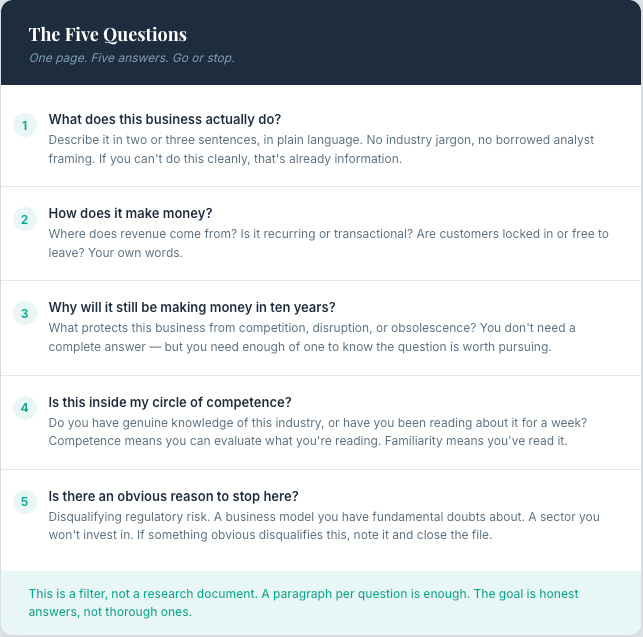
The Quick Screen asks five questions. Each one has a short answer, a paragraph at most. This is not a research document. It’s a filter.
1. What does this business actually do?
Describe it in two or three sentences, in plain language, as if you were explaining it to someone with no financial background. No industry jargon. No borrowed analyst framing. If you can’t do this cleanly, that’s already information.
2. How does it make money?
Where does the revenue come from? Is it recurring or transactional? Are customers locked in or free to leave? Plain language, your own words.
3. Why will it still be making money in ten years?
This is the key question. What protects this business from competition, disruption, or obsolescence? You don’t need a complete answer here, but you need enough of one to know the question is worth pursuing.
4. Is this inside my circle of competence?
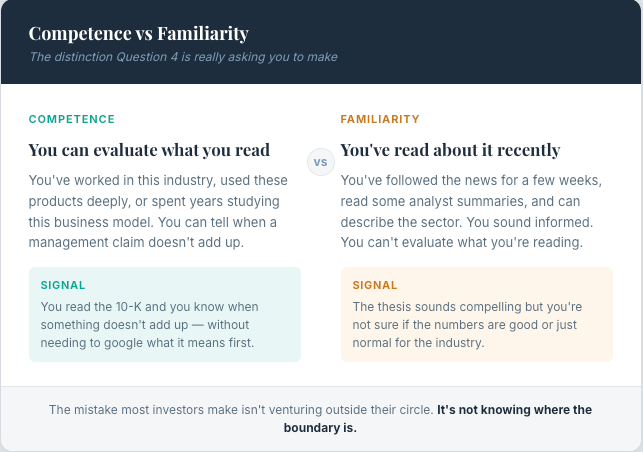
Be honest. Do you have genuine knowledge of this industry, or have you been reading about it for a week? There’s a difference between competence and familiarity. Competence means you can evaluate what you’re reading. Familiarity means you’ve read it.
5. Is there an obvious reason to stop here?
Regulatory risk that’s disqualifying. A business model you have fundamental doubts about. A sector you’ve decided you won’t invest in. If something obvious disqualifies this company, note it and close the file.
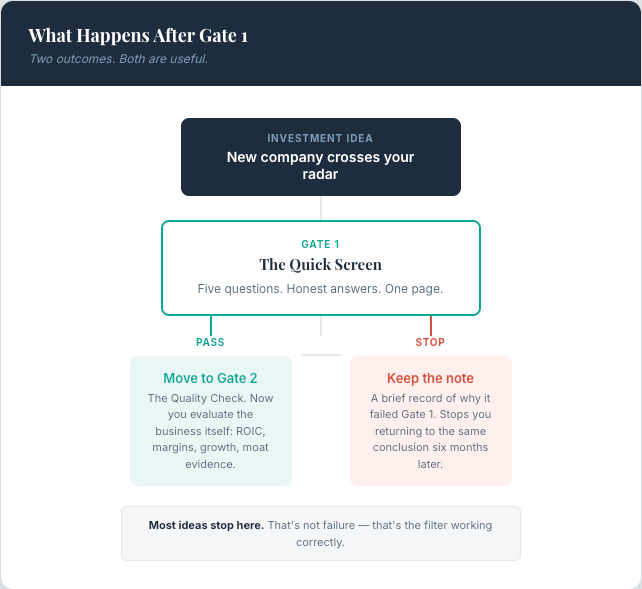
If the company passes Gate 1 (meaning you can answer all five questions honestly and nothing disqualifies it), it moves to Gate 2: The Quality Check. That’s where you start evaluating the business itself.
If it doesn’t pass, the Quick Screen is still worth keeping. A brief note on why a company failed Gate 1 is useful. It stops you from circling back to the same idea six months later and spending another afternoon on the same conclusion.
The hardest part of Gate 1 is being willing to stop.
There’s a particular kind of investment enthusiasm (I’ve felt it myself) where a business sounds interesting enough that you want to keep going. It’s an exciting sector. The numbers look attractive at first glance. A fund manager you respect owns it. And so you push past the honest answer to question four and tell yourself you’ll learn as you go.
That’s the pattern Gate 1 is designed to break. Learning and analyzing are not the same thing. The Five Gates system runs on informed judgment. Gate 1 is where you check whether you have it.
Most ideas stop here. That’s not failure. That’s the filter working.
Next issue: We're taking a step back from the gates to talk about the tool that changes how this research actually works in practice: AI. What it does well, what it doesn't, and exactly how it fits into the Five Gates process.
Until then, think carefully, invest systematically.
James WardVI Stack
New here? Start with Issue #1 — the problem most value investors don’t admit, and the system I built to fix it.
The Five Gates research process — referenced throughout this series — is also available as a free 11-page guide with a full worked example. Get The Five Gates →
No posts
Comments
Nothing yet. Say the first thing.
Sign in to join the conversation.