
By the time a company reaches Gate 3, you’ve done something important: you’ve established that you understand the business and that the business is excellent. Those two things alone put you ahead of most retail investors, who spend their time analyzing businesses they don’t understand or chasing businesses that aren’t actually very good.
Gate 3 is where you verify it all with evidence.
The Forensics is the most labor-intensive gate in the Five Gates system. It’s also the most straightforward in one sense, unlike Gates 1 and 2, which rely heavily on qualitative judgment, Gate 3 deals mostly with numbers. Numbers are either there or they aren’t. The financial history either supports your thesis or it doesn’t.
This gate has three parts: the financial history, the moat test, and the risk inventory.
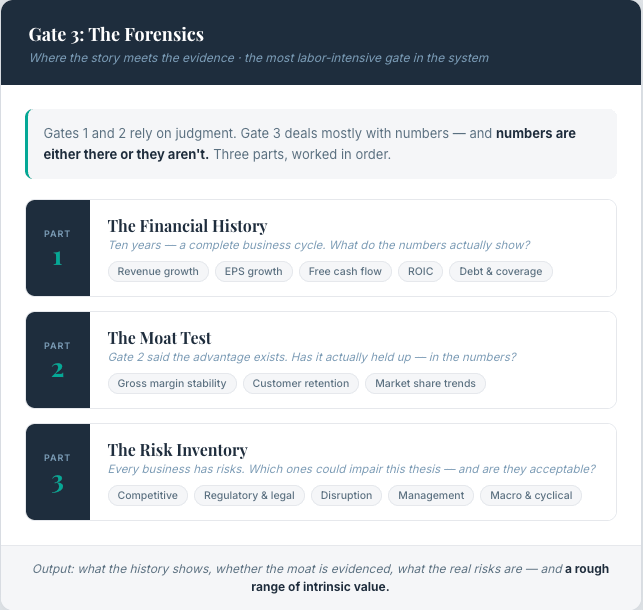
Part one: Ten years of financial history
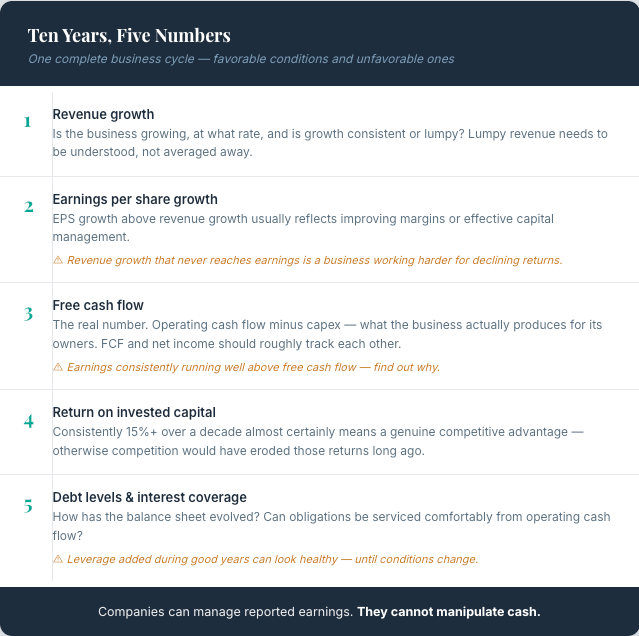
Ten years is the right window because it contains a complete business cycle. It captures at least one recession, probably two. It shows you how the business performed when conditions were favorable and how it held up when they weren’t.
You’re looking for five things across the decade:
Revenue growth. Is the business growing? At what rate? Is growth consistent or lumpy? Lumpy revenue can reflect project-based businesses, cyclicality, or one-time events, all of which need to be understood rather than averaged away.
Earnings per share growth. Revenue growth that doesn’t translate into earnings growth is often a sign of a business that’s working harder for declining returns. EPS growth that exceeds revenue growth, on the other hand, usually reflects improving margins or effective capital management.
Free cash flow. This is the real number. Free cash flow, operating cash flow minus capital expenditure, is what the business actually produces for its owners. Companies can manipulate reported earnings in ways they cannot manipulate cash. Look at FCF over ten years and compare it to reported net income. They should roughly track each other. If earnings consistently run well above free cash flow, find out why.
Return on invested capital. ROIC measures how efficiently the business converts invested capital into profit. A business that consistently earns fifteen percent or more on its invested capital is almost certainly protected by a genuine competitive advantage; otherwise competition would have eroded those returns long ago. We’ll cover ROIC in full in a later issue.
Debt levels and interest coverage. How has the balance sheet evolved over ten years? Is debt trending up or down relative to earnings? Can the business comfortably service its debt obligations from operating cash flow? A business that has added significant leverage during a period of growth may look healthy until conditions change.
Part two: The moat test
The moat test is where Gate 3 connects back to Gate 2. In the Quality Check, you assessed whether competitive advantages existed. Here, you look for evidence that they’ve actually held up.
The most reliable evidence of a durable moat is financial. If a business has maintained high returns on capital for a decade, across multiple economic environments, in the face of competition and disruption, that’s not an accident. That’s a moat.
Look for the following:
Gross margin stability. Gross margin is what’s left after the direct cost of producing the product or service. Sustained high gross margins and stability in those margins over time suggest that the business has genuine pricing power and doesn’t need to compete on cost to retain customers.
Customer retention signals. For businesses with subscription models or long-term contracts, look at churn rates, renewal rates, and net revenue retention if disclosed. For businesses without these metrics, look for qualitative evidence: are the same customers coming back? Is the business growing revenue per customer over time?
Market share trends. Is the business gaining or losing ground relative to competitors? Market share data isn’t always easy to find, but industry reports, management commentary, and relative revenue growth compared to stated competitors can give you a reasonable picture.
Part three: The risk inventory
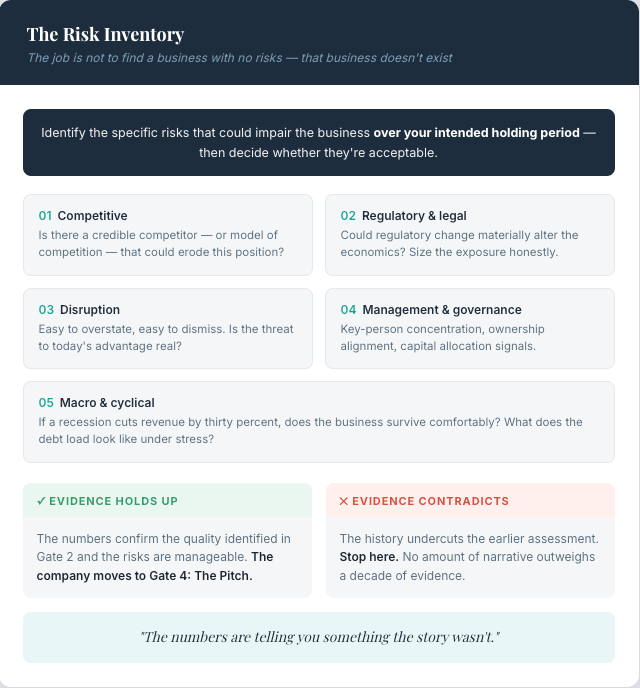
Every business has risks. The job here isn’t to find a business with no risks, that business doesn’t exist. The job is to identify the specific risks that could impair this business’s ability to perform over your intended holding period, and to decide whether they’re acceptable.
Work through the following categories:
Competitive risk. Is there a credible competitor, or a model of competition, that could erode this business’s position? New entrants, substitutes, or established players moving into adjacencies all count.
Regulatory and legal risk. Is the business operating in an environment where regulatory change could materially alter its economics? Healthcare, financial services, and large technology platforms all carry meaningful regulatory exposure that needs to be sized honestly.
Disruption risk. Is there a technology or business model shift that could make this company’s current advantage irrelevant? This is easy to overstate; most incumbents are more durable than disruption narratives suggest, but it’s also easy to dismiss in businesses where the threat is real.
Management and governance risk. Are there concentration risks around a single leader? Is the ownership structure aligned with minority shareholders? Are there any signals — in capital allocation decisions, related-party transactions, or compensation structures — that raise questions about governance quality?
Macro and cyclical risk. How sensitive is this business to economic conditions? If a recession cuts revenue by thirty percent, does the business survive comfortably? What does the debt load look like under stress?
What the Forensics produces
By the end of Gate 3, you should have a clear picture of three things: what the financial history actually shows, whether the moat is evidenced by the numbers, and what the real risks are. You should also have a rough sense of intrinsic value, not a precise figure, but a range within which you’d expect the business to be worth something.
If the evidence holds up, if the numbers confirm the quality you identified in Gate 2 and the risks are manageable, the company moves to Gate 4.
If the evidence contradicts your earlier assessment, stop here. The numbers are telling you something the story wasn’t.
Next issue
Gate 4: The Pitch. You have the analysis. Now you have to make the case. Seven slides, no padding, no hedging. Why the discipline of synthesis is one of the most valuable things you’ll do before committing capital.
Until then, think carefully, invest systematically.
James Ward VI Stack
New here? Start with Issue #1 , the problem most value investors don’t admit, and the system I built to fix it.
The Five Gates research process, referenced throughout this series, is also available as a free 11-page guide with a full worked example. Get The Five Gates →
No posts
Comments
Nothing yet. Say the first thing.
Sign in to join the conversation.