
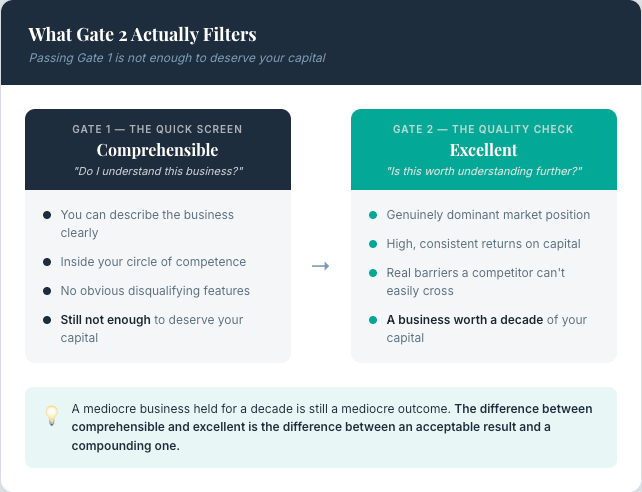
If Gate 1 asks whether you understand a business, Gate 2 asks whether the business is worth understanding further.
Most companies that pass Gate 1 — that sit inside your circle of competence, that you can describe clearly, that have no obvious disqualifying features — are still not worth your capital. They’re comprehensible businesses. Comprehensible is not the same as great.
Gate 2 is a quality filter. Its job is to separate businesses that are genuinely excellent from businesses that are merely acceptable. The difference matters enormously over a ten-year holding period. A mediocre business held for a decade is still a mediocre outcome. An excellent business held for a decade is something else entirely.
Where this comes from
The eight characteristics in Gate 2 are drawn from the public investment philosophy of Bill Ackman — documented across his investor letters, university lectures, and interviews over two decades. No proprietary formula — just the accumulated judgment of a serious practitioner, organized into a framework you can actually apply.*
** These characteristics are cited here as a reference to publicly available educational material. VI Stack makes no claim of affiliation with, endorsement by, or authorization from Mr. Ackman or Pershing Square Capital Management. All intellectual property remains with its respective owners.
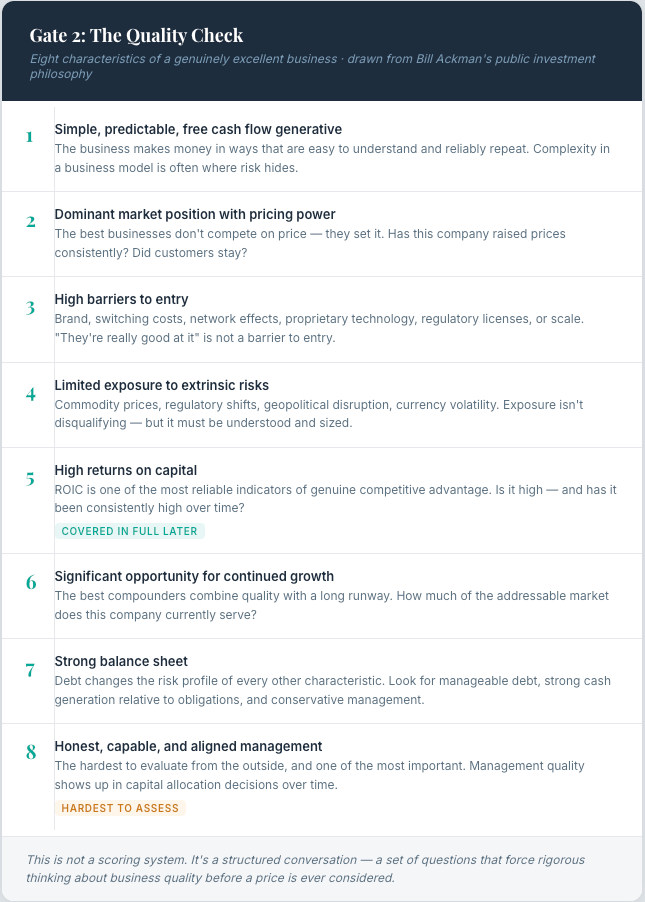
The point isn’t to apply them mechanically. It’s to use them as a structured conversation — a set of questions that force you to think rigorously about business quality before you ever look at a price.
The eight characteristics
1. Simple, predictable, free cash flow generative.
Great businesses make money in ways that are easy to understand and reliably repeat. If the revenue model is complicated, if results swing dramatically year to year without a clear explanation, or if the business consistently burns cash without a convincing path to profitability — that’s a signal worth taking seriously. Complexity in a business model is often where risk hides.
2. Dominant market position with pricing power.
The best businesses don’t compete on price — they set it. They occupy a position in their market that allows them to raise prices without meaningful customer defection. This is one of the clearest expressions of a real competitive advantage. Ask: Has this company raised prices consistently over the past decade? Did its customers stay?
3. High barriers to entry.
What stops a well-funded competitor from doing exactly what this business does? The answer needs to be specific. Brand, switching costs, network effects, proprietary technology, regulatory licenses, economies of scale — any of these can constitute a genuine barrier. “They’re really good at it” is not a barrier to entry.
4. Limited exposure to extrinsic risks.
Some businesses are exposed to factors entirely outside their control — commodity prices, regulatory shifts, geopolitical disruption, and currency volatility. None of that exposure is inherently disqualifying, but it needs to be understood and sized. A business whose profitability depends heavily on oil prices or a single government contract is a different risk profile than one that sells consumer staples across fifty countries.
5. High returns on capital.
A business that earns twenty percent on the capital it deploys is fundamentally different from one that earns eight percent. High returns on invested capital (ROIC) are one of the most reliable indicators of a genuine competitive advantage. They show that the business creates real economic value — not just revenue. We’ll spend a full issue on ROIC later in this series. For now, the question is simply: is it high, and has it been consistently high?
6. Significant opportunity for continued growth.
A great business in a shrinking market is a different investment than a great business with a long runway ahead of it. The best compounders combine quality with growth — they can reinvest capital at high returns for years, sometimes decades. Assess the whitespace: how much of the addressable market does this company currently serve? What would it take to grow that share?
7. Strong balance sheet.
Debt is not inherently bad, but it changes the risk profile of every other characteristic. A business with a dominant market position, high returns on capital, and an overleveraged balance sheet is a business that can be undone by a bad year or a rising rate environment. Look for manageable debt levels, strong cash generation relative to obligations, and a management team that treats the balance sheet conservatively.
8. Honest, capable, and aligned management.
This is the hardest characteristic to evaluate from the outside, and also one of the most important. Management quality shows up in capital allocation decisions over time — how they’ve deployed retained earnings, how they communicate with shareholders, and whether their incentives are genuinely aligned with long-term business performance. We’ll cover this in depth in a later issue. For now, the question is: do you trust these people to run your money?
How to apply the Quality Check
This is not a scoring system. You’re not adding up points and comparing totals. You’re having a structured conversation with yourself about whether this business meets a high standard across eight dimensions.
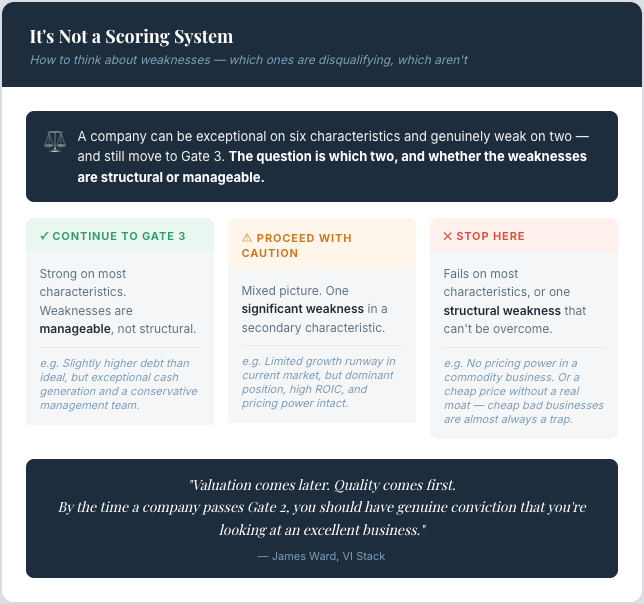
A company can be exceptional on six characteristics and genuinely weak on two and still be worth continuing to Gate 3. The question is which two, and whether the weaknesses are structural or manageable. Missing pricing power in a commodity business is probably disqualifying. Carrying somewhat more debt than ideal in a business with exceptional cash generation is not.
What the Quality Check should never do is let you wave through a business that fails on most characteristics just because it’s exciting or cheap. Cheap, bad businesses are almost always a trap.
The discipline the gate teaches
Most investment mistakes trace back to quality, not valuation — buying businesses that seemed cheap without understanding that they were cheap because they deserved to be.
The Quality Check is the antidote to that. By the time a company passes Gate 2, you should have a genuine conviction that you’re looking at an excellent business. Not a cheap one. Not an exciting one. An excellent one.
Valuation comes later. Quality comes first.
Next issue
Gate 3 — The Forensics. Where the real work happens: ten years of financial history, moat depth, risk factors, and a valuation framework. We’ll walk through what to look at, in what order, and what it’s all actually telling you.
Until then, think carefully, invest systematically.
James Ward
VI Stack
New here? Start with Issue #1 — the problem most value investors don’t admit, and the system I built to fix it.
The Five Gates research process — referenced throughout this series — is also available as a free 11-page guide with a full worked example. Get The Five Gates →
No posts
Comments
Nothing yet. Say the first thing.
Sign in to join the conversation.