
The New York Times ran my letter today. About 200 words. Getting there took a few days, and almost all of it I spent editing things away.
Here is what happened. On June 30, the Times published a guest essay by Matthew Vines called “I’m Gay, Not Queer. It Matters.” It ran the same day Becky Pepper-Jackson, a 16-year-old transgender girl from West Virginia, lost at the United States Supreme Court. Six justices held that her school could keep her off the girls’ track team. I read the headline and I remembered exactly how it felt to lose before that same Court, twenty-six years ago. (I wrote about it here.)
Vines did the hard, hard work of arguing his way through Scripture toward his own life, and he got married in a Baptist church in Texas. That’s work and we’re on the same side. My Lutheran religion was very important to me growing up. I want to say that at the top and I mean it, because what follows is a disagreement and I don’t want anyone reading it as an attack.
His argument is that the word “queer” is costing us. That it carries an adversarial charge, that its elasticity has muddied a message that used to be clear, and that in a moment of backlash we can’t afford the confusion. He wants us to return to the simple thing: being gay isn’t chosen, and gay people deserve what everyone else has.
I wish the word “gay” worked for everyone. It doesn’t. It works for gay white cisgender men who fought for it, claimed it, and owned it, sometimes at the expense of everyone else in the community.
I read his essay and I was furious. Not at him, but at what I felt.
Then I sat down to write 150 to 175 words, and I found out how little anger you can actually fit into so few words. They also remembered: anger never wins. Here is what ended up on the floor, and why the cutting turned out to be powerful.
Everything I cut kept circling back to one thing, so let me start there.
The single most reliable way to destroy a coalition is to convince it that it isn’t one.
In February 2025, the National Park Service stripped the words “transgender” and “queer” out of the Stonewall National Monument’s website, cutting the T ands Q off LGBTQ and leaving LGB. Marsha P. Johnson and Sylvia Rivera, erased from the riot they helped start. That same winter, an openly gay man sat in the Cabinet as Secretary of the Treasury. That August, Florida sent its transportation department to paint over the rainbow crosswalk outside the Pulse nightclub in Orlando, where forty-nine people were murdered in 2016, under a new law banning street art with “social, political or ideological messages.”
We had a seat at the table. And by “we,” I mean that gay white man.
And notice which words the government reached for first. Vines argues we should retire “queer.” The Park Service had already deleted it. It’s like the tail wagging the dog.
You can’t easily defeat a diverse coalition by pitting them against each other. They tell us the respectable, normal ones are being dragged down by the loud, pushy ones. That if a few people were quieter or less visible, the rest could finally be left alone.
Don’t take the bait.
There is always some short-term arithmetic where it looks true.
This isn’t about intent. I believe Vines is a person in a red state and a religious community, watching the ground shift under his new marriage, trying in good faith to find the argument that holds. I too have had that impulse. Then somebody ends up outside. Today, it’s “them.” Who do you think it’ll be tomorrow?
Vines quotes the Queer Nation manifesto. I was in Queer Nation. I was around nineteen, taking the train into New York from Rutgers. Sometimes frequently, sometimes occasionally, I was in the room.
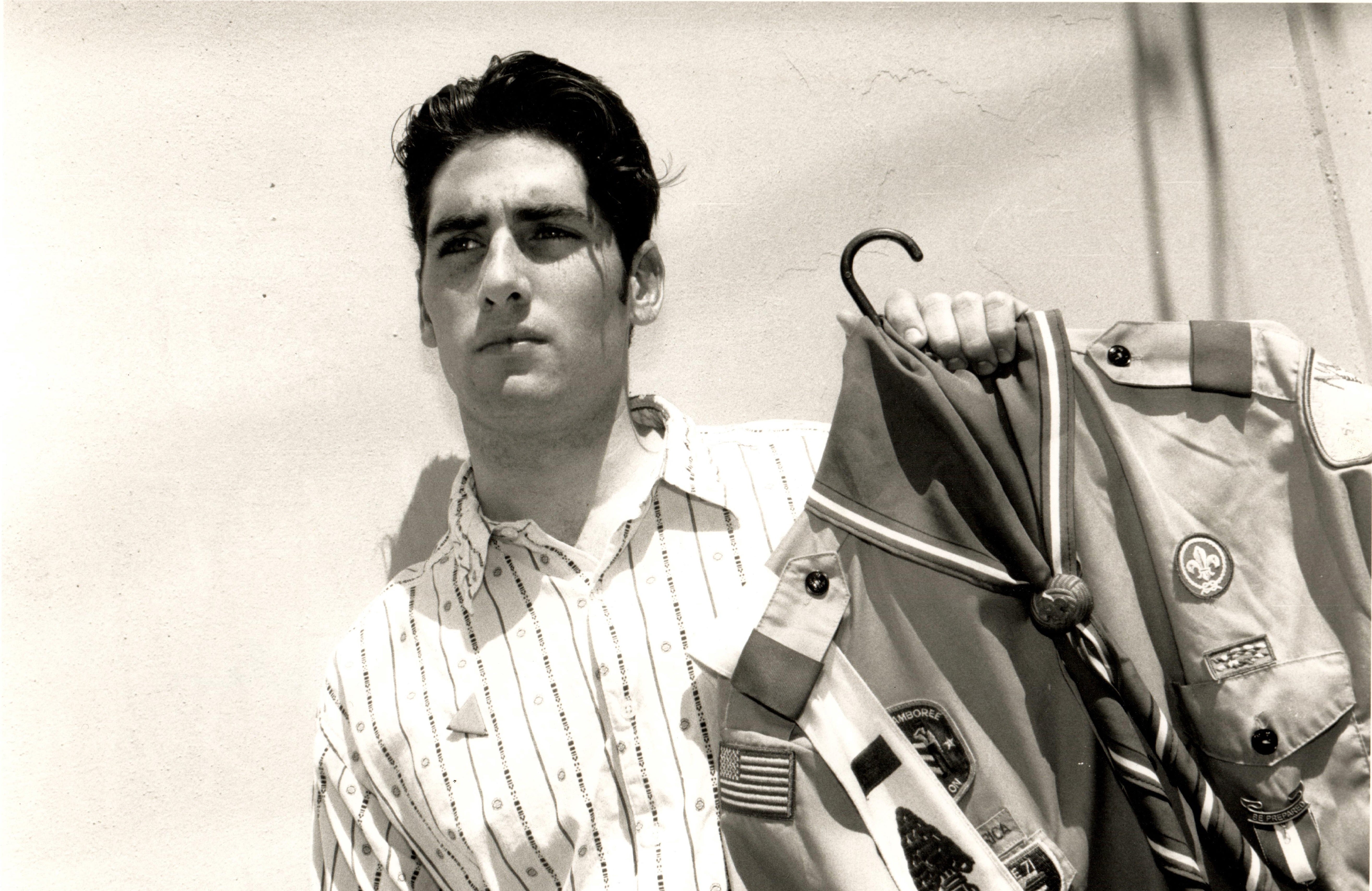
What he describes as a posture, an us-versus-them stance that outlived its moment, I experienced as oxygen and adrenaline. I had just been thrown out of the Boy Scouts of America for being gay. I had built my entire adolescent self inside an institution that decided, in a single letter, that I was unfit after they saw who I always was.
The people who taught me were the loud ones:the rebels, the queers and the fagots. The ones with the placards and the chants and the anger that made respectable gay men wince. They told me I had nothing to be ashamed of, and they told me at a volume I could hear over all the lies about being gay.
They gave me the strength to sue the Boy Scouts of America. I spent a decade in and out of court asking to be readmitted to the most iconic youth movement in the world.
The radicals didn’t make me want to burn anything down. They made me feel worthy of belonging. That is what I couldn’t fit my 217-word letter.
I found some round wooden beads and a few letters in some bins at JoAnn’s Fabrics, where every one of my mother’s sewing projects began. I strung them on clear monofilament wire the way you string popcorn garland at Christmas, and I fashioned a clasp and a hook on opposite ends. Five bright fuchsia letters, Q-U-E-E-R, sitting in the hollow of my throat between my Adam’s apple and my clavicle.
I knew how to do it because the Scouts taught me. Leatherwork. Knot tying. Basketweaving. Weeks away at summer camp learning to make things with my hands. The same hands that pounded my troop’s insignia into a leather hide strung the word Q-U-E-E-R onto a wire. The institution that expelled me gave me the skills to be proud.
Then I sued to get back in. My attorney was Evan Wolfson, who later founded Freedom to Marry and became the architect of the marriage equality movement that changed Matthew Vines’s life. He told me to lead with pain, not the anger. Was I a lifelong Scout seeking reinstatement, or an activist trying to change the Boy Scouts of America? The honest answer was both. In a courtroom you wear the tie and you make the reasonable case, and I did, for eight years, and I don’t regret it. It was code switching before we had the phrase. Taking the choker off in that room was never a betrayal. It was knowing which room I was in.
Here is what I did not understand until much later.
On April 26, 2000, I sat in the Supreme Court of the United States and listened to the Boy Scouts’ attorney, George A. Davidson of Hughes Hubbard & Reed, explain to nine justices what I had done to myself.
Justice Souter had just made the point in my favor. Mr. Dale, he said, has not asked to carry a banner in Scout troop meetings. He’s saying, I’m not going to carry a banner, I’m not going to get into it.
Davidson answered: “he put a banner around his neck when he put, got himself into the newspaper and Scout leaders throughout Monmouth Council sent the article in to headquarters. He created a reputation.” And then: “He can’t take that banner off. He put it on himself and, indeed, he has continued to put it on himself in this week’s Time Magazine, the Out 100, the New York Times.”
Wow, a banner around my neck?
Davidson had no idea the choker existed. It never came up, not in the briefs, not in the record, not once in ten years of litigation. He was describing a newspaper article, and he reached, without knowing it, for the exact object I had made with gay Boy Scout hands.
But here’s what he said. I got myself into the newspaper. Then Scout leaders throughout Monmouth Council clipped the article and mailed it to headquarters. The banner, in his own telling, was assembled by other people and hung on me by circulation.
The Scouts expelled me in July 1990, weeks after the Newark Star-Ledger printed that I was gay. Someone printed a fact about me and my own Scout leaders forwarded it. The pink triangle I wore on my chest ran in the New York Times on August 5, 1992, when I filed suit, two years after they had already thrown me out. The choker was made by a college kid who had nothing left to protect. Every banner Davidson listed came after the punishment.
So the offense was never my vocabulary. Justice Scalia said it that morning, asking Evan about a man who is publicly known to be a contradiction of the Scouts’ message, “whether the person wears a sign or not.” The sign was never the problem. You could have swapped “gay” for “queer” in every interview I ever gave and it would not have changed one word of my expulsion. What they could not tolerate was that anyone knew at all.
I can moderate what I say. But I cannot contort myself into acceptance. If they ask you to, it’s a trap.
Evan understood this better than anyone in the room. Pressed by Scalia on whether my simple presence was a message the Scouts should be forced to carry, he answered that a human being such as Mr. Dale is not speech. “A human being is certainly not speech as to a view, or as to a message, other than perhaps the message, I am who I am, I am here…”
The Court ruled against us anyway, and in the opinion I became a “gay rights activist,” as if those three words defined my entire being. They never said “queer” and their decision still hurt like hell for decades. But they were right about my passion and wrong about everything else. Being the calm one was never the opposite of being the activist.
The tie and the choker were never opposites. They were two things I did, sometimes an hour apart, walking from Evan’s Lambda Legal office to an ACT UP meeting across the park. Both kept me alive. Neither one was the real me while the other was a costume.
So I won’t do it, and I won’t let the fear do it either. At 55, I will be a whole person.
Queers like me fought back. We screamed for access to AIDS drugs, turned losses into victories, got marriage equality, sitcoms, mortgages, divorces with nasty custody battles. It took decades and it cost lives and we earned it.
But we climbed a ladder other people are still on. Trans kids are lower on it than anyone, and what we are doing to them right now is child abuse. Every gain I have in my life came from somebody above me on that ladder deciding to reach down to grab my hand reaching up. That is the only thing that has ever worked.
I was lucky to survive. Many people I loved did not. Queers Read This, the manifesto Vines quotes, was written by people watching their friends die while the country looked away. He calls that resonance understandable, then says it has outlived the crisis. I disagree. The reason I still carry the word isn’t nostalgia. Those people are my community. We are one.
My letter ran first. I keep looking at that, because I know what I cut, and they put the quiet one at the top.
Then I read the rest of the page, and something happened I didn’t expect. The arguments I’d thrown away were all there. Not in my words, but in everyone else’s.
I cut the point that they were coming for us before we said “queer.” Garrick Spears, in Canaan, said it plainly: they would come for us however polished and restrained we made ourselves. I cut the ladder, the idea that we owe the reach downward. Shannon Brennan, in Milwaukee, wrote that our responsibility is to those who lack power, not those who hold it.
I never had to carry all of it. Other people were holding the parts I had set down.
That is precisely the thing Vines says we aren’t: a posture, an us-against-them reflex that outlived its reason. Look at what that actually did on one page of the New York Times. We’re a community.
Matthew Vines and I want the same things: to keep marriage equality, and for the kid in Wichita and the kid in Monmouth County to grow up without being taught they’re defective. On the substance, we are not far apart at all.
But the people organizing against us aren’t confused about our vocabulary. They were coming for us in 1990, when the word “queer” had barely traveled out of New York City. They will come for the married Baptist in Texas and the drag queen in Ohio with the same bill, on the same afternoon, and they will not check which word either of us prefers.
So the question isn’t which label polls better. It’s whether we intend to be a community or a set of constituencies negotiating separately. In 1990, people who had every reason to be busy with their own survival made room for a nineteen-year-old they’d never met, and that room is the reason I had a life. I’ve spent every year since trying to make that room for somebody else.
We don’t win by figuring out who to leave outside. We only win we when we stand as one.
The letter as published in the Times:
To the Editor:
Re “I’m Gay, Not Queer. It Matters,” by Matthew Vines (Opinion guest essay, July 2):
In 1990, the year Queer Nation published the manifesto that Mr. Vines quotes in his essay, I was one of that group’s members. I was 19. That same year, the Boy Scouts of America expelled me for being gay, and two years later, I sued.
The case took eight years to reach the Supreme Court, which in 2000 ruled in favor of the Boy Scouts. My Lambda Legal attorney at the time, Evan Wolfson, went on to become a leader in the marriage equality movement that Mr. Vines credits with changing his life.
In his essay, Mr. Vines presents queer confrontation and mainstream acceptance as opposing forces. My life tells a different story. The welcome I found among queer radicals gave me the courage to fight for a place in the most wholesome institution in America. The people in the streets and the people in the courtrooms were the same movement. Often the same people.
I am 55. I survived the AIDS crisis and buried many friends. I have been queer all my life, in the streets and in the courtroom, and I never found those two fights as far apart as Mr. Vines suggests.
James Dale
New YorkOriginally published by the New York Times on July 18, 2026.
Subscribe to my Substack or follow me at JamesRDale.com.
Thanks for reading.
No posts
Comments
Nothing yet. Say the first thing.
Sign in to join the conversation.