
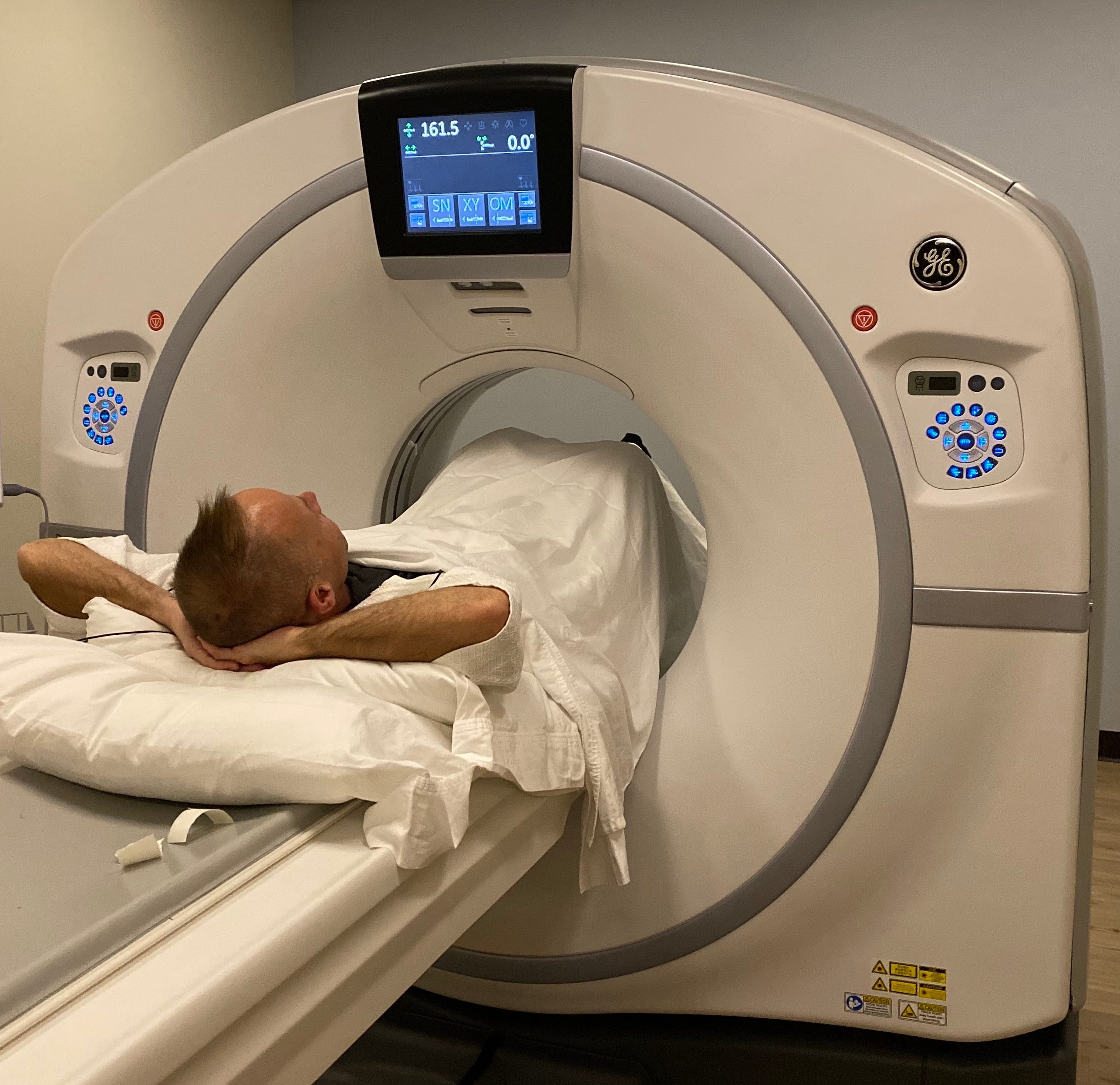
Two dates jut from my summer calendar, not for the reasons I want, the sweet envelope of friends or the whisper of leaves and waves. With one there is susurration and the shock of cool water as the IV pump squirts contrast up my arm.
The CT scanner whirrs.
“Don’t move. Hold your breath.”
The ultrasound is more human. The sonographer is right next to me instead of behind leaded glass, eyes trained on a screen, smearing gel along my thyroid-less neck with a smooth curvilinear probe. Each beep carries a small essential question. What have they found?
It is a vulnerable feeling, those minutes, like the capitano in Hernando Téllez’s story, “Just Lather, That’s All”, getting a straight shave from a barber who is deciding whether to cut his throat.
Every day, dozens of people wait in the ER after their x-rays or scans, balancing on the razor’s edge of before and after. Others are at home, their requests for imaging declined after a long wait. Some are even sent in by family doctors unable to hold a person’s worry about their headache, so they are shuffled our way for a CT scan or a conversation about how it’s not needed.
It is a bane of our position, right next to the machines, reassuring people that we have enough information without radiography, and that their body will sort out what doctors never could.
Some questions are as good as an x-ray. Can you bear weight? Is there tenderness along the ankle bones or the outside of the midfoot? The answers save time and money, sure, but they also preserve one of the last human acts left in medicine, touch, and with it an even closer eye.
“These bruises up your leg…are you falling often? Is it safe at home?”
People still want that x-ray though, “just to be sure”, Ottawa Ankle Rules be damned. And if you could keep x-raying, or better, MRI’ing my whole body such that we can be ‘sure’ about that too, that there is no wolf lurking in my bones waiting to eat me, I would be glad about that.
Not everyone is so worried. A few years before my grandfather died at 99 1/2, I was sitting with him in his front room, playing crib, when he started to have all the symptoms of a heart attack.
“I know what it is,” he said, waving away both my diagnosis and insistence we visit the ER. “I’ll lie down and see how it goes, but I’m not going to no hospital.”
As such, some of our view as emergency physicians is ‘selection bias’, meaning patients easy to reassure or with previous experience, limping from couch to bathroom seeing if the foot gets better over a couple days, or like my grandfather, are mostly at home.
And some of them are dead. That’s what makes our job hard, teasing out the two populations, the sick from the worried. As we tell our students, on every hypochondriac’s gravestone is written “I told you so”, so take care.
If I could guess, more than half the patients we see in our ER are there mostly from worries about their bodies than actual problems with it. The evidence backs this up. At one centre, four in five chest pain patients left without a pathological diagnosis. The prevalence of generalized anxiety disorder in the waiting room is ten times the population level.
‘I just want to be sure we’re not missing anything’.
Of course, we are never sure about anything, at least not for long. If the x-ray is negative, our mind asks, maybe a CT is better? Anxiety is our modern diagnosis. You don’t have to wait for a sonographer to land her curved probe on your neck for an alarming beep, you just need a phone nearby.
Beep.Voice note from mom. Earthquake in Turkey. Black Friday deals. An enlarged lymph node.
Medicine, especially in places where it is more profit-oriented than human-centred, has responded by expanding indications for imaging rather than limiting it. Give people what they want, or even better, a hunger for it.
Full body MRI’s are increasingly marketed to the rich and worried. I had one, as part of a $20k physical exam I took in California as research for this next book.
So far, the evidence around them is poor. Instead of assuaging our fears, it multiplies them. One in three people have a finding. One in six of these is a false positive. Fewer than one in five of the rest turn out to be serious. Across 32 studies and nearly 28,000 asymptomatic people, only 48 serious diagnoses were confirmed, a rate of 0.2%. Even meta-analysis, a research approach that combines studies, hasn't proven that full-body MRI extends a person's life.
In my case it did help. Or might have. They saw my medullary thyroid cancer, but under-called it. ‘Likely benign’, the report said, ‘recommend ultrasound’. It wasn’t. I didn’t. Felt a lymph node in my neck 6 months later.
Good doctor, bad patient.
I’ve read a thousand reports like that. The word “benign” felt like a blessing, then disappeared into the current.
There was a lot going on in those months. My mother died suddenly while my father was in the ICU. A global pandemic kept me from him, from everyone. Worry for myself barely charted.
I had no one watching over me. I thought medical school was enough. The MRI had been done by a company whose obligation ended once they delivered the results. Though a whole-body MRI was part of the contract, caring for a whole person wasn’t. That is a much larger covenant.
Evoking this promise gives me some success in assuaging a person’s fear without imaging. When I say to someone with sciatica, “No matter what the MRI showed, I would never let someone operate on you until we see what your body can heal on its own”, they soften. In the end, all we want to know is that something is on our side.
In Tellez’s story, the capitano stands up, wipes his neck, fishes pesos from a pocket.
”They told me you’d kill me if I came in for a shave, so I had to see for myself. But killing isn’t easy.”
Living isn’t either. My ultrasound is in three hours, and from there, I will go to the ER for my fifteenth shift in seventeen days and wait for my phone to beep me with my results while my patients wait for theirs.
When I got that news five years ago, I called my friend and poet, Calvin White.
“What are you thinking about?”
“Dying.”
“James, even on the day you think is your last, you don’t know. It’s not up to you.”
There is only one thing to be sure of. One day, our body will pass into a place smaller than the CT's bore, and the earth will bring us home. Until that day, here we sit, typing reading breathing
alive alive alive.
Comments
Nothing yet. Say the first thing.
Sign in to join the conversation.