
Medicine.
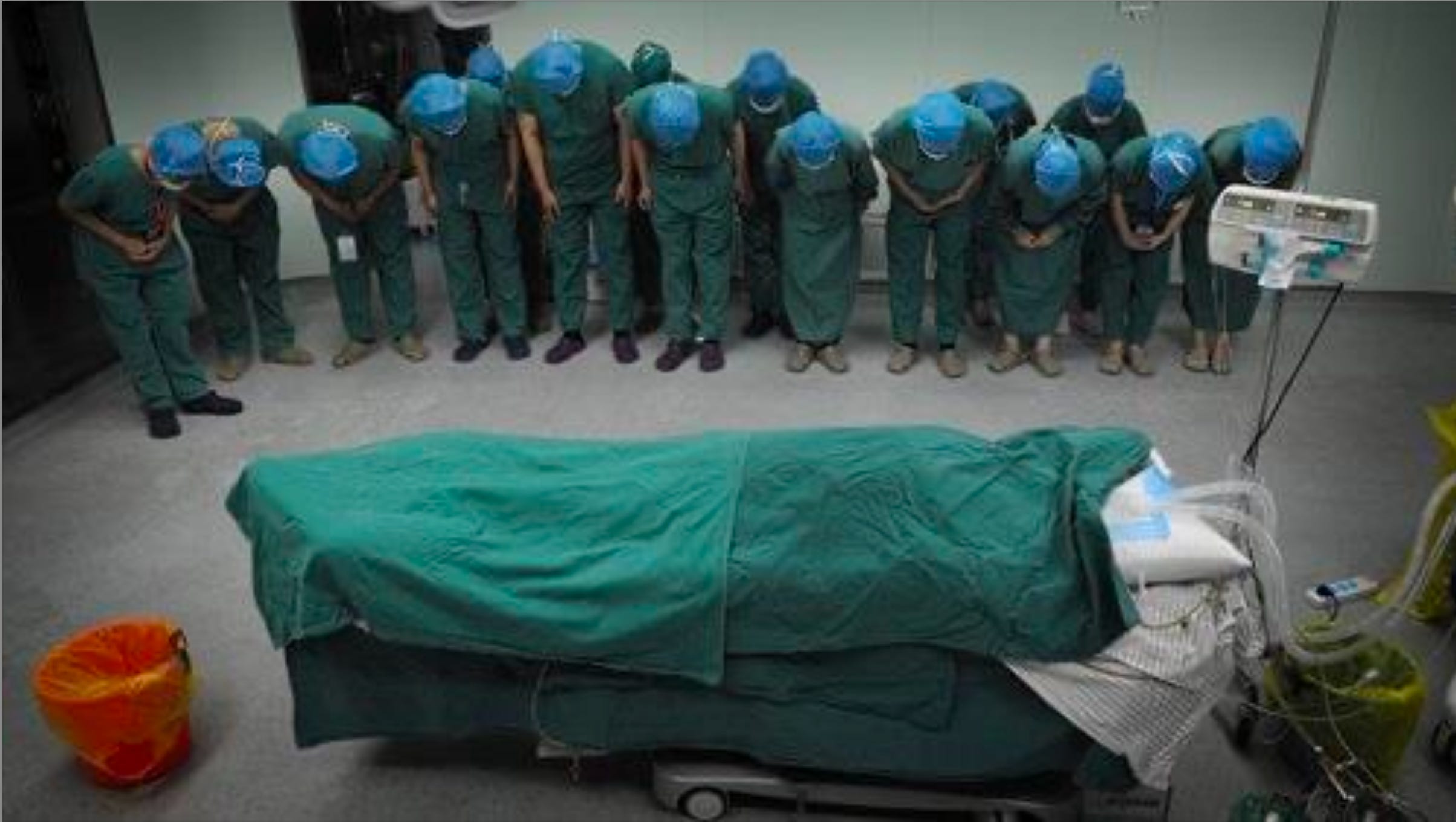
Image: Japanese surgical staff bow before taking organs from a donor
My dears.
As a shift worker, the week elides. As a shiftworking writer, the day does. As a shiftworking writing meditator, one wonders if it is all elision. One moment slides into the next, dreams intervene. Or a memory.
I am high in the clean blue air. Below me is the pale shore of an island in Lake Superior fringed with sand. My air is thin and shared. A stranger and I ignore the armrest between us, him one arm folded under the other, me elbows pinned.
In two hours we will land in Winnipeg, Manitoba, a place loved by millions of mosquitoes and plenty of people. Depending on the time of year. It is Canada’s annual emergency medicine conference, CAEP, and I’m to share the stage tomorrow with a great friend and colleague, Sara Gray, as we try to get people talking about what often remains unsaid.
I’ll explain more soon, maybe even have an interview with her and pass it on. She’s the best.
As preamble, tomorrow we are making a case for debriefing after intense, shared experiences in the ER.
There are three varieties, more or less.
The first, vanilla emergency medicine, ER 101. A person overdoses in the ER bathroom. A woman with a deadly allergy to bees is stung by one and her mouth swells shut.
We rush towards these, antidotes into IVs. People mostly do well, but sometimes they die. We don’t really talk about it one way or the other, unless there are mistakes.
The second type happens less often — maybe every week or two.
A child is badly burned.
The woman with the bee sting dies.
The third even less frequently. A well-loved nurse is killed by a drunk driver on her way home from a shift. A schizophrenic man pulls a knife, cuts a guard.
The first type (many people involved) is done as part of the resuscitation, in the moments right after, with a goal — systems improvements.
It would be cool if there was more than one key to the bathroom so we could have reached him faster.
What about a door with a punch code?
That’s great. I’ll write engineering and ask.Action follows idea.
The second is not about systems, or ideas, but people. Many humans involved, many hearts affected. This is not done at the first possible moment, but after a time, before everyone goes home. Part of this is functional — jobs half-finished to attend the greater urgency — part of it is a recognition that it takes time to let an emotion land. Especially so with our antennae turned towards the needs of others.
So before our shift is over, we get together in an empty room and say, “That was intense. How is everyone doing? Are we missing anybody? Take care of each other.”
Then we look in each other’s faces, see the best parts of ourselves. Later, we walk to our cars in the cool night air, keys jangling, these faces keeping company with the smell of singed clothes.
Together is how we get through.
Many humans involved, many hearts affected, over many days, maybe even for good. That’s how I think about the third instance.
I’ve been doing debriefings like this for a decade. Last month I did one and at the end of it the intensivist said, “I’ve learned more in the last hour than I have in the previous twenty years.”
She wasn’t talking about the how of medicine, or the what. She was talking about the why.
Each other. Different human hearts coming together, being hurt, making something bigger than would be endurable alone.
It was nothing I said, more what I didn’t say. I don’t try to fix people nor give them high-fives. I mostly ask them how they are feeling.
“I wish I would have checked in on her more often.”
“How does that make you feel?”
“Sad.”
“I can see that. I miss her.”
“Me too.”
And then it gets quiet for a while, and in that sweet space, a love for each other and all people hangs, and questions about how much longer we can do this work sit next to answers of “at least a little more.”
It will surprise you to know that in almost every ER, instead of these conversations, people go their separate ways, swipe open their phone hoping to be taken a bit further from where they are.
We don’t need to be perfect at either world-building or the difficult conversations. Its enough to be practiced.
We’ll see how it lands. The debriefing talk I mean. The plane too.
I love debriefing as much as I hate flying. I just find the latter so insane, and turbulence just takes little bites out of my soul. It’s the worst.
In case you haven’t gleaned it, we’ve started our descent. Clouds are piled on the edge the blue-black ground below as day turns to dusk /
I’ll update you soon. I’m excited about seeing the Human Rights Museum again. I recommend it to everyone.
May we know ourselves, and as we do, discover what we share.
Comments
Nothing yet. Say the first thing.
Sign in to join the conversation.