
About ten years ago, I was sitting at a crowded table inside a beautiful hotel, the Omni Shoreham in Washington, D.C. I was feeling like an absolute loser, not because I had an extra dessert, but because I had just witnessed stories of people who made an extraordinary impact on the world.
At the time, I was the Senior VP of Sales for Oneida. I was attending the annual charity dinner for the Sodexo Stop Hunger Foundation. If you are in the institutional food or hospitality space, you know Sodexo. They are a massive global powerhouse feeding millions of people across universities, corporate campuses, and business facilities every single day.
I expected the usual corporate presentation and dinner - polished PowerPoint slides, executive handshakes, and standard applause for the latest corporate plans. But after the main dinner plates were cleared, the presentation shifted.
Sodexo began highlighting their own people through their Heroes of Everyday Life program.
These weren’t C-suite executives or regional directors. These were everyday, frontline Sodexo employees - dishroom workers, line cooks, and kitchen staff. They were honoring individuals who finished a grueling eight-hour shift and performed selfless acts like gathering unused prepackaged meals that were sitting on the edge of expiration, and spent their personal nights loading up local food pantries. Another Hero of Everyday Life collected unused toiletries from the hotel he worked in, and delivered them to a local shelter so the homeless would have soap and shampoo. Each winner received a $5,000 grant for a hunger-relief charity of their choice and an all-expenses-paid trip to the annual Sodexo Charity Classic.
I sat there watching these ordinary workers change the planet out of sheer human empathy. Then, I looked down at my own title. Senior VP of Sales. I thought: What am I actually doing here? I’m just pushing metal forks across a balance sheet while these guys are actively keeping people alive.
I knew I couldn’t go out and personally drive a delivery van every night. But I realized I had access to a different lever: commercial volume.
Most B2B vendors treat enterprise sales like a simple math equation: Features + Price = Closed Contract. They walk into massive multi-billion-dollar accounts like Sodexo, trying to pitch a slightly lower per-unit cost or a faster shipping window. But at the enterprise scale, those marginal improvements rarely break through the noise. What vendors fail to realize is that major corporations aren’t just collections of purchasing agents - they have deeply entrenched corporate cultures, internal values, and philanthropic targets that their leadership is judged on.
If you want to move a mountain of an account, you don’t just sell to their procurement desk. You align your commercial engine with their cultural mission.
I had an idea - I wanted to take a percentage of our sales increases with Sodexo and use it to make a donation to the Sodexo Stop Hunger movement.
The next day from my hotel room, I emailed Marvin Deitz, our VP of Marketing at Oneida. Marvin is a marketer’s marketer. He loved getting in the weeds of a new program, a new initiative, or a new promotion. I knew I would have an internal champion with Marvin. I told him the story of the dishroom workers and pitched the raw concept. Marvin didn’t just love my idea - he also saw the strategic potential. By the end of the day, I had mock-ups of a program to present to my corporate contact at Sodexo, Kevin Demerrit. And beyond that, true to form, Marvin even came up with a witty name: “Pass the Plate.”
The next step was to present the plan to Oneida senior management. Our CEO Jim Joseph was instantly on board, and our CFO Andy Church crunched the numbers and gave his blessing with financial guidelines around the donation.
But a strategy like this only works if you secure complete ecosystem alignment. We needed our distribution network on board to handle the logistics. I went straight to our distributor, Edward Don & Company. Chris Colovos was the Don National Account Manager who handled Sodexo. Chris reviewed the idea with his national account management team, and not only did they like the idea, but they also agreed to help promote it at an operator level. Pass the Plate is becoming a reality.
Next came the final test. I scheduled a meeting with Kevin at Sodexo.
I didn’t walk in with a standard sales deck, catalogs, and product samples. I walked in and said, “I watched your Heroes presentation. I’d like to align our business with your cause. We’d like to commit to donating 10% of all sales increases through Sodexo directly back to the Sodexo Stop Hunger Foundation. Is that something Sodexo would allow?”
Kevin’s eyes lit up. The play was locked in.
We deliberately decided to run the “Pass the Plate“ initiative during the final quarter of the fiscal year. This gave us a tight window to bundle the campaign data, calculate the numbers, and prepare the final presentation prior to Sodexo’s next high-profile June event.
What happened next was a masterclass in market psychology.
Because Sodexo’s internal team was fully bought into the program, they didn’t view us as an outside vendor trying to extract a margin. They viewed us as an active partner in their own foundation’s success.
Sodexo corporate actively promoted the campaign down to their regional units.
Edward Don deployed their sales reps to echo the message across the distribution channel and at the operator level.
The Buyers reacted in a way we never anticipated. Local Sodexo dining facilities across the country started holding off on buying replacement stock from competitors, waiting specifically for the fourth quarter to hit, just so their purchases would be credited toward the foundation donation. They didn’t just buy - they stocked up.
Let’s be entirely transparent here: this was an incredible act of corporate goodwill, but it was also a lethal guerrilla marketing tactic.
The year before we launched “Pass the Plate,” Oneida wasn’t even a contracted, core supplier with Sodexo. We were fighting on the fringes, losing our single-digit market share against preferred suppliers.
By the next annual foundation dinner, we were sitting in the room as a featured vendor, presented directly on stage to the entire audience. In a matter of months, we bypassed decades of vendor bureaucracy and became a heavily favored supplier across their global footprint.
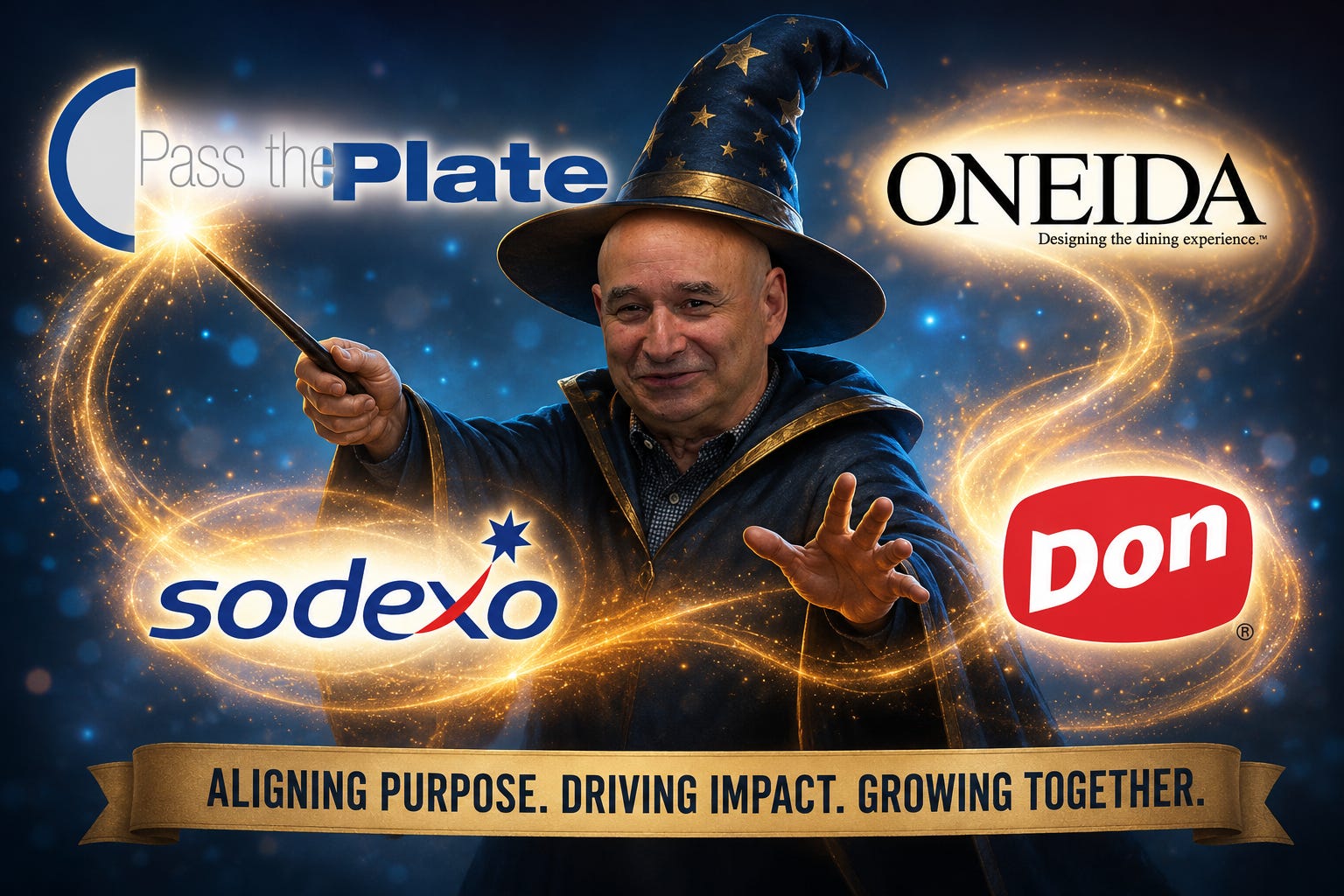
There is an unnecessary, imaginary wall in modern business that splits commerce from philanthropy. Companies mistakenly believe they either have to be cold, profit-driven operators or soft, non-profit entities.
Beyond looking at profit vs philanthropy, the commercial lesson learned is one of listening. What is your client’s culture? What moves the needle for them? How can you align your interests with theirs? In this case, we made a bold philanthropic move that helped the hungry, helped our distributor partner by providing a new and exciting program, and helped our revenue. Altruistic or commercial? In the end, it doesn’t really matter. We helped people, strengthened our client relationship, and grew the business. I’d call that a win for everyone.
The real magic happens when client-supplier initiatives align commercially and culturally. We didn’t exploit a charity to make a buck- we weaponized our corporate volume to fund an essential cause, and in return, the client rewarded us with their enterprise loyalty.
The Operational Takeaway: Stop looking at your largest client prospects as cold procurement sheets. Find out what’s important to them, and make it important to you. Then figure out how to connect your commercial interests to their internal mission, and watch potential turn into a relationship.
Have you ever won a major account by doing something completely different? I'd love to hear your story in the comments.
No posts
Comments
Nothing yet. Say the first thing.
Sign in to join the conversation.