
Most business owners view their Customer Relationship Management (CRM) platform through a very narrow lens. To them, it’s a standard sales tracking tool - a digital filing cabinet designed to keep reps organized, store phone numbers, and make sure follow-up emails get sent on time.
Business owners, I talk to seem to prefer complaining about rogue salespeople that won’t use the tech when they should be persuading the entire company to recognize their CRM as a sales, financial, and operational game changer.
When a business scales past a certain inflection point, treating the CRM like a basic administrative notebook becomes a massive strategic liability.
A properly managed CRM is not a passive ledger for the sales floor. When executed with ironclad operational discipline, it becomes the predictive engine for an organization. It acts as the structural bridge that connects raw front-end marketing intent directly to the demand forecasting team, the procurement pipeline, and the CFO’s financial and cash flow models.
If your organization is struggling to forecast revenue or if your fulfillment teams are constantly caught flat-footed by sudden spikes in volume, the problem isn’t your macro strategy. The problem is your CRM hygiene.
Here is how to transform your CRM from a basic sales log into an enterprise-wide forecasting asset.
Before a CRM can provide a single shred of predictive value to your executive team, the data inside it must be unassailably clean.
On a sloppy sales floor, the pipeline is a graveyard of stagnant files. Reps keep dead leads in active statuses because it makes their pipelines look “full.” They promise they are “still working on that account,” even though no one has picked up the phone to call them in three weeks.
The finance department sees the CRM as a monthly expense. And procurement and demand planning might not even know what the acronym stands for.
To run a synchronized operation, you must enforce a strict, non-negotiable protocol for every single deal in the system. Every active opportunity must permanently exist in one of three states:
It has a current activity occurring today.
It has a future activity explicitly scheduled on the calendar.
It is formally marked as Lost.
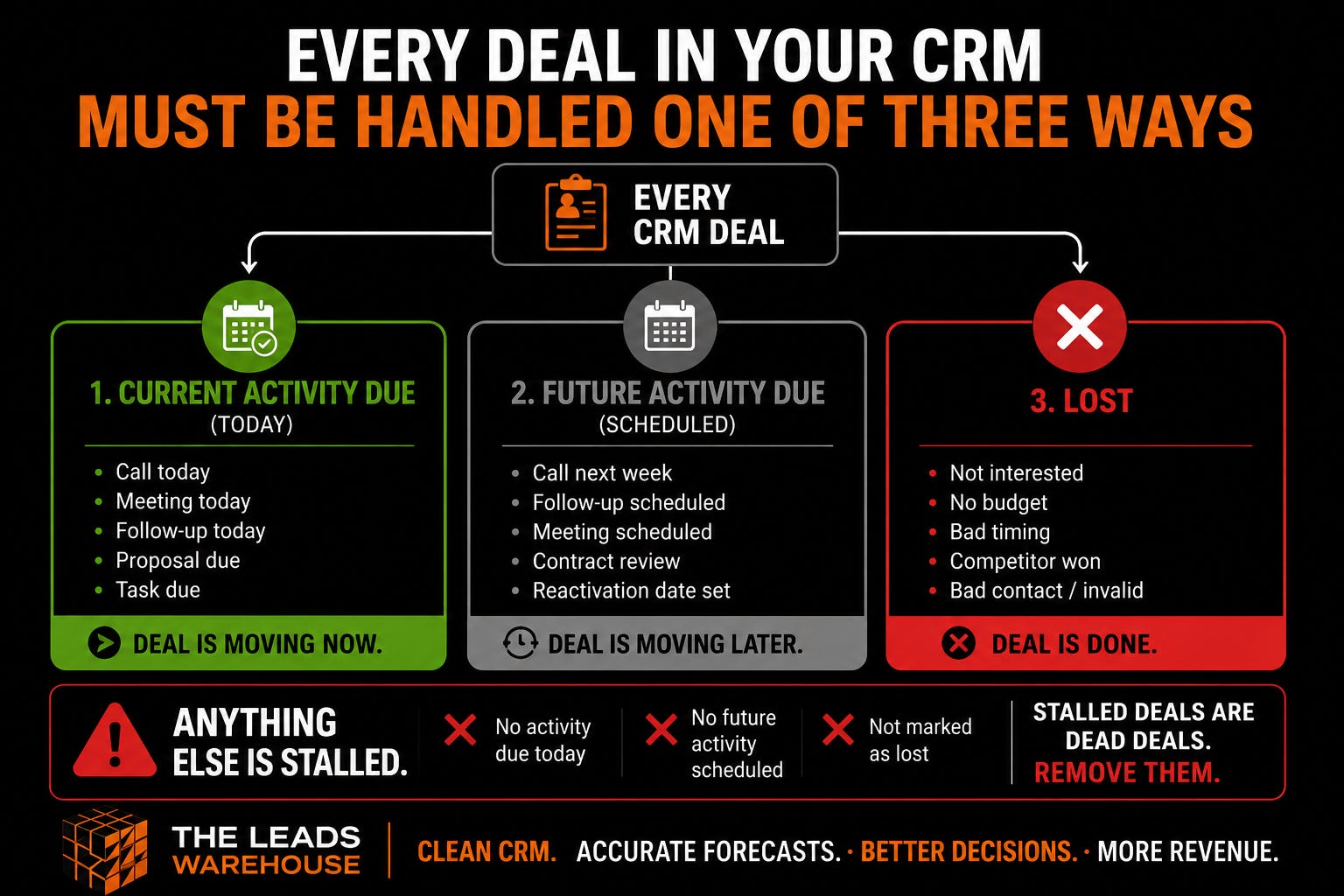
Deals that aren’t moving - meaning they have zero active or future tasks attached to them - are stalled. Stalled deals do not make money. They clutter the dashboard, distort averages, and inject pure fiction into the sales pipeline. If a rep does not have a definitive next step scheduled with a prospect, that deal must be moved to a closed-lost status immediately.
The ultimate mechanism for turning sales data into corporate intelligence is the disposition (dispo). Every single interaction - whether it’s a closed-won contract, an invalid phone number, a pricing objection, or a flat refusal - must be stamped with an accurate, standardized disposition.
When every file is cleanly categorized upon exit, the resulting dispo reports provide an unvarnished audit of your entire corporate health.
Judging Sales Effectiveness: Dispo trends will pinpoint exactly where your reps are dropping the ball. If a specific closer has an inordinate percentage of deals stalled at the “verbal agreement” stage, you don’t have a lead problem - you have a closing-mechanics problem that requires targeted role-play coaching.
Optimizing Your Marketing Partnerships: This is where the lead generation feedback loop becomes incredibly powerful. When you pass clean, granular dispo reports back to your performance marketing provider, you give them the exact ammunition they need to optimize your traffic. If your data vendor sees that leads from a specific digital sub-ID or creative angle are consistently hitting the “Closed - Lost: Out of Budget” wall, they can instantly pivot their media spend away from that audience. Clean dispos ensure your marketing partner can aggressively hunt down and bring more high-converting, highly profitable deals to your table.
Creating Future Opportunities: A proper disposition report can create more future opportunities than current opportunities. Consistently, at The Leads Warehouse, we see that 50% of new leads take over 90 days to close. In the frenetic world of sales, a rep can barely remember account details from yesterday. Memorializing next steps or closing friction sets the sales funnel up for future success. We also have a dedicated reactivation protocol that lives by disposition reports to know how to reactivate our own aged leads.
Once your team maintains clean activity tracking and rigid dispo protocols over a sustained period, a mathematical miracle occurs: your CRM data standardizes into predictable statistical distributions.
You stop guessing what your close rates look like. Instead, you know with absolute mathematical certainty that for every 1,000 data leads fed into the front end of the machine, a fixed percentage will convert to a live contact, a fixed percentage will progress to a formal pitch, and an exact percentage will land as a closed contract.
The second you possess those stable conversion metrics, you can apply them directly to your corporate balance sheet to run advanced demand planning and financial forecasting.
This infrastructure unlocks three critical operational capabilities:
Instead of relying on the emotional, “gut-feeling” projections of sales managers at the end of the quarter, executive leadership can look at the raw volume of opportunities sitting in the mid-pipeline stages and accurately forecast expected closes weeks in advance.
With clear visibility into the exact volume of closes heading toward the finish line, your operational, procurement, and demand planning teams can make proactive adjustments. They can ensure there is adequate raw material or work-in-progress (WIP) capacity in the fulfillment pipeline to meet incoming corporate demands without experiencing costly bottlenecks or service delays.
When I was at Clipper Corporation, we sold custom restaurant supplies to large chains. We included Demand Planning in our pipeline review so procurement knew exactly how much to order to keep our clients in business. A national chain will immediately fire a supplier that runs them out of smallwares integral to menu execution. We had a “Deal Calendar” to track every client opportunity, which synchronized sales and operations.
When you know your conversion velocity - the average number of days it takes a lead to travel from initial ingestion to a paid contract - your accounting department can map out future revenue arrivals with surgical precision. Cash flow forecasts switch from defensive rear-view reflections into offensive forward-looking playbooks, allowing you to time corporate investments, hiring cycles, and media expenditures perfectly.
A CRM is only an administrative chore if your management style allows it to be.
When you enforce ironclad data hygiene, standardize your dispositions, and seamlessly connect your front-end sales metrics to your back-end fulfillment and accounting departments, the CRM transforms into the primary command console for your business.
Enforce the three-state rule on your floor, pass the analytical data back to your marketing providers to refine your lead flow, and let the mathematics of clean data stabilize your corporate future regarding demand planning and financial forecasting.
Thanks for reading! This post is public so feel free to share it.
How tightly integrated is your sales CRM data with your procurement and accounting models right now? Are your reps using standardized dispos, or are they hiding dead weight in their pipelines? Let's talk about operational hygiene in the comments below.
No posts
Comments
Nothing yet. Say the first thing.
Sign in to join the conversation.