
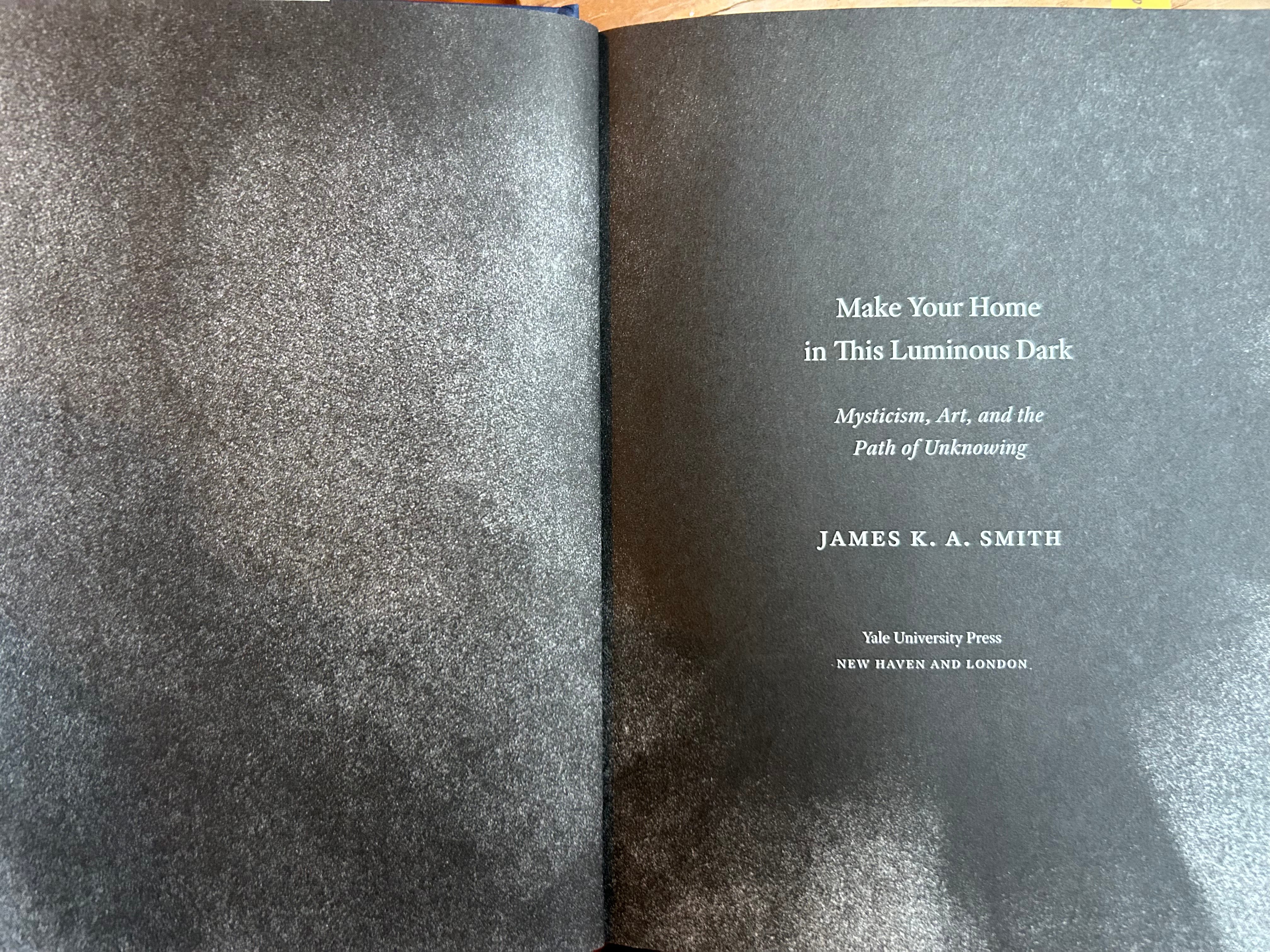
Exhale. The day has arrived. My new book can now be found in the wilds of this world—or in bookstores, at least.
I am beginning the day with gratitude instead of anxiety. Of course one hopes that readers will love the little book-child you’ve sent toddling into the world. But one of the benefits of writing weird philosophy books like I do is that you have zero illusions about being a “bestseller.” I’m just not playing that game. One thing I’m grateful for is publishers who make room for this strange genre I might describe as “philosophical counsel.” I still can’t believe I get to do this.
This book has been percolating for a long time. In many ways, it reflects my tenure as editor in chief of Image, which I often describe to people as my “MFA-by-other-means.” In the Image community I had the opportunity to engage an inspiring cadre of poets, novelists, and visual artists whose art drew me into new experiences and inspired me to attend to the craft of writing in fresh ways.
But the seeds of this book were planted before I ever knew how they would flower—before I ever could have known that I would have to write this book. In many ways, this is a book I wrote for my younger self—frantic, hungry, anxious, compelled to perform in the hope he might be loved. This is why I am also grateful for the partner I’ve had through this whole journey. As I put it in the closing lines of the Acknowledgments: “For years and years, my gracious, forgiving wife, Deanna, encouraged my frantic, restless younger self to ‘just be.’ I hope this book is proof that I was listening.”
I’m also grateful for so many of you who have already told me you’re looking forward to reading the book. Thanks for welcoming yet another one of my brood. And I’m grateful for a few of you who received advance copies for review and sent me notes about how the book seemed to meet you where you are, as whole persons.
The Table of Contents visually presents one of my central arguments in the book: instead of thinking about mysticism in terms of an ecstatic event of rapture (think: Bernini’s “Ecstasy of St. Teresa”), we should think of the mystical tradition of contemplation as a spiraling path.
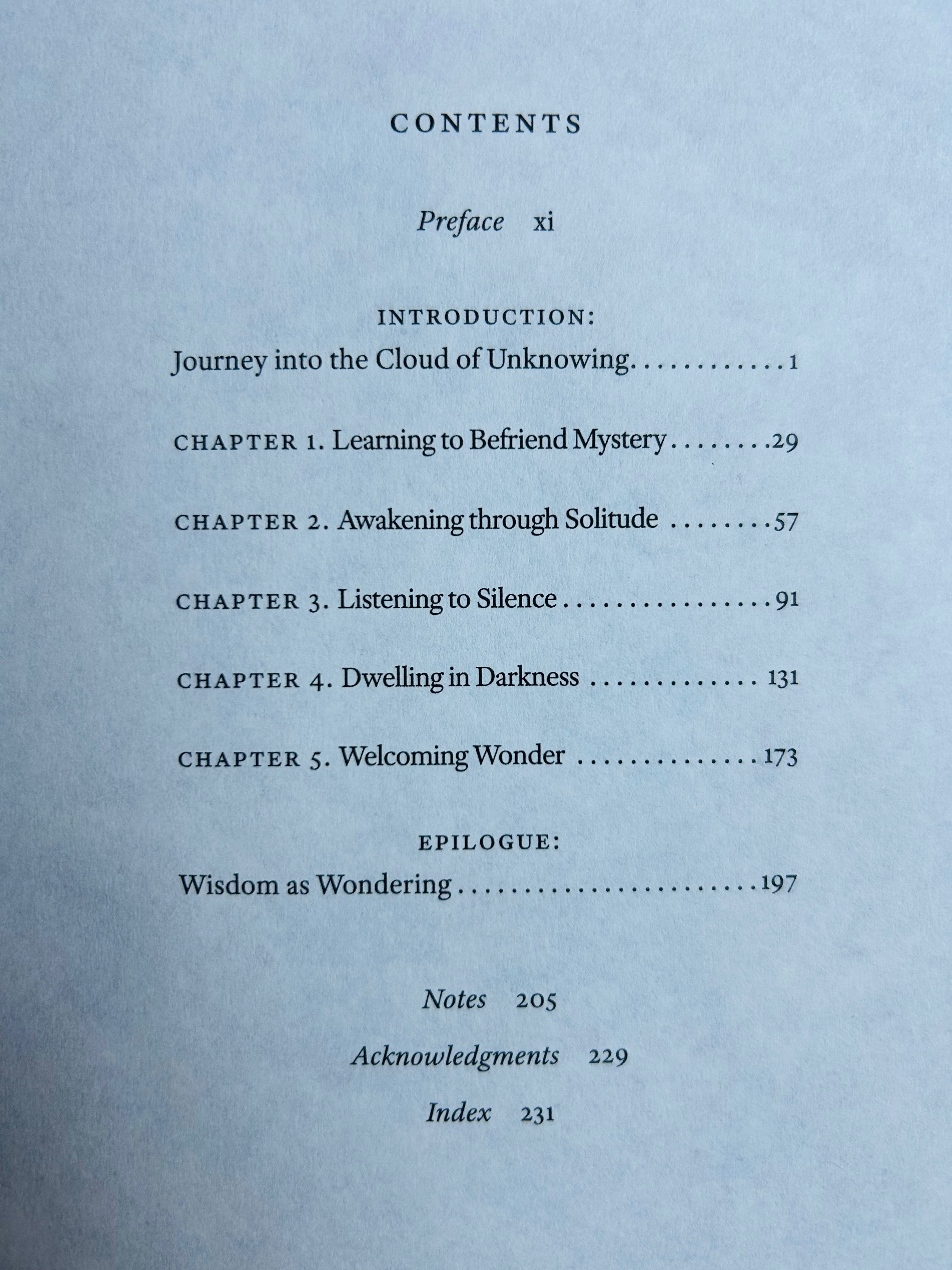
Of course this path includes experiences of union, even ecstasy. But as St. Teresa herself attests, nobody lives in ecstasy. One might touch this once and then live the rest of one’s life off its memory—a kind of wound of reason that is a mark of blessing like Jacob’s limp. This is why I describe mysticism as a spiraling path and ongoing journey of seeking solitude, sitting in silence, and dwelling in darkness in order to become the kind of person who can welcome wonder.
Another thing I’m grateful for: an editor with a keen writerly eye and the gentle capacity to push back and nudge me toward a better book (thanks, Jennifer!). In particular, she kept pushing for distillation and simplicity. Less is more. Get this down to the essential. This book is so much better than the longer manuscript I submitted.
But I thought this week it might be fun to share some snippets from the cutting room floor, as it were. (Is this what people call “bonus content?”) Here below is an example. This speaks to the journey aspect I’ve just described—the way in which mysticism is its own sort of pilgrimage of the soul.
[from the cutting room floor]
Contrast this, for example, with the way St. Augustine describes the vocation of being human. In a sermon from 416, preached at the shrine of St. Cyprian in Carthage, Augustine discusses a common image in monastic thought: the gospels’ contrast between Martha and Mary. When these sisters received Jesus into their home, Martha busied herself with the logistics and particulars of hospitality, attending to Jesus’ needs, while Mary simply sits at the feet of Jesus, attentive to his words. Jesus is grateful to Martha but praises Mary for choosing “the one thing necessary,” the “better part.” Mystical literature takes Mary’s “better part” to be devotion to contemplation. Augustine does the same, but he recalls this episode in the context of expounding chapter 3 of St. Paul’s epistle to the Philippians in which Paul emphasizes that he has “not grasped” perfection, has not arrived, is still seeking.1 The only perfection that can be realized in this life, Augustine emphasizes, is to become the pilgrims we are called to be: “perfect travelers, not perfect possessors.”2 To be human is to be ever and only on the way. “I am still following, still forging ahead, still walking, still on the road, still extending myself; I haven’t yet arrived.”3 Which is why, unlike for Descartes, the time for contemplation is never past. Contemplation is how we go on. The path of human life through the valley shadowed by death and doubt is survived by walking contemplatively. We keep walking, keep meditating, Augustine counsels, precisely because we haven’t arrived. If you think you’ve arrived, Augustine counsels, keep walking and your illusion of arrival will be revealed by what you face over the horizon. There is no end to contemplation.
...
At the end of his sermon, Augustine asks, “What does walking mean?” I’ll tell you, he says: “it means forging ahead, in case you should possibly not understand, and start walking sluggishly.” No one said you have to run or hurry. This is a pilgrimage, not a race. So when you don’t understand, when you can’t make sense of this sad world or the inchoate terrain of your own heart, trudge on. Take the next step. And then another. “Forge ahead, my brothers and sisters; always examine yourselves without self-deception, without flattery, without buttering yourselves up.” Realize that your own interiority is terra incognita, that across a life you’ll never not be puzzled by your own conflicted motives and tortured wants. You can spend a life walking the terrain of your own soul. Do so fearlessly, Augustine recommends. “After all, there’s nobody inside you before whom you need feel ashamed, or whom you need to impress. There is someone there, but one who is pleased with humility; let him test you.” Even if you only spent the rest of your life meditating on your own soul, plumbing the depths of the abyss within, there is no edge to this territory, no end to our exploring. And yet, even deep within yourself, you are not alone. This, Augustine attests, is the curious surprise of contemplation: this dawning of an Other in the midst of the dark, a someone who prizes not validity but humility. Someone you trust enough to let them test you, press you, and discover the surprising joy, not of being in the know, but of a humility that is liberating. Walking both requires and enacts an epistemic patience that can live without conclusions, without resolution. This is what it would mean to make friends with mystery. “And you, too, test yourself,” Augustine exhorts. “Always be dissatisfied with what you are, if you want to arrive at what you are not yet.” So “always keep on walking,” Augustine counsels, “always forge ahead.”4
P.S. If you’re a podcast listener, you can get a taste for the book in my discussion with Joshua Johnson on the Shifting Culture Podcast.
St. Augustine, Sermon 169.17 in Sermons 148-183, trans. Edmund Hill, O.P., The Works of Saint Augustine III/5 (Hyde Park, NY: New City Press, 1992), 233-234.
Augustine, Sermon 169.18 (234).
Augustine, Sermon 169.18 (234).
Augustine, Sermon 169.18 (235).
Comments
Nothing yet. Say the first thing.
Sign in to join the conversation.