
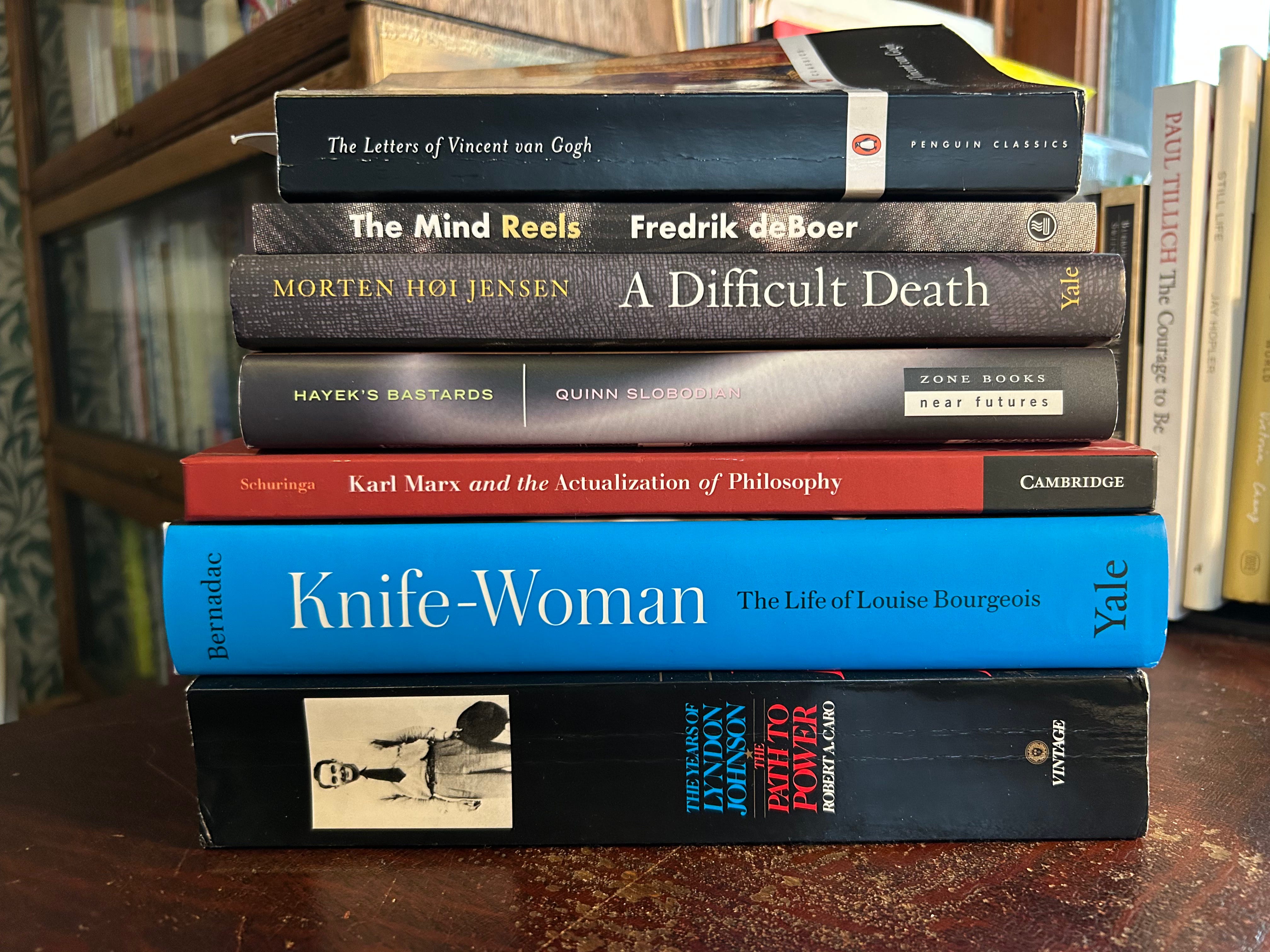
This is a pile of just some of the books I’ve been hoping to write about here at Quid Amo.
But alas, other more pressing obligations keep getting in the way. I’ve enjoyed a rich but heavy semester of teaching that includes new preps. In my 200-level course on modern philosophy (1600-1900), I’ve expanded the Marx unit and now incorporated the excellent new Princeton edition of Capital. And I’ve been teaching an intensive upper-level seminar on Robert Brandom’s reading of Hegel’s Phenomenology of Spirit. The students in this class have been intrepid readers alongside me as we wade through the brilliant density of Brandom’s 800+ age opus. This has turned the semester into an on-ramp to next year’s sabbatical project.
In addition, for the past month, when not teaching, I’ve been on the road in support of my new book, Make Your Home in This Luminous Dark. This began with several events in NYC the first week; since then I’ve enjoyed a rich conversation about the book at Harvard Divinity School, a big warm reception for the book right here in Grand Rapids, and I’m just back from three marvelous events in different parts of Austin, Texas. For many of these events, I’ve been on stage with interlocutors who have, in a sense, metabolized my book and then offered it back to me in ways that helped me see my own creation in a new light (or a more luminous dark!). Very grateful for these generous readers.
It’s been moving and invigorating to hear how the book is landing with people in different seasons of their own journeys. I’ve been especially heartened to be in spaces where young people are nodding in hungry curiosity as I’ve talked about the book. And thank you, dear readers, who have shared your own vulnerable notes. It’s kind of the heart of the book: there is a tenderness born of the darkness in which we find one another again.
While finishing up the semester and tackling stacks of grading, I’ll continue to travel in support of the book. Maybe I’ll be in your neighborhood?
Remaining Tour Dates
CHICAGO
Tuesday, May 5, 4pm
Seminary Coop Bookstore, 5151 S. Woodlawn
DENVER
Thursday, May 7, 7pm
Platt Park Church, 1601 S Clarkson St, Denver, CO
Sponsored by the Denver Institute
ONLINE
Wednesday, May 20, 4pm ET
Image journal conversation with Nick Ripatrazone
[stay tuned for link/signup]
WASHINGTON, DC
Wednesday, May 27, 5:30pm
Rooftop reception hosted by The Trinity Forum
I’ll also be participating in the Understory Festival in DC on May 28-30.
Writing Elsewhere
In lieu of posting here, I’ve had a couple of reviews published elsewhere over the past couple of months. (The book review might still be my favorite genre.)
“A Cosmos Fueled and Fired by Love,” in Plough. This is my review of Clare Carlisle’s enchanting new book, Transcendence for Beginners. My working title was “Little Incarnations Everywhere,” which I still prefer. A snippet:
It is no mistake, I think, that in Carlisle’s argument and analysis, it is the novels of Eliot and Proust and the paintings of Celia Paul that calibrate the eye for such perception. There is something about the condensed attention of the arts – whether a novel, a poem, a film, or a sculpture – that angles our perception to see the human sub species aeternitatis. Not all art, of course, but art in its best, most evocative modes. It is the same artistic and literary sensibility that Carlisle brings to her own writing. She brings a biographer’s heart and a novelist’s eye to attend to even unnamed human lives in a way that makes them shimmer, each “a sign that love flows through us because it is an element of reality itself: like water, like air, like fire.” In her new natural theology, she invites us to see little incarnations everywhere, each a sign that the cosmos is fired and fueled by love.
“Christopher Beha’s Journey of Belief,” in America. This is my review of Christopher Beha’s new book, Why I am Not an Atheist. The title of my review in the print edition is “Metaphysics Won’t Save Us.” A snippet:
This explains my perplexity, even anger, when Beha, near the end of the book, tries to pin Christian nationalism and what he calls modern-day illiberalism on the legacy of Romantic idealism. His strange—and I think mistaken—claim is that “the rise of illiberalism has gone hand in hand with a decline of theistic belief and religious practice.” (A reminder from Logic 101: Correlation is not causation.) Donald Trump, “the avatar of right-wing illiberalism,” is somehow the manifestation of Romantic idealism—“our first Nietzschean president.” And what about all of his support from Christians? Beha dismisses it as merely a form of identity politics. Those Trump supporters who “claim to be Christian tend to do so as an expression of a particularist identity rather than metaphysical belief.”
This, to put it mildly, is an all-too-convenient parsing of current realities. Metaphysics won’t save us from the specter of religious hatred and aspiring tyrants. One could argue that JD Vance shares Beha’s faith and metaphysics. He is no doubt committed to a correspondence theory of truth to boot. When Vance and Pete Hegseth invoke God, they are pulling the levers to power, not donning some pious mask. When you take them seriously, Beha’s attempt to play the cool-headed liberal feels like willful blindness.
And permit a proud-dad moment in here, pointing to another essay by a related Smith: our son, Coleson Smith, who won the 2026 Bette Howland Prize for nonfiction. You can read his winning essay, “Young Esco,” at A Public Space. It is moving and vulnerable and demonstrates a remarkable capacity to convey the lively compression of dialogue in nonfiction.
Quid Amo: Compact Edition
Here are a few things I’ve been loving over the past couple of months:
Granddaughters! Growing so fast. Walking and talking and crawling and climbing and singing and laughing and just constantly stealing my heart and filling it with joy. Thankful for their parents who call and FaceTime so we always feel connected and can watch them grow.
Pope Leo. That’s it. That’s the tweet. We’re Team Papa.
Two albums on constant loop: Mumford & Sons, Prizefighter and Noah Kahan, The Great Divide.
Comments
Nothing yet. Say the first thing.
Sign in to join the conversation.