
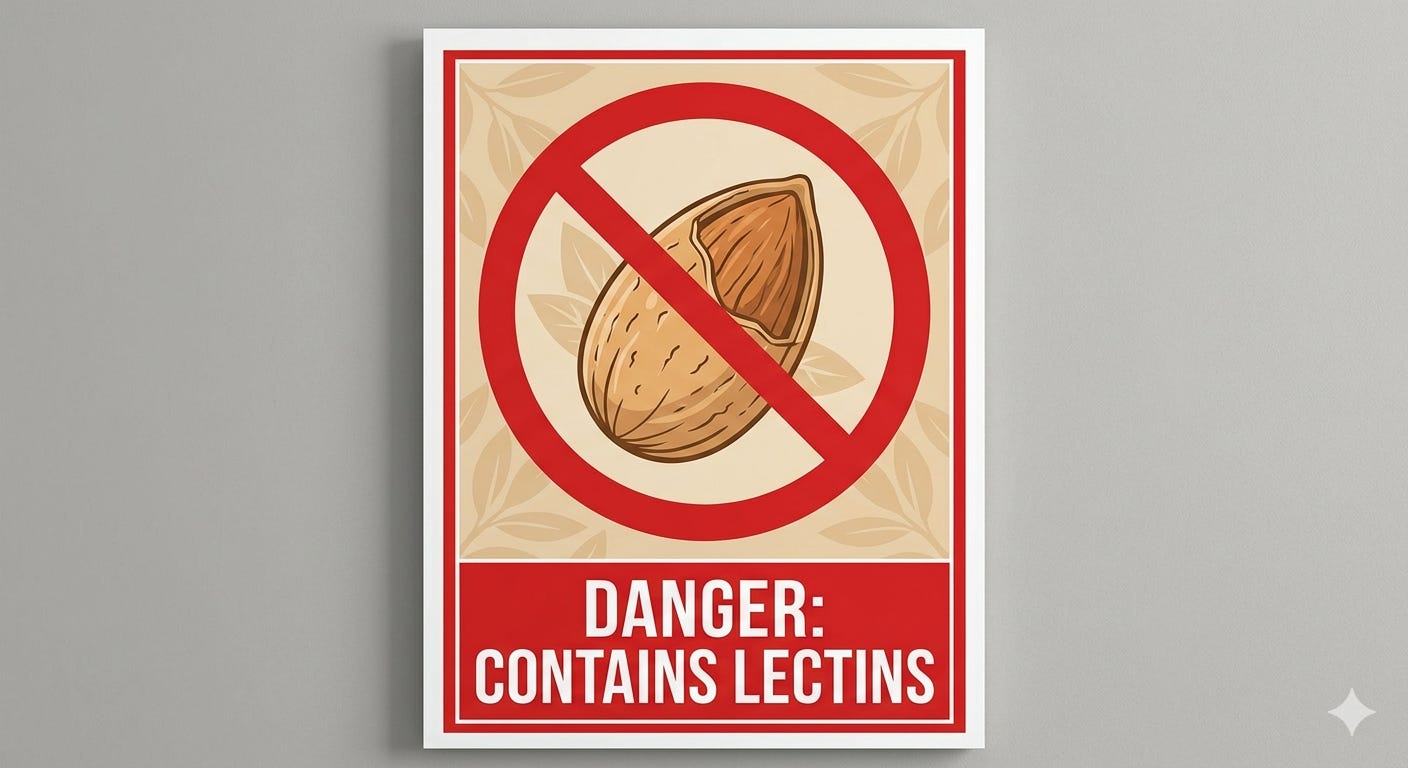
“Almonds are one of the worst foods you can eat because they contain lectins!”
Why this comment on this particular day set me off, I can’t really be sure. It popped into my Instagram feed along with the face of one of the countless relentless nutrition gurus preaching they’d found all the secrets to perfect eating, and if you sign up for their program, purchase their supplements, download their podcasts, etc. - in other words, line their pockets - they will impart to you the secrets of perfect human nutrition and you will be able to finally achieve intestinal bliss, perfect clarity of mind, a body that works perfectly, and finally merge with the Divine. (Disclaimer: This product and /or program is not intended to diagnose, treat, cure, or prevent any disease. Consult your healthcare provider if you have questions, concerns or symptoms unrelated to our products, information or refund policy. Representations of efficacy void where lack of sleep, stress, anxiety, lack of exercise, emotional turmoil or other factors may inhibit results.)
It’s exhausting.
Almonds? One of the worst foods? Almonds have reliably been shown to be one of the earliest cultivated tree nuts with agricultural origins dating from around 3000 BCE. So humans have been eating almonds for at least 5,000 years, not including the pre-cultivated species that hominids have probably been eating for, I don’t know, 100,000 years or more?
But this isn’t about Almonds. Or lectins, for that matter.
Like a lot of things in the post-internet world, social media and the rise of paid influencers are en-shittifying food, nutrition and cuisine at a dizzying pace. Everyone seems to have a hot take on what foods are behind a myriad assortment of our health challenges, offering advice to anyone/everyone about how, when, what and even ‘if’ to eat.
I call myself a ‘natural foods geezer’ primarily because I have seen every damn one of these trends and fads surface over and over again in the five decades since I first worked at 'Health Seekers’ - a health food store that was in Houston, TX in 1978. But nothing could have prepared me for the online onslaught of endless food and nutrition evangelists all claiming they have found the Golden Road to Perfect Digestion / Absorption / Elimination / Protein Uptake / Toxin Cleansing, etc. ad nauseam.
Food is not magic. It’s sustenance and memory, survival and sensory delight, necessary and indulgent. Food is glorious, and we seem to be failing to appreciate abundance, variety and availability as we flog ourselves for making ‘bad’ choices and rush to do penance for our sins. Then we pay for indulgences in the form of expensive nutritional supplements, online subscriptions to questionable nutrition protocols, and other forms of ‘wellness grifting’. It’s a huge industry and growing. It trades on misinformation and fear the same way medieval clerics sold relics and other assurances of passage to heaven. We evolve very slowly, after all, despite our protests to the contrary. We’re superstitious apes with smart phones.
For most of human history, food was what you could manage to scrape together from the environment in which one lived. Farming, foraging, hunting, herding, and storing up against the inevitable end-of-winter shortage, or even famine, defined our species’ relationship to food until the advent of the industrial and green revolutions. There is still famine, hunger, and severe malnutrition in the world but it is drastically reduced from what it once was (see graphic below). Food is also deeply embedded in culture and tribal memories and partly defines who we are, where we came from, and who our ancestors were.
Then came the aforementioned revolutions and the application of their principles of efficiency and methods of production to food production, processing, storage, transport and retailing.
Much good came out of that transformation, and many problems as well. I am acutely aware of the tradeoffs we are making in soil health, biodiversity, and the biosphere at large. But it’s hard to argue with the following information:
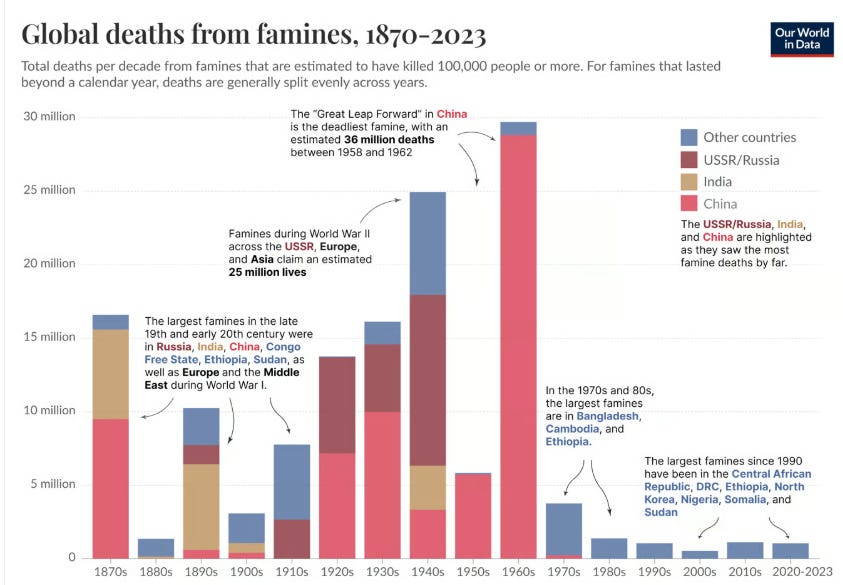
The last deadly famine, killing an estimated 36 million people in China, occurred in my lifetime! And immediately after, deaths from famine fall off a cliff. Why? Because the ‘green revolution’ prioritized yields of staple calorie-rich crops, mostly grains, legumes, starches (yams, etc), and feed crops.
Think about this. In 1960 there were 3 Billion human beings. Today, that number is 8.3 Billion. The 36 million deaths between 1958 and 1962 represented 1.2% of humanity dying from famine. If that were today, the death toll would be 100 million people.
At this moment, there are an estimated 363 million people at risk of acute hunger due to conflicts, economic shocks, and climate extremes, with famines in Gaza and Sudan. This is a horrible statistic and global relief agencies are doing what they can.
But that’s still 4.3% of humanity at acute hunger risk.
95.7% of us are not. Of 8.3 billion people, 176% more people than in 1960! All eating above the acute risk level. That’s a miracle, lectins aside.
And in the industrialized world, we have the absolute luxury of treating food choices as cultural shibboleths, using them to identify who is ‘in’ our little foodie / nutrition cults and who is not. I think that’s what sets me off.
Feel free to avoid almonds. And lectins. And gluten. And whatever else you think you need to avoid in order to feel empowered by your management of abundance.
Of course, I am NOT referring here to people with allergies, or celiac disease, or any other medical condition where foods can be life threatening.
But for the rest of us, when we consider not eating almonds because of lectins or any other privileged food choice, take a moment to acknowledge the blessing it is to be making that choice in an arena of abundance and food security we often take for granted. There are hundreds of millions of humans who would love to have the choice that abundance and security makes possible. And many more who would like more total food choices, period.
Sorry for the rant, and please consider donating to any of these worthy organizations:
Comments
Nothing yet. Say the first thing.
Sign in to join the conversation.