
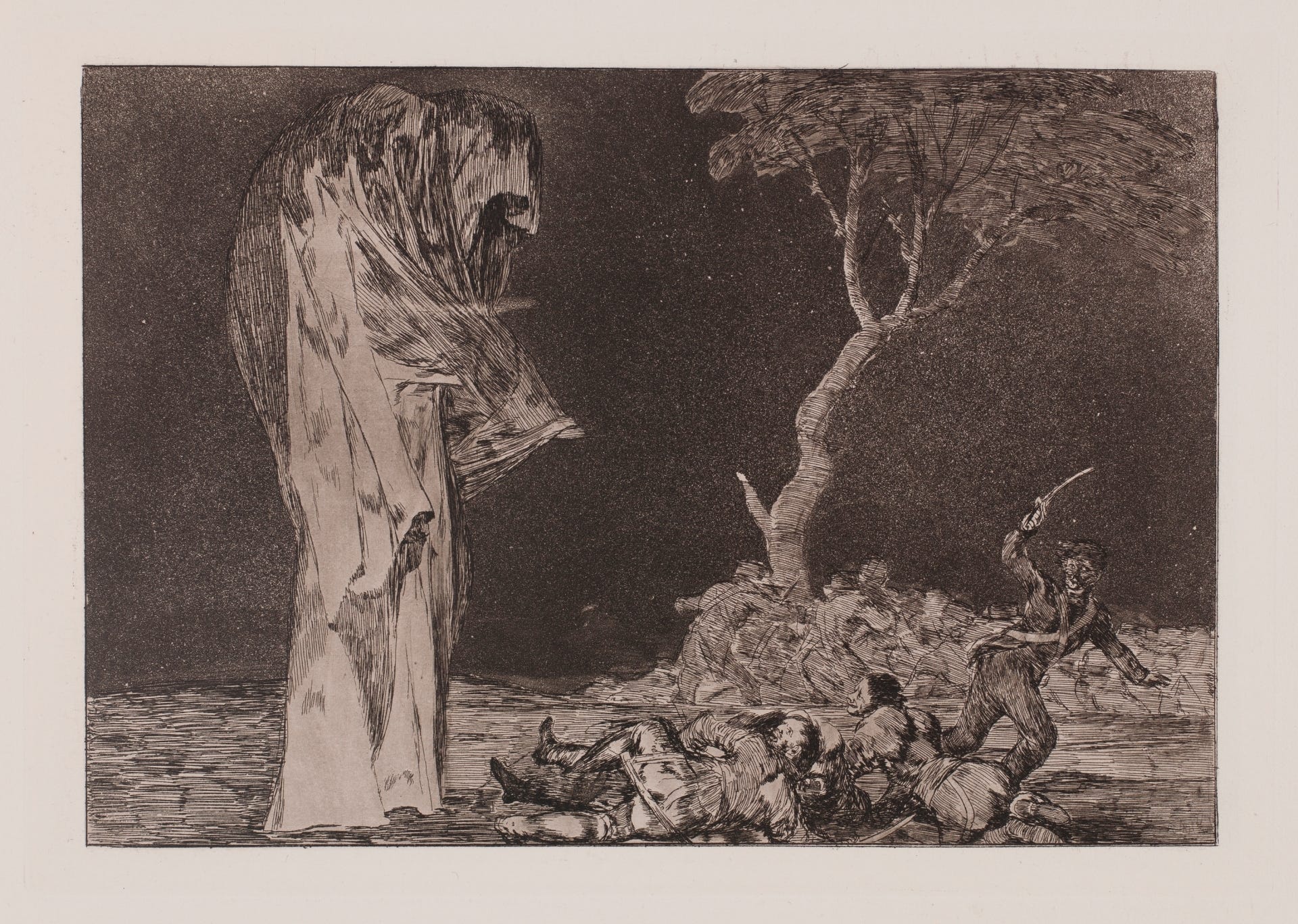
As the negative of the unity of a free and self-administered society—in whose direction humanity was pointed with the dissolution of liberal economics—fascism realizes the unity of an apparatus of oppression.
— Postscript: Remarks on Liberalism and Anti-Semitism (1939).
This post is a translation composed of two 1-page typescripts discovered in the Max-Horkheimer-Archiv. In addition to the continuity of thematic focus, marginal notes—both typed and handwritten—indicate that these typed paragraphs belong together: the first (typed) paragraph above is on a sheet with the typed title “Einfügung S. 9” (“Insert p. 9”) and the second (also typed) paragraph is on a sheet with the handwritten title “Fortsetzung Einfüg. S. 9” (“Insert p. 9 continued”). Both sheets have a number of handwritten corrections, some of which are legible and some of which are harder to make out. Significant portions of the text of the second are crossed out by hand, and replaced with handwritten notes for a paragraph that would survive—in part—the subsequent revisions. While there are several partial reiterations of these “insertions” (to page 9 of one of the earlier drafts of the essay), I used the most complete version—with the most unique text—of each paragraph that I could find.1
The state itself is the office of the rulers. The centralization of administration undertaken by National Socialism in Germany honors an older bourgeois demand that was already fulfilled elsewhere in the seventeenth century. The supposedly democratic aspects of the new Germany—the formal abolition of the wealthiest estates, the leveling across various spheres—are tied to this. Yet Richelieu handled the feudal lords less gently than Hitler has the so-called reaction. Large landowners enjoy protection from settlement projects. The centralization of administration at the end of liberalism is essentially different than the kind at the beginning: not a lessening but an increasing of social pressure, not the promotion but the inhibition of human powers. The structure of the apparatus, the doubled hierarchy of administration and party is neither simpler nor for that matter more rational than the old constitution of the estates. This structure is no element of a future society, but the bourgeois state in its starkest form. In the view of a rational society, the ascending hierarchy of administrative functions does not correspond to an increasing gradient of power. The execution of overarching plans demands neither higher intelligence nor greater exertion than any other activity. What is more abstract, more remote, more expansive is not necessarily what is “higher.” The rational society will not allow the central functions of administration, which, in the end, anyone will be able to perform,2 to become hypostasized and hardened—as little as the rational philosophy has hypostasized its abstract ideas or held them up in reverence as the effective powers of reality. When the state no longer essentially represents the domination of one group of human beings over others, but has really and truly become administration, the clerks and functionaries of the central bureau will no longer be held in higher esteem than the clerks of local offices. The same applies for all civil servants. True, the central functions are more comprehensive, but are, to the same extent, more monotonous and more tedious than tasks closer to concrete life.3 With the advance of technology, all tasks are becoming mechanized. It has long been remarked that even the function of a brilliant field general has been broken down into the routine of the general staff. The field general, however, possesses a crucial, indissoluble element: an imagination schooled in method, something found only in individuals. But as long as society continues to depend on the imagination of the individual, however methodical it might be, in the way that an army depends on its field general, the whole affair will remain just as barbaric as the military profession itself. No matter how far-reaching the decisions made among the highest-level councils might be, such decisions must actually, and not just formally, hark back to the power, the genius, the strength of the people who first delegated them to be representatives and who reserve the ability to recall their delegates at any time.4
As long as the functions at the top require such skill that the men at the top are exceedingly difficult to replace, as long as there is a hierarchy of administrative functions which, for technical reasons, demands a corresponding hierarchy of specially trained persons to fill them, a free society will not be possible.5 The history of class society makes this fact explicit. In every one of its epochs, the mode of production comes with a technical demand for leadership by groups with an advanced level of education. The monks in the early Middle Ages, the merchants and manufacturers at the beginning of capitalism—they were pioneers of specific forms of the domination of nature, forms the masses had to be goaded into adopting. After bringing forth an era of flourishing production and civilization, these elites consolidated their privileges and sought to perpetuate their pride of place through the stratification of education, monopolies over culture, and so on; they marshaled all manner of terrors to protect their orders of privilege well after the pretext for such orders had become plainly obsolete; they transformed from forward-driving historical powers into enemies of humanity. The superiority of today’s directors—who, as heirs to the older entrepreneurial class, now hold the reins—has already become extremely questionable. No matter what technical skills and qualifications they possess, any keen young worker could have picked them up just as quickly, especially in a generation born and raised to it. No matter what tricks they have up their sleeve for one another in their power struggles, no matter what sort of political game they might orchestrate with their peers in Partei and Wehrmacht, whether this includes the bribing of foreign ministers, inciting the masses of foreign lands to sedition, the ideological and physical conditioning of their own Volk, and so on—whichever skills the totalitarian elite can brag about having as a leg-up on their inept bourgeois-democratic counterparts, these skills are the kind learned as quickly as they become socially useless. In the backwards countries of Asia, it is possible that the fascist apparatus of domination will catch up with bourgeois development much more rapidly and cruelly than would have been possible without it. In Europe, the idiocy and the cowardice of the masses—the qualities the fascist apparatus points to as the reason for its own existence—are artificial products of unreasonable property relations that could, in fact, disappear in just a few years. Provided that a rational form of domination exists in the future, its goal can only be the abolition of domination. At base, even the most clueless know the score when it comes to faith in power and powerful personalities: however mighty or wise, their rulers and leaders are a dime a dozen in the countries where they come to power and they can be replaced without the slightest difficulty, especially in countries with firsthand experience with one or more leaders of the sort. Really there is only one motive for keeping them on, a motive that forms an indissoluble bond between the powerful and everything that depends on them, including those who seem to be the most hostile towards any kind of bureaucracy: fear of the freedom humanity has long been ripe for under the veil of lethargy and stupidity.6
This post is part of a series of translations pieced together from the unpublished materials produced for and around Horkheimer’s 1939 essay “The Jews and Europe”:
Cf. Theodor W. Adorno, “Contra Paulum” (1944):
We see the same danger in your critique of the concept of equality. The definition of freedom through “creative freedom” is unnecessarily convoluted: one need only say “schöpferische Freiheit” in the German to realize how inappropriate it is. Concepts borrowed from the spiritual Lebensraum of youth-movement gymnasts who want to express themselves precisely because they have nothing to express are used in the formulation of a concept of equality whose essence can be felt much more strongly in the Southern United States. True enough, we have said all sorts of things in opposition to egalitarianism, and by this we meant the oppressiveness of conformism; in your case, however, opposition turns into disguised tolerance for the inequality that exists: the critique of equality and justice “does not demand the chance for everybody to get everywhere.” This is naively ensnared in bourgeois categories. The concept of “chance,” which Mannheim has already made so much of, is inseparably bound to competitive society and a “career” within it. Socialism wants not to extend this without measure, but abolish it altogether; but first, of course, this would require that, as a non-religious socialist wrote in a now unpopular text, the remaining functions of state could be overseen by a cleaning lady. [*] Only if this has been made unmistakably clear is the critique of equality justified.
[*] A paraphrase of V.I. Lenin, “Can the Bolsheviks Retain State Power?” (1917): “We are not utopians. We know that an unskilled labourer or a cook cannot immediately get on with the job of state administration. In this we agree with the Cadets, with Breshkovskaya, and with Tsereteli. We differ, however, from these citizens in that we demand an immediate break with the prejudiced view that only the rich, or officials chosen from rich families, are capable of administering the state, of performing the ordinary, everyday work of administration. We demand that training in the work of state administration be conducted by class-conscious workers and soldiers and that this training be begun at once, i.e., that a beginning be made at once in training all the working people, all the poor, for this work.”
Cf. Max Horkheimer to Adolph Lowe, 1/4/1938:
The direction of the transformation we both have in view is determined by the fact that in the future the universal interest will be known as the one in which the particular is actually sublated—that is, that the ideology of today will become the reality of tomorrow. The abstractness of such expressions (as opposed to the formalism of sociological categories) disappears immediately when one takes them in connection with the theory to which they necessarily belong. The coincidence of which we speak is brought about by the socialization of the means of production and the abolition of classes and is ever-renewed by the active participation of individuals in administration.
Horkheimer and Adorno also wrote about the problem of centralized administration and universal participation in their notes for Horkheimer’s “State Capitalism” (1940) essay, later published as “The Authoritarian State” (1942):
Cf. Eugene Leviné’s theory of the ‘principle’ or ‘right’ of unconditional recall at any time, the substance of many of his speeches to both the revolutionaries and the workers of Munich during the turmoil of the short-lived Bavarian Soviet Republic in Spring 1919:
Leviné compared the soviets with a pyramid resting on a multitude of factory cells. In large factories, however, where the workers cannot know each other sufficiently, he explicitly warned against electing councils at general meetings: the mandates could easily fall into the hands of impressive speakers, and authoritative personalities. He advised that initially works or factory councils (Betriebsräte) should be elected on the shop floor where the workers are able to ‘know their men.’ They should be judged by their deeds and not by words and be recalled if they failed to defend adequately the workers’ interests.
Indeed, the right to recall an unworthy representative without any red tape, by a simple vote, was one of the greatest advantages of the soviet system. The electorate was spared the long years of waiting—four as a rule—to remove an inadequate parliamentary deputy. Under the existing German conditions this was a very important issue.
Disillusioned by the failure of the powerful Social-Democratic Party, which they had helped to build with so much effort and devotion, the revolutionary workers were tormented with suspicion: where was the guarantee that a new organisation would not let them down again?
Leviné was aware of that mood and untiringly emphasised the importance of the unconditional recall at any time of any delegate found wanting:
‘This is the essential principle which distinguishes us from the Social Democrats... this must be the basis of our propaganda.’
To my knowledge, none of the other leaders dealt with this problem—in speech or in writing.
Works councils, within the grasp and control of the workers, were designed to restore lost faith and were at the same time an incentive to greater activity.
Rosa Leviné-Meyer, Leviné: The Life of a Revolutionary. Introduced by E.J. Hobsbawm. (Saxon House, 1973), 59-60.
She goes on to quote directly from Eugene Leviné at length:
‘But parliamentary democracy has never been practised in its true sense: government by the people. We regard the Soviet system as the most effective means of making democracy a living reality. The man in the street is called upon to play his part in the destiny of the country not, as is the rule in a parliamentary state. Once in a fixed number of years, but hot on the heels of any crucial event. He is thus encouraged to reflect, discuss, watch, form an independent opinion. He is trained to participate in political affairs. He is empowered above all to recall at any time an incompetent or unworthy representative.
‘Far from stifling democracy—another accusation hurled at us—we endeavour to remove by these means all dictations from above and create the conditions leading to the abolition of the state itself.’
Levine persistently stressed this aspect of the Soviet system:
‘You are the engineers, we are only your temporary advisers. Control us and chase us away if you find us wanting and replace us by worthier men. ‘
...The government alone must hold the threads and control them; but the threads must be woven and brought into its hands by the proletariat. I do not appeal to you to collaborate, I appeal to you to do the job, just as you yourself have won the battle.’
In: Ibid., 128-129.
On Horkheimer’s connections to Leviné’s circles in revolutionary Munich, see:
Cf. Horkheimer, “Society & Reason” (Lecture II) (1944) on the utopian (viz., socialist) promise and repressive reality of this ‘leveling’:
[…] The end towards which the process of formalization moves has previously been described as ruthless self-preservation. A man whose actions do not spring from any real insight into some kind of objective truth eventually becomes a mere function of social forces. If he wants to survive, he has to transfer himself into an apparatus which responds at every moment with just the appropriate reaction to the intriguing and difficult situations which constitute his life. No doubt, this has been true for the entire history of mankind. One may be tempted to say that civilization is the gradual overcoming of natural selection by rational action. In the former, the survival of the species depends on the fact that specimens are naturally endowed with relatively well-adapted organs and attitudes. In the latter, survival or, let us say, success depends on the individual’s own will and decision to develop such attitudes as will enable him to respond to the pressure exercised upon him by society. However, the character of the individual’s intellectual and psychological resources to fulfill social demands has varied with the means of material production. The life of a Dutch peasant or craftsman in the seventeenth century or of a shop owner in the eighteenth was certainly much less secure than the life of a modern employee or mechanic. But the great progress which we have made has placed new pressures upon each individual. The greater initiative which is needed in practically all walks of life demands at the same time a greater ability to adapt oneself to changing conditions. Everyone must be ready to do whatever new things the situation demands. This does not mean that these new things are really new. If a medieval artisan—let us assume that it could be done—were to adopt another craft, it would certainly involve a more radical change than should be the case today if the mechanic becomes successively manager of an insurance company, a salesman, and, finally, a bureaucrat. It is well-known that economic progress equalizes all manipulations in industry and commerce and by that very fact makes it easier to change from one post to another. This is one of the material bases for socialist theory and practice.
This leveling is true not only for manual labor, but for intellectual work as well. Today, we learn in school the many combinations which are possible with a series of set plots, and the successful writer is he who is most expert in making use of the various schemes. These schemes have been synchronized to a certain degree with the requirements of other agencies of mass culture, particularly those of the motion picture industry. The heterogeneity of the various cultural spheres and with it the idea of the radically new is vanishing. The piece of fiction is regularly conceived with its film possibilities in mind, the symphony with consideration of its propaganda value. But the fact that the transition from one activity to another becomes easier does not mean that the ensuring of self-preservation leaves more time to intelligence for metaphysics or other deviations. On the contrary, the necessity to be alert every second of one’s life, and the urge to conform have grown tremendously. The more devices we have invented to dominate nature, the more we must serve these devices in order to survive. […]
No posts
Comments
Nothing yet. Say the first thing.
Sign in to join the conversation.