
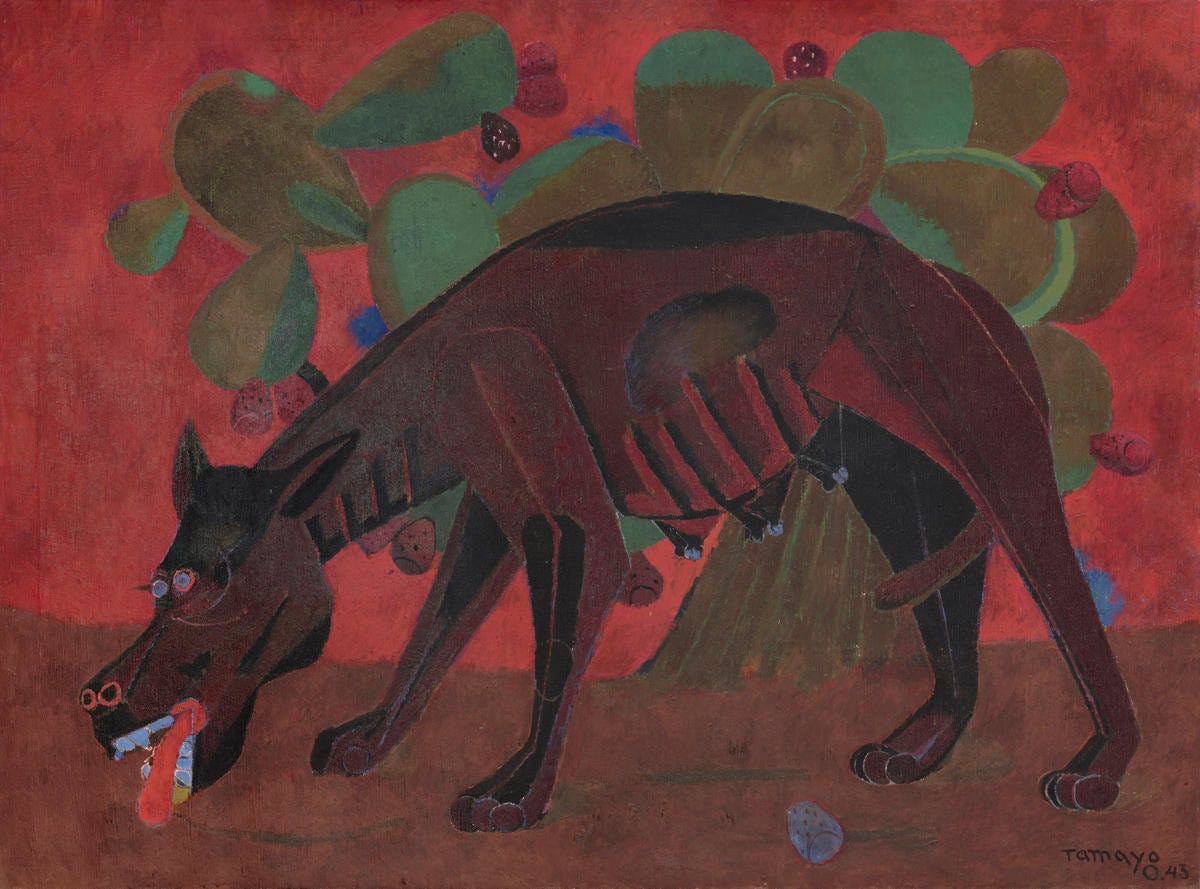
The dog that tucks its tail before its master plunges from play into the mythical darkness of “the stronger.” The fault lies with the master.1
I. Miscellaneous Notes (ca. 1940-1944).
The Downfall of Theory.2
Religion: Messianism or Spiritual Hygiene?3
Individual and Group Society.4
On the rights and wrongs of protecting the homeland against ‘foreign infiltration.’5
On Marriage; On the Relation between Speaking and Writing.6
On Puritan Social Critique.7
On the Relation between Spirit and Nature.8
On the Relation of the Freudian Method to Positivism.9
Enlightenment as Mythology; On Mimesis.10
Bourgeois Profession and the One-of-a-kindness of the Individual Soul.11
Key-Words.12
III. Stray Fragments (ca. 1941/42).
On the Genealogy of Myth.13
Idleness as distinguishing characteristic of both pre- and post-bourgeois eras.14
III. Phenomenological Analysis of the Concept of Reason (1941/42?).15
IV. Sketches on the Concept of Enlightenment (ca. 1942/43).
V. Parallelism between Paul Tillich’s Standpoint and Logical Empiricism (ca. 1944)
The downfall of theory. Theory is structured (consciously or unconsciously) around what one can or wants to change. In the Middle Ages, theory was driven by heaven; for Marx, by revolution. Today, where these other [drives] have been relegated to history, it is the domination-compulsion of rulers.
Religion as spiritual hygiene: this is an adjustment, and a very harsh one—because it is an adjustment to modern pragmatism. This is one of the many renaissances in our day. Was not the religious man far more neurotic? The way is—simply—the one to follow truth—to believe what we think is adequate to our knowledge. What is the connection between Messianism and—spiritual hygiene? Perfectionism may be a symptom of neurosis but it depends in whom. Was Flaubert a neurotic? And should we not resist this spiritual hygienic attitude—as soon as somebody tries to do something—perfect?
What is dangerous is not ‘intolerance of the individual’ but his passing his responsibility to groups and collectivities. The individuals who’ve survived liberalism are already the wiser for it in group society, and the next, the higher stage of humanity is indeed the group.
Naturally grown society (tribe) and homeland. In the name of protecting the homeland, it is opened up to others (via law [Recht]); injustice [Unrecht] begins with its manipulation. This is part of the “dialectic of enlightenment” in which all these measures become objective. This becomes clear in later epochs. The Parisian shoemaker sees his homeland “overrun by foreigners.” That he must tolerate them is a function of bourgeois tolerance and legal relations, just as much as the earlier (under the guild system) and later (in monopolism) cruelty in his rebuke of the foreigner.
Marriage—otherwise women (and men) would never return to work. Ein-bett (one-bedded, embedded) in American: the women maintain control.
Leave metaphysics to the experts. Expressing oneself otherwise is a luxury. “Make something worthwhile!”
One is always more stupid in writing. When speaking, there is intonation, presupposition, etc. Writing, however, has long been the work of experts. (Philosophers and their norms, for example! Each one makes you more stupid than the last.) Dialectics is the attempt to overcome these constraints. But, the business has already been concluded: what more is there to say—this is simply how it’s done here. Only the artists who “teach” literature become so blind to the fact of its abstract consumption.
The critique of society sub specie rich and poor (Mr. Müller, Lynd) came to be puritanical, a kind of duty—without any insight into the motivation of truth: bliss.16 (America against the admiration of “art”; the ego of a puritan romanticism.) One isn’t even allowed to admire the latest model Ford: as if one’s enjoyment wasn’t precisely its critique.
Spirit is inseparable from nature; it exists as determinate knowing, as nature reflecting on nature. In this reflection, nature is disclosed as relative, as something that is not one and all. In this knowledge of the difference, which makes every insight into insight through the sheer repetition of its object—spirit consists in this.
The explanation of the spirit, whether as the subjective faculty or an objective power that rules the world, as the true being, as the creator or producer of the universe—spirit is at the root of all idealistic philosophy in its distinct kinds. While it thus means to master its ideal of blind nature, it loses its content, except for that of disinterested power, no matter how much it strives to take nature back into the mind as a phenomenon inherent to it, or to derive nature from mind. Spirit becomes its own element of power, the abstraction derived from domination under the name of spirit as the highest sovereign, and spiritualism posits nature as a universal being. In it, philosophy reverts back to pre-animism, to the most primitive mythology. Among philosophers, Schelling was the only one who knew this.17
Though Freud’s method is based precisely on such insight, it is not concerned with the logical structure of judgments but only their psychological function—he does not drive his own insight to the point of contradiction with positivist logistics.
Enlightenment = mythology—because of the leveling of the new. The new is not just the middle [die Mitte] (Christ) nor just the future (socialism), but always also the special (unique individuals in the present).
Not only the Jewish look, but also beauty (Garbo) compels to mimesis. One shouldn’t conclude from all of this, however, that what is expressed, the imitated, is the good. Only the regression (imitation) is bad. Liberation is the good. Love is no intrinsic good either, but the attempt to explain it away as merely “emotional” is both correct and incorrect.
The bourgeois idea that one marries and then enters their professional life is the secularization of the one-of-a-kindness [Einzigkeit] of the individual soul.18 He still says to his lover, “you’re the only one,” but it’s in his very reportage, sous entendu, that he doesn’t really mean it. The lover is incorporated. (Shakespeare was still quite modern—perhaps through to the Symbolists.) Calvin’s life’s work was the refraction [Brechung] of the claim to one-of-a-kindness of the individual soul through incorporation into professional life. But isn’t the refraction also a break, a break with savagery, with mythology? Isn’t it a kind of “enlightenment,” a preliminary step towards abandonment of evil illusion—understood in the Schopenhauerian and Marxian sense? This holds true for profession in general: the idiotic, mindless, hopeless tasks the system demands that we perform in order just to live deprive us altogether of the one truly human endeavor—concern with the absolute, with bliss [Seligkeit]. And this is what makes us so violent when we think of having to take up a profession. We are still too wild, unorganized, unbroken—too mythological.
Christianity: as religion of reason, enlightenment.
Thinking: what significance can it have today?
History (true topic: horror)
History (interpretation of meaning, justification, rationality)
Sociology of Art
Positivism (pros and cons)
Religion (attempts at explanation)
Language: source of truth.
Reason (correct, adequate form)
It seems to me that the deepest root of myth lies in social compulsion. That which is feared becomes that which is worshipped insofar as one identifies themselves with it. Anyone who is summarily condemned in an American courtroom is condemned a second time in the hearts of the spectators, however sorry they might feel for the condemned. This is mythical. Durkheim’s contrainte sociale, Freud and Caillois’ explanations via conflict of the psyche—no doubt they are right, but they are still much too formalist. Mythical representations are a product of the assimilation of individual thought into that of the community, which is itself determined by domination in turn. Myths are rehearsals of obedience—be it obedience to the collective or to particular rulers.
Don’t get trapped in ‘science’! Desire not just to explain myth, but to express the truth oneself.
Since the Renaissance, authors have cursed idleness. But the world thus announced by Bacon and Machiavelli has in its logical course arrived back at mass unemployment—whose supposed remedy, industriousness, was the same prescribed from the beginning. Now the most industrious have been given free reign to administer fascism as remedy for the evil of idleness. Perhaps humanity will turn back to the ascetic, monastic way of life they’ve so thoroughly discredited? Humanity ought to make the earth into a dwelling place for Epicurean gods, and it can. First, of course, it will attempt to do so with total rearmament.
Phenomenological Analysis of the Concept of Reason.
What does it mean to “be rational”: starting from the nextmost determination that comes up, ascending to the loftiest determinations, unfolding contradictions along the way.
‘Rational’ action is what is good for one’s self and for others. Harmony as constituent of reason. What is good for me, is good for others—bourgeois concept of reason.
First theme: Reason as reconciliation. Rose in the cross of the present. From Aristotle through l’Hôpital to Hegel. Style alone—already reconciliation. Protestantism and Catholicism.
Second theme: Religion and Reason as opposites. Pragmatism of religion as bourgeois Hauptthema. Opposition between Reason as determination of fact and Reason as organ of the vocation of man.
Different kinds of language established by reason. Propaganda, Lies: against the ‘rational,’ obsessive-compulsive neurosis [Zwangsneurose], etc. (Dispositional compulsion [Dispositionszwang].)19 Equivocations of reason: reason as identical with domination of thinking, and other similar ‘agreements.’ Pragmatism and belief in harmony.
First theme: Reason (Idea of Philosophy) as reconciliation and adaptation. (Ideally: discuss kinds of reason through “Politics” XVI, then onto kinds of utopias, etc.) Argumentation and understanding are forms of appearance of reason in democracy. Socrates: reason as free-spiritedness.
Second theme: Reason as adaptation—difference in adaptation for the high and the low. The meekness of the poor. (Opposite this: distant reflection of the malevolence of power.) Reason as domination. Dialectic of the concept of nature.
Third theme: Reason and Religion. The idea of love (the Church Fathers). Construction of civilization through command. Folklore [X]20 against the Father. (Atheism: not for the plebeians.) Massification of enlightenment (Nietzsche). Double sense of democracy. Prohibition: of incest; prostitution; the insane. Anti-Semites. Spiritualization of God.21
Fourth theme: Reason and Truth. Meaning of dialectics. Anarchism and authoritarianism.
Problem of Education. What can one think today? Anti-Reason? Reason and its necessary relation to life. In democracy and absolutism, reason is valid within a special sphere.
Do not be embarrassed to speak English and French; raison is already a kind of hardening. Also highlight the good sides. The danger of idealism and Protestantism (Schelling, Kroner).
This could very well lead to the notion that “truth” comes down to an ultimate, ‘rational’ sense. The danger is: that the truth is not so practicable. [X] … By way of Kant and Husserl.
Cunning of Reason—cf. Remarks on Reinach. Reason and Progress. (Gumperz [?], hostility to theory.)
Lies are always more poisonous the less the lied-to (and the liar!) can hope for something from a transcendent authority.
Coming back to the definition of reason as knowledge, specifically knowledge of good and evil. So long as words have no content, they are abstract and unclear; having concrete content, however, makes them self-contained.
Theory of the rational ground. Not merely affirmation, not merely what is obvious to natural cognition (cf. Husserl’s logic), not merely psychological—hence the errors of formal democracy.
Attempting to find even one positive, objective noun to add onto the description of humanity today is impossible. Should one speak of “the few,” the free, the courageous, or the true human beings? How ridiculous!
I translated “Humane Society” as “Tierschutzverein.” And so, I believed, surely, they must be there for the protection of animals. Yet I discovered, oddly enough, that the free animals taken there are killed as soon as another living animal is brought in. Their primary purpose seems to be preventing animals from wandering around—for the protection of humans from animals. For the animal, falling into the hands of such an organization is almost always a grave misfortune. The “humane” in the name refers solely to the manner of death. The animals are not to be treated as human beings are before the Inquisition or whatever other powers they presently defy. Instead, they are simply killed.
Yes, certainly — but isn’t that better than …? — asks the realist. He is more just than the society he presupposes. When he speaks of reason, he means reason within. “Reason,” however, stood as a symbol above this, revealing itself as an empty word. (Legend of innate reason, etc.) Reason is, of course, identical with what ought to be, with the “good”—but, precisely for that reason, not with the heteronomous.
Admission that all these concepts—freedom, reason, morality, and yes, even happiness—converge. Reason = the organ / cognition of the good, the right, the orthos logos. Distinction between ‘humanity’ [Humanität] and reason—the former, first and foremost a naturalistic concept.
Rationalism (without God) only poses the question of reason already contained in Monotheism itself. Else is just asylum. The problems stem from there.
Kantian autonomy as pure “Einfall.” Antinomy or Dilemma of reason: either it is determined by other persons, i.e., heteronomously, or without ground, i.e. meaninglessly. Therefore, Kant’s way out: respect for sheer form; or Husserl’s Evidenz. Both are only embarrassing. Both contain autonomy—in a veiled form.
Against the idea that what makes one happy is ‘rational.’ But: European (problematic!) identification of reason with active self-assertion.
[Certain] materialists, whose whole theoretical structure becomes meaningless without compassion [X]. When they turn back to themselves, they say: yes, certainly, I have no meaningful grounds for my morality, and it’s quite foolish. These—theoreticians!
The opposition between Religion and Reason merely conceals the problem, which lies within God’s reason as well as in human reason. Spinoza’s question about the freedom of God—only occurs to human beings.
Reason, the highest Wesen (essence, being, nature) of the French Revolution. The fatherland—one of its manifestations. Reason in the sense of evidence needs to be discussed: in mathematics, etc., rational, or supposedly rational evidence (cf. Husserl’s philosophy). Introduce language as guardian of the universality of the logos, despite pragmatic straightjackets.
Return to this later: skepticism is rationalism itself, rationalism radical against itself. What is the social ground of what exceeds society in the concept of reason? Hope—out of class society. Liberalism as a particular adequation of reason to society.
Positivism could say reason and pragmatism are naturally identical, since reason cannot mean anything but the effort to do the best, i.e., most agreeable action. To this, we answer that “the best” is not synonymous with the most useful, and reason is precisely what seeks to discover the difference.
Domination in nature—propagated by domination in society. Role of man as “super-animal” [Übertier] and “super-enemy” [Überfeind] is to be explained not anthropologically, but socially.
Indication that education with ‘reason’ as the highest concept leads to depravity when reason is not conceived in an emphatic sense. Reason was not conceived from the outset as ‘the highest concept,’ but as what serves life (pragmatism).
Enlightenment contra Religion betrays the secret of the bourgeoisie. (D’Holbach, Histoire Critique de Jesus Christ ou, analyse raisonnée des evangiles. Jesus is judged as revolutionary.)22
Religion as protection against falling prey to superstition (astrology, etc.). To this extent, it fulfills the function of reason.
The tenor must be: we do not believe in reason in so sentimental a sense, but we would make it an instrument of the weak.
Reason-as-transcendence is identical with the object of natural theology, it is the lumen naturale.
To be brought to the fore: that thinking is a bourgeois function—ideology producing, philosophy of the division of labor: thinking is tied to the individual—but presupposes its opposite.
Reason is now exposed, but what has disappeared in this process? What is left of it, despite everything? Precisely that which reveals the falseness [Lügenhaftigkeit] in the concept of reason: the false harmonization, which sabotages the true one. How does this relate to the concept of purpose [Zweckbegriff]? What was right for the bourgeoisie seems cheap to us; we take it at its word that its reason is expediency. Careful: that we do not just recommend the opposite of expediency [Zweckmäßigkeit].
Problematic: the non-belief in God by those who are doing well, out of solidarity with those who are doing badly.
Kant’s definition of the human being: freedom to do the worse, even when one knows the Good.
There is something unthinkable for empiricism; it turns away from grace, which opens up the human being. [X]23
Discussion of the interpretation of self-preservation with respect to how the self relates to family, group, nature, humanity.
Reason of the masses is dangerous the moment when a better order is really in their sights.
Objectification of the human being through reason (treating the human being as means) is at the same time unfettering, and so it is at the same time a presupposition for liberation. With objectifying, making them means, one binds themselves to human beings; it is a way of being dependent on human beings by lacking something. Pragmatism as liberation.
Objectivity of reason. (Not identity, but mediation through—consideration? compassion?)
In Fascism, partial return to natural law (only the mother is sacred; only the mother is [X] known). [X]
The massification of the bourgeoisie at the same time transforms the proletariat.
And that’s why it’s always the history of philosophy—because no one believes in philosophy anymore.
Death is easier for the shrunken individual. Would the empirical “I” be valid again? Utopia of the right society. Self-preservation in the Spinozist sense also contains humanity. But it remains contradictory in the worse reality—(towards the right concept of reason).
Our mistake: perhaps we are too easily inclined to oppose right and wrong society, right and wrong reason, to one another. Perhaps separation is impossible, auch im Begriff. “Right” reason is an abstraction, and it is not made better when supplemented with another one (viz., of the “wrong” reason). Hegel and dialectics sought to resolve this—but is this even possible?
The existence [Dasein] of human beings (Bevölkerung) is a result of relations of domination. ‘Scarcity of nature’ is therefore a social concept and cannot be assumed as ground of forms of repression, as Democritus-Marx did. Turn Marxism against itself, application of social categories and confrontation with nature. This is the path to a concrete formulation of theological problems.
PASSAGES.24
Dialectic—to every truth, the opposite truth. (Pascal, §567)
The two contrary reasons. We must begin with that; without that we understand nothing, and all is heretical; and we must even add at the end of each truth that the opposite truth is to be remembered.
Reason— “… how much horror” —Nietzsche.
Ah, reason, seriousness, domination of the affects, this whole gloomy affair named reflection, all these prerogatives and showpieces of man: how dearly they’ve been paid for! How much blood and horror lies at the bottom of all ‘good things’!
Also defined by Cohen, Religion of Reason.25
[…]26
Rationalization—Lowie, Anthropology.
With reference to its code any fair-sized community is bound to have its martinets and its outlaws. The average member neither flouts tradition at all costs nor follows its guidance through thick and thin: he compromises, rendering obeisance to fine principles in the abstract and finding excellent excuses for doing as he pleases in concrete circumstances. The Burmese are Buddhists, hence must not take the life of animals. Fishermen are threatened with dire punishment for their murderous occupation, but they find a loophole by not literally killing the fish. “These are merely put out on the bank to dry, after their long soaking in the river, and if they are foolish and ill-judged enough to die while undergoing the process it is their own fault.” Such sophistry is evidently the product of a mind of more than common subtlety. It represents the acme of what psychiatrists call “rationalization,” i.e., a secondary justification for behavior whose real motives are of a far less creditable character. When so convenient a theory had once been expounded, it naturally became the apology of the whole guild of fishermen.27
Language—Purism. Leibniz (Discourse)
… how none of our acts are forgotten; how everything is to be accounted for; even careless words and even a spoonful of water which is well used; in fact how everything must result in the greatest welfare of the good, …
Theory of Language (not from needs, but suffering), Rousseau, Second Discourse.
Let me be allowed briefly to consider the perplexities regarding the origin of Languages. I could leave it at here quoting or restating the Abbé de Condillac's investigations of this matter, all of which fully confirm my sentiment, and which perhaps suggested its first idea to me. But since the manner in which that Philosopher resolves the difficulties he himself raises regarding the origin of instituted signs shows that he assumed what I question, namely some sort of society already established among the inventors of language, I believe that I ought to supplement the reference to his reflections with reflections of my own, in order to exhibit these same difficulties in the light best suited to my subject. The first difficulty that arises is to imagine how languages could have become necessary; for, Men having no relationships with one another and no need of any, one cannot conceive the necessity or the possibility of this invention if it was not indispensable. I would be ready to say, as many others do, that Languages arose in the domestic dealings between Fathers, Mothers and Children: but not only would this fail to meet the objections, it would be to commit the fallacy of those who, in reasoning about the state of Nature carry over into it ideas taken from Society, always see the family assembled in one and the same dwelling and its members maintaining among themselves as intimate and as permanent a union as they do among us, where so many common interests unite them; whereas in this primitive state, without Houses or Huts or property of any kind, everyone bedded down at random and often for only a single night; males and females united fortuitously, according to chance encounters, opportunity, and desire, without speech being an especially necessary interpreter of what they had to tell one another; they parted just as readily. The mother at first nursed her Children because of her own need; then, habit having made them dear to her, she nourished them because of theirs; as soon as they had the strength to forage on their own, they left even the Mother; and since almost the only way to find one another again was not to lose sight of one another in the first place, they soon were at the point of not even recognizing each other. Note, further, that since the Child has all of its needs to explain, and hence has more things to say to the Mother than the Mother has to the Child, it is the child that must contribute most to the invention, and that the language it uses must largely be of its own making; which multiplies Languages by as many as there are individuals who speak them; their roving and vagabond life further contributes to this multiplication of languages, since it allows no idiom enough time to become stable; for to say that the Mother dictates to the Child the words it will have to use in order to ask her for one thing or another shows how Languages already formed are taught, but it does not teach how they are formed.
Let us suppose this first difficulty overcome: Let us for a moment cross the immense distance that must have separated the pure state of Nature from the need for Languages; and, by assuming them to be necessary, let us inquire how they might have begun to get established. New difficulty, even worse than the preceding one; for if Men needed speech in order to learn how to think, they needed even more to know how to think in order to find the art of speech; and even if it were understood how the sounds of the voice came to be taken for the conventional interpreters of our ideas, it would still leave open the question of what could have been the interpreters of that convention for ideas which have no sensible object and which could therefore not be pointed to by gesture or by voice; so that it is scarcely possible to frame tenable conjectures about the origin of this Art of communicating one's thoughts and of establishing exchanges between Minds: a sublime Art which is already so far from its Origin but which the Philosopher sees as still so immensely far removed from perfection that no one is bold enough to assert categorically it will ever be reached, even if the revolutions which time necessarily brings about were suspended in its favor, even if Prejudices were to retire from Academies or fall silent before Them, and They could attend to this thorny topic for Centuries together without interruption.
Man’s first language, the most universal, the most energetic and the only language he needed before it was necessary to persuade assembled men, is the cry of Nature. Since that cry was wrested from him only by a sort of instinct on urgent occasions, to implore for help in great dangers or relief in violent ills, it was not of much use in the ordinary course of life, where more moderate sentiments prevail. When men's ideas began to expand and to multiply, and closer communication was established among them, they sought more numerous signs and a more extensive language: They multiplied the inflections of the voice and added gestures which are by their Nature more expressive, and less dependent for their meaning on prior agreement. Thus they expressed visible and moving objects by means of gestures, and objects that strike the ear by imitative sounds: but because gesture indicates almost only present or easily described objects and visible actions; because it is not universally serviceable since darkness or an interfering body render it useless, and because it requires attention rather than exciting it; it finally occurred to men to substitute for it the articulations of the voice which, although they do not stand in the same relation to some ideas, are better suited to represent them all, inasmuch as they are instituted signs; a substitution which can only have been made by common consent, which men whose crude vocal apparatus had as yet had no practice must have found it rather difficult to implement, and which is even more difficult to conceive of in itself, since this unanimous agreement must have been motivated, and since speech seems to have been very necessary in order to establish the use of speech.28
Socrates and Slavery—Zeller.
Still less are we justified in asserting—as Hildebrand appears inclined to do (‘Xenophont, et Arist. de Oeconomia publica Doctrina, part i. Marb. 1845)—that Socrates was in principle opposed to slavery. If he held many things which according to Greek prejudices belonged to slaves not to be unworthy of a free-man, it by no means follows that he disapproved of slavery; and the view that slavery is contrary to nature (mentioned by Aristotle, Polit. i. 3) is not attributed to Socrates as its author. Had it belonged to him, it would undoubtedly have been so mentioned. But the whole connection does not suit Socrates, to whom the distinction between physis and nomos is foreign. We ought rather to think of the Cynics.29
Diogenes, Utopia—Zeller.
Another matter which they considered to be equally indifferent with family life for the wise man, was civil life. Indeed the sharp contrast between slavery and freedom does not affect the wise man. The man who is really free can never be a slave—for a slave is one who is afraid—and for the same reason a slave can never be free. The wise man is the natural ruler of others, although he may be called a slave, in the same way that the physician is the ruler of the sick. Accordingly it is said that Diogenes, when about to be sold, had the question asked: Who wants a master? declining the offer of his friends to buy him back. Not that such conduct was a vindication of slavery. On the contrary, the Cynics seem to have been the first among Greeks to declare it an institution opposed to nature, quite in conformity with their principle, that every difference between men other than that of virtue and vice is unimportant and has nothing to do with the law of nature and reason. Yet they did not go so far as to attempt even in a small circle (as the Essenes did at a later time) the abolition of slavery, regarding the outward state as something indifferent, the wise man even in slavery being a free man. Nor was it otherwise with civil life. The wise man of the Cynics feels himself above the restraints which civil life imposes, without therefore feeling any impulse to mix himself up in such matters; for where could be a constitution which would satisfy his requirements? A popular government is severely censured by Antisthenes. An absolute monarch only appeared to these freedom-loving philosophers a bad and miserable man. Aristocratical institutions fell far below their ideal, none being adapted for the rule of wise men: for what law or custom can fetter him, whose life is regulated by the laws of virtue? What country can be large enough for those who regard themselves as citizens of the world? Allowing therefore a conditional necessity for a state and laws, the Cynics refused in their homelessness to take any part in civil life. They wished to be citizens of the world, not of any one state; their ideal state, as far as they do sketch it, is a destruction of all civil life. All mankind are to live together like a flock. No nation may have its own special laws and boundaries severing it from others. Confining themselves to the barest necessaries of life, needing no gold, that. source of so much mischief, abstaining from marriage and family life, they wished to return to the simplicity of a state of nature; the leading thought of their enlarged political sympathies being not so much the oneness and the union of all mankind, but the freedom of the individual from the bonds of social life and the limits of nationality. Here again may be seen the negative spirit of their morality, destitute of all creative power.30
S[alomon] Reinach (Cultes, mythes et religions I)31 polemicizes against the hygienic interpretation of ancient prohibitions (exogamy) with justification. But: aren’t social prohibitions—even when not pragmatically motivated—also extremely useful, so to speak, socially hygienic? What religious prohibitions were—not a deeper conception of pragmatism—a kind of secret cunning of reason, nature for the survival and higher development of humanity—with all the negatives these entail?
[Handwritten notes from the composition book with the earliest sketches of “Mythos und Aufklärung”]32
In its anticipatory identification of the all-mathematized world—its contours incomprehensible in their mathematical demonstration—with truth, enlightenment believed itself protected from the return of the mythical. (Principle of Partiality.)
Still to be identified: the point at which the doubling performed in language no longer merely reproduces relations of power and nature. This point need not be temporal; perhaps it can be logical. […]
Human beings were gifted the “Self” as the single thing that was theirs and theirs alone, distinct from all the others—no doubt to make them that much more securely the same as others. Because it never quite worked, even during the liberal period, enlightenment has always sympathized with the compulsion of domination.
America—is enlightenment triumphant. People have arranged everything for their material existence. Therefore, “social research” asks: how have they arranged it? Forms of social action are immediately purposeful [zweckvoll]—or should be. Thus, the positivism of such research is in fact appropriate. To ask about “meaning” is meaningless here, where in fact none has developed. All other forms: burial, marriage, and the corresponding feelings (dreams, etc.), are only ornaments of domination. Life is sheer fact.
Inherent to the self-limitation of thinking to organization and administration, the practice of superiors since Odysseus through CEOs, is the limitedness that afflicts those of their rank whenever tasked with more than divvying up small matters in the apparatus of self-control and domination.
[…]33 But with this, the sole thought that points beyond immanence is leveled into it; the circle is closed from which thinking, philosophy, and enlightenment were supposed to liberate. Positing spirit as power, as creator, as principle over nature turns it into a thing of nature itself; these relations are reflections of natural relations, relations of domination.
Enlightenment is likewise the model of knowledge as power, that happy marriage of human intellect with the nature of things, which, according to Bacon, has so long been hampered by recollection of history. While enlightenment combats the concept of spirit as a metaphysical-idealistic concept, it nevertheless appoints its successor in the form of science as absolute ruler. Bourgeois spirit is modeled on science even where it—with all due calculation—hoists irrationality up on its shield [auf den Schild hebt]. Spirit is enlightenment’s pure element.
In enlightenment, thinking makes itself an autonomous, self-operating process, which, precisely where it runs in its most perfected form, runs as automatically as the machine that can replace it. Against this, the assertion by all philosophers of German idealism that the reflection of thinking on itself is a necessary element of thinking itself. […]34
In making mathematics the canon and prototype of thinking, and universal mathematization the sole means of cognition, the mathematical method in a certain sense became the culture of thought—even appearing to thinking as something objective, necessary, and eternal, above and beyond it, although it springs from thinking and belongs to it.
Of Bodies chang'd to various Forms I sing:
Ye Gods, from whom these Miracles did spring,
Inspire my Numbers with Cœlestial Heat;
Till I, my long laborious Work compleat:
And add perpetual Tenour to my Rhimes,
Deduc'd from Nature's Birth, to Cæsar's Times.Before the Seas, and this Terrestrial Ball,
And Heav’ns high Canopy, that covers all,
One was the Face of Nature; if a Face,
Rather a rude and indigested Mass:A lifeless Lump, unfashion’d, and unfram’d,
Of jarring Seeds; and justly Chaos nam’d.
No Sun was lighted up the World to view;
No Moon did yet her blunted Horns renew:
Nor yet was Earth suspended in the Sky;
Nor pois’d, did on her own Foundations lye:
Nor Seas about the Shores their Arms had thrown;
But Earth, and Air, and Water, were in one.
Thus Air was void of Light, and Earth unstable,
And Water’s dark abyss unnavigable.
No certain Form on any was imprest;
All were confus’d, and each disturb’d the rest.
For hot and cold were in one Body fixt;
And soft with hard, and light with heavy mixt.But God, or Nature, while they thus contend,
To these intestine Discords put an end:[…]
Thus, while the mute Creation downward bend
Their Sight, and to their earthly Mother tend,
Man looks aloft; and with erected Eyes
Beholds his own hereditary Skies.
From such rude Principles our Form began;
And Earth was metamorphos'd into Man.Ovid, Metamorphoses.35
The pre-established harmony of Tillich’s standpoint with logical empiricism: everything which cannot be demonstrated according to “established procedure” is myth. From this, he deduces: the unconditioned can only be thought as a symbol. A symbol is something that can be believed in, even if only as symbol (Cross). By virtue of such impoverished “knowledge” (for not a single sentence to be taken literally escapes this philosophy in its search for God), they nevertheless imagine their logical, fundamental doctrines are true—much like the positivists with their probabilistic logistics. Enlightenment = theology: the proposition that the true is mythological is mythology itself. Intentionlessness of truth.36 Tillich elevates the theology of the symbol above the judgment of Jewish law. (One must not leave the Männer Gottes out of the discussion, but some things must be said regardless.) Before Tillich, we are completely naive. We seek the truth directly; we believe what we say. So as he says—it all comes down to who is “serious.”37
The prehistory of humanity—and that is where we are—has robbed the human being of its last mythological and philosophical cloaks. Here, at the end of the world, it reveals itself to be just what it has become: as blind to all but the narrowest of purposes—as the enemy. This and this alone is what the powerless and animals have always known humanity to be.38
“Der Untergang der Theorie.” In: MHA Na 800, S. 1. Author’s translation.
“Religion: Messianismus oder geistige Hygiene?,” Handwritten note, 1 page. In: MHA Na 800, S. 2. English in original.
“Individuum und Gruppengesellschaft,” Handwritten note, 1 page. In: MHA Na 800, S. 3. First sentence in English, second in German.
“Recht und Unrecht des Schutzes der Heimat gegen ‘Überfremdung’,” Handwritten note, 1 page (two sides). In: MHA Na 800, S. 9-10. Author’s translation.
“Über Ehe; über das Verhältnis von Sprechen und Schreiben,” Handwritten note, 2 pages. In: MHA Na 800, S. 15. Author’s translation.
“über puritanische Gesellschaftskritik; bürgerlicher Beruf als Brechung der seelischen Einzigkeit,” Handwritten note, 1 page. In: MHA Na 800, S. 16. Author’s translation.
“Eigene Notizen u.a. über: Verhältnis von Geist und Natur,” Handwritten notes, 3 pages. In: MHA Na 805, S. 317-318; 321. Author’s translation.
“Eigene Notizen u.a. über: … Verhältnis der Freudschen Methode zum Positivismus,” MHA Na 805, S. 316. Author’s translation.
“Aufklärung als Mythologie; über Mimesis.” Handwritten note, 1 page. In: MHA Na 800, S. 21. Author’s translation.
“bürgerlicher Beruf als Brechung der seelischen Einzigkeit.” Handwritten note, 2 pages. In: MHA Na 800, S. 17-18. Author’s translation.
“Stichworte.” 1 page, typed. In: MHA Na 800, S. 19. Author’s translation.
“[Zur Genealogie des Mythos] (1941)?),” In: MHGS, Bd. 12 (1985), 314. Author’s translation.
“[Folgen der Tüchtigkeit] (1942?),” In: MHGS, Bd. 12 (1985), 315. Author’s translation.
“[Phänomenologische Analyse des Begriffs der Vernunft],” date assigned by F. Pollock: [1941/1942?]. Handwritten notes, 12 pages. In: MHA Na 800, S. 22-45.
Cf. “Spirit of Enlightenment” from Adorno and Horkheimer’s Spring 1942 ‘Schemata’:
On Hermann Cohen’s notion of Einzigkeit: “In formal logical terms the word einzig means “one of a kind,” i.e., it refers to a singular proposition where the species has but one member. Yet for the logic of cognition, the unique or singular proposition is meaningless. It resides beyond the limit of conceptualization. The unique is the inconceivable par excellence. The very word “individual” is a negation, the Latin equivalent of the Greek a-tomos. Thus what is named here takes the form of an infinite judgment: in-divisible; it is inherently beyond description. Cohen speaks of “Einzigkeit” (uniqueness) to characterize the human individual in correlation with God. I am einzig, i.e., “the only one,” but my uniqueness is contextual. The individual is “the only one” that counts in the situation of culpability; the unique God is “the only one” that counts for this individual in the moment of self-knowledge and acceptance of guilt. This situation, though common and liturgically formalized, is nevertheless unique for the individual as the self that acts at a time and in a space. To this self, its Self is not replaceable, namely as the origin of sin and as the person in need of forgiveness and transformation. No other causality is considered here but the self-generated recognition of a self-generated transgression.” In: Michael Zank. The Idea of Atonement in the Philosophy of Hermann Cohen. Brown Judaic Studies, 2020. [link]
[Editor’s note:] [X] = illegible (so far).
Cf. Horkheimer to Egon Wissing, 8/26/1941. Author’s translation here:
Reference unclear: either—Johann Anastasius Freylinghausen, the German Pietist; or—St. Athanasius of Alexandria.
[Editor’s note:] Where possible, I’ve tracked down Horkheimer’s references and included them here in English translation.
Cf. Horkheimer to Pollock, 10/4/1941. Author’s translation here:
Apparently references to ‘philosophical utopia’ or ‘utopia of philosophy’ in the works of John Dewey. Cf. Horkheimer’s Second Lecture of “Society and Reason” (1944):
Robert H. Lowie. In: An Introduction to Cultural Anthropology (Rinehart & Co.: New York, 1940), 379.
Jean-Jacques Rousseau, The First and Second Discourses. Together with the Replies to Critics and Essay on the Origin of Language. Edited, translated, annotated by Victor Gourevitch (Harper & Row Publishers, 1990), 152-155.
In: Eduard Zeller, Socrates and the Socratic Schools. Translated by Oswald J. Reichel (London: Longmans, Green and Co., 1877), 171. [Footnote No. 4]
In: Eduard Zeller, Socrates and the Socratic Schools. Translated by Oswald J. Reichel (London: Longmans, Green and Co., 1877), 322-326.
Salomon Reinach:
D’ailleurs, on est toujours sûr de s’égarer lorsque l’on tente d’expliquer par des raisons de ce genre des usages ou des prohibitions remontant à une très haute antiquité. Est-il besoin de rappeler que la circoncision et la défense de manger de la viande de porc, pour ne citer que ces deux exemples, étaient tout autre chose, à l’origine, que des prescriptions hygiéniques? Mais il arrive presque toujours, lorsque la signification des anciennes pratiques a été oubliée, que l’on invente, pour les justifier, un argument tiré de l’utilité publique ou de l’hygiène. Si une tradition ininterrompue ne nous rappelait pas la signification mystique du baptême, il se serait déjà trouvé des gens pour y reconnaître un bain de propreté. En général, la propreté et l’hygiène sont le dernier souci des peuples primitifs; et l’on peut dire qu’à cet égard bien des peuples civilisés sont encore, à l’heure qu’il est, très primitifs. Point n’est besoin d’emprunter aux voyageurs des descriptions de l’effroyable saleté des sauvages; il suffit de voyager dans le midi de l’Europe pour en rencontrer à chaque pas l’équivalent. En ce qui concerne les lois restrictives des relations sexuelles, il est évident que si l’observation des fâcheux effets de l’inceste leur avait donné naissance, nous trouverions partout des prescriptions non moins sévères contre les unions entre individus d’âges très différents ou d’individus souffrant de certaines maladies; or, même dans les civilisations les plus avancées, il n’y a rien de pareil. Enfin, il faut rappeler que, chez tous les primitifs, la maladie passe pour être l’effet d’une possession, d’un sortilège, non pour la sanction d’une méconnaissance de l’hygiène individuelle ou collective. A cet égard, aussi, bien des civilisés pensent et agissent encore comme des primitifs. Done, l’explication ordinaire de l’horreur qu’inspire l’inceste est inadmissible: il faut chercher autre chose.
In: Cultes, mythes et religions. Vol. I. (Éditions Ernest Leroux: Paris, 1922 [3rd Ed.]), 159-160. [PDF]
“Max Horkheimer und Theodor W. Adorno: Eigene Notizen zum Begriff der Aufklärung, 12 Blatt;” In: MHA Na 801, S. 131-176.
[Ed.:] Preceded by handwritten notes of Adorno’s, which are as of now illegible to the editor.
[Ed.:] What follows seems to be an incomplete note on how the enlightenment neglect of reflection on thinking and Fichte’s emphasis on the transcendental reflection about the conditions of thinking repulse one another on a shared basis: the denial of any given truth in thinking.
Horkheimer references the first part of the first book of Ovid’s Metamorphoses (“Ovid, ‘Weltschöpfung’ [X]”) at the top of the handwritten note titled “bürgerlicher Beruf als Brechung der seelischen Einzigkeit.” In: MHA Na 800, S. 17. (English by John Dryden [link].)
Horkheimer is referring to a passage in Walter Benjamin’s “Epistemo-Critical Prologue” to The Origin of the German Tragic Drama: “The being of ideas simply cannot be conceived of as the object of vision, even intellectual vision. For even in its most paradoxical periphrasis, as intellectus archetypus, vision does not enter into the form of existence which is peculiar to truth, which is devoid of all intention, and certainly does not itself appear as intention. Truth does not enter into relationships, particularly intentional ones. The object of knowledge, determined as it is by the intention inherent in the concept, is not the truth. Truth is an intentionless state of being, made up of ideas. The proper approach to it is not therefore one of intention and knowledge, but rather a total immersion and absorption in it. Truth is the death of intention. The structure of truth, then, demands a mode of being which in its lack of intentionality resembles the simple existence of things, but which is superior in its permanence.” In: The Origin of the German Tragic Drama. Translated by John Osborne. (Verso, 1998), 35-36.
“Parallelität von Tillichs Standpunkt und logischem Empirismus,” 1-page handwritten note [from: “Notizen, ca. 1940 - 1944”], in: MHA Na 800, S. [8]. Author’s translation.
Excerpt from: Max Horkheimer, “The Enemy,” from the 1944 ‘Encore.’ Full translation here:
No posts
Comments
Nothing yet. Say the first thing.
Sign in to join the conversation.