
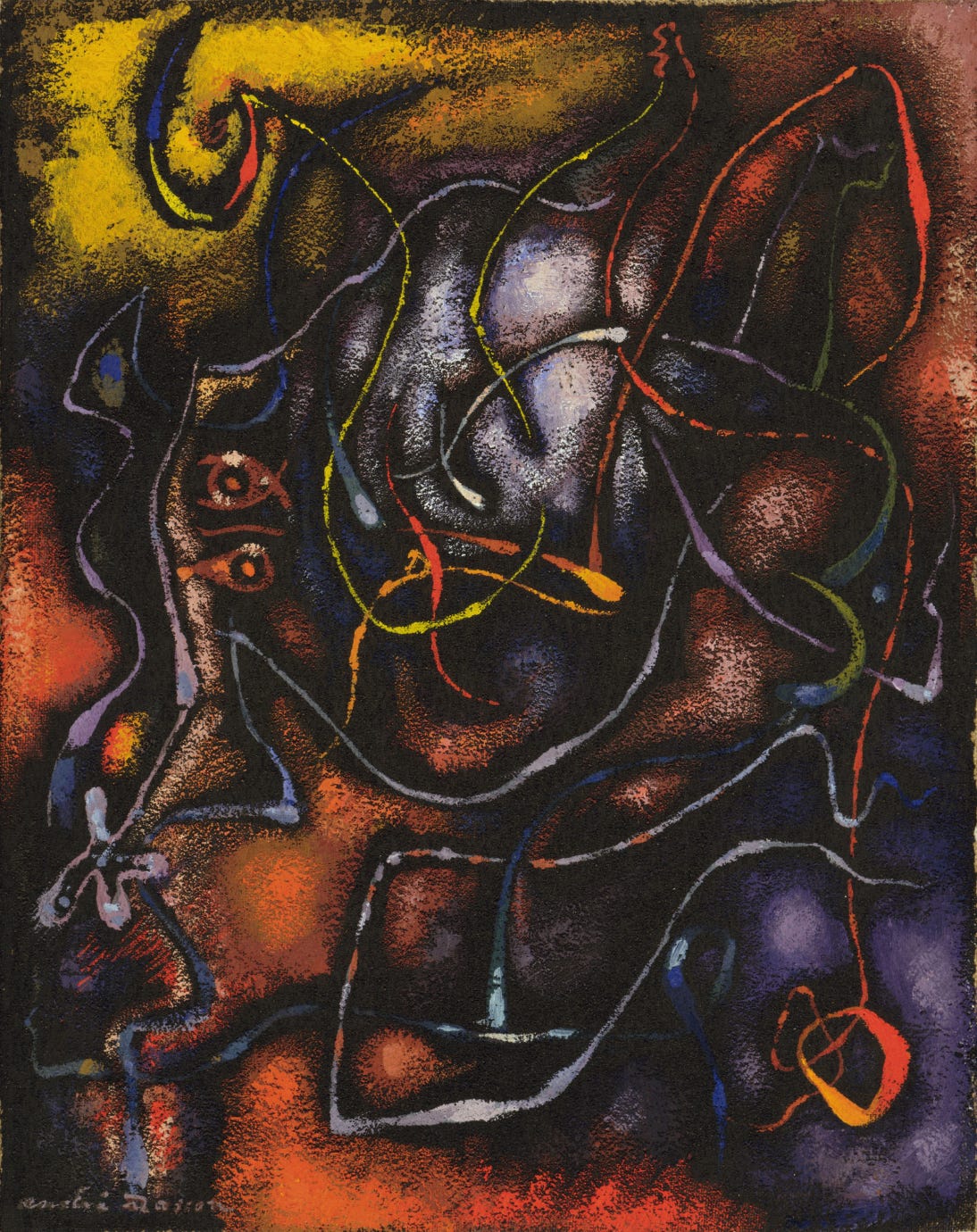
… The horror of civilization rests on this: that it could only be bought with the lie. …
Part (II) of a series of posts devoted to translations of ‘Concepts’ from the supplemental ‘Encore’ to the Philosophical Fragments in 1944, the “first textual variant” of Dialectic of Enlightenment:
These three ‘Concepts’ in particular revolve around the development of a historical-philosophical theory of the Urgeschichte of anti-Semitism (Adorno) and the formation of so-called ‘Jewish character’1 in the inhuman Vorgeschichte of humanity: the personal-impersonal orders of domination in class society and the struggle against it, refracted in the conflicts that form the core of the history of religion and theology (Horkheimer). Following a line of argument begun elsewhere, I propose that, along with a number of the other elements of the “Elements of anti-Semitism” (1942/43), these three ‘Concepts’ be read as sketches towards Adorno and Horkheimer’s idea for a historical materialist response to Freud’s 1939 Moses and Monotheism—a desideratum that seems to me a neglected key for the interpretation of both their theoretical and their social-scientific (or socio-psychological) work throughout the 1940s.
The greatest fault of the Jews is: that for millennia, they practiced no domination, they were always dependent on the protection of others, however rich they may have been. And this is why they find it so difficult to comprehend that the condition of all culture up to now has been repression, terror, injustice. They desire lives of peace and security, opportunities for growth and advancement, and hold the ruling castes of the world responsible for creating the presuppositions for these things. They demand the impossible.
The distinction between Jewish and gentile character lies in the coldness and detachment the practice of iron discipline has imparted to the members of the ruling class and, ultimately, to anyone free in this reality. The Jews were not free. They neither subdued nor suppressed. What history left of them is what slipped through the meshes of its net—otherwise, it wouldn’t exist.
They are utopians. In their consciousness, they seek to align themselves with everything gentile and deny the lack of experience on which their mission rests. But their essence, formed by history, belies them. The dichotomy between their being and speaking, their individual character and historical mint [Prägung], finds expression in all of their traits. It is, at the same time, the sole guarantee against complete betrayal: they must bear witness to the impossible, whether they want to or not.2
According to the spirit of the Christian world-order, all actions had to conform to one maxim: do nothing that would endanger one’s eternal bliss. It was an egoism—for the hereafter. As to whether the man of the Middle Ages truly observed this, today it is hard for us to make out. However, given the biographical accounts of popes past who, upon their election to the papacy, strove, in horror, to outrun their new office for the sake of the eternal salvation of their own souls—it would seem this conception is not entirely mistaken.
In modern times, too, all actions are supposed to conform to one maxim: do nothing that would endanger one’s income. This, too, is an egoism—for the here-and-now. The bourgeois human being can only be understood through the bitter resolve to such egoism. The whole of his upbringing and education is ordered to teach him to despise himself should he conduct himself otherwise. For that would make him weak, pathetic, mad.
This conversion of heavenly into earthly egoism has accomplished all those wonders of which the present era has to boast. The tremendous significance of this advance from superstitious to worldly egoism should not be underestimated. Once this step was taken, any thought not thought in its service was regarded as ideology. Calvin was executor of an upheaval compared to which even the totalitarian one of today appears less invasive. All the same, the latter, too, marks a transformation in the anthropological structure. Hitler laughs at nation, race, Volk. In the same instant the peoples of the world eradicate themselves, any illusory semblance of their substantiality disappears. Hegel would have said they refute each other: dialectics in practice with “whistling bombs.”3
The prehistory of humanity—and that is where we are—has robbed the human being of its last mythological and philosophical cloaks. Here, at the end of the world, it reveals itself to be just what it has become: as blind to all but the narrowest of purposes—as the enemy. This and this alone is what the powerless and animals have always known humanity to be.
From the mouths of their prophets, the Jews adopted the teaching of peace, love, and justice. Even when they complained or acted against it, they nevertheless honored the discourse of the prophets as human.
In Christianity the messenger was elevated into God. The magnitude of alienation, hatred, and disgust the principles of Christianity must have aroused in the peoples of Europe when their proclaimers had either to be shoved into some far-off beyond or else case aside in contempt! No less than the measure of dogged lust betrayed by the eternalization of evil in Christian theology! The attraction of the Divine Comedy in Christian theology is not the allure of heaven but the seduction of hell—to misdeeds as much as their punishments. Even in the deification of Jesus, one can still detect traces of the revulsions his teachings were met with among all of those who were not slaves. It could only be endured through the invention of the devil—compensation, to to speak, for the Immaculate Conception. Since for certain economic and social reasons one could not officially make Jesus into Beelzebub himself, the role was assigned to a double upon whom all the hatred Jesus perpetually kindled could be unleashed in all its fury.
For the Jews, however, who introduced Christianity to the Germans and the other savage peoples, no such effort was spent on the creation of a double. They were immediately identified with the devil. No two ways about it, they are held to be the Gottes-bei-uns and experience all that roiling wrath released from the those Europeans into whom civilization was driven under hammer-blows of Christendom. Radiating outward from the Mediterranean, anti-Semitism increased as it traveled further east throughout Europe. In Germany the devil bore Jewish features and the Jews bore the stigma meant for love, for Logos, for truth.
Freud, Reik, Samuel, and others saw much of this. Where they falter is on the character of Christianity itself. For the religious ground of anti-Semitism should be sought not in the converted masses but in Christianity itself. It deifies the civilizing virtues, the reverse side of alienation [Verfremdung] and demonization [Verteufelung]. However true the teachings of the Gospels might be in themselves, they are perverted by their conversion into religion. The devil may have many sources in the psyche, but the lie from which he draws his eternal life-force is the deification of the Son of Man. This follows from the historical course of domination, both direct and indirect. Alongside the sword of Charlemagne, the coffers of Jewish merchants—for whom, of course, the whole business has proven a bad one over the centuries—had a share in this too. The horror of civilization rests on this: that it could only be bought with the lie. In the last instance, anti-Semitism is not so much the veiled hatred of Christianity as consequence of the fact Christianity itself is the veil. The hatred of God is secondary. True hatred lies in deification. The cross that is worshipped instead of abhorred is already the infamous vow of the torture machines European history has so faithfully fulfilled. Since the cross was sanctified, every wood seems destined by nature to be materials for gallows and witch-pyres.
Cf. Horkheimer and Adorno’s respective 1945 memos on so-called ‘Jewish character’ in human (pre-)history: “The Jews and the Oath,” by Horkheimer; “Memorandum On a Conversation with Anton Lourié,” by Adorno. Author’s translations here:
Cf. Horkheimer’s conclusion to “The Jews and Europe” (1939):
Nothing can be hoped for from the alliance between the great powers. There can be no relying on the collapse of the totalitarian economy. Fascism sets in place the results of the collapse of capitalism. It is utterly naive to encourage the German workers from abroad to revolution. Someone who can only play at politics should keep away from it. The confusion has become so general that the truth receives more practical dignity the less it eyes self-styled praxis. Theoretical insight is needed and its transmission to those who eventually will lead the way. The optimism of the political appeal arises today from dejection. The fact that the progressive forces have been defeated and fascism can last indefinitely takes away the intellectuals’ ability to think. They believe everything that works must also be good, and thus they prove that fascism cannot function. But there are periods in which the status quo in its strength and competence has become evil. The Jews were once proud of abstract monotheism, their rejection of idolatry, their refusal to make something finite an absolute. Their distress today points them back. Disrespect for anything mortal that puffs itself up as a god is the religion of those who cannot resist devoting their life to the preparation of something better, even in the Europe of the Iron Heel.
Cf. Horkheimer’s “Notes on the Curfew (1942).” Author’s translation here:
[Translator:] English in original.
No posts
Comments
Nothing yet. Say the first thing.
Sign in to join the conversation.