


Although I have yet to be named King of the Historians, even though I think I would make a pretty good power-mad demagogue, I believe I can speak for most, if not all of us when I say that there isn’t a single historian alive or in the past who hasn’t considered at some point that those devious ancient bastards were all just pulling our legs. It’s also a running joke among archaeologists that if one discovers some intricately crafted amulet or complex social site where human interaction cannot be easily explained, it can all be given the label ‘ceremonial’ and then we can all jump in the van and head to the pub for a ‘debrief’.
There is also the sneaking suspicion that at some point in the future, robot AI archaeologists and historians that consist of nothing more than a slowly pulsating brain in a jar on a shelf, will look upon the humans of the early 21st Century and wonder what our true relationships with our Smartphone Gods were like and why, every year, we slavishly sacrificed gifts at the tree altars of the Santa Demon.
If we could, we would, of course, tell them ‘No, no! You’ve got it all wrong! We didn’t worship Santa Claus … it just looked like we did.” Those electronic academics of the 25th Century might then ask us, with some justification, why, considering we appeared to go to all this bother, we didn’t worship the things we appeared to idolise so religiously.
So what is going on in the past? What is the ‘Santa Paradox’ here? Is it possible that we have been misled into believing that ancient cultures took their apparent beliefs far too seriously? Is it possible that we should instead think of those cults as something closer to our own interactions with the ghosts and ghoulies of Halloween or the jolly red avuncularness of Santa Claus? Did they take it all as seriously as we seem to assume? Have we missed the joke?
At the risk of coming across a bit ‘academic historian’, we should probably start by trying to understand what we mean by ‘Romans’ (in this context). The Romans were not a single people with a single hivemind. A senator in the late Republic, a freedman running a bakery in Pompeii, a legionary on the Rhine frontier, a priestess of Isis in Ostia, a provincial farmer in Gaul who still pours libations to local gods whose names Rome never bothered to learn are all ‘Romans,’ and they almost certainly had very different relationships with the divine. Roman religion was not like Christianity. There was no creed and no statement of faith you were required to assent to. Nobody asked you whether you actually believed Jupiter really sat on some throne on top of a mountain. What mattered instead was practice. Had you performed the rites correctly? Did you observe the festivals in the prescribed manner and did you make the proper offerings? The technical term is that Roman religion was orthopractic (concerned with the correct practice) rather than orthodox (concerned with the correct belief). This is an important distinction, because it means that the question ‘did they really believe it?’ is, if you like, the wrong question. It assumes a Christian framework of doctrinal happy-camping in a world that actually operated on a completely different set of principles.
If we ask whether the Romans (and the Greeks, by extension) genuinely believed in their myths, the answer is simultaneously yes and no. That’s not because they were confused or unsophisticated but because their ‘belief’ system operated in very different ways than ours do. Christian orthodoxy has grown into a, if I may use a simplistic argument, a case of ‘believe what this book says, or you’re going to hell’. Roman belief systems didn’t work on that level. In effect, not believing in the gods would be like not believing in the milkman. Everyone knows the milkman is there because the milk turns up. But you don’t necessarily have to engage in a direct relationship with the milkman or accept his teaching - you just have to keep making sure the milk turns up every morning. All the milkman wants from you is to pay him at the end of the week and make sure the empty bottles are on the doorstep every morning. If you masturbate at night, the milkman doesn’t give two hoots, and neither, crucially, did Jupiter. Humans might have a closer interpersonal relationship with the gods on occasion - when the milkman bangs on the door and asks you for a favour - but the rest of the time, you don’t really care what each other are up to. A Roman could sacrifice to Jupiter with po-faced ritual seriousness in the morning and spend the evening guffawing at a bawdy story about Jupiter’s love affairs over dinner, and neither act would cancel out the other. We do something similar in the modern world, where we might sing a Christmas Carol about a virgin birth, engage in some quasi-religious practices, and all the while still maintain a scientific view of reproductive medicine. These are not necessarily circles that we constantly feel a pressure to square, and there’s no reason to assume that ancient people viewed the world any differently just because they lived a long time ago.
In Aristophanes’ The Birds (not that one) (414 BC), performed at the City Dionysia, two Athenians abandon their city and persuade the birds to build a new city in the sky, Cloud Cuckoo Land, Νεφελοκοκκυγία, from where we get the phrase for something absurd. This interferes with communication between man and the gods, who, now starving and desperate, are forced to negotiate terms. In The Frogs (405 BC), performed at the Lenaia (another festival in honour of Dionysus), the god Dionysus himself is a character on stage, and he is mocked as a coward, a buffoon, and the butt of his slave’s jokes. The thing about these stories is that they were performed at religious festivals in honour of the very god being mocked. The audience sat in the Theatre of Dionysus, and at the City Dionysia, a statue of the god was ceremonially carried into the theatre before the performances began. So the Athenians were laughing at their god in the god’s own house, at the god’s own party, with the god symbolically watching. If that is not evidence that ancient people were capable of humour about their religion, I do not know what is.
Take Seneca’s Apocolocyntosis, written shortly after the emperor Claudius died in 54 AD. The title is a pun on apotheosis, the process by which a dead emperor was formally declared a god, so apocolocyntosis means something like “the gourdification” or (in traditional English) “the pumpkinification” of Claudius. In the satire, Claudius dies (his last words, Seneca claims, were a declaration that, literally, he had shit himself), limps up to Olympus, and petitions the gods for admission to their ranks. The divine senate debates his case and rejects him. He is banished to the underworld, where he is first condemned to rattle dice forever in a bottomless box (the dice always slipping through his fingers), and then claimed as a slave by Caligula, who hands him off to serve as a law clerk for eternity. This is a Roman Stoic philosopher, a former advisor to the emperor, writing a savage mockery of the entire machinery of state deification. Seneca had his reasons for doing so, not least because Claudius had banished him from Rome, but you get the point, especially when one considers that the machinery of state deification was, formally, part of Roman religion. The Senate had already voted to make Claudius a god, and temples were earmarked for dedication. The ritual priests who would administer his cult had already been appointed. And here was Seneca writing a pamphlet in which he called the whole thing a pumpkin farce in which the central character shits himself.
Or consider Lucian of Samosata, writing in the second century AD. Lucian is sometimes described as the ancient world’s prime satirist, and his favourite targets were religious credulity and philosophical beard-stroking pretension. In Zeus Rants, Zeus has a panic because a philosopher has been arguing in public that the gods don’t exist and nobody is listening to the gods’ counterarguments. In Zeus Catechised, a philosopher interrogates Zeus about the logical contradictions in divine providence, and Zeus is all over the place in reply. In the Dialogues of the Gods, the Olympians bicker, scheme, and gossip like fishwives at a market. Lucian was not some marginal crank (even though he was a bit of a nutter), he was a celebrated writer who lectured across the Greek-speaking world and eventually held an official government post in Egypt. His work tells us that, in the second century, a literary culture existed in which sustained, public piss-taking of traditional religion was not only tolerated but really quite popular.
But the really extraordinary evidence comes from the Roman intellectual elite, because what we find there is not just casual throwaway humour but a sustained, serious philosophical engagement surrounding the question of whether the gods exist and what religion is actually for, conducted by people who were simultaneously serving as priests.
Cicero’s De Natura Deorum (On the Nature of the Gods), written in 45 BC, takes the form of a dialogue between three speakers, each representing a major philosophical school. Velleius presents the Epicurean view (the gods exist but are completely detached from human affairs and don’t care about us). Balbus presents the Stoic view (the universe itself is rationally ordered and divine, and the gods manifest through nature). And Cotta, who represents Academic Scepticism, takes both positions apart piece by piece. And the thing about Cotta is that he is also a pontifex, a member of Rome’s highest priestly college. Cicero has one of Rome’s senior religious officials systematically flat-batting every theological argument put before him, until, at the end, Cotta essentially says: I find it easier to say what I don’t believe than what I do, but I will continue to uphold the religious traditions of Rome because they are the foundations of the state.
We can all sit here forever and yabber about whether the milkman is divine or not, but we’re putting the empties out on the doorstep tomorrow, just the same. We need the milk.
Roman religion never asked you to consider the nature of the milkman, or to believe that the milkman was powerful and could make volcanoes happen - it asked you to put the bloody milk bottles on the bloody doorstep every bloody morning.
A generation earlier, the great Roman scholar Varro (whose works survive only in fragments, mainly preserved by the Christian writer Augustine, who quoted them extensively in order to attack them) proposed a formal categorisation of Roman theology into three types. There was the theology of the poets (genus mythicum), which was the stories of the gods as told by Homer and the tragedians: entertaining, often scandalous, not to be taken as literal accounts of divine behaviour. There was the theology of the philosophers (genus naturale), which was the reasoned investigation of what the divine might actually be. And there was the theology of the city (genus civile), which was the actual religious practice of the Roman state: the festivals, the sacrifices, the temples, the priesthoods. Varro’s point was that these were different aspects of belief, not competing truth claims. The poets told grand stories about epic journeys and fighting lions; the philosophers stroked their beards and considered what it all meant, and all the while the city put the empties on the doorstep. And a Roman - any Roman - could participate in all three without any contradiction. And according to Augustine (who was, it must be said, a rather biased source), the pontifex Scaevola went even further, reportedly arguing that it was “expedient for states to be deceived in religion,” that the maintenance of civic religion was a matter of political and social utility rather than anything to do with theological truth. Whether or not Scaevola said exactly that (and Augustine had his own reasons for making Roman religion look this cynical), the fact that this kind of argument was circulating at all tells us something important about the range of attitudes available to educated Romans.
It would be easy to read all of this and conclude that the Roman elite were all secret atheists who cynically manipulated religion for political purposes while the ignorant masses genuinely believed, and that would be just as much of a distortion as assuming everyone believed everything literally. The evidence from Pompeii, for example, gives us a city that was both deeply religious and profoundly sinful. The walls are covered in graffiti that ranges from the pious to the obscene, often within a few feet of each other. Household shrines (lararia) were maintained with evident care. Amulets and curse tablets show a population that took supernatural forces seriously enough to invest real effort in harnessing or deflecting them. And yet this is also the city where phalluses were carved everywhere as good-luck charms in a way that is simultaneously “religious” and “a bit of a laugh,” where people noted certain hostelries as a great place to stop for a shit and argued over who wanted to fuck the barmaid more. There was not a great dividing line through Pompeian society, with the stern-faced puritans on one side and bawdy toilet drunks on the other; Pompeians were both at the same time.
And then there is Saturnalia itself, which is perhaps the closest Roman parallel to the Santa Claus phenomenon. Saturnalia was a midwinter festival (originally December 17, later extended) in honour of Saturn. Whether this is the origin of such midwinter practices in modern times is an interesting conversation and one for another time, but it involved feasting, drinking, gift-giving, gambling (normally restricted by law), and a temporary inversion of social hierarchies: slaves dined with or before their masters, a “king” of the Saturnalia was appointed by lot, and the normal rules of social behaviour were relaxed. Gifts were exchanged, and our sources tell us that these gifts were sometimes serious (money, books, silver) and sometimes deliberately absurd, gag gifts accompanied by joking poems. Any British Christmas is not complete without Christmas crackers, small parcels that are normally a part of the dinner party which guests have a little tug-of-war over, with the winner (whose victory is signalled by a little jokey ‘bang’ from the ‘cracker’) keeping the contents of the parcel, normally a comedy paper hat, a dreadful ‘gift’ which is dependent on the amount the host has spent on them and a scrap of paper with a terrible joke. Sounds familiar, doesn’t it? The poet Martial wrote entire collections of these little gift-tag poems (Xenia and Apophoreta), and they range from the elegant to the deliberately bathetic. Saturnalia was, formally, a religious festival with proper sacrifices and ritual observances. It was also a party. It was also a licensed period of social commentary, when things could be said that couldn’t normally be said. It was also an occasion for genuine warmth, generosity, and communal feeling. All very Christmasy.
As always, the broad answer is that the ancients were neither terribly sincere nor completely jokey. What we perceive as the correct attitude towards sincere belief systems doesn’t always map nicely onto ancient contours. One could say that their approach to belief was much like ours. We have Christmas (and other such festivals) not because we believe that Santa is some sort of god, but because such rituals are the glue that helps bind our societies together. We put out a glass of whisky for Santa and a carrot for Rudolph because even if we don’t think that Santa is divine and we’re pretty sure he doesn’t exist, if we don’t do that - if we don’t leave the empties out on the doorstep each morning - then there’s always a chance that he might not come. Better to be safe than sorry, right?
Especially after all the naughty and nice you’ve been up to so far this year!
If you’ve been reading this newsletter for a while, you already know what the paid side looks like: longer, deeper, and occasionally in Latin. The paid articles go out every week, alongside a full translation and reader’s guide to the Historia Augusta, a text so strange and unreliable that it has occupied classicists for a century, and me for a decade, without resolution. If that sounds like your kind of thing, the subscription is $5/month. The link is below.
It’s $5/month (or $50/year), and you’ll also get a free copy of my translation of Suetonius’ Twelve Caesars as a welcome gift.
If this piece was worth your time, a $5 tip on Ko-fi is very welcome!

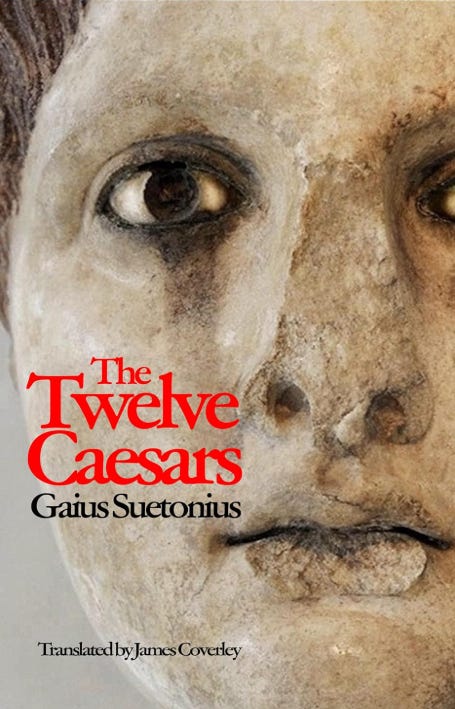
Suetonius is one of the main sources for the Roman emperors, but most modern readers never get through him.
Not because the material is difficult, but because the translations are.
My edition of The Twelve Caesars presents the text in clear modern English, restores what earlier editors removed, and explains the context as you go.
If you want to see what Rome actually looked like from the inside, this is the place to start. CLICK BELOW TO ORDER YOUR COPY!
Comments
Nothing yet. Say the first thing.
Sign in to join the conversation.