
‘One of the best ways to keep the peace,’ noted the first President of the United States, George Washington, ‘is to be prepared for war.’ What was true of the late eighteenth century remains every bit the case to this day, and certainly so at a time when here in the UK, we’ve become complacent about the peaceful state in which our country exists. As a consequence, we no longer seem sufficiently willing to protect ourselves against our enemies. There are plenty calling for urgent rearmament and massively increased defence spending, but they all seem to be ‘formers’: former senior military commanders, former ministers, a former Secretary-General of NATO, former newspaper editors. Mostly elder statesmen. I can’t think of any influencers on social media, any British George Clooneys putting their political heads above the parapet, any prize-winning novelists or rock legends. The Sun newspaper might call for action, and there have been a fair few columnists doing so, but while the wider public appetite remains mute - and let’s face it, worryingly disinterested - the current government can kick the can of defence spending down the road.
It’s worth pointing out that the best Russian troops are not getting themselves slaughtered in the Donbas in eastern Ukraine but are facing the Baltic states. The 11th Army Corps is based in the Kaliningrad Oblast, formerly East Prussia and Königsberg before 1945, but now an isolated enclave on the Baltic coast with Lithuania in between it and the rest of Russia. The Baltic Fleet is based there, as well as special forces and various missile capabilities. The 6th Combined Arms Army, meanwhile, faces Estonia, as does the 76th Airborne Division, the 1st Tank Army and 44th Army Corps. If you’re Estonia or any of the other Baltic States or Scandinavian countries, this is a very serious and real threat. An alternative view is that Putin has his forces there at China’s behest to create the impression of a possible incursion into the Baltic States and has no intention of any military operation in that theatre. China, the theory goes, is anxious to understand US intentions in the Indo-Pacific and so wants to test America’s commitment to Europe and NATO. As President Trump has made clear, he’s no longer interested in Europe or NATO.
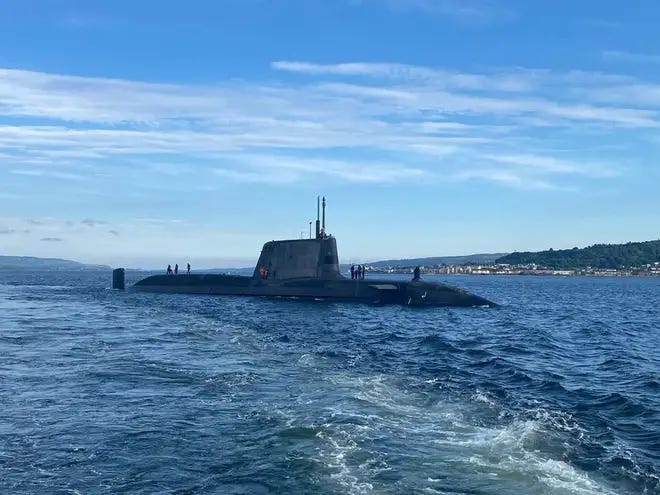
The consensus is that Putin is in no position at the moment to test the water in the Baltic but why would anyone risk betting against it? No-one can seriously doubt that he wants to wrench back the Baltic and even Finland too, given half the chance. Right now, Putin is currently trying to change to law in Russia to give him greater legal freedom to intervene internationally to ‘defend’ Russians, and just as there are ethnic Russians in the Donbas, so there are in the Baltic states and not least Estonia. Why do this if he doesn’t have plans to call upon these new powers? He might, for example, cross the border and capture an Estonian village known to have a majority of ethnic Russian citizens, or, as the Swedes are currently suggesting, perhaps order his troops to storm and take one of the many islands in the Baltic Sea. This would constitute an act of war and trigger Article 5, compelling fellow NATO allies to leap to the defence of the afflicted nation. Trump would almost certainly renege on the Article 5 commitment, which would then leave the rest of NATO jumping to the rescue without their most powerful ally. That would mean war. Shots would be fired, missiles directed and furious negotiations take place before things got really out of hand. Meanwhile, Russian subs could dip into the North Sea and cut a handful of cables in the North Sea - just to make the point that they hold the upper hand.
Russian surveying of our cables is so far the most sinister and serious threat they’ve made to Britain’s sovereignty, notwithstanding the relentless cyber warfare they’ve already been carrying out. Most of us store data on the cloud these days and I suspect the majority assume it is somehow magically stored so that we no longer have to worry about it and without giving it too much further thought. It’s important to understand, however, that this information doesn’t drift through the ether. It’s not in the atmosphere or floating around an actual cloud. Rather, cloud storage depends on immense physical infrastructure and reaches those storage data centres in Nevada or Utah via a massive network of underwater cables. These run through the North Sea and across the Atlantic. Britain has a network of some sixty undersea cables that carry more than 99% of our international data, including daily internet traffic, much of our financial transactions and global communications. On top of that, 77% of our gas - the most common means of household heating in the UK - comes via pipelines across the North Sea from Norway. A large proportion of our electricity is also transmitted along cables running across this all-important seaway.
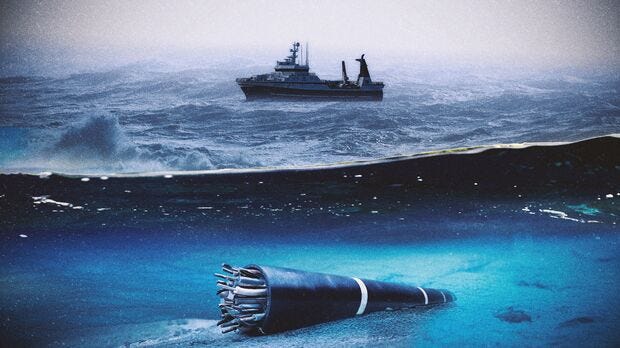
It is these very cables that the Russians have been relentlessly mapping in recent times. They’re not doing just for kicks. They’re doing it so that one day they can cut them should the opportunity arise. And should they do so, the consequences hardly bear thinking about. In the meantime, as Swedish intelligence has just reported, Russia is dramatically ramping up its cyber operations against European energy supplies.
Meanwhile, around 40% of our food also comes from overseas, and while that means we produce some 40% domestically, most farmers can barely keep their businesses afloat. As a friend and farmer recently pointed out to me, it’s not so much food security we need but food self-sufficiency. We do not have this at present. What’s more, Britain is also still dependent on imported fertilisers, needed for home production. We need to become more resilient across the board – and especially so because we’re different from the rest of Europe, not just because we’re no longer in the European Union, but because we are a collection of islands separated from the continent by the sea.
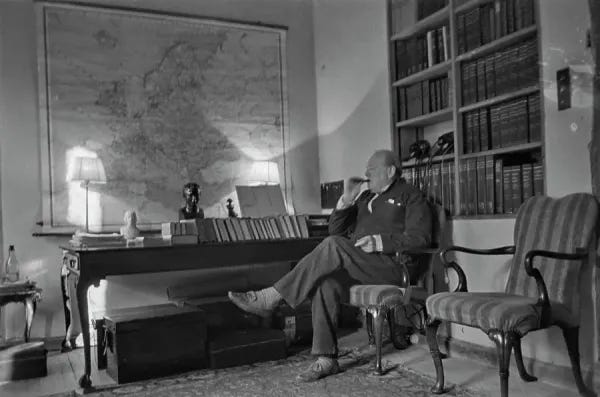
There has been much talk in recent times of comparisons with the 1930s. The governments of that dark decade have been routinely criticised by historians for the lack of investment in defence while Nazi Germany turned itself into a military superpower, Japan became ever more militarised, and democracies came under attack from autocracies. Neville Chamberlain, Prime Minster at the start of the Second World War, has copped the most flak for appeasing Hitler at Munich in 1938. He was warned that kowtowing to Hitler would not work and nor did it. ‘The maintenance of peace,’ noted Winston Churchill, one of the strongest critics of appeasement and then out of government, ‘depends upon the accumulation of deterrents against the aggressor.’ He was spot on, as was George Washington before him. It’s a sentiment as relevant today as ever.
Despite the vilification Chamberlain has received ever since, more than 90% of the population was opposed to going to war over Czechoslovakia in the autumn of 1938, a percentage in a democracy that was decisive. Nor was the Chamberlain government ignoring defence. It’s important to know that in 1939, Britain had comfortably the world’s largest navy, largest merchant navy and the world’s only fully co-ordinated air defence system. Sure, the army was small, but factories were already working around the clock during the Munich crisis making arms, more ships, upgrading older models, building aircraft and explosives, while more factories were under construction. By the summer of 1940, Britain was out-producing Germany in aircraft at a rate of more than 2:1 and, by late summer, by 3:1. In other words, despite the army’s defeat on the continent in France in May and June 1940, Britain was incredibly well placed to hold out, fight back and later play a significant role in eventual victory.
What do we have now? Excellent special forces and 16 Air Assault, half-decent anti-cyber ops, a growing number of drones and that’s about it. Our navy has become a laughing stock, the RAF is woefully depleted and our army run into the ground and tarnished by expensive procurement projects such as the Ajax that speak of ineptitude and mismanagement. Morale is also poor at present, in part because of the negativity surrounding the state of all three services, but also because of a shortage of equipment and ammunition. The harsh reality is that our armed forces are woefully denuded. Can we defend our cables in the North Sea? No way. Can we sustain a lengthy contribution to a European war? Nope. Can we deter our enemies with a show of military strength? Not remotely.
Currently, there is neither a plan to rescue British farmers - after all, there are not enough of them to make a meaningful difference to voting intentions – despite the urgent need for food self-sufficiency, and no firm plan to increase defence spending. In fact - and I find this hard to comprehend - military chiefs are currently under instruction from their civilian bosses to further cut expenditure. The truth is that the majority of people in Britain simply know little about this precarious situation in which we find ourselves, and don’t care either, because it’s not a threat they are directly experiencing right now because, other, more immediate issues, seem more pressing. We’ve become so used to living in peace, the experience of that earlier world war is slipping from living memory and because the idea of being at war here, on our backdoor, seems fantastical. It won’t happen to us.
But it might.
Meanwhile, politicians continue to dither, faff and prevaricate. ‘We can’t afford it,’ is the oft-repeated refrain, even though the percentage of public debt to GDP was as high as 135% in the 1930s and 250% in 1945, and we managed to turn both of those debt millstones around. Today it’s around 95%. Incidentally, in 2024, the British public spent double on holidays what the government spent on defence and roughly the same as the defence budget on new cars.
Interestingly, the country in Europe with the highest expenditure on defence - Poland - has one of the continent’s fastest-growing economies, while Germany is now massively investing in defence and fully intending to kill two birds with one stone: to protect itself and boost the economy. The German government is currently spending around €100 billion annually, while between 2023 and 2025 it issued €188.4 billion on no less than 255 major defence procurement projects. And this is a crucial point: significant extra defence spending doesn’t need to spell economic disaster. There are means of borrowing the money at very low interest and paying back long term. I suspect few in Britain would object if there was every chance the borrowing would be paid back. For debt to be cleared, there needs to be economic growth, after all. So, let’s create growth by dramatically increasing rearmament. It really isn’t rocket science.
And there is the means to fund a significant boost to defence spending. There is, for example, the Defence, Security and Resilience Bank (DSRB) being worked up at the moment by creative Brits and championed by none other than NATO’s hero of the hour, Mark Carney, the Prime Minister of Canada. It provides super cheap loans for member states, super cheap loans to industry or innovator priorities operating within those members states, and also guarantees to member state commercial banks, investors and funds to incentivise the release of a stack of private investment into the DSR space at a scale not seen since WW2. Money borrowed under such terms can be used to give the economy a huge kick-start, provide growth and at the same time, make us safer. What’s not to like? It’s the Keynesian model and has a huge amount in its favour. But it requires action NOW.
Frustratingly, this is decisive action that is not emanating from the British government. In the movie, Jerry Maguire, Tom Cruise tells the sports star he represents, ‘Help me to help you.’ I want to scream this line to the Prime Minister and his cabinet. Act with purpose, vision and clarity. The DSRB was conceived here in Britain and there was a golden opportunity to host the bank with all the associated prestige and capital growth a global institution such as this would inevitably bring. Tragically, it is not to be, however. Unbelievably, some key officials in the Treasury were against it, largely because it wasn’t their idea, and what has followed has been a faceless strategy of empty chairing negotiations by UK officials to delay its development in favour of their own Multinational Defence Mechanism – an enterprise that is neither as ambitious or has had the take-up from fellow allied nations that has been enjoyed by the DSRB.
So, it seems the bank will not be based in the City of London, but in Luxembourg and Toronto. Seriously. Sir Keir Starmer, John Healey and even Rachel Reeves, it seems, are in favour of signing up to the DSRB. If so, they would be sitting alongside some 40 other NATO and global nations that are already in the process of doing so, while at least eight founding member states are currently crafting the first such banking charter that allows for serious deterrence funding. Yet despite continual championing by several Labour MPs and the House of Commons Defence Committee, they cannot get through to enough of those crucial civil servants at the Treasury to make it happen. A whopping parliamentary majority is not enough. It’s enough to make one weep. How could we be so short-sighted?
But this is why pressure needs to come from elsewhere. If the PM is impotent to act, then it must be left to others to wake up the nation from this sleepwalking. And there are faint signs of hope. The proportion of those who believe defence spending should be increased is now 44% up from 30% a couple of years ago. This rising figure is something those of influence should be working with now and urgently so. There is not a moment to lose. We should not be leaving it to the ‘formers’ but galvanising those with genuine influence to help change public opinion, just as a handful of writers and other public figures did in the 1930s.
This wonderful, beautiful, varied country, with its astonishing landscape and coastline, it’s rich culture and history, its incredible talent, and wealth of immensely creative people is so worth protecting. We have the skills, ability and wherewithal to make ourselves watertight safe, to thrive and blossom once more. Complacency - that terrible word - short-termism and an abject lack of resolve are threatening to undermine us. It’s time for us to wake up and move once more to the sunlit uplands.
Come on, people.
We can do it. But we need to act NOW.
No posts
Comments
Nothing yet. Say the first thing.
Sign in to join the conversation.