
On 14 May 1940, the same day the Germans , having crossed the mighty River Meuse, blew a giant hole in the French defences, President Roosevelt had met Henry Morgenthau Jr, the Secretary of the Treasury, and General George C. Marshall, the Chief of Staff of the US Army, for a meeting at the White House. Marshall was fifty-nine, with the best part of forty years’ military service under his belt, and had been Chief of Staff of the Army, the top job in the US military since 1 September 1939, the very day Germany had invaded Poland. Intelligent, calm and soft-spoken, Marshall possessed both an inner steel and a clear, logical mind. As an administrator he had already proved himself to be exceptional, but, like Roosevelt, he was keenly aware how poor America’s defences were. For several months he had been trying to persuade key figures in Congress and the Government of the need to increase defence spending.
He had also put his case to Henry Morgenthau, but for men like the Secretary of the Treasury, who had been almost solely concerned with domestic issues, the world of dramatic rearmament was something new and involved dizzyingly high sums of money at a time when America had very little to spare. Although national debt as a percentage of GDP was only around 50%, the United States was still only slowly emerging from the catastrophe of the Wall Street Crash, the self-inflicted global tariff war, and the long legacy of the Great Depression. For all Roosevelt’s domestic public works projects and initiatives of the New Deal, there was a widespread acceptance that America was still not yet out of the woods. Unemployment, for example, stood at a whopping 17.2% at the time the war broke out. It was Morgenthau’s job to ensure the government did not now overspend or undo the fragile but slowly growing economy. None the less, he was supportive of Marshall, but knew the only option was to take the matter to the President, the ultimate arbitrator over such matters. Perhaps needless to say, that the Germans had launched their attack a few days earlier was very much to Marshall’s advantage.
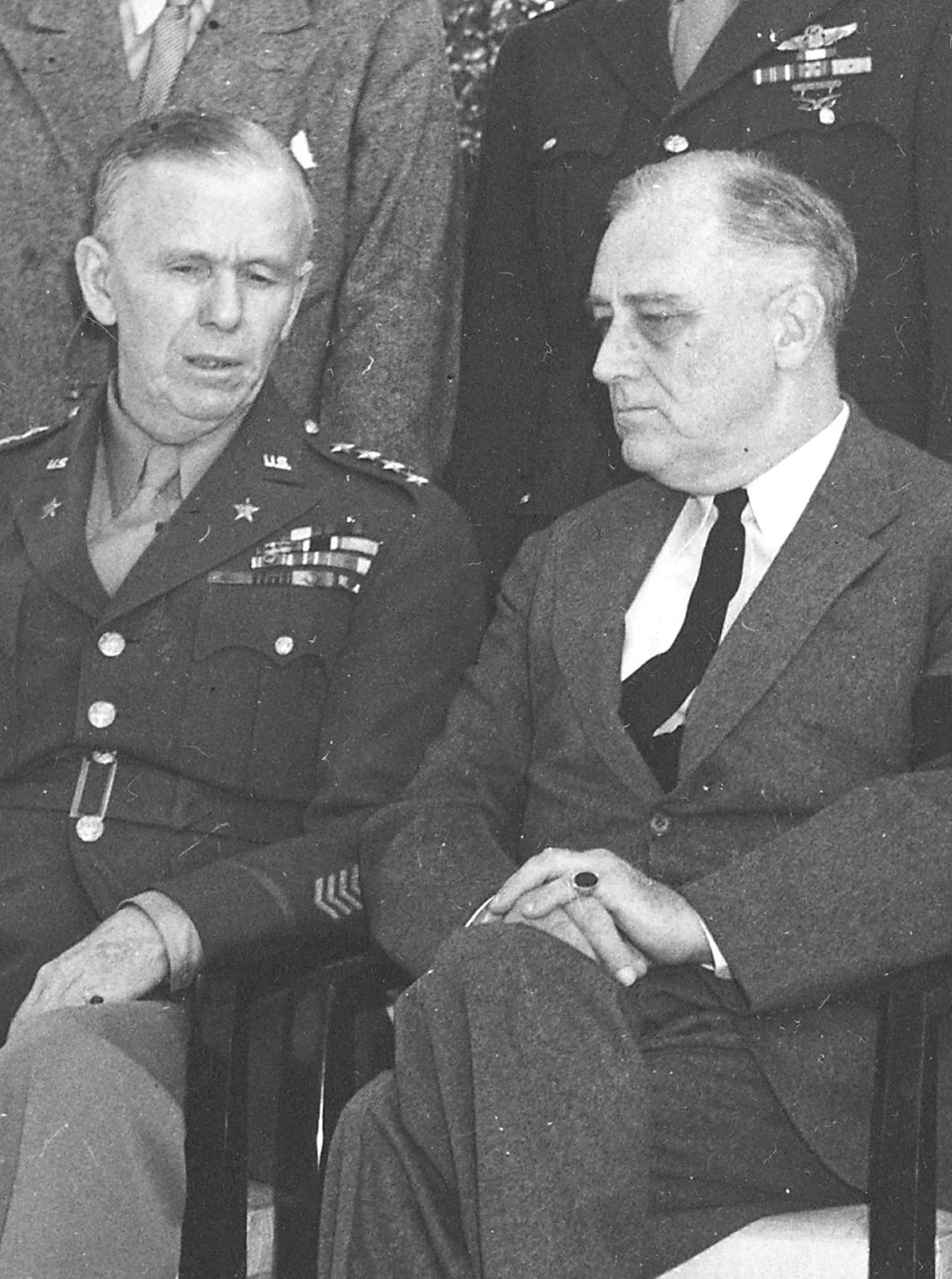
Also attending were the isolationist Secretary of War, Harry Woodring, and the ineffective Secretary of the Navy, Charles Edison. The debate quickly became heated, and neither Morgenthau nor Marshall was getting through, until eventually Morgenthau asked FDR to listen to the Chief of Staff. ‘I know exactly what he would say,’ Roosevelt replied. ‘There is no necessity for me to hear him at all.’ At this, Marshall got up, strode over to Roosevelt’s chair and said with quiet authority, ‘Mr President,’ he said, ‘can I have three minutes?’ Apparently disarmed, Roosevelt agreed, and Marshall then presented the President with some blunt truths. It was time, Marshall pointed out, for the President to make some tough decisions.
The Army was in a woeful state, he told him, and he was quite right. It really is hard not to overplay just how moribund the US armed forces were in May 1940. The Army’s equipment was out of date, in terms of troop numbers it was tiny, and it was in no position whatsoever to confront the Germans. There were just a few hundred tanks, and no anti-tank guns whatsoever, and there was a shortage of mortars, machine guns and other essential weaponry. On 1 September 1939, the US Army could muster a mere 189,000 troops, perhaps large by today’s British standards, but tiny at the time; this ensured it was sandwiched between Portugal and Uruguay as the nineteenth largest army in the world. The Army Air Corps had just 160 fighters – or pursuit planes, as the Americans called them – and fifty-two heavy bombers. These were as good as nothing. The Navy was also in a bad way, with an antiquated structure and no central means of procurement. Roosevelt had increased naval shipbuilding since 1936, but it was not enough. If Japan decided to go to war against them too – and Japan’s imperial ambitions were becoming all too evident – then the US would be powerless to stop it. Fighting a war on a two-ocean front was unthinkable. What Marshall urged Roosevelt to do was not only demand far greater spending on rearmament, but also to gather together a group of industrialists to help advise the government on how to achieve massive rearming as quickly as possible. Because, Marshall made clear, getting the cash was only half of it. Even more challenging was going to be mobilizing American industry for war. The US Army had only six working arsenals manufacturing weapons, and much of the machinery was both old and obsolete. The time for paying lip service to the isolationists was over; the US needed to act, and act fast. ‘If you don’t do something,’ Marshall told him, ‘and do it right away, I don’t know what’s going to happen to the country.’ This was as stark as warning as Marshall could give him.
Further warnings of doom had come from the new British Prime Minister, Winston Churchill. At the outbreak of war, Roosevelt had written to Churchill asking to keep informally in touch with him personally. The two had met – albeit only once before – back in July 1918, when Roosevelt, as Assistant Secretary to the Navy, had been in London on a fact-finding mission and had attended a dinner for the War Cabinet; Churchill had not impressed Roosevelt, while the Prime Minister had forgotten the encounter altogether. In other words, the two knew about each other, but that was all. On 15 May, the day after Marshall’s entreaty, Churchill wrote his sixth letter to the President. ‘The small countries,’ he wrote, ‘are simply smashed up, one by one, like matchwood.’ He painted a darker picture than Churchill believed to be really the case, and warned of an imminent invasion of Britain. ‘But I trust you realize, Mr President, that the voice and force of the United States may count for nothing if they are withheld too long.’ He asked for more direct support in terms of arms and war materiel, and particularly the loan of forty or fifty old destroyers to bridge the gap while British shipyards made up the shortfall. He also pointed out the need to purchase steel from the US now that Britain’s traditional markets in North Africa and Sweden were threatened. Roosevelt, who accepted that US security was directly linked to Britain’s survival, responded the next day with as much encouragement as he dared. And on that same day, 16 May, and bucked further by polls suggesting the public was warming to the idea that the US needed to adequately rearm, the President addressed Congress and asked not for the $24 million increase to the Army budget that had been originally put forward, but a staggering $1.2 billion, and to increase both the Army’s and the Navy’s air forces to some 50,000 aeroplanes. US aircraft manufacturers had produced just 2,100 military aircraft in 1939. ‘These are ominous days,’ he told a joint session of Congress.15 ‘The American people must recast their thinking about national protection.’ The generally isolationist Congress, shocked by what was happening in Europe, not only applauded the speech, but approved the President’s request. It was a start – a step closer towards all-out rearmament.
Roosevelt responding swiftly and decisively to these entreaties, and did so primarily through deficit spending and borrowing. Much of the huge investment in defence in the second half of 1940 and into 1941 was achieved by issuing Treasury bonds and by borrowing, using the Federal Reserve to absorb debt and expand the money supply. For those who read and hear a lot about government bonds but don’t know how they work, they are effectively IOUs – that is, loans. They’re long-term, triple-A guaranteed and at low-interest, so anyone buying them will get the money back, with interest, once the bond matures. The argument against them is that it increases national debt; on the other hand, a massive injection of cash, when used judiciously, can significantly boost the economy, kick-start growth, and provide jobs, which in turn then brings taxes into the government coffers, investment and increased markets both domestically and internationally.
What is axiomatic, however, is that a stagnating economy, existing through draconian austerity measures, is the best way to ensure the economy continues to stagnate to the point where national debt continues to increase rather than decrease.
As it happened, Roosevelt had been keenly aware for some time that neither the Atlantic nor the Pacific were quite a mighty defence barriers they had once been. After all, it had been an American, Charles Lindbergh, who had been the first man to fly solo across the Atlantic back in 1927. Roosevelt understood that it was only a matter of time before fleets of aircraft could cross the oceans. The world, he knew, was shrinking in this rapidly evolving technological age of dramatic scientific developments. Radio and radio waves were transforming communications but also navigation and detection. Weapons were becoming ever-more powerful and destructive. What could be achieved by air power, still only 37 years-old in 1940, was evolving so rapidly that battleships had been overtaken by aircraft carriers as the pre-eminent naval warship. Science and technology were essential to the modern conflict and the United States needed to keep up, yet just as important was mass: numbers counted and was the potential chink in the armour of the Axis powers now waging war against those of democracy and western capitalism. Neither Italy, Nazi Germany or the emerging threat of Imperial Japan could compete with Britain, let alone the United States, for global reach and resources. America had the commercial infrastructure to turn over onto a war footing: it had by some margin the largest automobile industry in the world, not just with vast assembly lines but also a wealth of small and medium sized business making a stack of component parts. It also had the construction industry to support the building growth that had grown alongside automobiles. Yet, if Roosevelt could steer America in the right way, it could help save the free world from tyranny and oppression and at the same time grow ever wealthier. Those initial grants from Congress, no matter how eye-wateringly high, could be converted from deficit into immense riches and wealth.
The trouble was that the United States had got itself into a bind through red-tape, new laws and a liberal political culture that firmly eschewed conflict. What’s more, most of this new isolationist, inward-looking anti-war culture had come on Roosevelt’s watch. In fact, he’d taken over the presidency in March 1933 – six weeks after Hitler had come to power – on a largely isolationist ticket. American involvement in the First World War had been perceived as a terrible mistake, in which big business had gotten rich on the blood of young Americans. The theory was this: have a large military and the nation is compelled to use it; keep small, and the country will avoid going to war. Yet even after the Wall Street, this antagonism towards big business prevailed, with the perception that blue collar workers and the ordinary man was losing out because of the greed of the fat cats of US finance and industry. The losses suffered in the Great War had become conflated with the economic catastrophe of the Great Depression, whereas in fact, the biggest consequences of that global conflict had been America emerging as the unquestionably richest and most modern nation in the world. This had been squandered by greed and a lack of banking regulation, which directly caused the Wall Street Crash of October 1929. In fact, the ordinary American, seduced by the prospect of buying motor cars and other modern temptations, had borrowed like a modern-day credit card abuser and had certainly played his part in the collapse. None the less, the determination of the New Dealers to perceive armaments production, especially, as an evil to be rooted out of American society, ran deep, and had led to something of a witch hunt.
Encouraged by Roosevelt himself, Senator Gerald Nye had led an investigation that heavily criticized leading companies like Du Pont, General Electric, General Motors, Curtiss, Boeing and others, claiming they had been ‘merchants of death’ driven by greed, lies and hypocrisy. It had been chastening for those under scrutiny and a number, such as Du Pont, had simply turned their back on armaments manufacture as a result; it simply wasn’t worth the hassle. This was one of the reasons the US now had almost no explosives. Furthermore, as a consequence of the Nye Committee, a number of new restrictions and tax laws had been introduced to prohibit any future war profiteering. No firm manufacturing armaments was allowed to make more than 8 per cent profit, which was acceptable, but firms were also to be audited to ensure such a cap before a contract was awarded. The problem, though, was that since most companies embarking on arms production would be new to it, they would have no idea what the costs and profits might be until they’d started the work. Second, it was now law that the amortization rate was a staggering sixteen years. This meant no company expenses – such as machinery, labour and so on – could be offset against tax for that period of time. In other words, any company embarking on arms production in 1940 could not claim back any tax breaks until 1956. Finally, anyone who wanted a government contract not only had to go through a lengthy bidding process but also had to stump up the costs of doing so. This might mean building a prototype tank, for example. Why would any firm invest that amount of money, time and energy for a contract it might never win? Nor would it ever be reimbursed for those costs even if it did win the contract. The intentions of the Vinson–Trammell Act, which had introduced these tight new laws, were all very noble, but there were now far too many reasons for American industry not to touch arms manufacturing with a barge pole. As a result, in May 1940, there were such six private armaments production plants in the entire United States and only one manufacturing explosive. In Britain there were hundreds.
What was desperately needed at this dramatic moment were plenty of incentives. The trouble was, both the President and the New Dealers had built their administration on tackling big business and curbing the kind of greed and profiteering that was widely believed to have been responsible for the Depression. To cast those ideals – and laws – aside now would be a giant political volte-face.
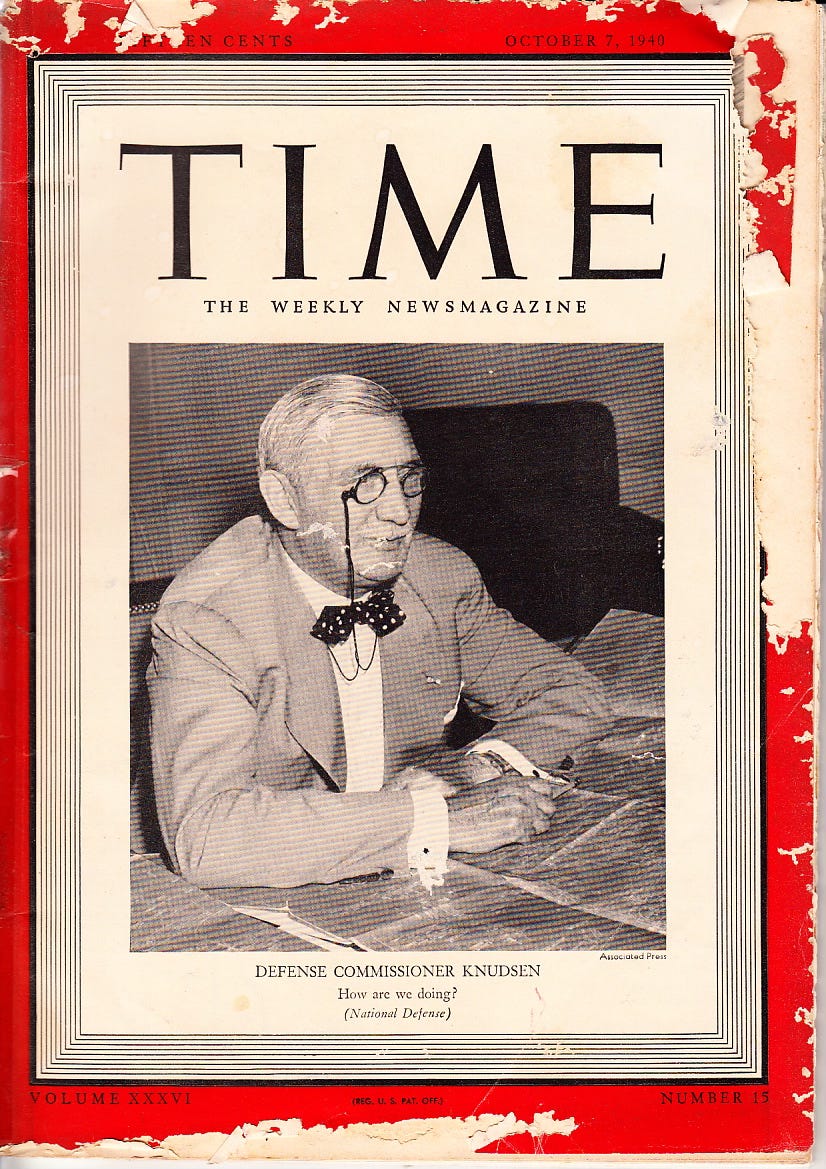
One of those now advising the President at this critical moment was Bill Knudsen, the President of General Motors. A first generation Dane who had come to America in 1900, he had worked for Ford and come up the idea of the assembly line, that key concept behind mass production. He had fallen out with Ford over the automobile mogul’s refusal to develop new types beyond the Model T, moving to Chevrolet and then transforming General Motors into the leading automobile business in the world. Knudsen was not a political animal and cared little for political niceties, but he felt that the United States had treated him well and he was happy to do his bit to help in turn, becoming one of the first of the vaunted ‘dollar-a-year’ men – technocrats brought in to bring pragmatic experience and business and production know-how to the process of transforming the United States.
In a meeting with FDR in June, Knudsen asked him, ‘Mr President, do you want statistics, or do you want guns?’ Roosevelt laughed. ‘What do you mean?’ Knudsen told him – it was a question of choice: the President could keep his Nye Committee laws but then there was little hope of the mass rearmament now being proposed. Instead, he urged the President to axe the pre-contract audit and change the amortization rate – he had to explain to FDR what amortization was – and suggested introducing a letter of intent, something he had picked up from the British. The Army or Navy would send a pre-contract letter of intent to a company, which would protect that manufacturer on any expenditure it made before the contract was actually signed. In other words, the company could get going right away, without tedious bidding, without waiting for a formal contract to be drawn up, and safe in the knowledge it was not investing any time, money or effort for nothing. Any money it put in would be reimbursed. Roosevelt was initially doubtful, but Knudsen again stressed the importance of clearing paths through red tape. To make the kind of arms in the numbers envisioned required nothing less than a major overhaul of legislation. General Marshall had stressed the battle against time. Tough decisions would have to be made. Red tape and lengthy governmental procedures needed to be cut.
The President listened, although not only to Knudsen, but also to his new Secretary for War, Henry L. Stimson, now seventy-two but a grandee of American politics. It had been clear for some time that FDR needed to bring new men to the key offices of War and the Navy. Woodring, Stimson’s predecessor, was an isolationist and notoriously ineffective. Edison at the Navy was not much better, yet Roosevelt had always been curiously reluctant to sack people. The axe had finally fallen on both men, however, in June, with France heading for unavoidable defeat and with Britain sending ever more desperate signals for help. Disaster on the other side of the Atlantic had been the spur that had forced FDR to finally take action. Even so, the appointments astounded many of Roosevelt’s supporters. Both Stimson and Frank Knox, the new Secretary of the Navy, were Republicans and fervent critics of the New Deal; but Roosevelt was shrewdly making his Democratic presidency increasingly cross-party.
It showed, as Churchill had also realized, that the focus now had to be on getting ready to tackle Hitler and the potential threat from Imperial Japan and without a moment’s delay. The all-out preparation for war – and war itself should it come to that – had to transcend domestic politics. What Roosevelt now understood was that he needed the best men for the job – whether they be men from big business or Republicans. With public opinion swinging rapidly in favour of rearming, he now felt able to take the political risks needed to see the job done. Tall, lean and erudite, the Colonel, as Stimson was known, had long recognized that the United States needed to be ready for war and had for years taken every opportunity, whether it be speeches, radio broadcasts or newspaper articles, to sound the warning call. That the President was now desperate to make up for lost time was music to his ears. He also recognized in Bill Knudsen not only a kindred spirit but a man who was talking sense. ‘My impression of Mr Knudsen’s ability and his tact grows with each time I see him,’ Stimson noted in his diary. And, like Knudsen, he recognized that big business needed to be able to make money out of rearming. There was no time for any more hysteria about war profiteering. He urged the President to listen to Knudsen’s proposals. Within a few days, the letter of intent had been accepted by Congress and the Vinson–Trammell Act suspended. It was another very important step towards rearming.
Knudsen had also warned FDR that it would take eighteen months before America was producing significant amounts of war materiel: six months to prepare the machine tools needed to make tanks, guns, bombers and so on; six months to transition workers from commercial to war production; and a further six months to get the assembly lines operating at full pelt. He said this in June 1940, the moment that France fell and the first great strategic earthquake of the war shattered pre-war assumptions. Fast forward eighteen months and in December 1941 Japan attacked the US Pacific Fleet in Hawaii and America entered the war, seemingly already fully formed.
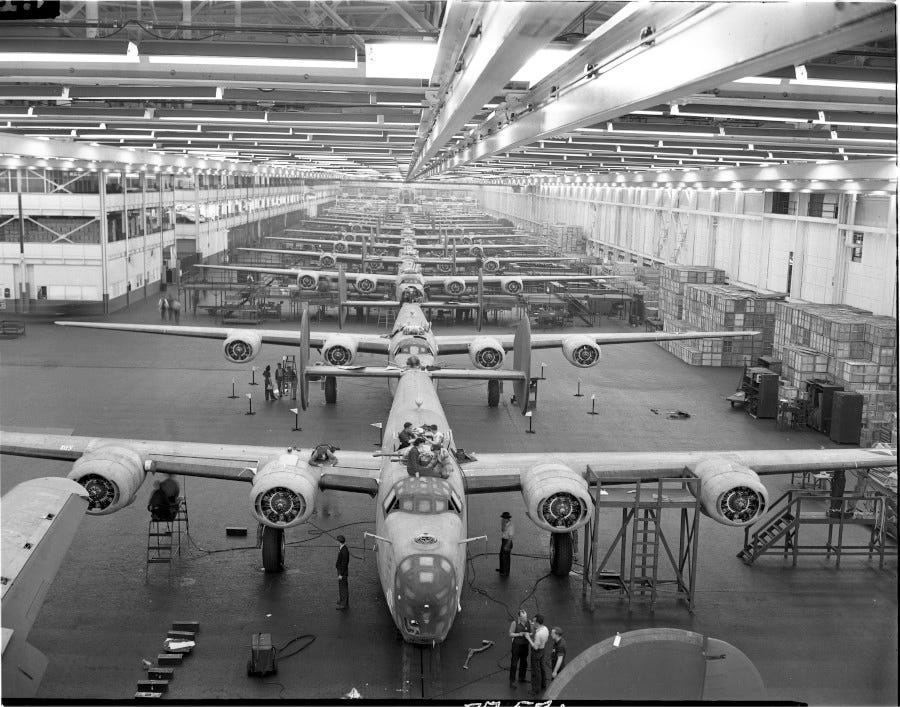
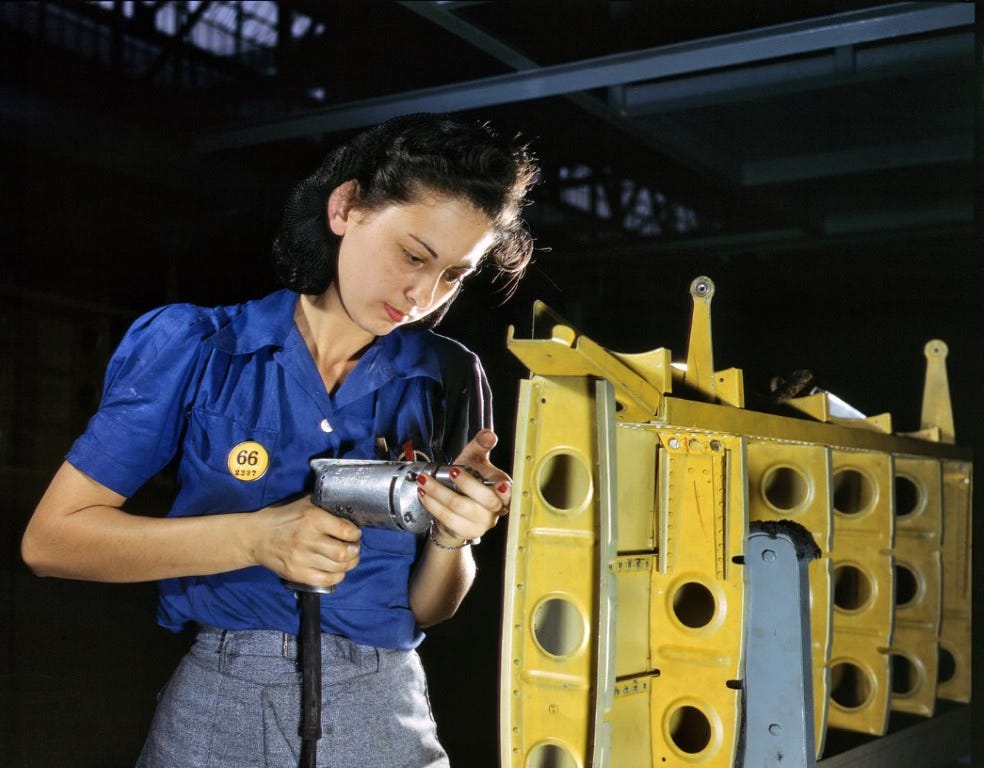
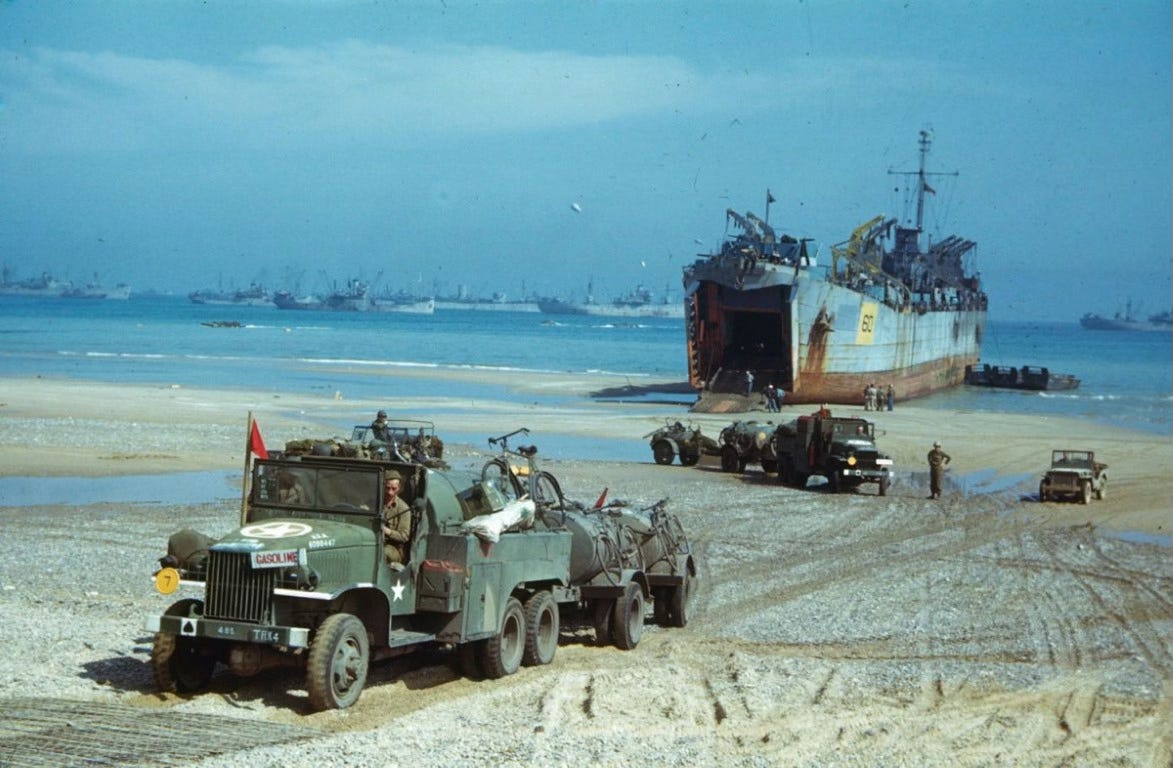
It was in December 1940, however, after winning an unprecedented third term – then perfectly legal – and with a bone fide whopping landslide rather than an imagined one, that Roosevelt was able to address the nation during one of his radio transmitted fireside chats on 29 December and talk of the urgent need to rearm. ‘So I appeal to the owners of plants – to the managers and workers – to our own Government employees – to put every ounce of effort into producing these munitions swiftly and without stint. With this appeal I give you the pledge that all of us who are officers of your Government will devote ourselves to the same whole-hearted extent to the great task that lies ahead. We must be,’ he continued, ‘the great arsenal of democracy.’ And so they became. 315,000 aircraft were built by the USA in the war – 83,000 alone in 1943. Millions of trucks and vehicles were built, tens of millions of shells and bullets, while 10,000 ton ‘Liberty’ merchant ships were constructed at breakneck speed. The US also built an astonishing 74,000 Sherman tanks and tank hulls. This cost, of course, with national debt to GDP rising to 120%, 25% more than it is currently in the UK but making America the richest nation the world had ever known in the process.
The lessons are obvious. As I have written and said repeatedly before, history is here to help. As the current UK government faces economic stagnation, rising welfare, increased threats from its enemies and an ever-changing world in which having a strong defence is not just important but a bare-faced necessity for future security, stability and even survival, the transformation of the United States during World War II should act as a huge inspiration.
Britain has the talent, the wealth, the know-how, and the capability to not only transform its economy but also make the nation safe. What it requires are some bold decisions, a change of mindset, some vision and single-minded determination. It’s all entirely possible. Overhaul procurement processes, borrow through the new Defence, Security and Resilience Bank currently being established, streamline production, instil a sense of national emergency, work across parties and take some bold decisions. The nation is crying out for this kind of dynamism, clear-thinking and frankly, strong, decisive leadership. The government should not be finding reasons or excuses not to take this path but to settle on the end-goal and work backwards. As Churchill famously commented on the endless challenges of building two mobile harbours each larger than Dover that were to be floated across the Channel for the Normandy campaign in 1944, ‘Don’t argue the matter. The problems will argue for themselves.’ And so they did. The Mulberry Harbours were triumphs of ingenuity and of what was possible.
In other words, just get on with it. Take the tough decisions and sell it to the nation, which will then mean convincing Parliament. If a Prime Minister was to tell the country it was going to change laws to reduce the amount of litigation, massively boost the economy, create jobs, wealth and investment, bring a renewed sense of national purpose, and, by the way, make us considerably safer as we confront this disturbingly unsettling world, I strongly suspect the majority would cheer from the rafters.
Someone needs to play the role of General Marshall. Prime Minister, can I have three minutes? This vision for a better, wealthier and safer Britain can become reality. No, it has to become reality. To paraphrase the England cricketer, Ben Stokes, this is not the time for weak men.
No posts
Comments
Nothing yet. Say the first thing.
Sign in to join the conversation.