
Progress is a pendulum, not a snowball
For some reason, I ended up reading this essay for a16z by Alex Danco on a late night train ride, and it made me reflect on the idea of Progress, and wonder where the hell metamodernism went. The piece by Alex Danco, which is short and that I will use as scaffolding in this even shorter text on the same theme, centers on the idea of Prediction as being the successor to the meta-theme of postmodernism. It posits this idea as the next stage in societal intellectual and cultural evolution; “Predictions, as a movement, are the answer to our postmodern malaise. They give us something to do.”
I think Danco is right in that there is a meta-thematic vibe shift, but I think he confuses the symptom with the cause. Prediction markets are not the signs of a new meta-theme, it’s just postmodernism discovering it can monetise its own anxiety. Rather, what we’re entering now, and have been entering since around 2016, is Austere Postmodernism.
Meta-themes are not evenly mapped onto history. Modernism in art was well under way when modernism in business first appeared, and was all but gone when the modernist corporate model reached its post-WWII peak. Postmodernism as an intellectual theme was built on the material riches produced by modernism, its relativism and fragmentation enabled by modernism’s abundance. A material abundance which is rapidly deteriorating because in the process we stopped building.
Danco frames Obama as the last president of the 20th century. I think that is true, but in the sense that Obama was the last president of comfortable postmodernism – postmodernism cushioned by modernism’s progress, while Trump is the first president of austere postmodernism. Postmodernism in its true unbounded form.
Modernism, postmodernism ... funny how these words have entirely swapped their political valence since the mid-2010s, when the alt-right attacked the left as relativising postmodernists and the left derided anything remotely modernist. Today the alt-right embraces postmodernism – because it was never really about truth; it was about power – while the left writes Abundance.
These are all headwords anyhow, Qiaochu Yuan’s framing of the vapid language springing from the mind (or LLMs) vs the visceral words that come from the stomach, what is theorised vs what’s felt, what’s imagined vs what’s real. We can replace “modernism” and “postmodernism” with Light and Dark or whatever dualism that feels alive in you. One is not necessarily better than the other, no yang without yin, and the Rational Light of Modernism has produced horrors beyond human comprehension. It has also produced a life where we live in comforts unthinkable for kings a century ago (as I wrote about in the last post, this essay by Charles C Mann is a must-read: We Live Like Royalty and Don’t Know It.)
Reframing these terms as a duality helps us break free from the idea of Linear Progress™, which is an entirely modernist concept and part of that apex of the pendulum. Being blinded by the imagined light of Progress makes it hard to see postmodern reality for what it really is when we’re in that apex of the pendulum, and then you’re quickly lost, mistaking a maze of self-referential truths as predictable reality. In short, progress is linear while we’re in a modernist mindset, not so much when in a postmodern one.
I believe that this is maybe what happened to Metamodernism. In the end it was little more than a plea for modernism in cool kids’ clothes, a longing for an era in which we could build, institutions, infrastructure, society. As a friend in the mid-2010 metamodernist sphere once confessed to me one late night after many beers, “All we’re really trying to do is make Swedish 60s social democracy sound cool again.” A valiant effort, but the West had different ideas.
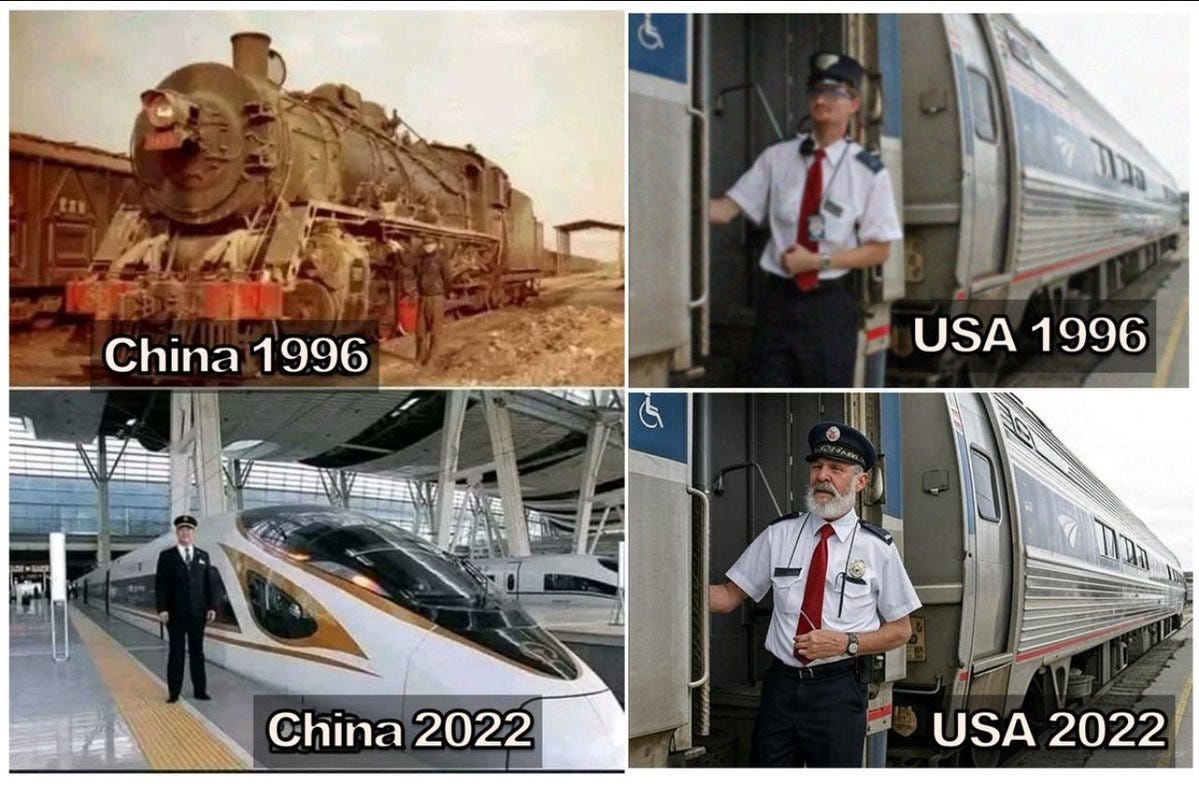
The pendulum of progress does not swing evenly over the centuries, and not over the continents. While Danco talks prediction markets, China builds high-speed rails, and India builds steel plants. These successors to the Western world order are entirely modernist countries. They build abundance, water, power, healthcare, eradication of poverty. On a subconscious level the West has realised this, but don’t worry - you can turn your anxieties into assets while you wait for the wrecking ball.
As the meme goes, hard times create strong men, strong men create good times, and good times offshore industrial base to emerging markets.
A recent ad from Jindal Steel, one of India’s largest steel plants.
Evan Armstrong wrote a great piece on prediction markets earlier in the summer. I believe he’s spot on that this concept is a huge step for Truth, because it puts skin in the game for the truth-seekers. I won’t participate since I’m no expert (don’t think the prediction market potential for interactive art is that big unfortunately), but I would love to hear from those who have.
I read the prelude to Yuk Hui’s latest, Post-Europe (waiting for the book to arrive), and was really taken by the personal and political tone, his description of food and the material composition of our nourishment as one of the strongest indicators of homeness, and his honest attempts at defining the scope of a philosophy of technology beyond the limits of European thought. Very relevant to the argument above, while political/intellectual progress might be a pendulum, technological progress is not.
The postmodern condition is a technological condition, in the sense that technological development has sublated the modernity that produced it. If the modern began with a sense of certainty and security, as in Descartes’s meditations, where such certainty is the only possible beginning of knowledge and its guarantee, the postmodern condition is one under which knowledge no longer emanates from the human subject. Instead, technologies-robotics, artificial intelligence, databases, synthetic biology, etc. — exceed human-centered knowledge production and subvert the relation between the subject and its knowledge. Under the postmodern condition, one no longer finds oneself at home. Instead, one finds oneself in an insecure and uncertain world which is at the same time open and fearful.
The Necks released a new album last week, Disquiet, and it’s everything that I want from music ~ >1h long tracks, extremely slow progressions, gradually patterned rhythms, while still maintaining the improvisational feel that sets it apart from the clinical vibe of similar minimalist music. This is the kind of stuff I’d like as live background music in a bar.
No posts
Comments
Nothing yet. Say the first thing.
Sign in to join the conversation.