
A few of you told me how helpful ‘Three Essential Resources I Regularly Share with Clients: Practical support for Autistic and ADHD adults’ was, so here are a few more.
Whether you’re Autistic/ADHD yourself, or you support people who are, these resources may help put words and frameworks to some common experiences, and help you explore well beyond the brain.
Resource by All Brains Belong VT (2023)
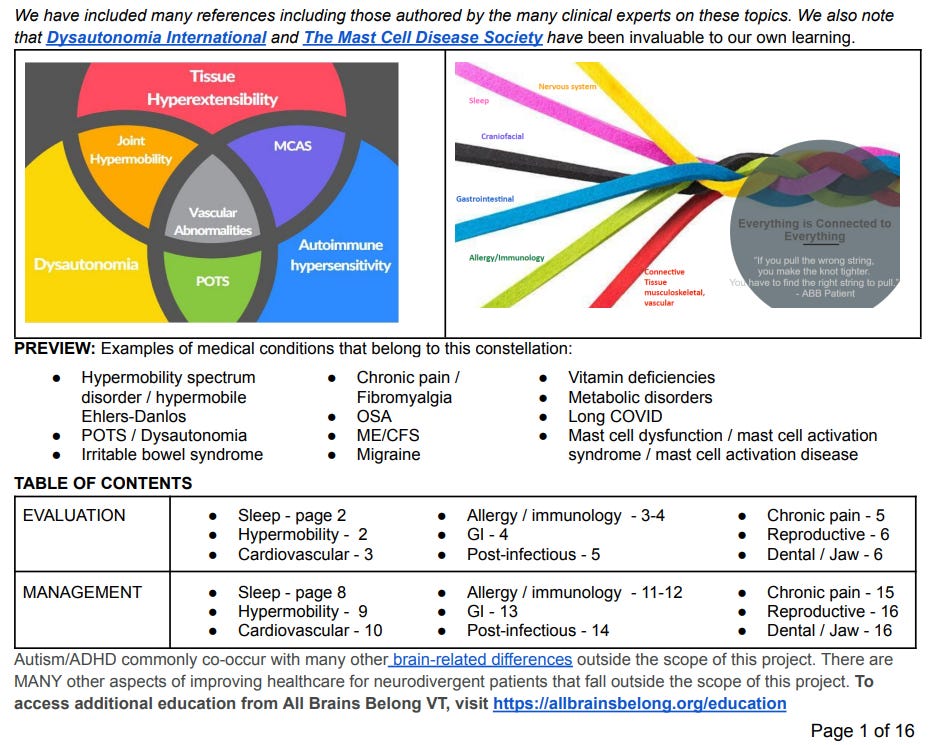
There’s increasing community recognition and research that being Autistic/ADHD can bring with it a higher likelihood of experiencing a range of co-occurring health conditions and other neurodivergences. This guide from All Brains Belong highlights many of these.
The pdf is designed for clinicians and provides an important resource that Autistic and ADHD people can hand to their GP or other healthcare professionals. Knowledge of these connections is hugely variable from person to person, so it can be complete luck of the draw whether a professional is able to connect the dots between your autism or ADHD diagnosis and the range of physical symptoms you’re experiencing.
That’s why this guide is so useful for Autistics and ADHDers too. Understanding what may be going on for us health wise - and what we might need as a result - can be a vital step in accessing the care we actually need, instead of feeling dismissed by professionals who may be missing the knowledge necessary to realise which tests or referrals are needed.
Autism and ADHD are not things that exist in the brain, and they’re not isolated from everything else. Our neurology covers our entire bodymind. The way everything we experience is received, processed, understood, stored, reinterpreted, and in turn interacts with the broader environment comes under this, in constant two-way flow. Understanding our ecosystemic reality, and challenging the separation of mind and body, can help us to understand more about ourselves and our needs on a very practical level.
You can get the resource as a pdf.
Article by Mati Boulakia-Bortnick (2025)
Autistic meltdowns and shutdowns can be experienced very differently from person to person. Someone may find their meltdowns come in the form of explosive rage - while another may cry uncontrollably, for example.
Understanding the difference between meltdowns, internalised meltdowns, and shutdowns - and how each looks for you - can be extremely useful. They’re very different whole bodymind states, which means supporting yourself and recovering in different ways. Noticing the differences in energy and the ways in which they express can help you to map out and understand triggers, signs, preventative steps, and what you need when they do happen. Mistaking one for another - or conflating them with other experiences such as panic attacks - can make it harder to get your needs met, or mean you don’t get support at all.
Mati, The Autistic Coach & Rabbi, gives examples of the internalised meltdowns that are often mistaken for shutdowns, and why they’re so commonly misunderstood. You can Mati’s piece here.
Janae Elisabeth - Trauma Geek’s piece on distinguishing meltdowns and shame spirals is also a valuable read for many.
Article by Tiffany Joseph (2025)
This piece from TJ was written in response to the harm caused by speaking Autistics denigrating and dismissing some of the communication methods used by Non-Speakers.
Whether or not that applies to you, the reality is that community knowledge around Dyspraxic traits and experiences is nowhere near as advanced as it is around Autistic and ADHD ones - at least not from where I’m writing in the UK.
It’s very difficult for adults to get an assessment for dyspraxia (developmental coordination disorder) on the NHS, and many people who experience a significant number of traits - or would even meet the criteria for a clinical diagnosis - are completely unaware of it.
I share Tiffany’s piece with clients not because I think they’re out there trying to shut down the communication methods of Non-Speakers, but because understanding dyspraxia is relevant to all Autistics and ADHDers, and many mention challenges that could potentially be well understood through this lens. I also consider it incredibly important for all of us to listen to, and to learn from and about, the most marginalised members of the Autistic and broader Neurodivergent communities.
I’ve written about the pool of traits that lead people to identify as Autistic, ADHD, or both (AuDHD). I included a link to Tiffany’s piece in there, along with a note that we probably need to include Dyspraxic traits in the pool too. Autistic, ADHD and Dyspraxic attributes may come as a group. Each individual who identities as one of these things almost invariably experiences at least some traits from the other diagnostic categories. It’s important to remember that the lines drawn between them are choices humans have made, not essential and unchanging barriers, and that there is considerable overlap. Dyspraxic, Autistic and ADHD attributes and experiences absolutely exist, but the medical diagnoses that seek to characterise them are evolving constructs.
Tiffany’s piece can help people begin to understand the motor differences that may underpin or contribute to experiences from Autistic inertia and ADHD paralysis, to why so many of struggle to find the right words - or any words at all - when under stress or pressure.
As mentioned earlier, autism and ADHD (and dyspraxia) are not merely brain differences, and they are not things we’ll find located there. They are whole bodymind neurological differences that have a far greater impact than merely the way we think or process information.
You can read TJ’s piece here, along with a follow-up about the apraxia-dyspraxia spectrum.
What I offer:
Online counselling for adults (18+). Sessions usually take place weekly, fortnightly, or on an ad hoc basis.
Rewind trauma therapy for PTSD symptoms can be carried out as part of counselling work or as a stand-alone therapy.
One-to-one neurodiversity discussion for anyone wanting to understand more, and ad hoc clinical consultation and supervision around neurodiversity for counsellors, therapists, mental health practitioners, education professionals and others.
I offer a free, 15-minute online video call for anyone who is interested in supervision, counselling or rewind trauma therapy with me and would like to find out more.
Please get in touch via contact@jadefarrington.com
Comments
Nothing yet. Say the first thing.
Sign in to join the conversation.