
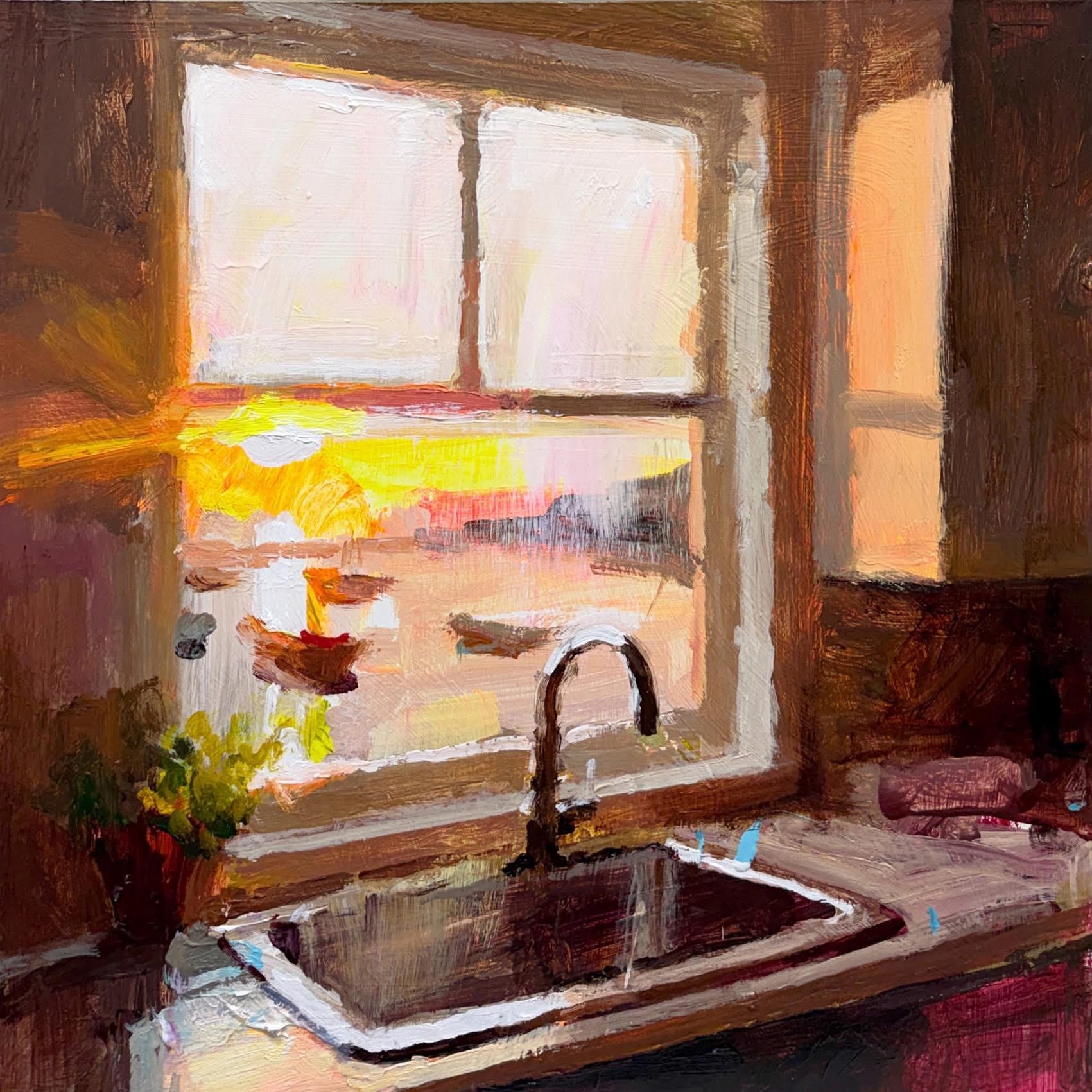
"Hope is not a lottery ticket you can sit on the sofa and clutch, feeling lucky. Hope is an axe you break down doors with in an emergency."
- Rebecca Solnit, Hope in the Dark, 2004
"Why, my soul, are you downcast? Put your hope in God, for I will yet praise him."
- Psalm 42:5
Hello lovely Beaglers, can I call you that, Beaglers? We are beagles for beauty here after all!
Welcome to this July edition from an absolutely sweltering, melting UK. I kid you not, we are not OK. I’m living off of iced lollies at the moment. It’s fun seeing Italians, Texans and the Spanish coming to our defence this past month, they get it, the heat lands differently here. UK homes are built to keep heat IN, not let it out. I saw a report earlier of predicted temperatures up to 45 °C by 2056, goodness, that is a lot of ice lollies!
I’m about to enter my next, and final, study block — two papers due by September, woohoo! Before diving in, I enjoyed a glorious two weeks off to read, slouch, mooch, potter, idle and laze and catch up with beloveds. It’s been bliss. Research begins today: I’ll be grappling with Darwin’s Theory of Evolution and its effect on Christianity and AI’s effect on the Imago Dei.
For a while now, I haven’t been taking very good care of myself physically, a combination of life’s curveballs and what I’ve termed “study-bod.” I’m taking steps to remedy that: eating better, sleeping properly, managing screen time. Small things, but they matter.
Plans may be slightly scuppered for a few weeks, as I managed to break my index toe Friday night and am sporting a rather sexy black ortho boot for the next 4-6 weeks. Satan was seen falling like lightning, no doubt a dramatic sight, but my friend witnessed me falling like a sack of potatoes, which I suspect was considerably more entertaining. When the doctor asked whether I spend much time on my feet, I had to laugh. Plans to shed the study-bod will have to wait a few more weeks yet. Don't misunderstand my view of my current enhanced form though; she has carried me through two years of life’s demands and turned in some decent papers along the way. I'm not mad at her, but she does deserve better care.
Alternatively, you can contribute £2 to The Oxford Studies Kitty Jar via this LINK.
Did you know I link every book, film, recipe etc in the Beagle? Where you see words in BOLD and UNDERLINED, simply click the link.
“Lord God, whatever I have written which is of Thine, let Thy people recognise. If I have written aught which is of mine, forgive Thou, and let Thy people forgive.” -
January 1st 2004, we were approaching the height of the Australian summer, where the days melt together under an unforgiving sun. I’d known for two years I was going to have a second child, a son to be named Jonathan, but hadn’t told my husband until New Year’s Eve, the night before. I knew once my secret was shared, there would be no delay or dissuading him from wanting to begin right away! My traumatic birth experience five years earlier with our daughter had put me off wanting any more children, but it seemed God knew how much this new little life would bless our family. Still, I sat on the news for quite some time, working up the courage, waiting until I felt ‘ready’. In the end, God sent me a sleeping dream to settle my anxieties, an undeniable disclosure. It involved choosing between Matt Damon and Sean Connery, (funny story). After some deep thinking and studying the dream’s symbolism against scripture, I saw I had the choice between following my gifting as a singer/songwriter, or a path that would put that on hold, but a more mature choice, seasoned and stable in the long term. Five weeks later, those little lines on a white stick confirmed what I felt in my body. The following week, I miscarried.
Back from the hospital, we took two days aside together, to grieve, comfort each other and most importantly, pray. It was the most painful season we had faced as a couple, yet the shadow of death held light at its edges through the kindness of dear friends. Scripture arrived to soothe our heartache and to give hope. Hope. How could we hope now? Who was the lost child? Was it Jonathan? Does the miscarriage mean the next baby will be someone else? What about the two years of knowing, the signs along the way, the name given, the dream? I was pierced through with many troubling questions. Yet in that freefall came the fortifying words of God.
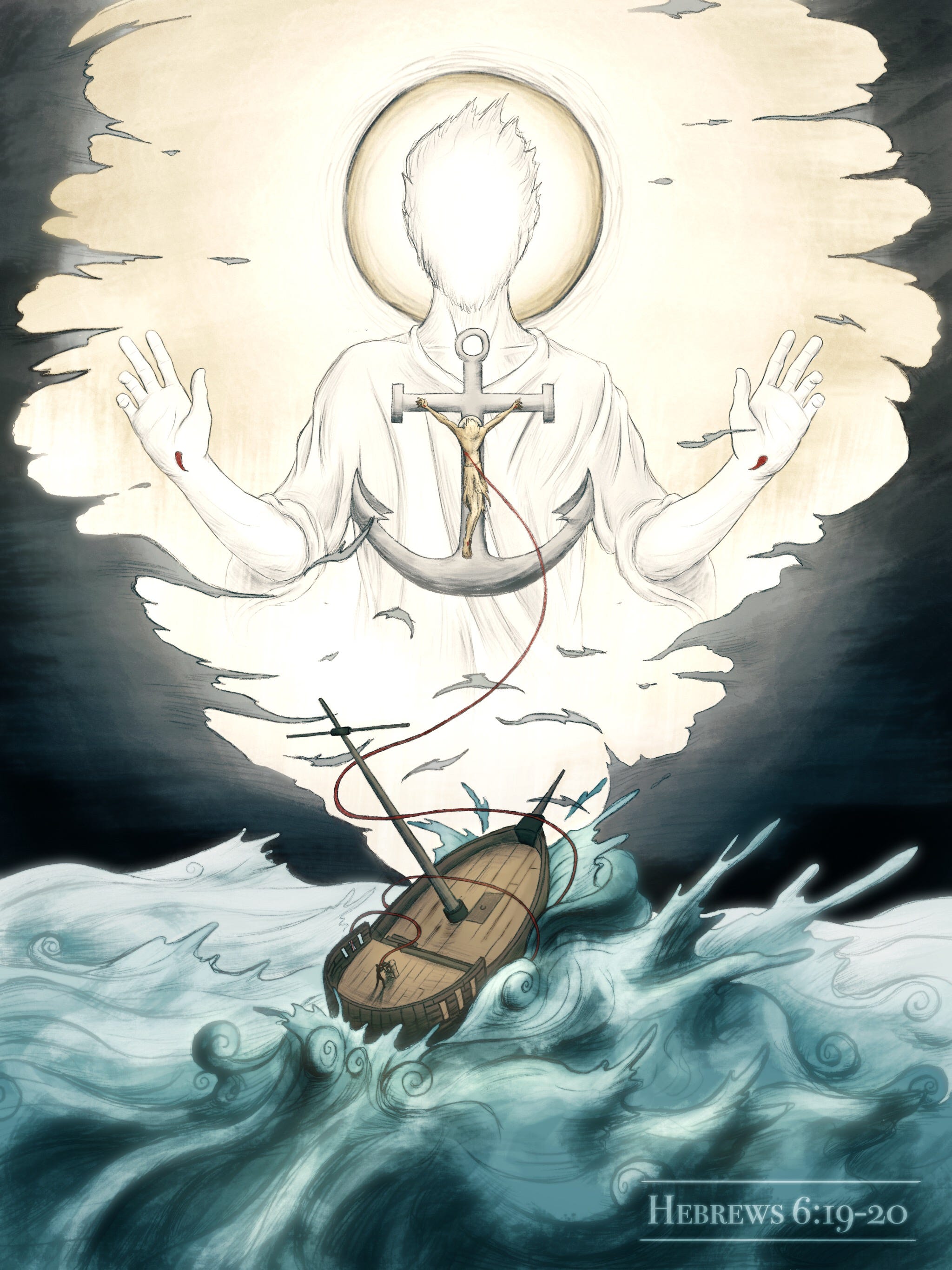
[Now] we have this [hope] as a sure and steadfast anchor of the soul [it cannot slip
and it cannot break down under whoever steps out upon it—a hope] that reaches
farther and enters into [the very certainty of the Presence] within the veil,
where Jesus has entered in for us [in advance], a Forerunner …
Hebrews 6:19-20b AMPC
These words were so secure and trustworthy, they anchored our hearts and made us able to hope again for the boy God has promised. I had imagined that hope would feel like feathers, as Emily Dickinson so famously writes (no shade to Emily), a buoyant sensation, maybe, carefree, possibly, even laughter in the face of trauma. But this hope had substance; it was a galvanising cloak of peace with us held firmly at its centre.
I have six A5 pages in my journal from that time, holding a treasury of promises God gave me. I won’t share them all, but only this, which you will come to see is a marvel at the end of this story. Genesis 21:1, but personalised —
The Lord visited “Jacqui” as He had said, and the Lord did for her as He had promised.
And so hope felt more like a stone, an anchor, in this season of heaviness. It wasn’t the usual kind dropped down into the seabed, but the kind spoken of in Hebrews 6. The mention of it here is absolutely unique in the New Testament; its image is that of an anchor going up, through the veil, to Christ who has gone before. In the context of the passage as a whole, it speaks of a covenantal oath and an unbreakable bond. The hope described here is weighty because it’s real: covenantal, historically enacted, already accomplished. The phrasing in the Amplified brings out the almost architectural characteristic of this hope; you can step out upon it.
As I reflect back on the seasons I have had to step out upon that hope, I see it’s predominantly when I feel least hopeful, least close to God, most fragile. But as I’ve considered the lives of others, those living, and the great cloud of witnesses, I see reflected that same solid hope found in the midst of tremendous strain.
Harriet Tubman, an abolitionist and social activist, ran 13 missions on the Underground Railroad at great personal risk. Harriet was burdened by the hope of rescuing the enslaved. She famously said, “I never ran my train off the track and I never lost a passenger.”
Mary, the mother of Jesus, heard the words “a sword will pierce your own soul”, yet lived with the tension of hope and heartache anchored to the promise of God as she raised the Son of God.
Joni Eareckson Tada, who became a quadriplegic at 17, is a living example of a sure hope. Joni has spent six decades in a wheelchair and still speaks of hope without sentimentality.
Julian of Norwich, following her divine visions, famously wrote the refrain “all shall be well” from what she believed was her deathbed.
And then there is Jesus Himself, His own tethering to joy can be seen in Hebrews 12:2, “Who, for the joy set before Him, endured the cross”, steadying Him towards His Passion.
The weight of the anchor is precisely what makes it useful. A featherweight anchor does nothing in a storm. Feathers drift, anchors hold fast.
March 12th 2005, Jonathan was two days old. The midwife, Diane, came to our home for both of our health checks (yes, they do that in Australia, amazing). Diane clucked and cooed over him as we gathered round, all in delight. “Little promise,” she said softly as she smiled into his wide brown eyes. My husband and I looked to each other, marvelling and almost in disbelief, remembering one of the scriptures God gave us more than a year before: you will have your promise.
Friends, perhaps you are reading this feeling utterly defeated, bereft of hope, waiting on a promise that seems impossibly far away. Waiting on a feeling to lift you out of the heaviness you might be carrying. Will you let me remind you: the hope you have is strong and secure, and it can take the weight of your situation. It’s not wishful thinking. Christ has gone before you into the very presence of the Father and left the way open. You can step out upon it, even now, even here, even in this.
It has brought me a lot of joy reading back over my journals and sharing this story with you today. I hope it encourages you.
* If you would like to read the full creative process and concept behind the illustration, you can read about it here.
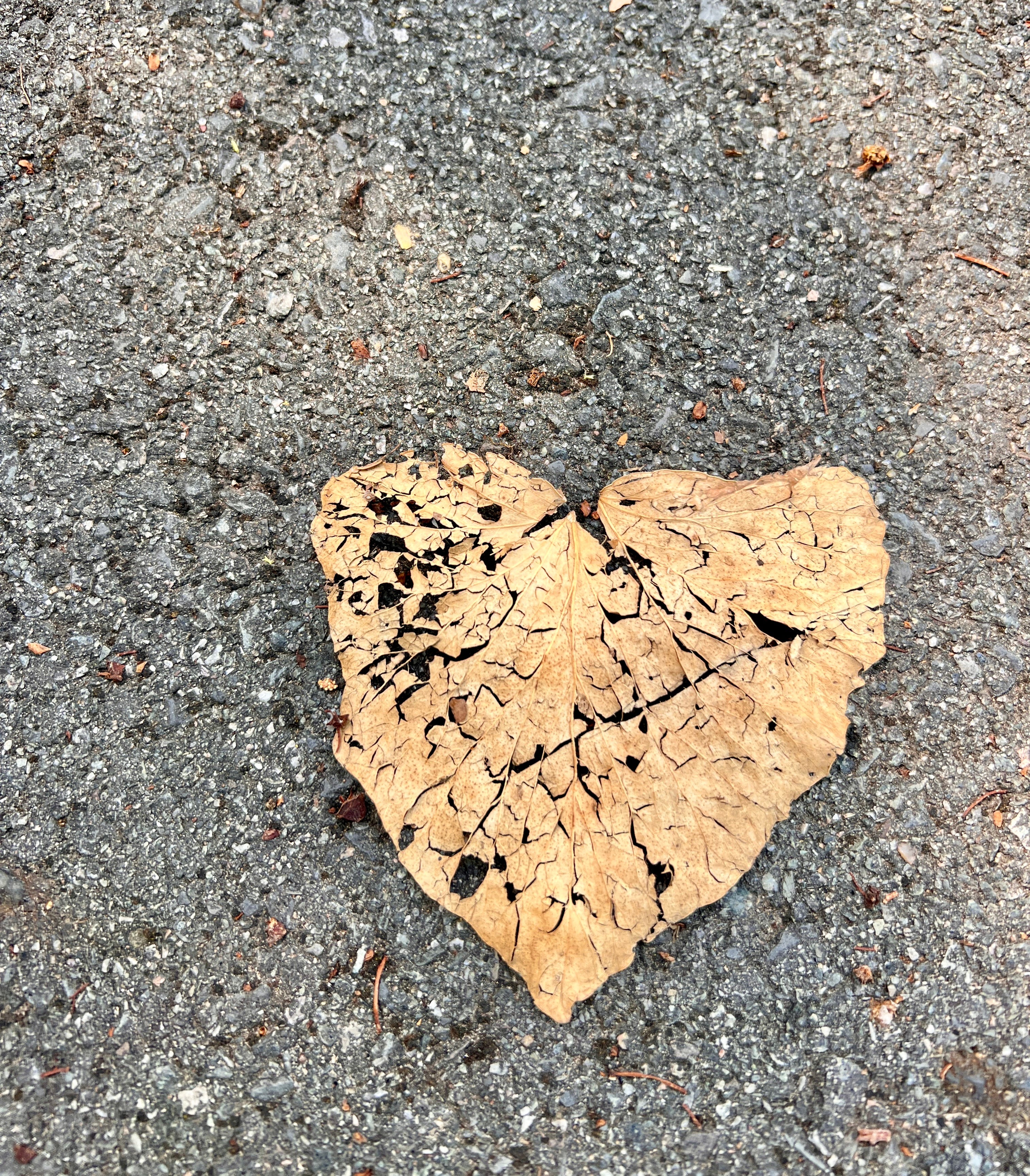
Reasons to Stay Alive, Part Four, pages 178-179
Jeff Foster
From the Introduction:
Can we fall in love with the most ordinary moments of our days? Can we find our salvation in them? A cup of tea. A walk to the post office to mail a letter. Sitting with a friend in silent contemplation. Perhaps the kingdom of heaven is here, right here on Earth.
In the devastation we can truly meet.
And knit with the spiders at dawn.
Giggle with the afternoon crows.
Play hide-and-seek with the grown-ups:
make them forget their melancholy,
if only for a moment.
Sing star-mantras with the wolves.
And live the days.
Somehow live through the days.
Where the beauty is just too relentless.
Where we haven’t got the strength to stand.
Where we cannot breathe ourselves
and so Love breathes us instead,
and warms us from the inside,
and fills us with new hope
under an iridescent sky.
She Stands. Still.
As I wrote last month, I’m finding comfort and renewed inspiration in stripping back my creative process, in returning to the first love of composition. The simplest images are often the most potent, the bare bones of a thing saying more than a fully fleshed-out display. A few years ago I was growing my own parrot tulips, as seen here. This beauty unexpectedly sprang up this year in a neglected pot. From the driest, rubble-like ground, she pushed on through. You go girl!
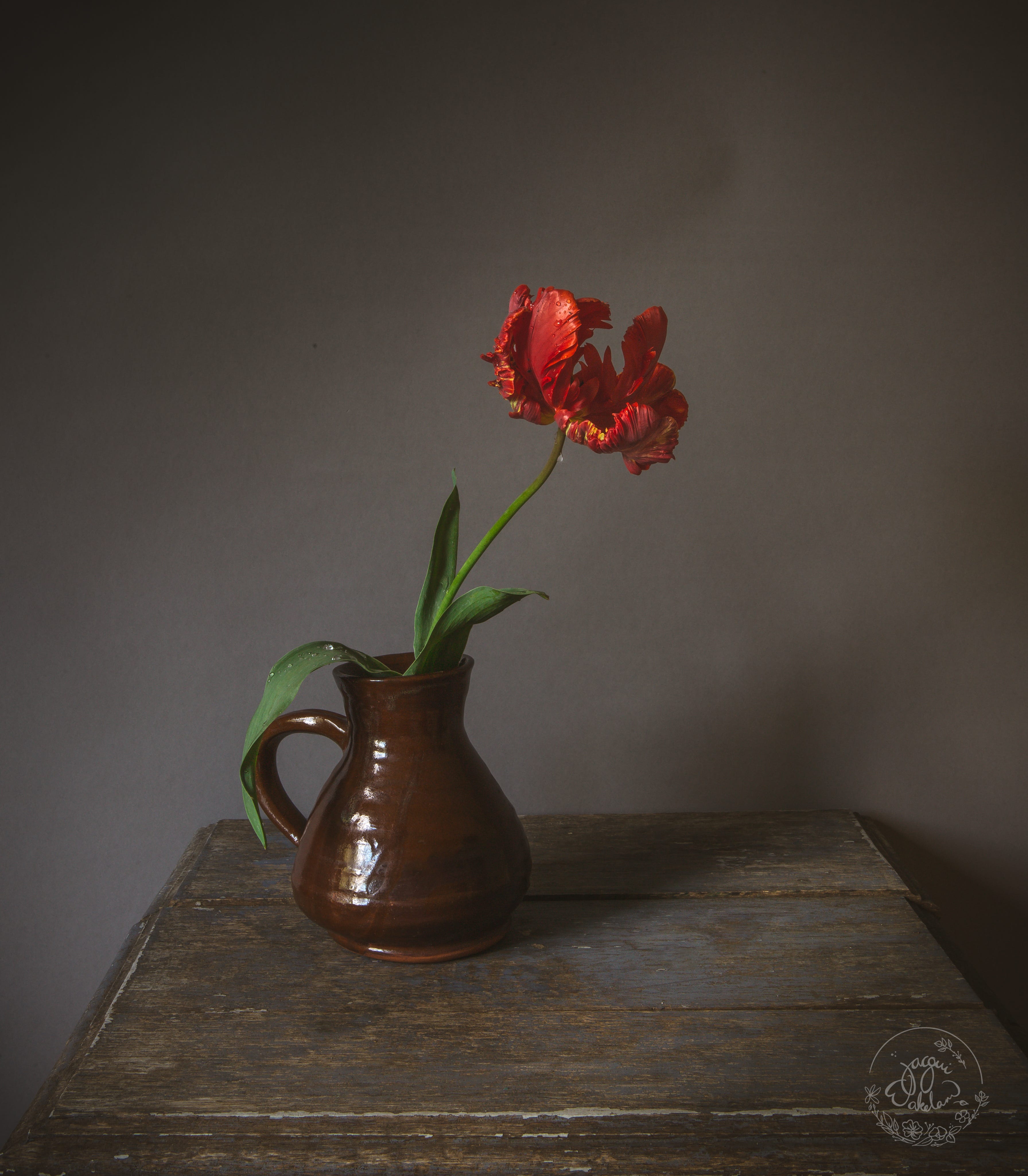
Monthly paid supporters will have full access to each image for your personal use. I am deeply grateful to my financial partners, it means so much to me that you get behind my work, thank you.
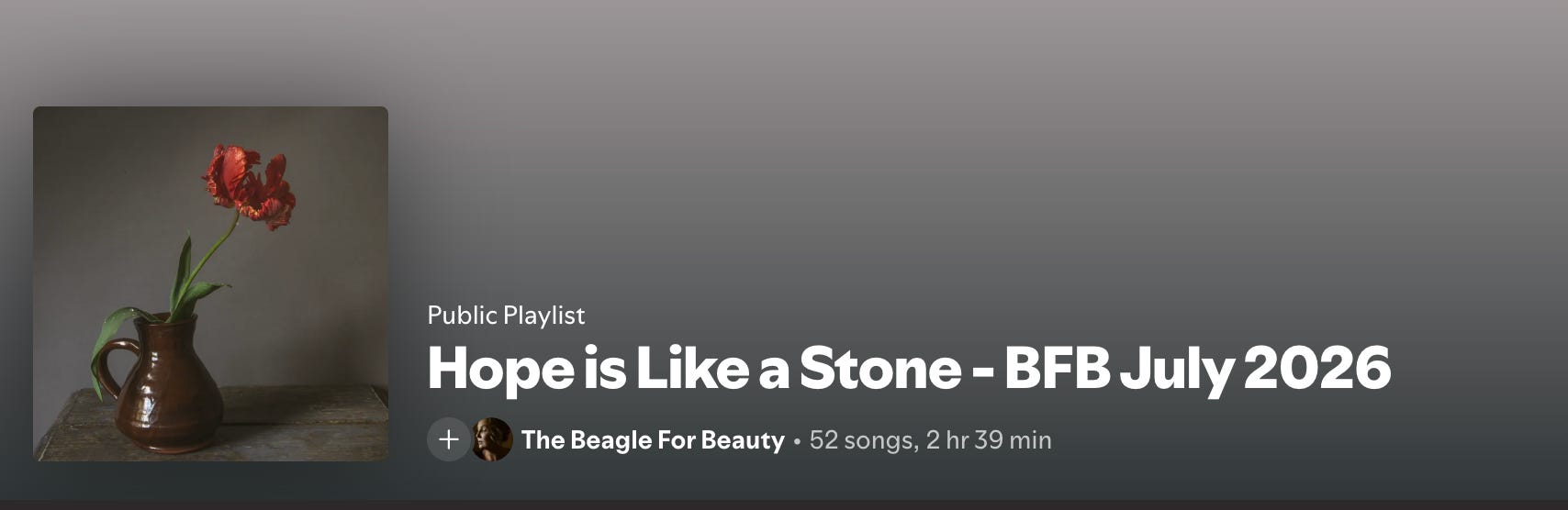
I’ve curated an upbeat, summer-drive, sunshine-vibes playlist for this month.
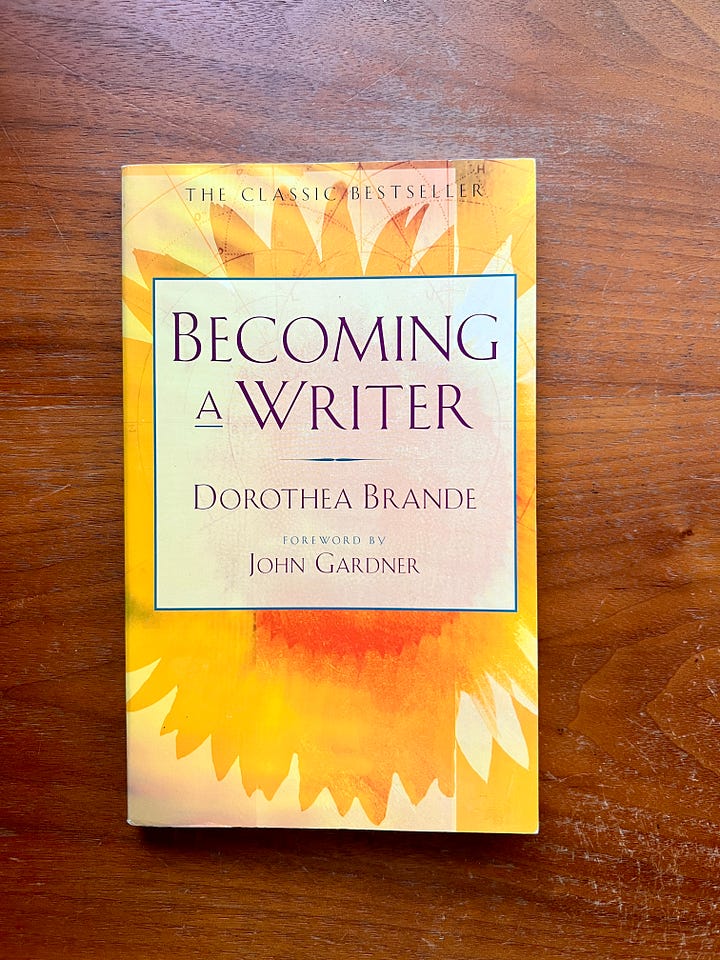
Becoming a Writer, Dorothea Brande. I heard this referenced by a respected writer on this platform, so I invested in it for my library and future inspiration.
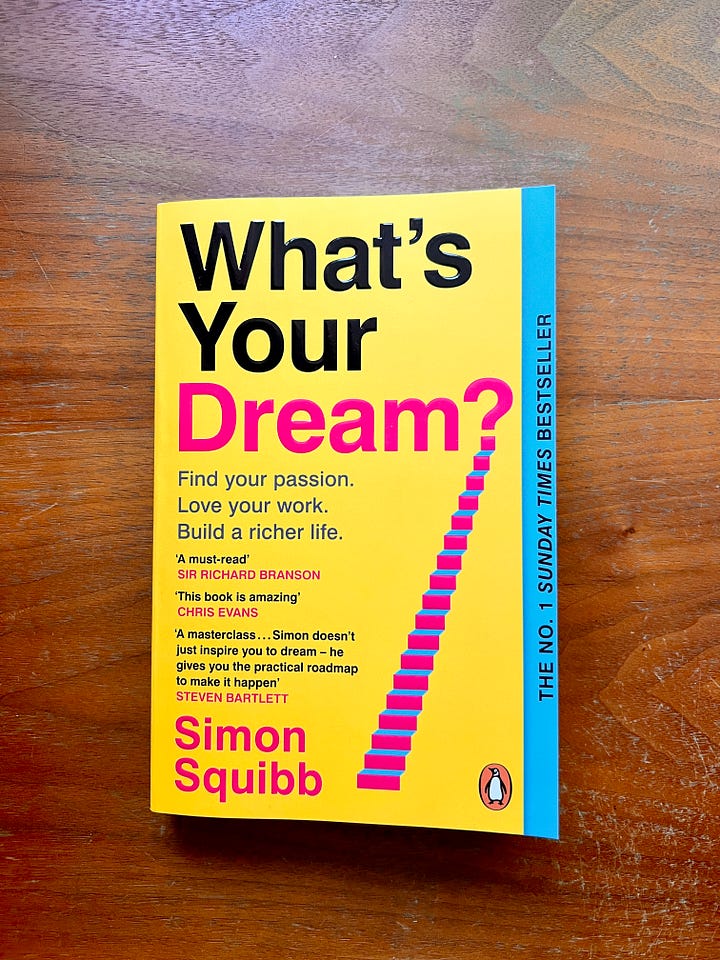
What’s Your Dream? Simon Squibb. Simon is an entrepreneur who is known for helping people launch initiatives and ventures they hold in secret, usually under a tombstone of doubt and self-defeat. I think this might be good to help me get myself out of the way and dream bigger in the Holy Spirit about what I might put my hand to in future years.
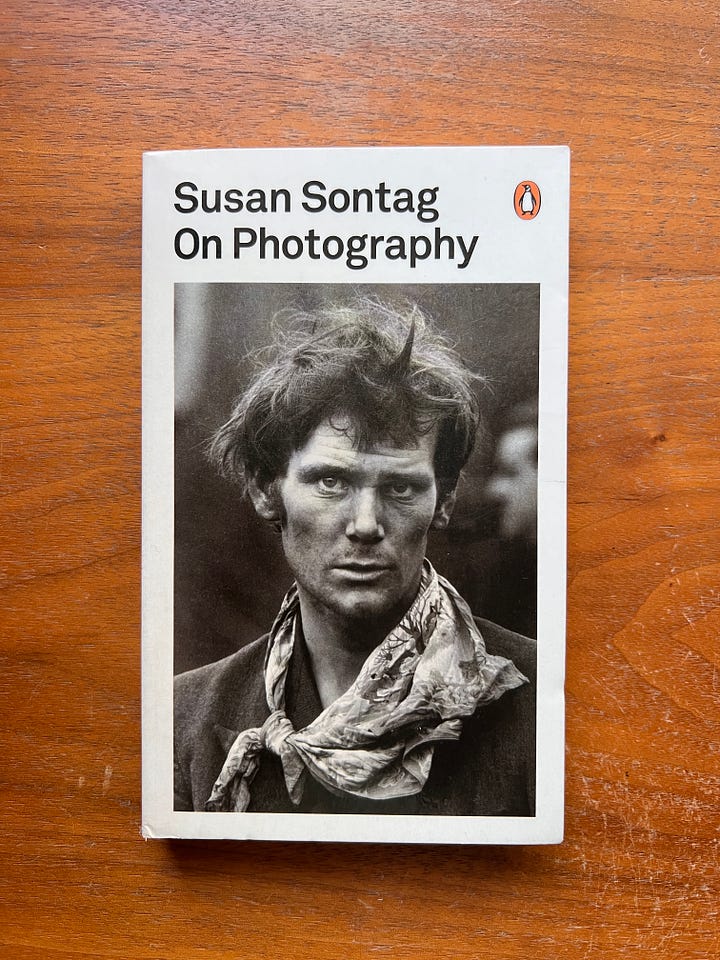
Susan Sontag on Photography. I saw a quote from this book a couple of weeks ago which piqued my interest. Apparently, a respected and staple resource for photographers, so I’m hoping it will expand my understanding of the craft.
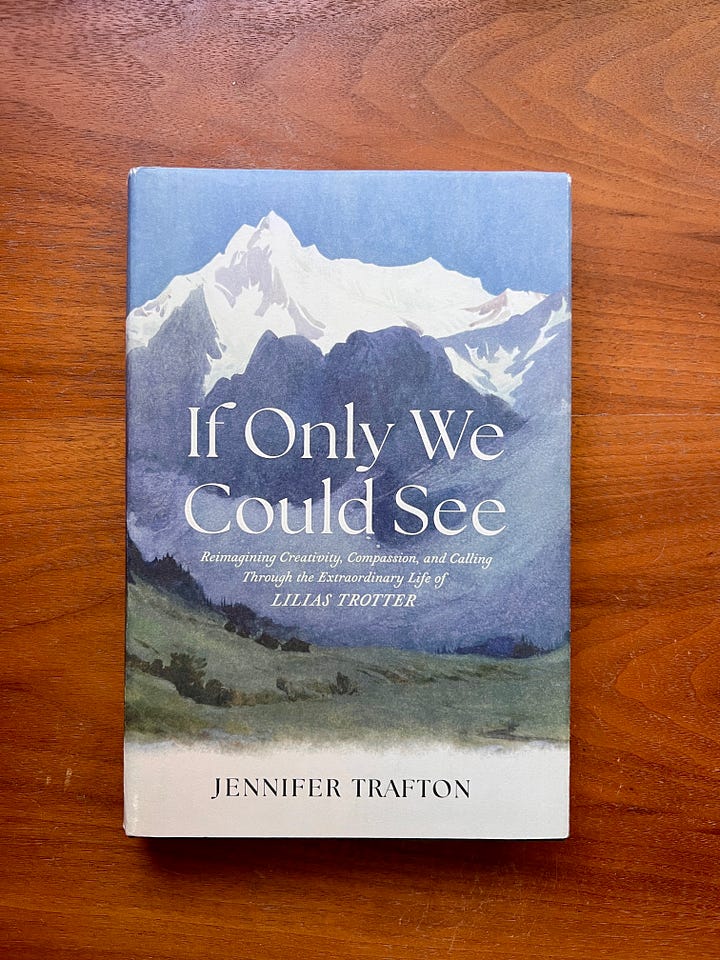
If Only We Could See, Jennifer Trafton. My ongoing daily read.
I can see I’m lacking a good fiction book at the moment. I have Jayber Crow and Gentian Hill on my bookshelf. Which do you think I should read?
I’ve recommended this film before, but I recently rewatched it (always a good sign). And as I said regarding it previously, if you can suspend knowledge and any supposed connection to Jane Austen’s untouchable classic, you will enjoy this delightful, very sweet, fun interpretation of Persuasion. The cinematography is beautiful.
[Occasionally, my recommendations may not be for everyone. My choice of films, books etc are based on my particular tastes and tolerances. Just a note for my G-rated friends]
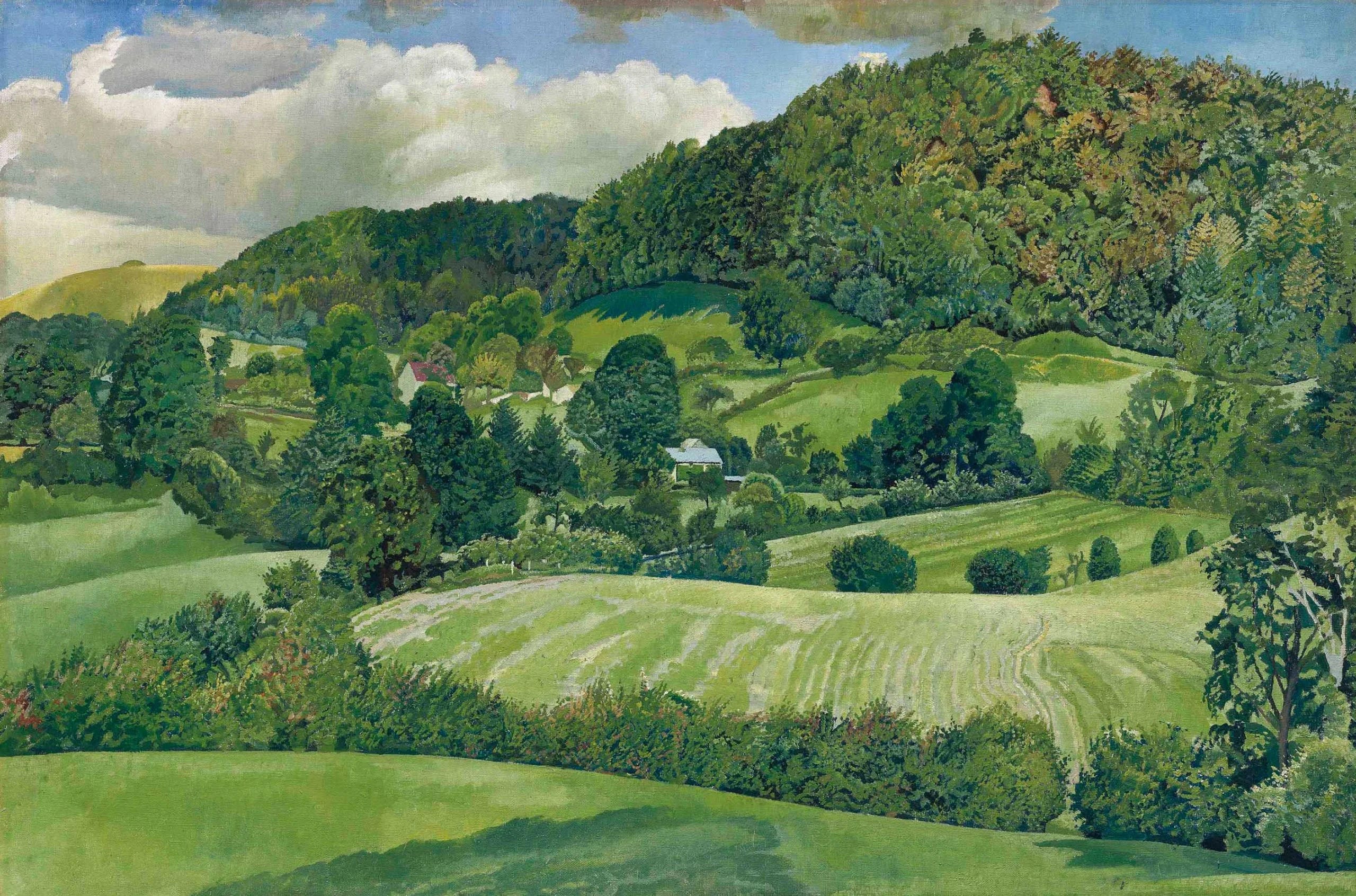
Landscape, Gloucestershire — Stanley Spencer, 1940.
Stanley Spencer (1891-1959) is one of the most distinctive and beloved British painters of the 20th century, sometimes called “the English visionary.”
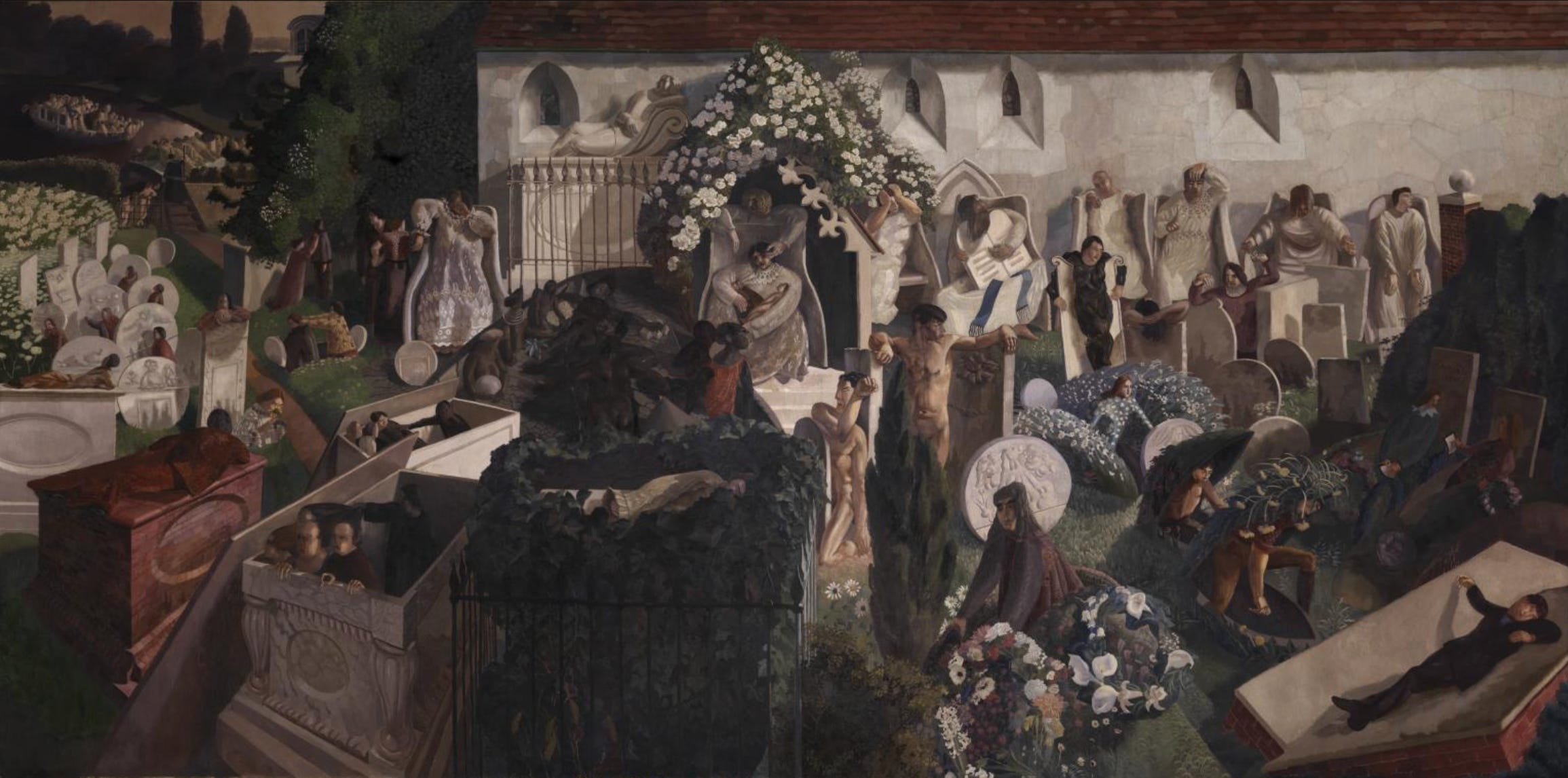
He grew up in Cookham, a small village in Berkshire on the Thames, and never really left it spiritually even when he was away physically. He believed Cookham was a holy place, and his most famous works transplant biblical scenes directly into its streets and riverbanks. The Resurrection, Cookham (1924-27, now in the Tate) shows the dead rising from Cookham churchyard in summer clothes, entirely matter-of-fact about it.
His central preoccupation was the intersection of the sacred and the utterly ordinary. He saw divine life pulsing through everyday English village existence, which gives his work a quality that is simultaneously strange and deeply warm.
During WWI he served as a medical orderly in Macedonia, and later painted an extraordinary series of murals for the Sandham Memorial Chapel in Burghclere, depicting not the heroics of war but the mundane duties: scrubbing floors, sorting kit, making beds. The resurrection scene above the altar shows soldiers handing in their crosses rather than weapons.
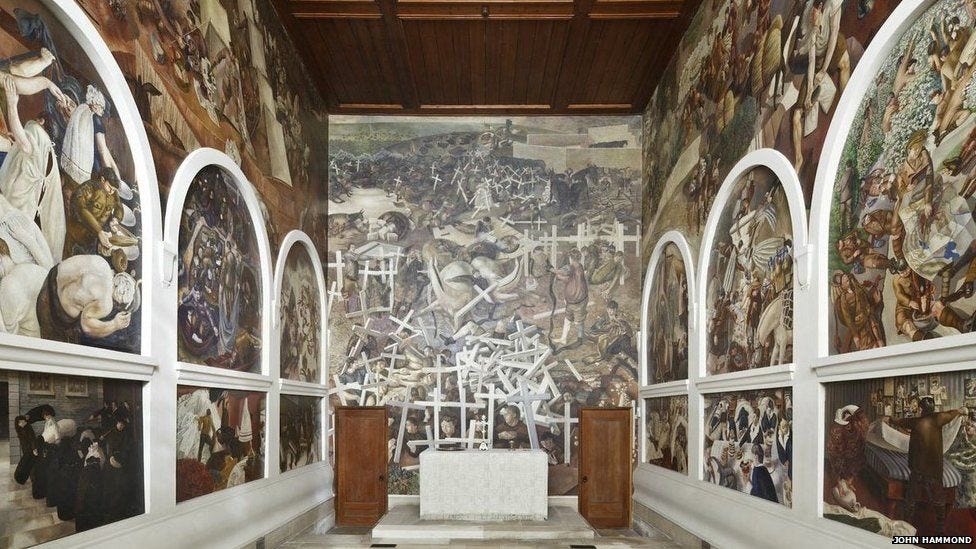
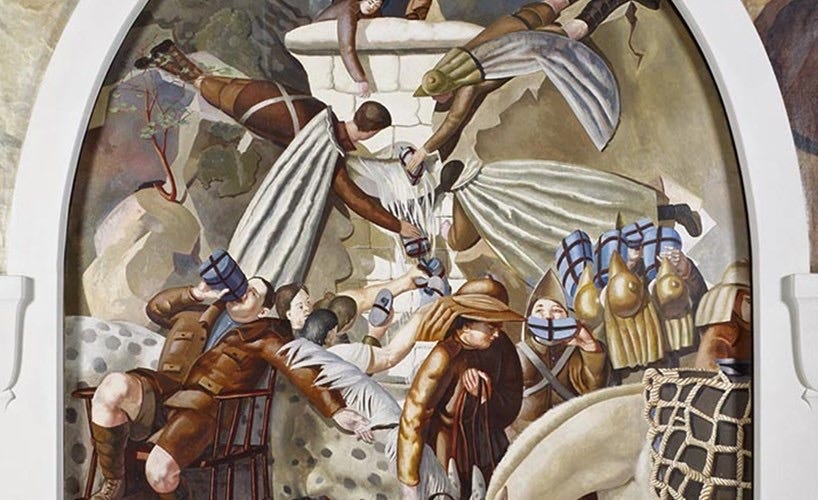
His personal life was chaotic and somewhat notorious. He was devoted to his first wife Hilda Carline even after their divorce, and continued writing her letters after her death.
His landscapes, including the Gloucestershire work featured, are less celebrated than his figurative paintings but beautifully attentive. The 1940 date puts it in his wartime period, when he was moving around England and painting the countryside with the same close, loving attention he gave Cookham.
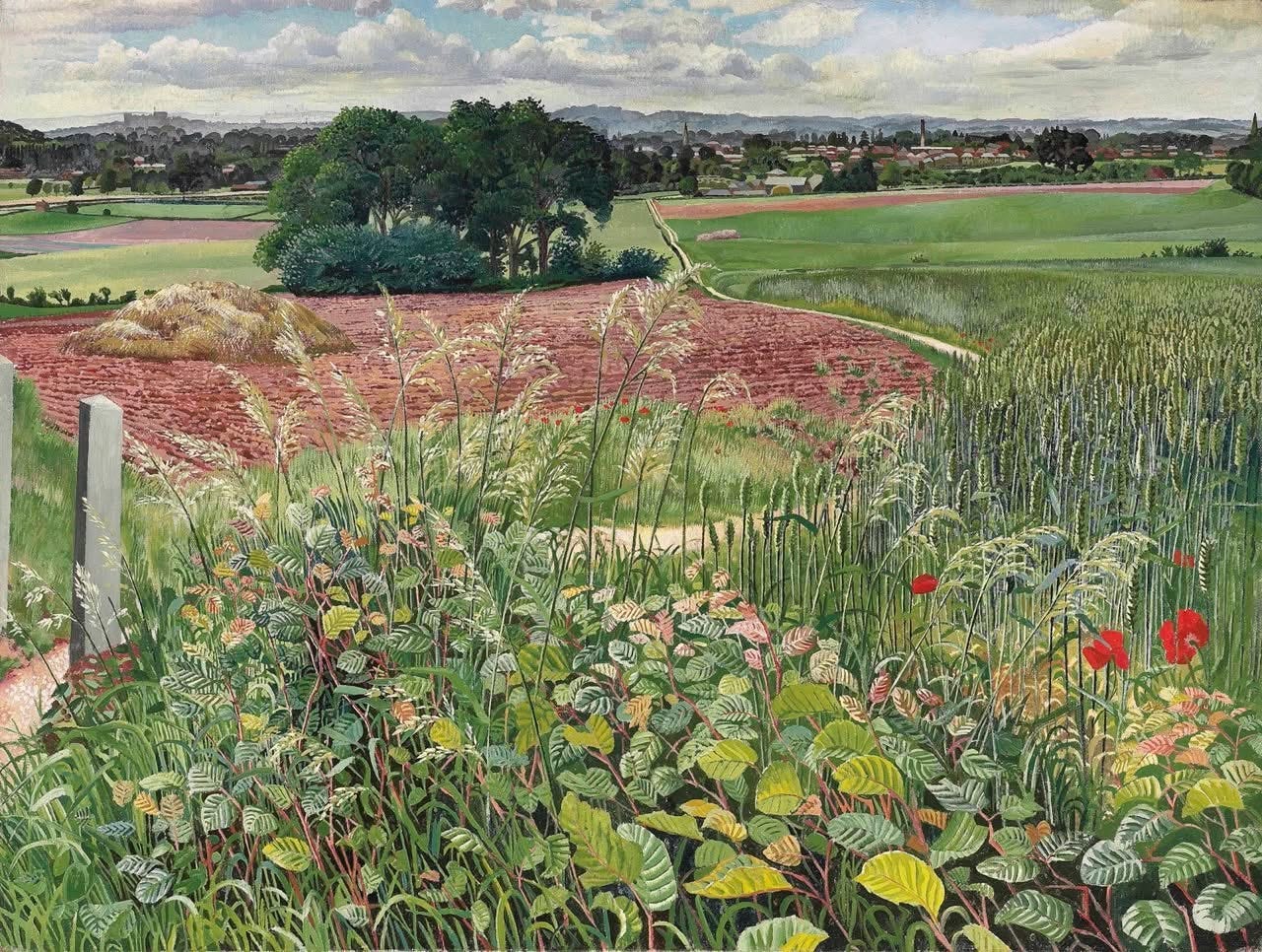
I think his summertime rural landscapes are simply stunning and remind me of my childhood years growing up in the Hampshire countryside.
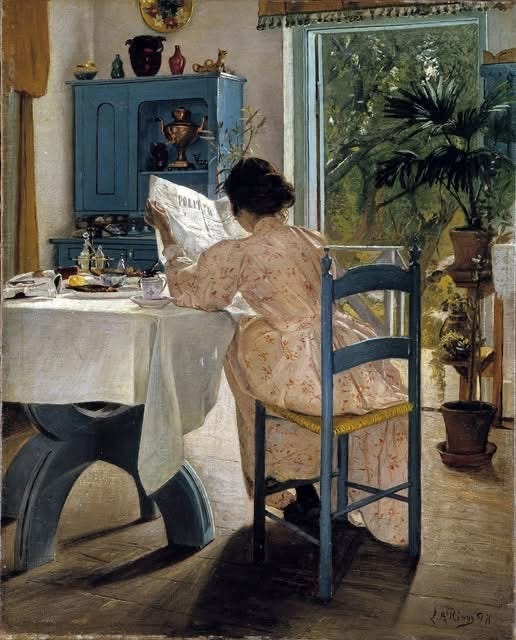
Let me leave you with the tranquil scene of a quiet dining room, the lone figure of a woman reading her paper, the gentle light falling across the room, cup of tea to her side. No noise, no phones (no children :), maybe just the chirping of the birds outside. And, breathe.
A Blessing—
The Lord bless you and keep you; the Lord make his face shine on you and be gracious to you; the Lord turn his face toward you and give you peace.
Numbers 6:24-26
Jacqui
Comments
Nothing yet. Say the first thing.
Sign in to join the conversation.