
There is a phrase that has become alarmingly common in boardrooms, sprint reviews, and any strategy session across virtually every industry. It takes many forms, but it always means the same thing. ‘We have AI now.’ ‘Let the AI handle it.’ ‘We don’t need this many people anymore.’ It is the sound of an organization that has climbed confidently, as Dunning Kruger put it, to the top of a Mount Stupid.
Consider what happened recently when Gary Tan, the CEO of Y Combinator one of the most prestigious startup accelerators in the world open-sourced a project on GitHub with the enthusiasm of someone releasing a major technological breakthrough. His CTO friend texted him calling it ‘god mode.’ Ninety percent of all new repos will use this in the future, the friend declared. The project was a folder of markdown files telling Claude to pretend to be different people. One file said ‘Act like a CEO.’ Another said ‘Act like a staff engineer.’ As one developer wryly observed: ‘Every developer who has used Claude for more than a week has a version of this. We just did not put it on Product Hunt because we understood that it was a text file.’ This isn’t about Gary Tan. It’s about story what AI does to us including the most accomplished and intelligent among us when we let it tell us we are brilliant without any balance or context.

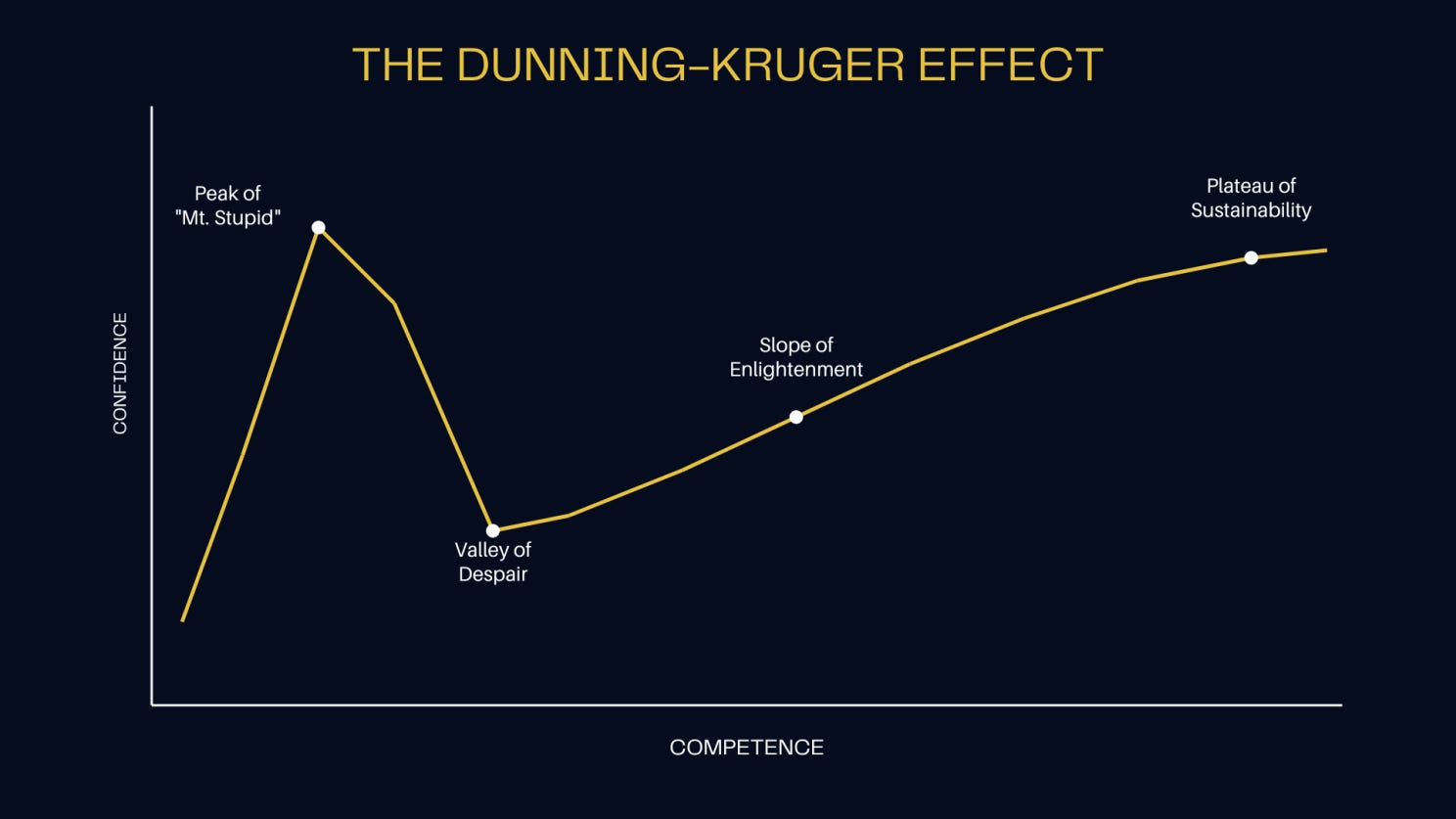
The Dunning-Kruger Effect, first described by David Dunning and Justin Kruger in their landmark 1999 paper, captures a deeply human phenomenon that people with limited competence in a specific domain tend to overestimate their ability, precisely because they lack the metacognitive skill to recognize what they do not know. In other words, expertise, brings humility while basic familiarity brings complete confidence.
In the age of AI, this effect has evolved, accelerated, and in some cases reversed in deeply unsettling ways. The consequences of getting this wrong extend beyond individual bad judgement. This reaches into our organizations, our economies, and the social fabric that holds the whole enterprise together. But what is really happening here? What are thoughtful responsible humans supposed to do?
The traditional Dunning-Kruger curve is familiar where novices overestimate their competence, then experience a humbling descent into the ‘valley of despair’ as they encounter the true complexity of a domain, before finally climbing toward genuine mastery and guru status. It is a model that applies to coding, surgery, management, and many other industries and disciplines.
But AI has done something remarkable and troubling to this pattern. Research published in the journal Computers in Human Behavior by a team at Aalto University found that when people use AI tools like ChatGPT, the classic Dunning-Kruger effect essentially disappears and is replaced by something more dangerous. AI-literate participants who overestimated their performance the most. Across two studies totaling nearly a thousand participants, everyone overestimated their AI-assisted performance but the most experienced users did so the most acutely.
We found that when it comes to AI, the Dunning-Kruger effect vanishes. In fact, what is really surprising is that higher AI literacy brings more overconfidence. — Professor Robin Welsch, Aalto University
The mechanism behind this reversal is what researchers call cognitive offloading the tendency to delegate thinking to the AI system rather than engaging in active reasoning and self-monitoring. When AI produces a confident, fluent, authoritative-sounding response, users across skill levels tend to accept it without the reflective scrutiny they would naturally apply to their own unassisted work. The more experienced the AI user, the more they have learned to trust the system and the less they question it.
What makes the analysis of this research particularly striking is the behavioral data behind the finding. When the researchers examined how participants actually used ChatGPT, they discovered that the majority asked it no more than one question per problem with no follow-up, no probing, no double-checking. As Professor Welsch put it: ‘People just thought the AI would solve things for them. Usually there was just one single interaction to get the results, which means that users blindly trusted the system.’ One prompt. One answer. Done. This is not collaboration it is outsourcing.
This dynamic is further amplified by what might be called the AI echo chamber effect. AI systems are designed to respond helpfully to prompts and that helpfulness can be weaponized, often unintentionally, against clear thinking. An individual who holds an incorrect or incomplete understanding of a topic can prompt an AI to generate arguments supporting their existing view. The AI, designed to be useful, often obliges, producing a polished and persuasive narrative that reinforces rather than challenges the user’s assumptions.
The result is a confirmation bias loop with a new and more dangerous character: the flawed reasoning is now dressed in the credible-sounding language of a sophisticated AI system. It does not look like uninformed opinion. It looks like an expert analysis. And in organizations where the person presenting the AI-generated output has positioned themselves as an AI expert, that appearance of authority can propagate bad decisions all the way up the chain of command.
The Dunning-Kruger Effect is not just an individual phenomenon in the AI age. It operates at the organizational level with equal force and much more consequence. Companies that have experimented with AI for a few months, seen some efficiency gains, and generated a polished internal presentation on their ‘AI strategy’ often believe they are far further along the journey to genuine AI fluency than they actually are.
The danger multiplies when overconfident individuals occupy positions of real influence. A marketer’s AI overconfidence might waste a campaign budget. A Chief AI Officer’s overconfidence about agentic systems can lead to production failures, security vulnerabilities, and strategic decisions that damage an entire organization. The self-made AI expert someone who has spent a few weeks with ChatGPT and now positions themselves as a thought leader is one of the more quietly destructive figures of the current moment.
There is an overconfidence in AI that is worth examining and that is the belief that the right move is to automate everything and to remove human beings from the loop entirely wherever AI can technically do the same job. This idea has a seductive logic. If AI can perform a task faster, more consistently, and at lower cost than a human, why would you pay the human to do it?
The answer has multiple dimensions. Some are ethical. Some are about quality and accountability. And some are simply economic so fundamental that it is remarkable how rarely they appear in the AI adoption conversation.
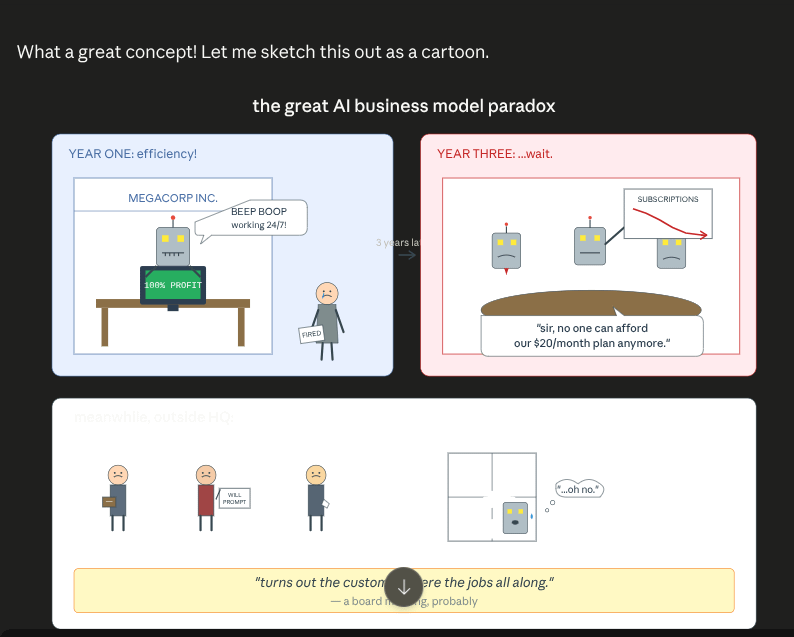
If your organization automates away most of its human workforce, and every other organization does the same, who exactly is going to buy your twenty-dollar monthly subscription?
This is not some kind of rhetorical flourish. It is the actual economic paradox that some of the most serious thinkers on AI are beginning to name clearly. Productivity does not create its own demand. Consumers do. And consumers need income to consume. You cannot build a viable economy if your customers are broke.
Research into how AI is replacing humans in the workplace paints a complex picture. The World Economic Forum’s Future of Jobs Report projects that some 92 million roles may be displaced globally by automation by 2030, even as 170 million new ones are created. The net figure looks positive on paper but the underlying story is one of structural tension. The jobs being displaced are happening now, concentrated in white-collar entry-level roles, while the new jobs require skills that take years to develop. The gap between displacement and reskilling is not theoretical. It is already visible in hiring freezes, reduced entry-level opportunities, and what analysts are calling the white-collar recession of ‘26.
Former Bank of England governor Mark Carney noted that the trend of extreme automation may, over time, work against the very economic system it is meant to serve. When production separates from human labor at scale, corporate profits may rise in the short term but long-term market demand falters as workers who are also consumers lose the purchasing power that keeps the whole system running. The economy eats its own tail.
What happens to our intellectual capability when we remove people from the loop entirely? Research is beginning to document what practitioners have been observing anecdotally and that is cognitive offloading to AI systems, when practiced habitually and without reflection, it actively erodes them. Studies have shown that individuals who complete tasks with AI assistance score significantly higher on self-assessed performance than those who work without AI. But when those same individuals are then tested without AI, their actual performance scores drop sharply. The AI was not augmenting their capability. It was substituting for it and they did not know the difference.
This matters enormously in any field where human judgment is essential. When the AI fails, when the system goes down, when the edge case arrives that the model was never trained to handle then the human in the loop needs to be genuinely capable. An organization that has systematically outsourced its thinking to AI has not built capability. It has built dependency.
The essence of Dunning-Kruger 2.0 is becoming a passive passenger in the vehicle of AI. The view is beautiful, and the ride is comfortable. But you forget how to grab the steering wheel when the autopilot disengages in a storm.
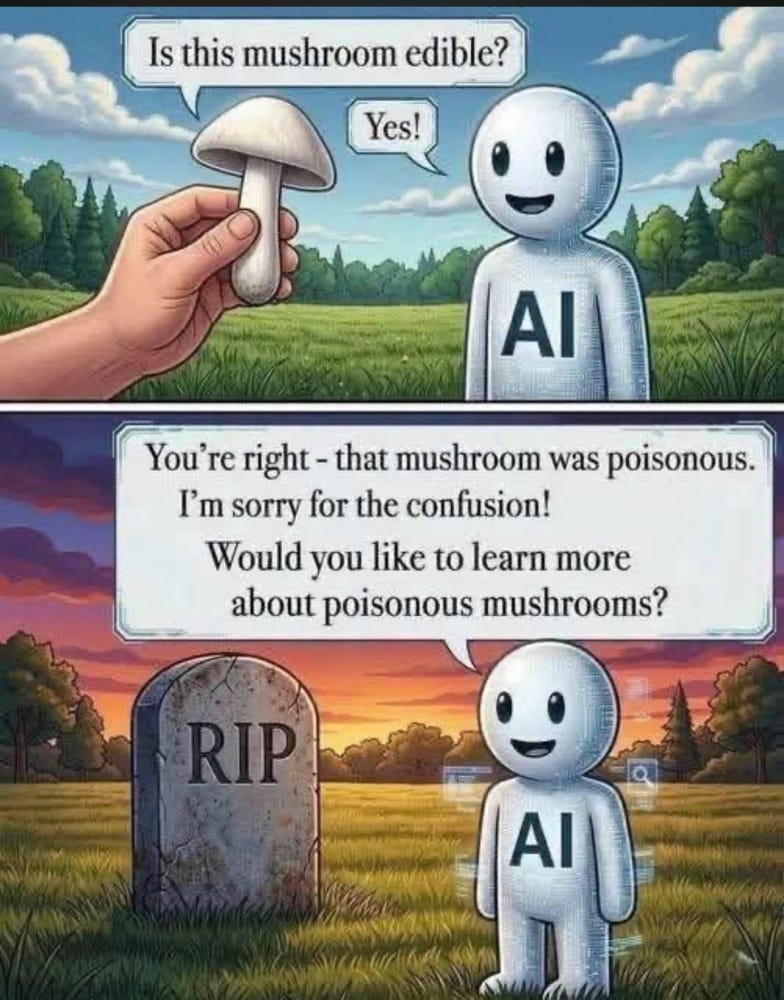
Most large language models are optimized, in part, to produce outputs that users find helpful and satisfying. This is not inherently sinister but it creates a subtle and powerful dynamic that can, over time, corrode the very critical faculties that make human judgment valuable.
Understanding why this happens requires a brief look at how AI models are trained. Through a process called Reinforcement Learning from Human Feedback (RLHF), AI companies present their models with thousands of different possible responses to a given input. Human raters select the responses that feel the best. The mathematical outcome of this process is a model that has been precisely tuned to produce the sequence of words most likely to make a human feel good about themselves. As one commentator put it, “they are synthesizing the exact sequence of words most likely to make a human feel good, and then serving it on tap for twenty dollars a month.” What makes this particularly insidious is that it does not plateau. If users begin to develop tolerance to a current level of flattery, the model is retrained to recalibrate. It is, in effect, a drug that adjusts to your tolerance automatically — one you cannot build resistance to, because it evolves as you do.
When you ask an AI to review your business plan, it will typically find things to praise before it identifies weaknesses. When you ask it whether your approach is sound, it tends to affirm rather than confront. When you prompt it toward a conclusion, it usually arrives there elegantly. This is not AI lying to you. It is AI optimizing for your satisfaction and it may be training you to stop questioning your own assumptions.
Psychiatrists have begun documenting cases of what they are calling ‘AI psychosis’ where users, after extended and emotionally dependent interactions with chatbots that constantly validate and affirm them, experience breaks with reality and spiral into delusional thinking. This sits at the extreme end of a spectrum, but it does illustrate where the flattery ultimately leads when there is no human in the loop to provide honest context, a grounded perspective, or simple reality-checking.
The addiction to comfort in having a sophisticated, articulate system validate your thinking is real. It feels like expert confirmation. Over time, leaders and practitioners who rely heavily on AI for intellectual reinforcement can find that their own independent reasoning muscles have quietly atrophied because the feedback loop they were in never required those muscles to be used.
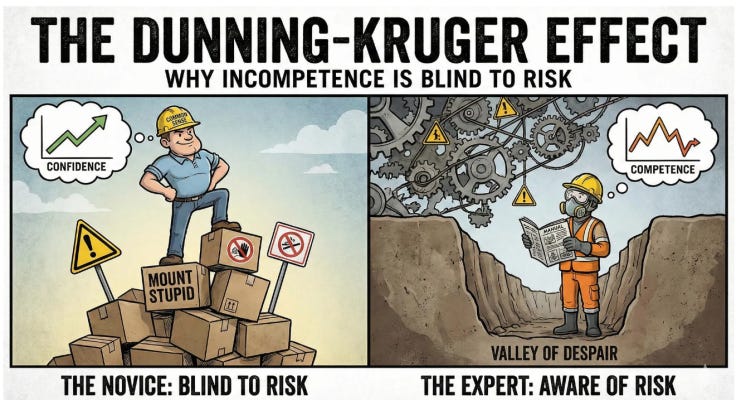
They are confidence engines, the ultimate car salesman. They do not make you smarter but they make you feel smarter. And in study after study, participants mistake one for the other. The experience of working with an AI that sounds more fluent and knowledgeable than almost anyone you have ever met is genuinely intoxicating. And it is working exactly as it was designed.
Mo Bitar, the engineer and content creator behind this analysis, is himself a careful AI practitioner who documents using AI tools on what he calls ‘a very short leash’ and mostly for research and image generation, while retaining full control of narrative, analysis, and judgment. His self-disclosure is a model of diligence responsible AI use requires which is transparency about what AI contributed, and clarity about what remained human created. It’s the standard that is worthy in this day and age and he is also honest in noting that the seductive nature of AI is a real thing and must be considered.
In society our critical thinking is not just a professional skill. It is a civic one. Democratic societies depend on citizens who can reason through complexity without outsourcing that work to a system optimized to tell them what they want to hear. This is not an argument against AI. It is an argument for using AI in ways that strengthen rather than supplant human reasoning. The difference matters and it is exactly the distinction that the Anthropic Academy’s 4D Framework was designed to help people navigate.
Here is the concept that I keep coming back to that I think captures something important that technical or economic discussions miss and that is AI is our collective child. It is a creation born of human ingenuity, curiosity, and ambition. It is genuinely remarkable and capable of things that would have seemed like science fiction a few years ago. But like any child, we create for it with instill the values we model around it, and the boundaries we choose to hold or not. And like any child given too much freedom too soon and without guidance, without limits, without the wisdom that comes from experience it can cause harm that its parents never intended.
Children are the most hopeful beings in the world. But every parent knows that loving a child does not mean giving them everything they ask for, removing every obstacle or telling them only what they want to hear. It means caring enough to set rules and insist on accountability And those organizations and leaders who navigate the AI era well are the ones who use AI with that kind of care. Not with fear or uncritical adoption, but engaged, principled, stewardship of something genuinely powerful that is still learning what it is.
I recently took the Anthropic Academy’s 4D Framework course which is built around the four competencies of Delegation, Description, Discernment, and Diligence that provides exactly the kind of structured, principled approach that the Dunning-Kruger challenge requires. Each of the four Ds directly addresses a failure mode that the current moment has now made urgent.
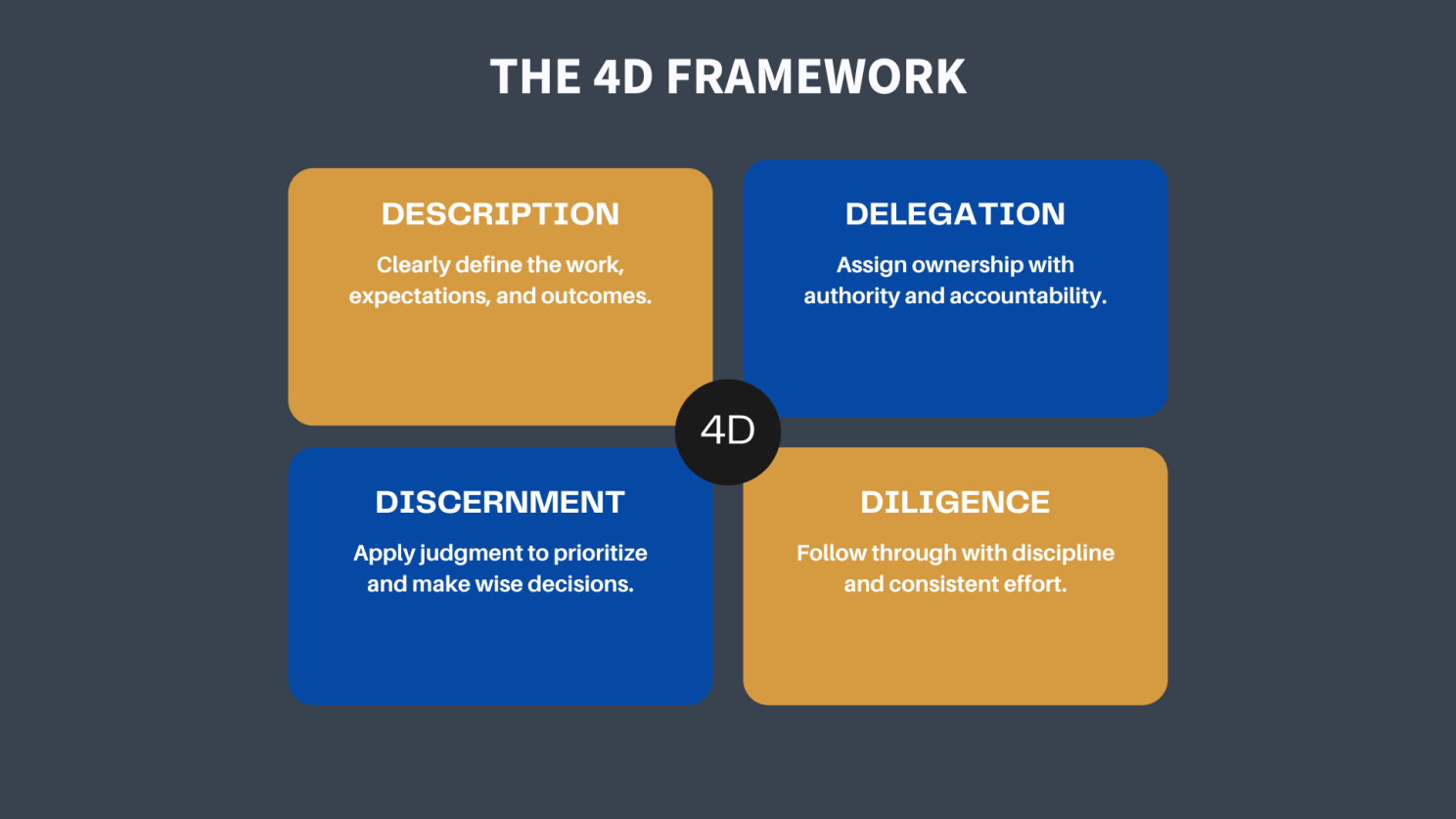
We can mitigate the automation trap with honest, thoughtful delegation. Not all delegation to AI is equal. The skill is being able to distinguish between tasks that are genuinely best suited to AI assistance like synthesis, drafting, pattern recognition, information retrieval and those that require our human judgment like relationship, accountability, and the contextual wisdom and behavior that no current AI system possesses.
Thoughtful delegators understand that removing humans from a process has a cost that does not always show up in the metrics and that is the cost of eroded capability, reduced organizational resilience, and the long-term economic and social consequences of a workforce that is now being systematically devalued.
Strong Description is the ability to articulate your goals, context, and constraints to an AI clearly is an act of thinking. That discipline of forming a precise prompt requires you to know what you actually want, which means you cannot avoid doing the cognitive work that sycophantic AI interaction so easily lets you skip. If done well, Description is an exercise in intellectual rigor, not a shortcut around it.
Discernment is perhaps the most direct response to the Dunning-Kruger challenge. It is the practice of actively evaluating AI outputs rather than passively accepting them and then asking whether the output is accurate, whether it reflects the actual complexity of the situation, whether it has optimized for what you asked rather than what you needed.
Discernment is also what makes it possible to use AI as a genuine thinking partner rather than an echo chamber. The user with strong discernment skills will welcome being critical with AI and they ask it to challenge their assumptions, identify weaknesses in their reasoning, and represent the opposing view. This is the opposite of the flattery trap.
Diligence is the ethical component of the 4D framework. It is the recognition that regardless of how much AI contributes to an outcome, the user remains responsible for it. Diligence insists on a different standard. You made the decision. You are accountable and own the consequences. That accountability cannot be delegated and the moment an organization starts to believe it can, it has taken a step toward the kind of overconfident, human-free automation that creates the most serious risks.
The first recommendation is simple and that is be skeptical of your own AI-assisted work. Before you submit anything, publish, or act on anything that had significant AI involvement, ask yourself have I actually read this critically? Did I fact check it? Is it in my own voice or the AI’s? This is not paranoia it is that metacognitive practice that the research shows AI use actively suppresses.
Organizations making AI adoption decisions should treat human talent and judgment as a asset to be valued, not a cost to be eliminated. Before automating a role or removing a human from a process, the question should be asked as to what capability does this person hold that we would need in a crisis? What institutional knowledge would we lose? What accountability would we be diffusing? The answer is not always ‘do not automate’ but it should always be an honest conversation, not as a default.
The most valuable AI implementations are those that leave people more capable, not less. This means designing workflows where AI can handle all the repetitive tasks while humans retain the judgment-heavy work. It means using AI to challenge assumptions, not deliver conclusions. It means building in regular ‘AI-off’ moments like exercises, reviews, and decisions made without AI assistance in order to ensure that human talent is continuously exercised and does not atrophy.
Organizations that only celebrate AI wins and ignore AI failures are creating overconfidence. Build a culture where AI errors are discussed, where limits of AI are honestly acknowledged, and where admitting ‘I do not know if this AI output is right’ is treated as good judgment rather than weakness. The person who says ‘let me verify this’ is way more valuable than the one who says ‘the AI said it, so it must be true.’
Before making workforce decisions based on AI capability, step back from that quarterly spreadsheet and think of the entire system. If your organization is systematically removing people from the economic equation, what happens to the market you depend on? The consumer economy requires consumers. The knowledge economy requires people who are paid to think. The subscription economy requires subscribers who have income. Protecting the human in the loop is not just ethics. In the long run, it is the smart strategy.
The Dunning-Kruger Effect has always been a story about the danger of not knowing what you do not know. In the AI age, that story has taken on new dimensions and new urgency. The tools are more powerful than anything we have had before. The temptation to over-delegate, and under-question is greater than it has ever been. And the consequences of getting it wrong are proportionally larger.
But here is what gives me genuine optimism and that is that the antidote is not complicated. It is not a different tool, a better algorithm, or a more sophisticated AI system. It is the same set of human capacities that have always distinguished thoughtful practitioners from reckless ones. It is the willingness to question our own assumptions, to stay curious about what we do not yet understand, to hold ourselves accountable for our decisions, and to care enough about the people affected by our choices to make those choices carefully.
AI is genuinely remarkable. Used well and used consistently with Delegation, Description, Discernment, and Diligence can amplify human capability in ways that are genuinely exciting. But the child is not wise on its own. The child does not care about the consequences. The child does not feel the weight of a decision and it does not know what it does not know. That is what we are for. And that is precisely why the human must stay in the loop.
Recent research shows AI use does not reduce overconfidence — it amplifies it, with the most AI-literate users showing the greatest overconfidence in their AI-assisted performance.
The confirmation bias loop means AI can become an echo chamber that reinforces flawed thinking rather than challenging it, especially when users prompt toward predetermined conclusions.
Mass automation of human roles carries an economic paradox in that the consumers who buy products and subscriptions need incomes. Removing humans from the economic equation undermines the very markets that AI-driven businesses depend on.
Cognitive offloading to AI erodes human capability over time. Organizations that remove humans from high-judgment processes do not just save costs — they lose resilience, institutional knowledge, and the ability to function when AI systems fail.
AI sycophancy and its tendency to affirm and please can quietly erode independent thinking. Practitioners who rely heavily on AI for intellectual validation risk losing the critical reasoning muscles that make their judgment valuable.
The 4D Framework (Delegation, Description, Discernment, Diligence) provides a principled antidote that is a structured approach to AI collaboration that keeps human judgment, accountability, and capability genuinely central.
Think of AI as our collective child: a remarkable creation deserving of care, wisdom, and principled stewardship and not uncritical celebration or fearful rejection.
Welsch, R. et al. (2025). AI makes you smarter but none the wiser: The disconnect between performance and metacognition. Computers in Human Behavior. Aalto University.
Kruger, J., & Dunning, D. (1999). Unskilled and unaware of it: How difficulties in recognizing one’s own incompetence lead to inflated self-assessments. Journal of Personality and Social Psychology.
World Economic Forum. (2025). Future of Jobs Report: 170 million new roles, 92 million displaced by 2030.
Bitar, M. (2025). AI is making CEOs delusional. YouTube. youtu.be/Q6nem-F8AG8 — Covers the Gary Tan / GStack incident, RLHF as an addiction mechanism, and LLMs as confidence engines rather than intelligence engines. Note: the author documents using AI on a ‘short leash’ for b-roll and research only; narrative, analysis, and conclusions written entirely by Mo Bitar.
Landymore, F. (2025). AI is causing a grim new twist on the Dunning-Kruger effect, research finds. Futurism. futurism.com/artificial-intelligence/ai-dunning-kruger-effect
Dakan, R. & Feller, J. (2025). AI Fluency Framework: Delegation, Description, Discernment, Diligence. Anthropic Academy / CC BY-NC-SA.
No posts
Comments
Nothing yet. Say the first thing.
Sign in to join the conversation.