
I’m so excited to announce that my hybrid essay collection The Lunatics’ Ball is first runner-up for The Gournay Prize and will be published by Mad Creek Books/The Ohio State University Press in their 21st Century Essays series next year.
I published the title flash, “The Lunatics’ Ball,” in f(r)iction in 2019. I’ve been working on the collection, piece by piece, for at least five years, but some of the memoir essays about my aunt’s suicide and our shared bipolar diagnosis were written before I even imagined the book. Choosing the “lunatics” I would feature in our extended family tree and researching their lives—some copiously documented, others almost lost to history—was challenging. Developing hybrid forms to explore those lives was challenging. Deciding how to shape and organize my 350-page collection, what to exclude, what to include and in what order, was challenging. I can hardly believe that I’m approaching the finish line.
In the 19th century, lunatics’ balls in asylums gathered together lunatics, staff, and the public. Intended to show off the asylums’ enlightened treatment of their inmates, the balls often functioned as voyeuristic spectacles for a curious public, furthering the divide between “us” and “them.” I was intrigued by the fact that my own grandmother attended a 20th-century lunatics’ ball at Greystone, the local mental hospital, long before her daughter and granddaughter were hospitalized in mental wards. Were there more of us? My lunatics’ ball introduces women from the past two centuries whose lives were touched by mental illness and who have been either misrepresented or excluded from history. Some are well-known, such as Zelda Fitzgerald, Sylvia Plath, and Nina Simone. Others are lesser-known but equally compelling, such as Lorina Bulwer, who embroidered her story in enormous samplers; Lizzie McNally Halliday, a serial killer called “the worst woman on earth”; and the writer Janet Frame, who narrowly escaped a lobotomy. Many of these women led tragic lives, trapped in asylums for decades or dying by suicide. Many of them spoke out or found other means of expression. Telling their stories required me to devise new forms of creative nonfiction. Exploring their lives also led me to scrutinize my own. I realized that I had let my bipolar diagnosis trap me and that it was time to emerge from my self-imposed silence to celebrate their courage and speak up myself. I needed to come out as bipolar and tell my story along with theirs.
Initially inspired by my grief over the suicide of my young aunt “Maddy,” The Lunatics’ Ball grew into something much larger than I’d expected, a collective (auto)biography combining research-based snapshots of over thirty female “lunatics” with memoir essays and flash. (See my next Substack post for a full list.) I hope you find these women as amazing as I do.
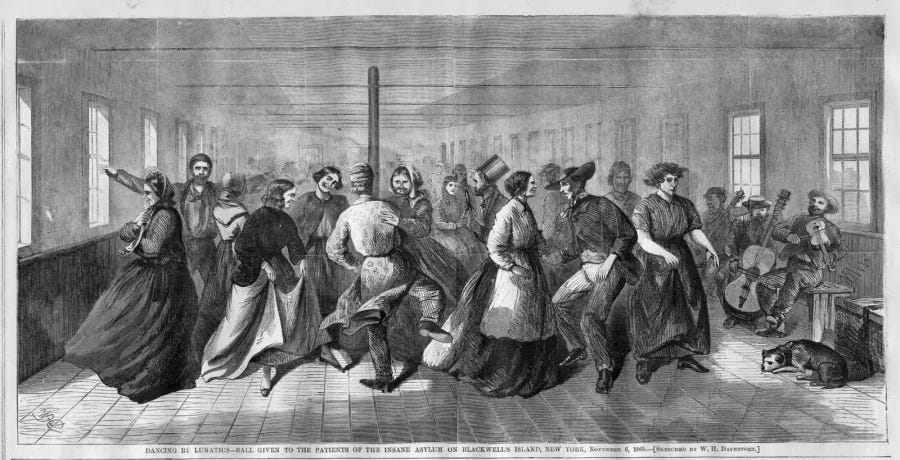
Lunatics’ Ball, New York City Insane Asylum on Blackwell’s Island, Harper’s Weekly (December 2, 1865), sketched by W.H. Davenport
No posts
Comments
Nothing yet. Say the first thing.
Sign in to join the conversation.