
In the last edition, we took a whirlwind tour of the history of automobile supply chains over the last 100 years. I argued that six dimensions can help us understand the changes in the structure of automobile supply chains. The six dimensions are ownership boundary, geography, inventory philosophy, supplier structure, product architecture, and data/information flow/intelligence.
Amara’s Law states,
We overestimate technology in the short run and underestimate it in the long run.
The 100-year journey will give us a fair shot at avoiding Amara’s Law as we think about the future of automobile supply chains. Today’s edition will look through the six-dimensional lens and see if we can make some predictions. Looking at the next 20 years, I may misjudge the timing, and given Amara’s Law, I will likely undershoot the change that will happen in that time.
To clarify, the six dimensions are not mutually exclusive. For example, geography and supplier structure overlap as more and more international suppliers emerge. Product architecture, inventory philosophy, and intelligence overlap in modular architecture and just-in-time work, enabled by sophisticated information and data flow systems.
Over the next 20 years, the data, information flow, and intelligence dimension will become front and center as these elaborate supply chains undergo another round of evolution and revolution.
If you recall last week’s edition, for the entire history of automobile supply chains, the data and information flow network was all about plumbing. It started with pen and paper, then moved to EDI, then the dreaded ERP, and finally cloud computing. Each technological advancement reduced the gap between an IRL event and the moment of observation.
The big change for the future is that data and information flow is changing from plumbing to capital. Whether it is Tesla’s fleet-learning advantage or operational datasets generated by warehouse robots, they have become competitive assets and key capabilities. Every additional layer of data and intelligence improves the product.
If we add digital twins on top of it, its product development and iteration cycle speeds up significantly. Digital twins also help improve the operational efficiency of the supply chain and the product during operation.
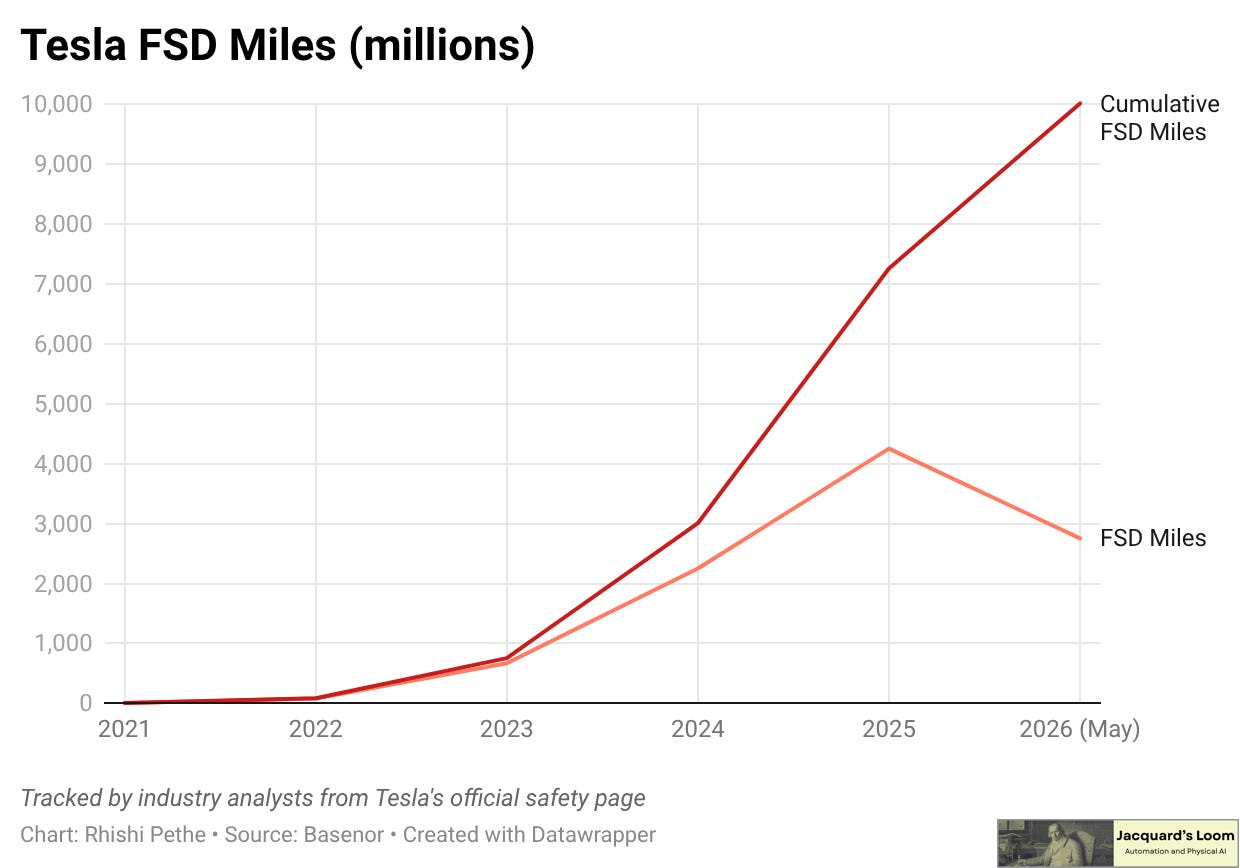
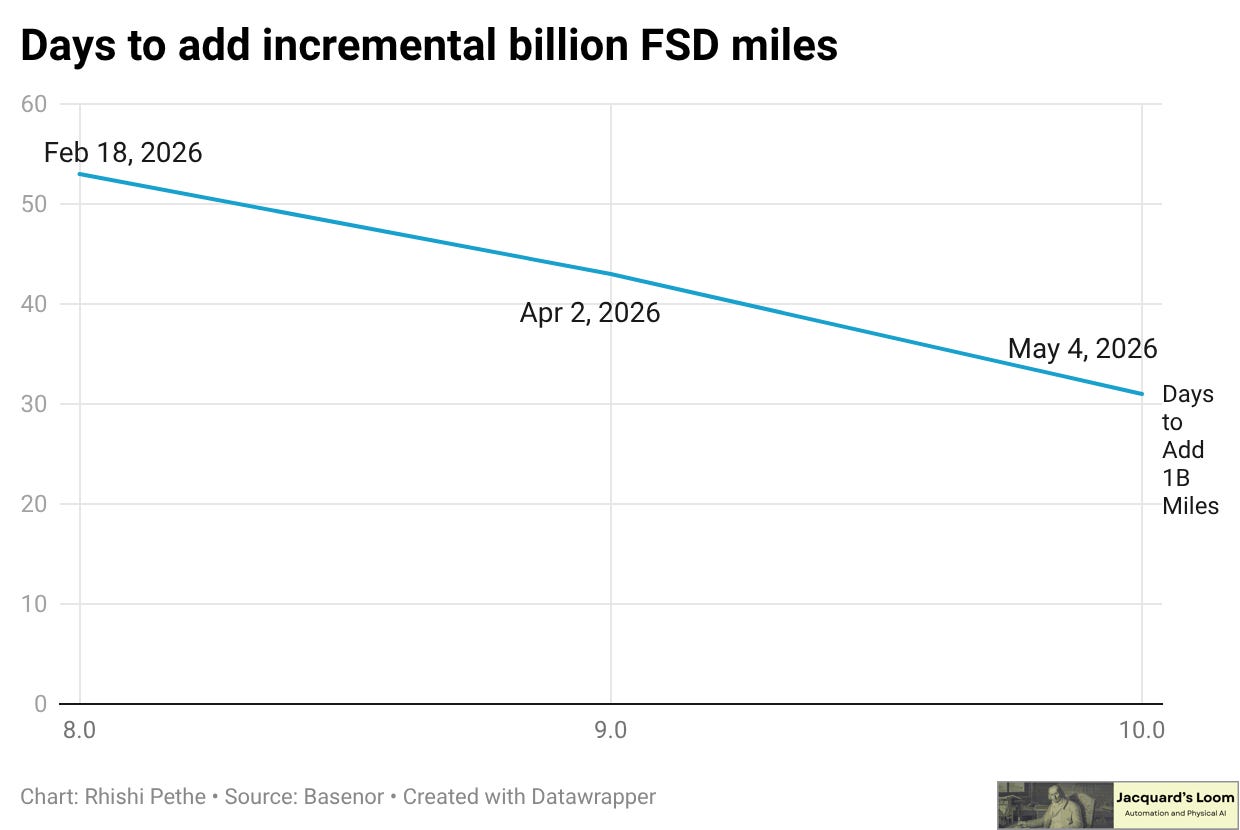
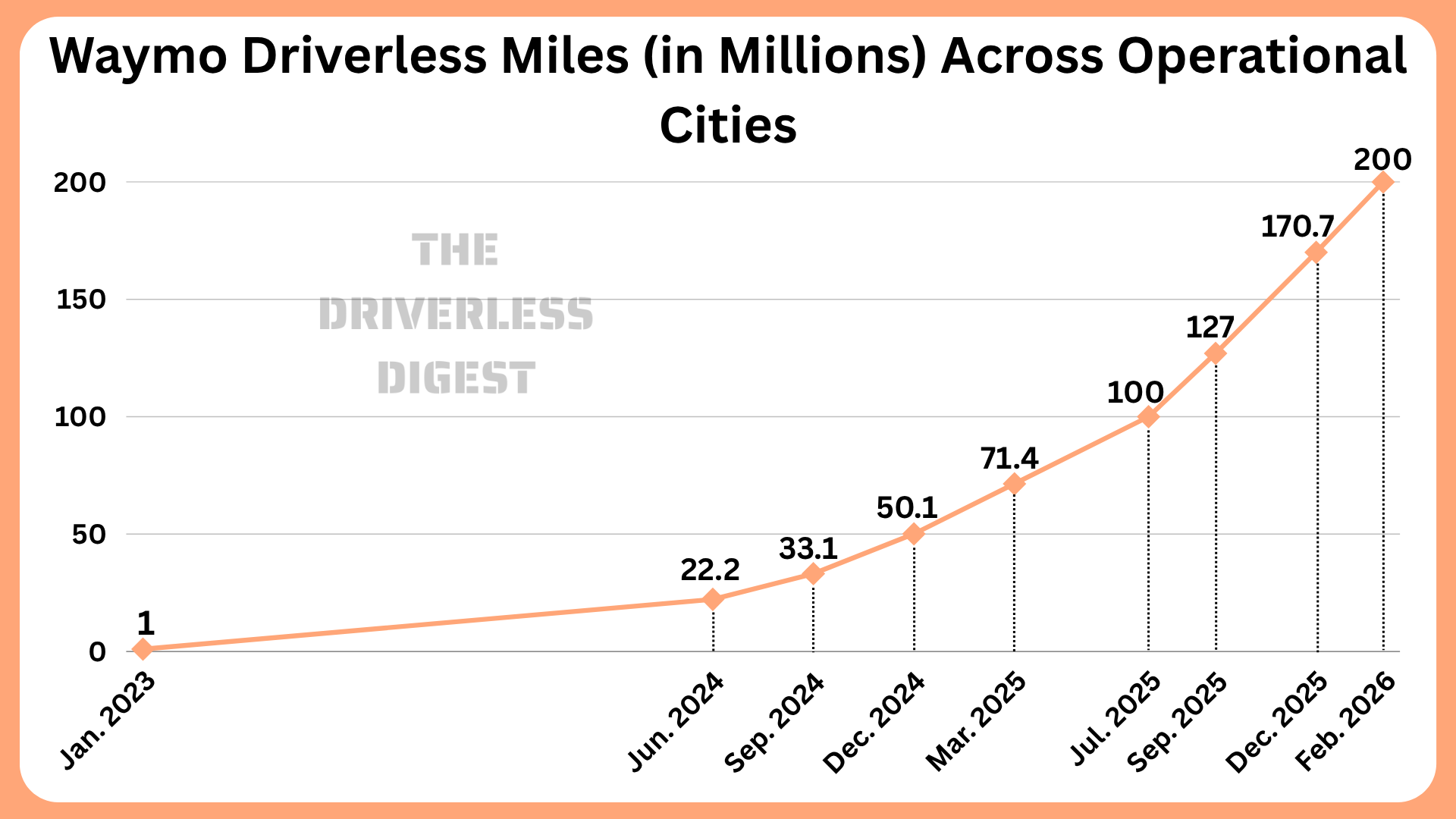
Image source: Waymo Stats 2026: Funding, Growth, Coverage, Fleet Size & More by The Driverless Digest authored by Harry Campbell
While it might seem like Waymo has done 50 times fewer miles than Tesla, we need to differentiate between quality and quantity. Waymo’s miles are RO (rider-only) miles and represent a higher level of autonomy than Tesla’s, which are FSD miles (Full Self Driving - Supervised) and always require a human driver to pay attention. The human driver is responsible for safety in Tesla cases.
My 2045 bet is that data and intelligence will become the primary dimension. It is what moves the needle on your car. The OEM, which owns the operational data flywheel and the simulation layer, will gain a competitive advantage in capabilities, deployment scale, quality, and product velocity.
When I worked at i2 Technologies, Amazon, and Bayer, on retail, food & agriculture, and high-tech supply chains, the question of who is a supplier was clear. It was typically any entity that provided an ingredient or a physical part used in your product. The multi-tier supply chains of the 1990s had massive multibillion-dollar companies.
You had your Tier-1 automotive suppliers who designed and delivered your mechanical systems. That ecosystem has evolved on the mechanical side, with a change in the product architecture itself. Still, it is now outflanked in strategic terms by the providers of chips, software, sensors, and cloud infrastructure. Technology segments the supplier structure.
My 2045 bet is that suppliers will split into mechanical component suppliers and a new silicon-and-software supplier. The mechanical suppliers will become high-quality commodity providers, whereas the intelligence layer will become a part of strategic sourcing and risk management conversations.
With the higher adoption of electric vehicles and vehicles becoming software-defined, the industry is collapsing from 100-plus scattered electronic control units into a handful of high-performance central computers.
For example, the US domain controller revenue alone is projected to roughly triple to about $12 billion by 2035, with a 15% CAGR. At CES this year, Qualcomm positioned its Snapdragon platform as a foundation for in-vehicle intelligence and announced LOIs with future Volkswagen and Rivian models.
The reality is that the most strategically important component in the car is the one that does not appear on the hood, whether it is NVIDIA or Qualcomm with its Snapdragon components.
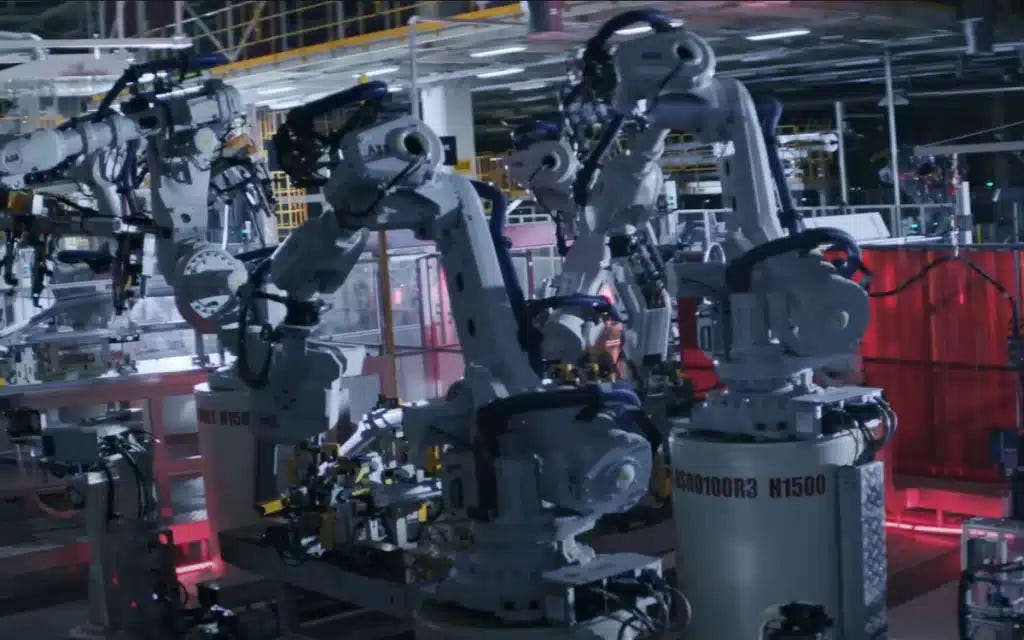
Due to a change in product architecture, the manufacturing process is also changing and is more automated. For example, Dark factories are coming up in China.
EVs roll off these factories at about 800 units a day. It is a fully autonomous factory for EVs. There are hardly any humans in the factory, and the ratio of robots to humans is 10:1. This is the Zeekr factory in China, with Zeekr being less than six years old. Henry Ford would have been proud of this factory.
My 2045 bet is that a car is a data center on wheels. The mechanical excellence will become table stakes and will be a differentiator only at the margins. The entity that controls the automobile’s compute platform will be in the driver’s seat (pun intended). The product architecture fight will be about who controls the vehicle’s intelligence layer.
The Toyota Production System popularized the vocabulary of concepts such as jidoka, kaizen, kanban, and andon cords. The Toyota Production System was a manufacturing and management philosophy. With the rise of EVs and China’s dominance in EV manufacturing, I expected a new vocabulary to emerge as a result. But surprisingly (maybe just for me), it has not produced a new lexicon.
The difference between Toyota and China’s rise is that Toyota articulated a philosophy, whereas China has pursued an intense pace and competitiveness. For example, the word neijuan (内卷) translates as “involution”. Involution means that the competition is intense, everyone runs faster, but no company gets ahead. It is like being in a theatre where everyone gets up to get a good view, but all end up in the same spot.
Neijuan became the word of the year in the Chinese industry, signifying an EV price war.
BYD and its rivals have been inside an MMA price-war death-match cage. Almost 130 EV brands are competing in China, and BYD has cut its average price by 32% in the last few years. The average vehicle price has fallen 11% over three years. Industry profit margins have fallen to 4.3% in 2024, down from 8% in 2017. (Data is from Bloomberg, Fortune, VW Group, and the China Passenger Car Association / CADA, respectively). The CEO of BYD admitted during his statements in April 2026,
“We also recognize that competition in the (new energy vehicle) industry has reached a fever pitch, and is undergoing a brutal ‘knockout stage’,” BYD chairman Wang Chuanfu said, while reaffirming its overseas push.
As we were building farm robots at Google X, the pandemic and subsequent supply chain disruptions made it very clear that the underlying intelligence-layer components, like chips and batteries, were the key to delivering our robots on time.
As we discussed last time, the ownership pendulum swung from Ford’s total integration at the Rouge plant to the asset-light models of the 1990s to Tesla and BYD pursuing massive vertical integration.
I don’t believe we will go to either extreme for the next phase. It won’t outsource everything or die, or integrate everything or die. Just like Marie Kondo, the chips, the data, the simulation stack, and the raw input layers will spark joy (and competitive moats) for OEMs and will be kept within OEMs’ ownership structures through vertical integration. OEMs will let go of other commoditized parts.
They will target the parts that control them as a business if they don’t control those parts. We already saw these examples last week, with Tesla signing an offtake Lithium deal and BYD owning its own intelligence stack.
My 2045 bet is that OEMs will vertically integrate the intelligence stack and the most strategically exposed inputs, just like Marie Kondo. They will happily outsource the commoditized physical layer. Make-vs-buy stops being a corporate philosophy and becomes a per-layer decision driven by where the moat and the risk actually sit.
The internet has traditionally been split between the Chinese internet and the rest of the world. The automobile supply chain risks splitting into two distinct supply chains, just like the internet. China produces nearly 51% of the world’s rare earths. They process about 76% of them. As of now, it feels like China has control over Arrakis for car manufacturing and, in theory, will have control over the future of automobile manufacturing.
Unlike the books, the rest of the world (especially the United States) will respond by reshoring, friend-shoring, and sourcing additional rare earth metals. (Salton Sea, anyone?? The Salton Sea in Southern California is sitting on top of one of the largest lithium deposits in North America.)
My 2045 bet is that geography for automobile supply chains will bifurcate with two largely separate automotive supply chains. A China-centered supply chain will serve China and much of the Global South, including the Middle East. When I was in Abu Dhabi and Dubai last year, you could not miss the large number of BYD cars everywhere. The second supply chain will be dominated by Western manufacturers, serving higher-margin, policy-protected markets, and the single global supply chain of the 2000s might not return.
Just-in-time philosophy obviously didn’t die during the chip shortage triggered by the pandemic and the subsequent high prices during the current AI wars. The automobile industry learned very painfully that you cannot treat strategic components like chips, modular control units, etc., the same as door handles and tires. The industry knew the difference between strategic and non-strategic components, but it was slow to recognize the sudden shift in the value of newer strategic components.
Eliyahu Goldratt, in his classic 1980s book, taught a generation of people to find the bottleneck and manage it. The challenge over the next few decades is that the bottleneck will shift, and OEMs will have to continuously evaluate which parts are strategic and which are commodity, and manage their inventory philosophy accordingly. It is a hybrid approach with just-in-case safety-stock buffers for strategically concentrated parts and just-in-time inventory management for commodity parts.
My 2045 bet is that inventory philosophy will snap back towards safety and resilience for strategic parts. The boundary between commodity and strategic will shift in real time in response to demand signals, geopolitical risk, and supplier health and flexibility. OEMs will be invoking Marie Kondo frequently and continuously in the future.
Ownership will re-verticalize, but selectively around the intelligence stack. The inventory philosophy will swing back towards just-in-case. The product architecture, which will become a compute platform, and the supplier structure will be split into mechanical and intelligence tiers.
Geography is not going to snap back but actually break into two parallel systems divided along a geopolitical fault line. Interestingly enough, this geopolitical fault line will run through the periodic table of elements.
Even though I called data, information flow, and intelligence as a dimension, in essence, it becomes the master variable. Going back to Goldratt, it is the binding constraint. It is the lever that moves and shapes all the other dimensions. Product architecture, suppliers, and inventory philosophies will reorganize around who can own the compute, who can own the models, and who has the intelligence layers worth controlling.
Detroit couldn’t picture a Toyota-led market. Wall Street couldn’t picture a vertically integrated Chinese carmaker.
I’m confident we’re overestimating what automation and physical AI can and will do to the automobile supply chain over the next two years. And we are underestimating where these six dimensions will be in 2045. But the people who win in the next evolution of the automobile supply chain will be those who treat the intelligence layer as the design center of the entire supply chain.
See you in two weeks.
No posts
Comments
Nothing yet. Say the first thing.
Sign in to join the conversation.