
Jacquard’s Loom is a fortnightly publication focused on automation and physical AI. It will be published every alternate Wednesday morning. I have experience working on physical AI, automation, supply chains, and digital transformation through my advisory services, Google X, Amazon, and many other startups.
Today’s edition focuses on the automotive supply chain, how it has evolved over the last 100 years, and which dimensions have shaped that evolution. The supply chains were rebuilt repeatedly when external forces hit. Most supply chain analysis treats each disruption as its own story. They are all variations on the same six dimensions, which makes this a clean lens for predicting what Physical AI will do next. This week’s edition will set us up for next week’s, which will focus on how future supply chains will be affected by data and intelligence (physical AI).
One of my favorite laws about technology development and adoption is Amara’s Law. Amara’s Law states the following:
We tend to overestimate the effect of a technology in the short run and underestimate the effect in the long run.
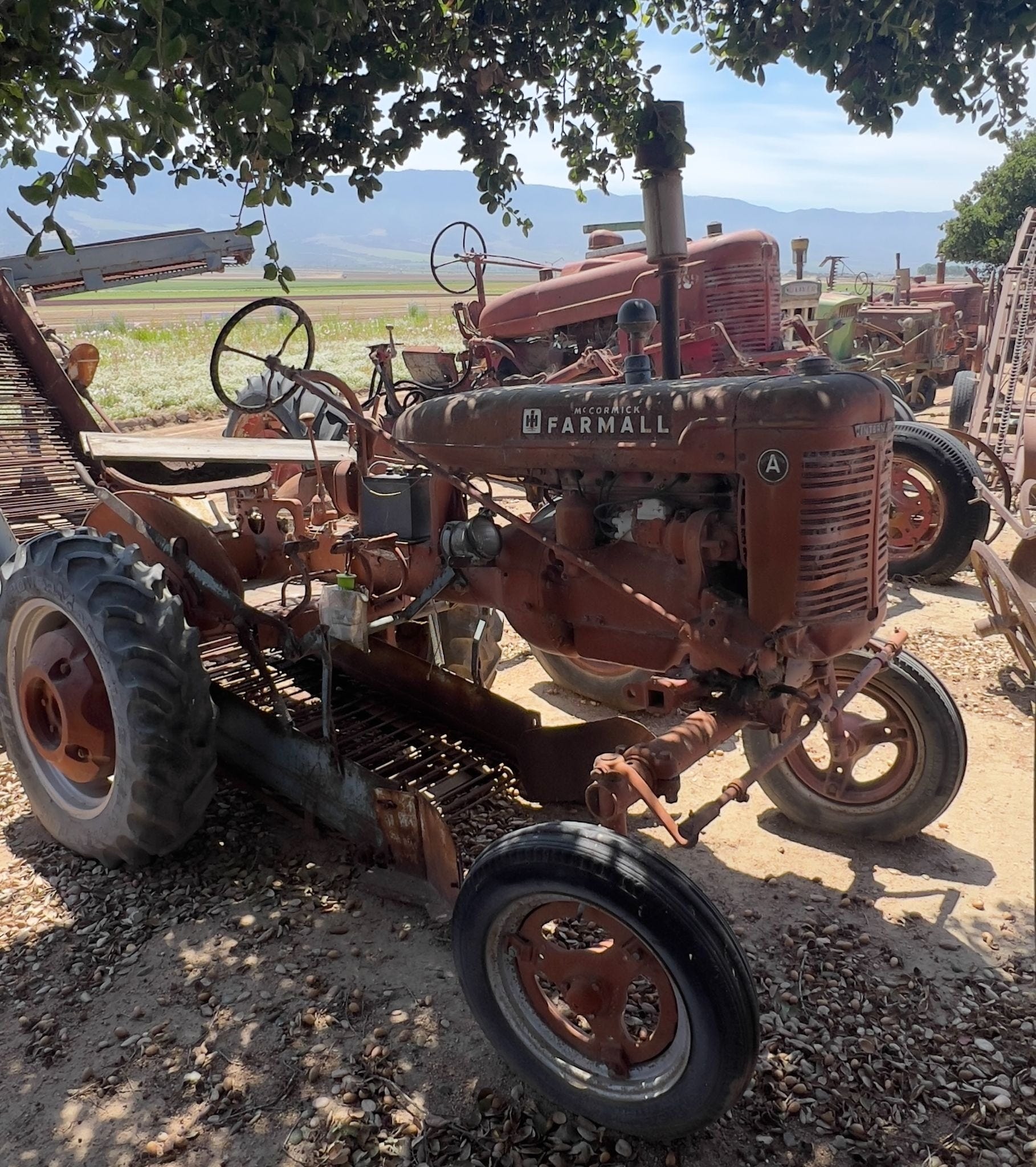
I recently got a solid reminder. I was visiting some farms in the Salinas Valley, CA. On one of the farms, I saw many vintage tractors, including some models from the 1930s. I had driven there in my Tesla Model Y with assistance from FSD. The contrast between today’s electric, software-driven, AI-enabled self-driving technology and 1930s technology was stark.
Even though one is a piece of farm equipment and the other is an automobile, both share many similarities in how they have evolved as products, though their supply chains have taken different paths.
Every few decades, the automobile manufacturing supply chain has had to rebuild itself around a new binding constraint and the dimensions that define it. Whether it was the world wars, the oil shocks of the 1970s, the farm crisis of the 1980s, COVID, EVs, or the geopolitics of the AI arms race, each was an external factor that changed some internal supply chain dimensions. It forced the industry to rebuild itself and sometimes, revisit old strategies and philosophies.
In today’s post, we will take a whirlwind tour of how the supply chains of automobile manufacturing have changed over the last hundred years, what kind of changes have happened to the following six main dimensions, and what it could mean for the future (in the next edition)
Ownership boundary
Geography
Inventory Philosophy
Supplier Structure
Product Architecture
Data, Information Flow, and Intelligence
The automotive supply chain is one of the most studied in the industry. During my undergraduate days, studying industrial engineering and supply chain management, we covered the Toyota Manufacturing System. We had fun saying words like jidoka, kanban, poka-yoke, and pulling andon cords. (If Seinfeld was made in the 70s or 80s, we would have an episode where Jerry keeps saying Jidoka, the way he loved to say salsa, or kept saying “babka”). In fact, one of my big presentations was about kaizen (continuous improvement) and the just-in-time production systems. Reading “The Goal” by Eliyahu Goldratt was mandatory reading for all students.
But the Toyota Manufacturing System came much later in the 1970s. The car manufacturing supply chains had already gone through a few iterations of change and rebuilding.
Before Henry Ford famously said, “ You can have any color of the car, as long as it is black, individual engineers and entrepreneurs built cars. Every unit was a handcrafted work built in one location. Parts could not be interchanged and didn’t fit well.
A car was built the way a house is built — bespoke, by craftsmen, in a stationary location, with parts that didn’t quite fit until someone filed them down. In fact, when Cadillac demonstrated parts interchangeability by dismantling three Cadillacs, scrambling their parts, and then reassembling them, it was considered an engineering marvel.
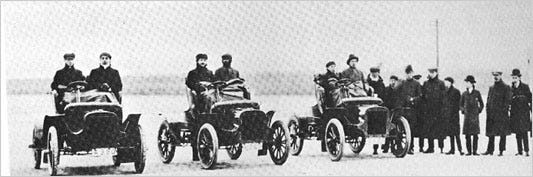
Henry Ford famously built the assembly line to manufacture Model T cars at a very low cost. It made the car affordable to a large number of US consumers. But the early supply chains were highly local and hierarchical, as all suppliers were in or near Detroit for Ford. The product architecture moved to mass production. Ford consolidated ownership under one corporation. The inventories of parts were large and intentional, ensuring the assembly line never stopped.
But the First World War caused multiple supplier problems for Ford, so, in typical Henry Ford style (Henry Ford would have been great on X/Twitter, and he was almost an Elon-like figure of the early 20th century), he decided to do away with suppliers. Ford leaned hard on vertical integration.
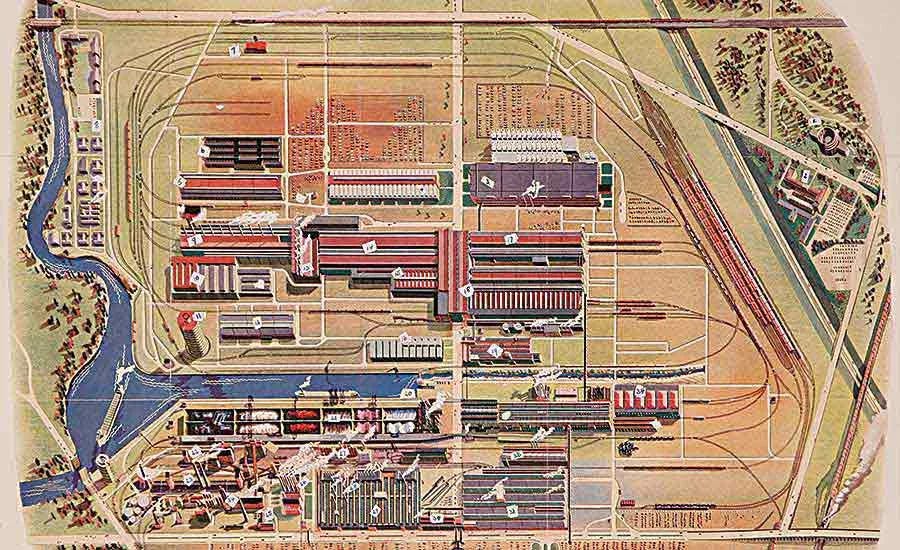
During its heyday in the 1930s and 1940s, the Rouge was a temple of vertical integration. The vast industrial complex included a steel mill, a glass factory, a power plant, a rubber factory, foundries, machine shops, stamping plants, and assembly lines. It also included a cement plant, a paper mill, a leather plant, and a textile mill.
Ownership: fully consolidated, vertically integrated. Geography: hyperlocal Detroit. Inventory: high, intentional buffer. Suppliers: captive or absorbed. Architecture: single-model mass production. Information: paper, internal.
Ford competed and optimized for the lowest cost car and found enormous success. Americans lapped up Ford cars in droves, and it transformed American urban and suburban life and culture. Ford was famous for driving down costs and competing on price (he did the same on tractors, and you can hear that story in my podcast episode with Tim Hammerich on Tractor Wars)
Alfred Sloan of General Motors decided to compete against Ford by organizing around a portfolio of brands, including Chevy, Pontiac, Buick, and Cadillac. These brands created an aspirational ladder for consumers and signaled their success. Even today, Cadillac is one of the most referenced brands in music and serves as a symbol of success, rebellion, and American culture across multiple genres. General Motors also introduced an annual model change in the late 1920s, making the car a luxury good. And you thought Apple got us hooked to the annual upgrade cycle!
The product variety had significant supply chain consequences. The variety required flexibility, which reduced vertical integration. Unlike Ford, GM did not own mines, for example. The supplier ecosystem began to specialize, creating a tier structure for suppliers. The Second World War turned all that manufacturing capacity into a strategic national asset.
Ownership: consolidated, partially de-integrated. Geography: Detroit-centered. Inventory: high, intentional. Suppliers: specialized tier ecosystem, still captive. Architecture: multi-brand portfolio on shared chassis. Information: paper, internal.
The 1950s and 60s was the golden age of American cars. The protection from foreign competition oriented the US supply chains around long production runs, batch manufacturing, and adversarial supplier relations. Inventories remained high because the assembly plants had to keep running. The information flow inside those supply chains was still very much on pushing paper as Detroit doubled down on scale, batch, and inventory.
American cars were big gas guzzlers and very much a part of American culture. Marisa Tomei could famously describe the features and tire marks of a 1950s car in “My Cousin Vinny.”
Ownership: consolidated. Geography: Detroit, protected market. Inventory: high, push-driven. Suppliers: adversarial, transactional. Architecture: long production runs, large vehicles. Information: paper, internal.
But post-war Japan was not idle, though a lack of capital, land, and oil plagued it. Resource scarcity gave rise to a new inventory philosophy of demand-driven manufacturing. Taiichi Ohno studied the American System very closely and then helped create the famous Japanese and Toyota Manufacturing system, which produced only what was needed, only when needed, and only in the amount needed. Resource scarcity created a hyper-efficient, flexible manufacturing system that incorporated Just-In-Time as a key philosophy.
Toyota started rolling this out not only within their own manufacturing plants but also to all their suppliers. It required efficient data sharing, clear information flows, and intelligence built into inventory management and supply chain systems.
Ownership: consolidated, with deep ties to keiretsu. Geography: Japan, resource-constrained. Inventory: just-in-time, demand-pull. Suppliers: collaborative, embedded partners. Architecture: small, efficient, quality-driven. Information: paper-based, but with disciplined cross-firm data sharing.
The 1973 oil embargo made big American gas-guzzling cars very unattractive for consumers. It opened the US market to small, fuel-efficient Japanese car imports. Toyota’s US market share grew rapidly from the 1970s, and it became one of the leading car brands in the US in just a few decades. The Detroit playbook of optimizing for scale, batch, and low-cost transactional sourcing was becoming an albatross around their neck.
American car manufacturers in the 1960s were clearly violating Amara’s Law. Nobody in Detroit in 1973 thought Toyota would one day lead the US automobile market.
Toyota had changed the game by focusing on quality, flow, and supplier relationships to achieve a better cost structure for its products. Toyota was in the right place on the quality-cost curve, whereas Detroit optimized only the cost side of the curve. Inventory moved from the asset side of the ledger to the liability side. Supplier relations shifted from adversarial vendors you beat down on price to collaborators and partners across the overall value chain.
Ownership: dispersing. Geography: globalizing (Japanese imports, US transplants). Inventory: shifting toward just-in-time. Suppliers: collaboration model spreading. Architecture: smaller, fuel-efficient, quality-led. Information: paper, with early digitization.
The global outsourcing and stretching of supply chains continued and accelerated in the 1990s. The Japanese competition and pressure from Wall Street, which loved asset-light industries, pushed more and more American manufacturers to outsource component production to suppliers. It led to the rise of tier-1 mega suppliers, which were giant engineering organizations that designed and manufactured entire vehicle subsystems.
Car manufacturers asked them to deliver complete modules, and the car manufacturers focused on assembly. It created a global car manufacturing supply chain with supplier base concentration, including the entry of India and China. Information flows became critical and went electronic.
When I worked on demand-driven supply chain technologies, a large retailer like Walmart would share detailed demand information with its critical suppliers using a system called RetailLink. The granular sales and demand data allowed suppliers to plan production and inventory against actual demand signals.
Ownership: dispersed, asset-light. Geography: global, with India and China entering. Inventory: just-in-time, extended across tiers. Suppliers: powerful independent tier-1 mega-suppliers. Architecture: modular subsystems delivered by suppliers. Information: digital, electronic data interchange across the chain.
Nixon’s opening of China and the subsequent policies of the CCP created a massive market for consumer goods, and cars were not far behind in satisfying Chinese consumers. Starting in the late 1990s and early 2000s, many car manufacturers, including GM, began producing cars in China and localizing parts production to support Chinese vehicle output.
When I worked on multi-tiered supply chain orchestration and visibility at i2 Technologies and Amazon, we saw firsthand how modularization of product architecture dramatically reduced product development and manufacturing costs and made after-sales support much more efficient and responsive.
Car manufacturers started making modularization a dominant design philosophy. Modularization created platforms that could serve as the base across multiple brands and markets, with shared components and subsystems. It led to fewer parts and tighter inventory control.
Still, it required much more sophisticated data and information flows, as well as supply chain software, to provide the necessary production and supply chain intelligence. However, software remained on the periphery, not in the product itself, which was mostly mechanical and electrical.
Ownership: dispersed, with China-based JVs. Geography: globally distributed, China rising. Inventory: lean, multi-tier, fragility exposed by 2008. Suppliers: tier-1 mega-suppliers with a deep footprint in China. Architecture: global platforms, modular by design. Information: digital, supply chain software at the periphery of the product.
In the February edition of the newsletter, “How EVs are Changing Auto Manufacturing,” I mentioned that the shift from gas-powered internal combustion engine cars to EVs has drastically changed the car bill of materials and is reshaping automobile manufacturing.
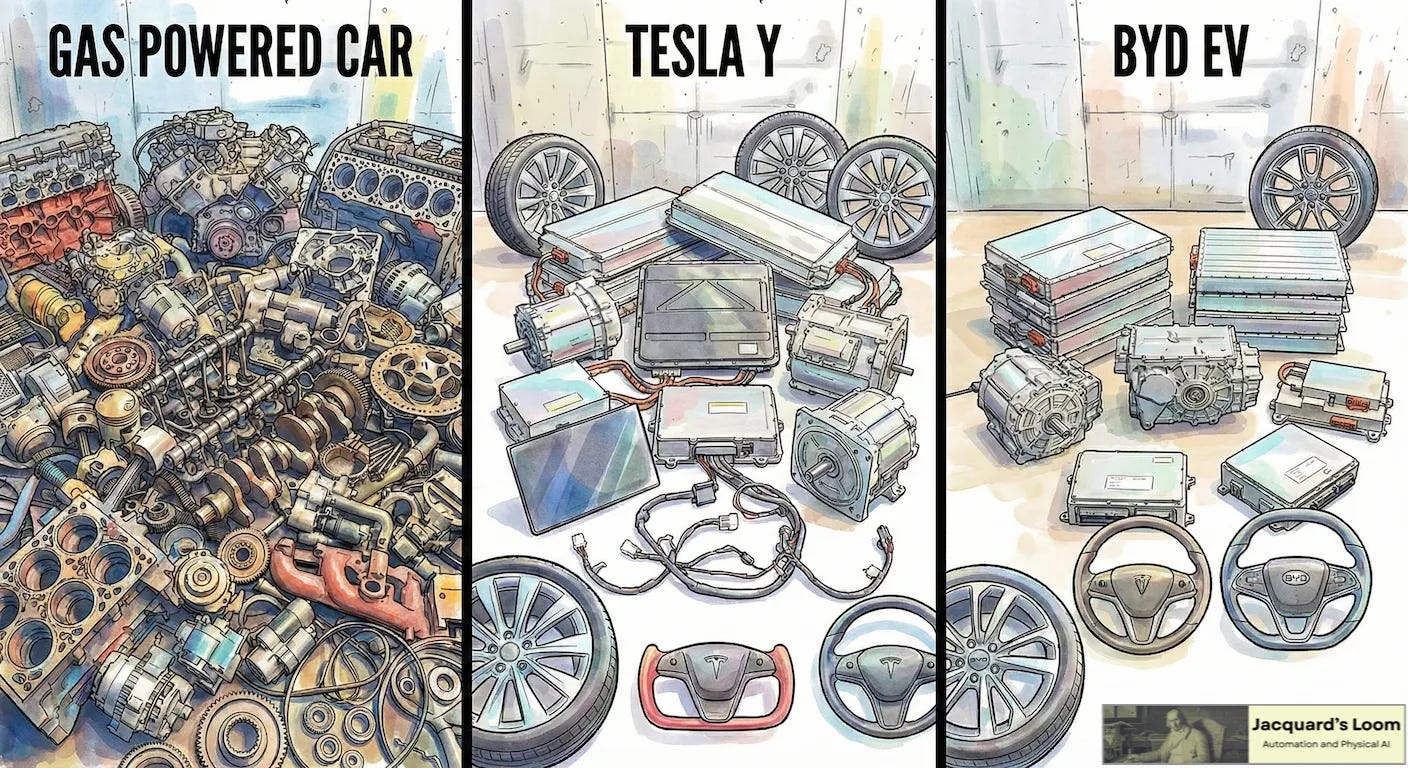
Just as Henry Ford did 100 years ago, Elon and Tesla decided to entirely ignore how the car-manufacturing business worked. Tesla built one of the most vertically integrated automotive operations, with battery cells, electric motors, power electronics, the Supercharger network, and direct-to-consumer sales. According to an SEC report, Tesla even signed a 5-year deal with Piedmont Lithium to secure access to lithium, a critical element for battery manufacturing.
As I said in my February edition, Chinese EV manufacturers like BYD have taken the vertical integration story to the extreme (at least for the 21st century) by also getting their own ships to transport vehicles to their destination markets. Given the rise of Chinese manufacturing, the center of gravity has shifted to China.
According to the IEA’s critical minerals report, the EV transition has put China at the center of the world’s automotive supply chain.
Software and AI are now integral parts of the car. Suppliers have also started to segment based on technology, rather than purely based on manufacturing capabilities and geographical proximity. With the rise of self-driving cars, data, information flow, and intelligence become critical to supply chains, not only at the manufacturing level but also at the operational level.
Ownership: re-consolidating around platform owners (Tesla, BYD). Geography: shifting decisively toward China; critical minerals dependency. Inventory: resilience for strategic parts, JIT elsewhere. Suppliers: segmented by technology. Architecture: EV-native, smaller bill of materials, software-defined. Information: digital and intelligence-driven; software inside the product, not just around it.
As I said at the beginning, various external forces and binding constraints triggered changes in the automobile supply chain. We can slot most of those changes into the six dimensions of ownership, geographical concentration, inventory philosophy, supplier base structure, product architecture, and data, information flows, and intelligence.
As we saw with re-verticalization, these dimensions do not move only in one direction, but can swing back based on other factors.
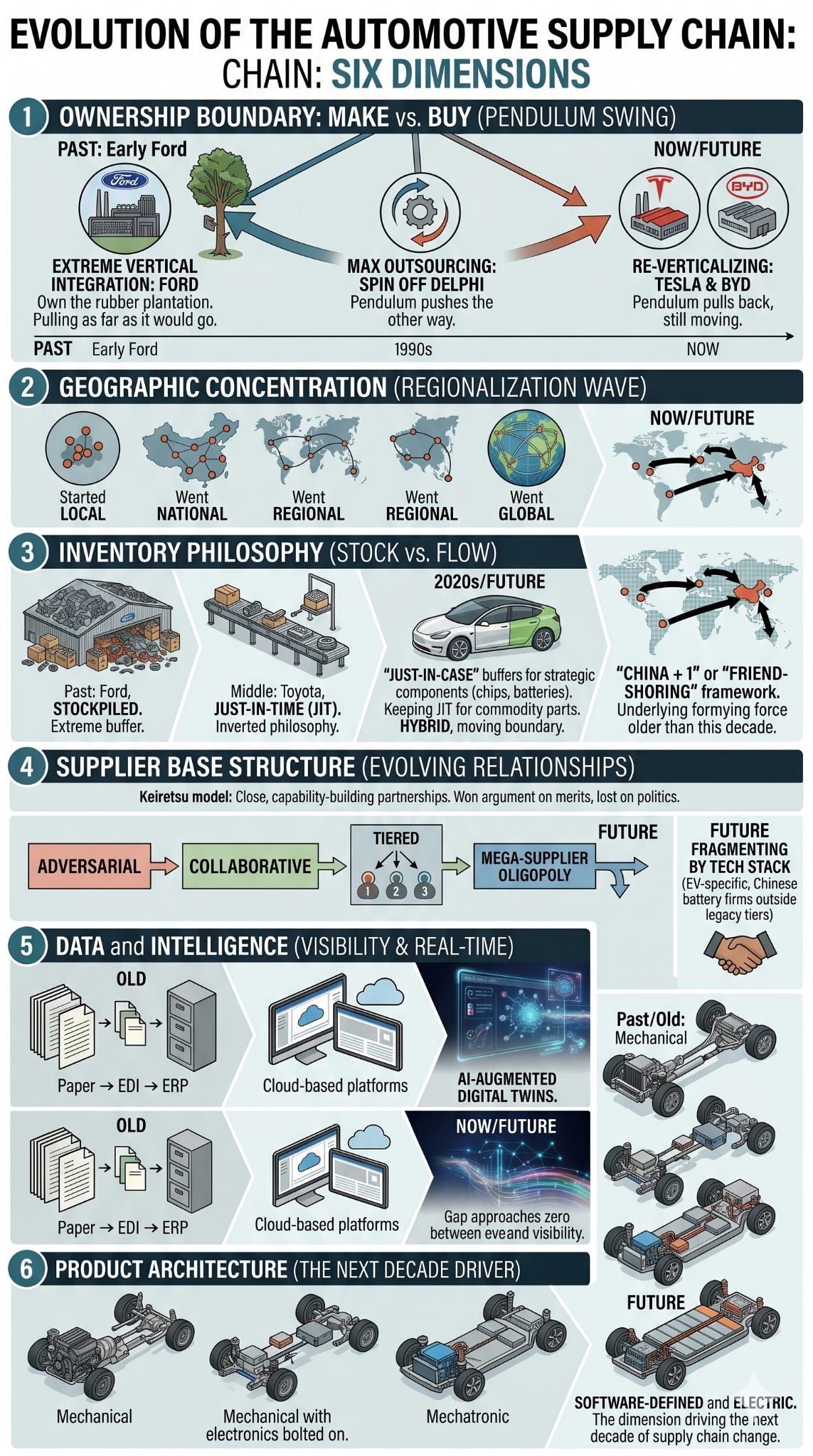
The binding constraint for the next remaking of the automotive supply chain feels like the intelligence layer. It is becoming as important as the physical layer. Physical AI is the integrating concept for what’s about to happen across automation, robotics, logistics, and manufacturing. The auto industry, as it has done with every previous wave, will be where you first see whether the argument is right.
It brings us back to Amara’s Law.
We are almost certainly overestimating what Physical AI will do to the auto supply chain over the next two years and underestimating where the six dimensions will sit in 2045.
Detroit in 1965 could not picture a Toyota-led American market. Wall Street in 1995 could not picture a vertically integrated Chinese carmaker operating its own fleet.
The mistake, in both cases, was reading the present too literally and the long arc too cautiously.
Physical AI will definitely reshape the auto supply chain. The question is which of the six dimensions snap back, which break in directions we don’t yet have language for, and who is positioned to read the change early enough to act on it. That’s what the next edition is about.
See you in two weeks.
No posts
Comments
Nothing yet. Say the first thing.
Sign in to join the conversation.