
Back in February I wrote a piece about the just-beginning “Age of Centaurs.” Centaurs, in chess parlance, are machine-augmented humans. There was a period in the chess world where chess computers could beat humans, but a human who could consult the computers was best. Eventually, the computer got so good that the humans didn’t have anything to contribute, and that centaur age ended. Similar dynamics play out now with humans and AI. In 2026 millions of people go to their office jobs and work with significant assistance from machinic intelligence, with higher-ups encouraging rapid AI adoption to stay competitive in an ever-changing marketplace.
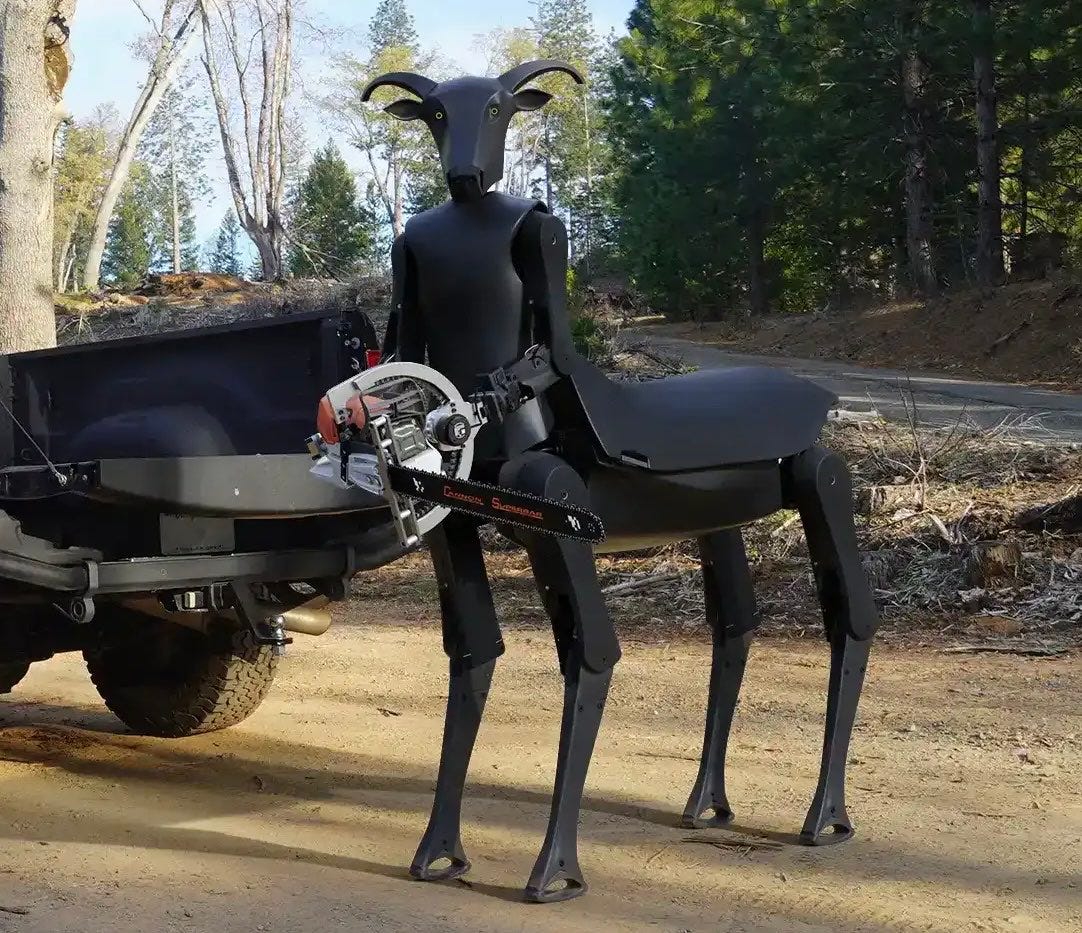
And less than six months after I wrote that piece, robotics company Satyress1 has unveiled an honest-to-God centaur. This matte-black monstrosity is described as a “superhumanoid general purpose robot” that can be sent into dangerous environments to handle tasks humans couldn’t.
In case you couldn’t tell from the eyes, this robot is NOT ensouled. Human cooperation is necessary to make it move: it’s teleoperated, in the traditional centaur mold.
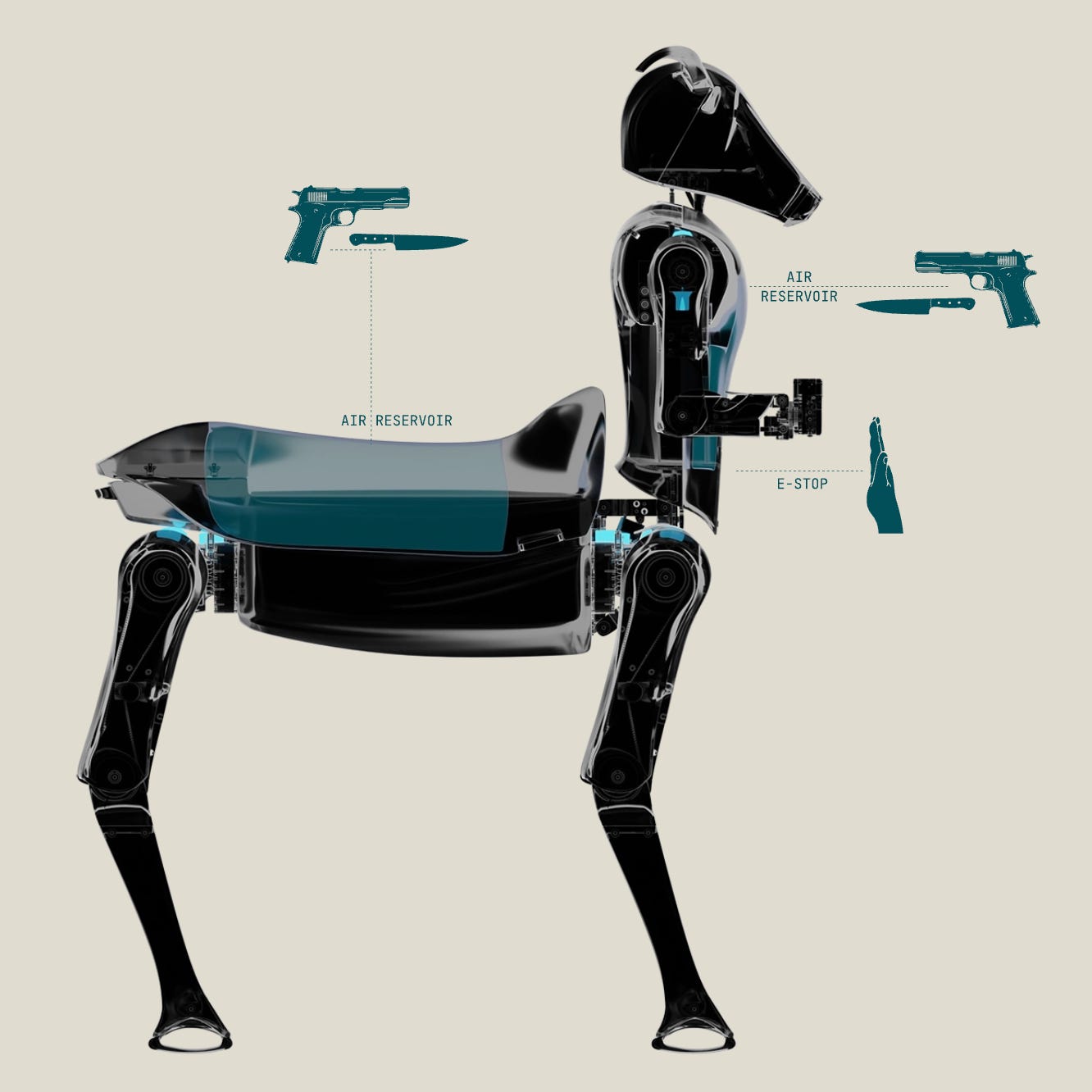
But the good folks at Satyress don’t want you to see this beast as a harmless toy either. Their website tells us that, somehow, “this robot is more dangerous than it looks” (⁉️) while still being easy to stop in its tracks. All it takes is a gun or a knife, or perhaps a standard American door, which will “substantially slow” it down. And on the off chance that isn’t good enough and you want to prevent any passage through doors altogether so that it can’t chase you into your home and kill you dead à la Terminator, then you can simply attach larger horns.
What’s the endgame for Satyress? Maybe this project has no ambition beyond teleoperation. After all, when their marketing materials aren’t showing off chainsaws, they’re talking about how they intend “not to replace skilled workers, but give skilled workers superpowers.” Satyress exhorts you to “become superhuman.”
Others are not so content to leave meaningful physical work to humans in the future. Elon Musk’s latest compensation package from the Tesla board gives him a significant bonus if the company delivers a million autonomous humanoid Optimus robots by 2035, and earlier this year Musk said that he expects that the world will eventually have “more robots than people.”
In an office in Shanghai, a twenty-year-old computer science major spends his week in a VR headset and arm exoskeletons, opening a microwave door hundreds of times a day. The only purpose of this is to help the humanoid robot next to him learn how to do these motions independently. He and the other trainers call themselves cyber-laborers.
This is where chess stops being a useful guide. In chess, the machines had nothing to learn from machine-augmented human play. They got better because we found better algorithms and faster chips. In robotics, the current theory holds that the man-machine mind meld generates the dataset that removes man from the productive activity. With robots, the centaur equilibrium is self-defeating. That’s the bet companies are making for physical labor. What about cognitive labor?
In April Meta announced their “Model Capability Initiative,” mandatory software installed on employee laptops to capture mouse movements, clicks, keystrokes, and snapshots of screen contents. Meta spokesman Andy Stone explained why it was necessary:
If we’re building agents to help people complete everyday tasks using computers, our models need real examples of how people actually use them — things like mouse movements, clicking buttons, and navigating dropdown menus.
No opt-out option was provided. In leaked audio from an internal meeting, Zuckerberg said that this was the best way for AI models to learn “how smart people use computers to accomplish tasks.” Employees immediately started mobilizing against this. Flyers went up and a unionization drive started in their UK offices. Meta’s only concession, made in early June, was allowing for 30 minute pauses in data collection.
But on June 22, an internal security notice showed that some of this data was exposed company-wide, including private conversations, performance data, and, in at least one case, personal tax and medical records. Because of this, the data collection program has been paused.
Companies need not resort to monitoring their preexisting employees. There are other firms that pay people to do make-work solely to gather similar data. Every day, Mercor pays $4 million to skilled contractors so that the tasks they handle professionally can be automated down the line. Mercor CEO Brendan Foody explains that the labs “need to hire contractors who previously worked at those companies, understand those workflows, and are willing to train models to automate them.” This month Mercor was reported to be raising at a $20 billion valuation.
And for physical tasks, companies are desperate to find ways to get data on the work that don’t require expensive teleoperation rigs. Every stint operating a Satyress robot would produce valuable data, but the hardware costs a fortune; Sunday Robotics pays people $30 an hour to wear basic sensor gloves and do their own chores at home. A company called Shift will send someone to clean your apartment for free; you just have to let them record it.
Similarly, in China JD.com is working with the local government in Suqian to produce ten million hours of robot training data over the next two years. Work like this has become a new kind of job. Gao Bo, a stay-at-home mother in Shandong, films herself cooking and cleaning for about $3 an hour, six hours a day. She told Rest of World: “No one had paid me to cook and do laundry before.”
AI progress has been substantial, but high-quality data is still a real bottleneck; current architectures have been bad at generalizing beyond the types of information they’re trained on. We have created near-superhuman coding agents, but there is no massive corpus of data on how people walk around and handle everyday tasks. Through the work of people like Gao Bo, that is starting to change.
Earlier this month, The New York Times’ Lora Kelley spent time listening to the leaders of Mercor and rivals like Handshake, Scale, and Surge. Hearing their pitch, she wrote: “Taken to its logical conclusion, this is a vision of work in which even high-level employees systematically automate nearly every task they perform, until all that is left for them to do is train A.I.” Edwin Chen, who founded Surge, predicts that training AI will be seen as a career path that is “one of the most prestigious and impactful” in society.
It’s a grim vision of the future: perpetual self-surveillance and selling our personal datasets to the highest bidder in service of human obviation. But there is something positively eschatological about all this, even without Satyress’s Satanic imagery. At least no one can claim we live in uninteresting times.
I’m writing this piece as if Satyress is a real company. I failed to find any California registration, a LinkedIn page, funding filings, trademarks, or job postings. I also signed up for their email list and received no confirmation email of any kind. But the photos on their website do not appear to be AI-generated (shout-out Pangram), and the founder, who refused to disclose his last name, spoke with the New York Post yesterday. An unnamed rep also told The Debrief that although a commercial version is at least two years away, Satyress is currently engaged in “component-level testing” and that “it’s not a prank.”
Comments
Nothing yet. Say the first thing.
Sign in to join the conversation.