
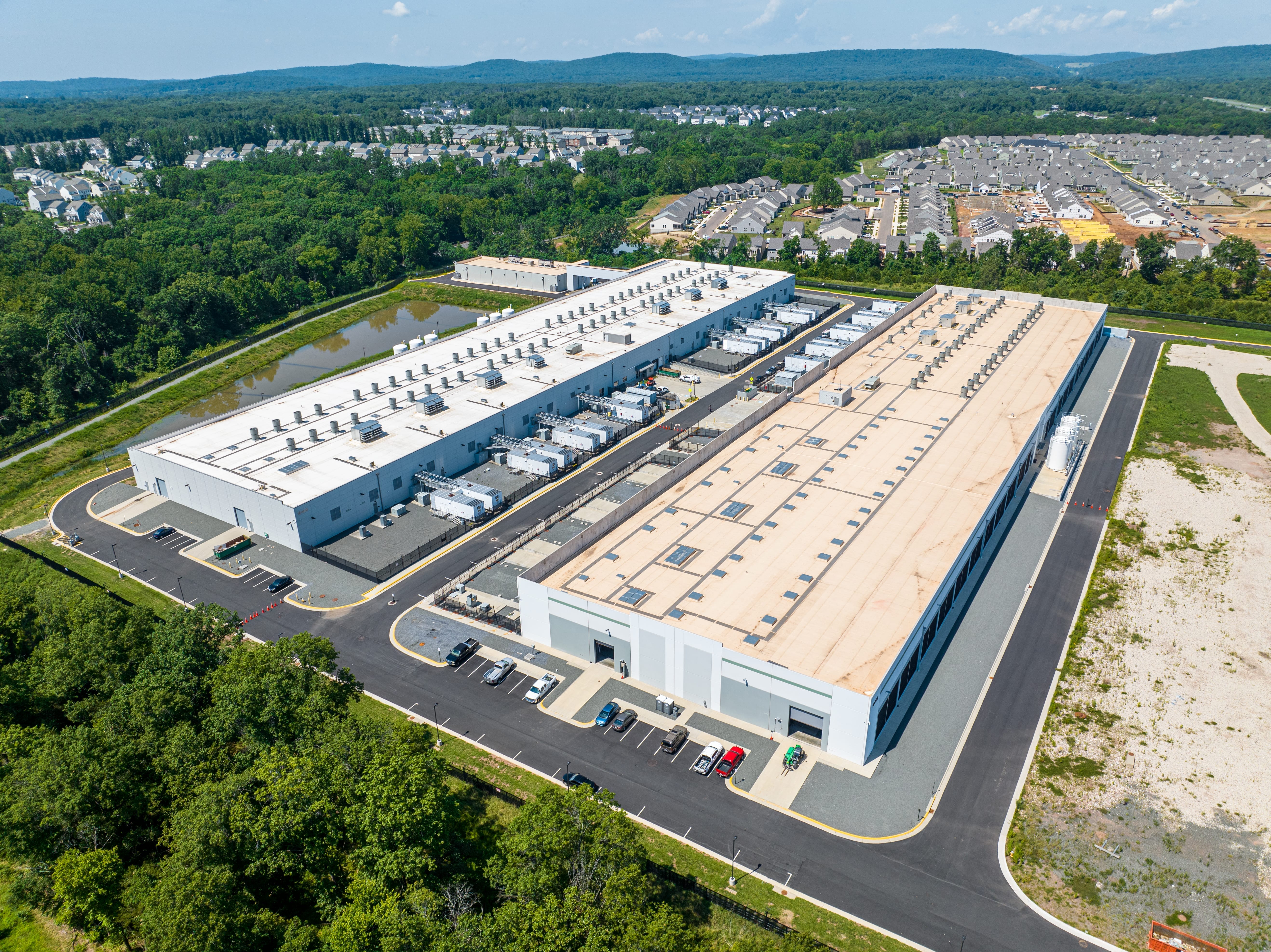
The other day, a journalist friend and I were discussing data centers. He was working on a piece about them, and mentioned how little data centers bring to a community.
“I know they don’t use a ton of water, but they really strain the electrical grid, and they don’t contribute much at all to a town!”
I gently suggested that data centers contribute in one big way: with tax revenue. He was skeptical, and I suggested we look up Loudoun County’s tax revenue. Unlike in much of the country, data centers are well-established in this corner of Northern Virginia. One of the internet’s first big exchange points was built here in the early 90s, and Loudoun has been building data centers ever since. A frequently cited statistic holds that 70% of the world’s internet traffic passes through this region, which is referred to locally as “Data Center Alley.”
As it turns out, a recent study from the Loudoun County Preservation and Conservation Coalition estimates that data centers will contribute about $1.14 billion in 2026, roughly 42% of the county’s total local tax funding. That’s a lot of money! But it doesn’t necessarily mean that data centers are an unalloyed good for the town they’re built in.
These were my beliefs with regards to data centers. Many of these were informed by Andy Masley’s excellent reporting in this area.
Data centers do not use very much water.
Data centers do use a lot of electricity, but it appears unlikely that this typically causes electricity prices to go up.
Data centers generate a lot of noise.
Data centers take up a decent chunk of space.
Data centers do not create many long-term jobs.
Data centers create significant tax revenue for the local community (unless the community chose to give tax exemptions that zero this out).
Having data centers on American soil is crucial for geopolitical reasons.
When I considered those seven beliefs, I tended to conclude that:
Data centers, on net, likely positively contribute to their local community. And they contribute significantly to the broader American community by ensuring compute sovereignty.
But, you know, I’m always open to new information. It’s entirely possible that data centers really do pollute the local environment in unusual ways, or that there’s other issues I haven’t considered. I just haven’t come across any information to that effect.
The day after that conversation, I met a young man at a party. He was a conservative (“I voted for Trump, but I wouldn’t do it again. I definitely wouldn’t go for Kamala though”) and an Ivy Leaguer who hailed from the DC suburbs. I asked which suburb, and he said Northern Virginia, clarifying that he was specifically from Loudoun County. My eyes lit up.
I knew exactly one thing about Loudoun County, so of course I was going to ask him about it.
“Loudoun County—how are people there feeling about the data center buildout?”
“Oh, everyone’s tired of the data centers. There’s so many of them, it takes up so much space. I think they’re not going to let them build more.”
“I thought they contributed like half the county’s tax revenue.”
“Oh, yeah, there’s a ton of money, but it hasn’t brought any of our taxes down. We just have a pool on every block now. We don’t need that many pools!”
“What’s wrong with the data centers? I’ve heard they can be loud.”
“Nah, they’re not loud. But they are ugly.”
“Have electricity rates gone up?”
“No, I don’t think so, but they have to build all this infrastructure to send more electricity to the data centers, so it takes up a ton of space. It’s a hassle. It’s too much.”
This conversation prompted some further research. I learned that Loudoun County has cut the real property tax rate for homeowners significantly in the last decade, from 1.145% to 0.805%, while simultaneously increasing spending on services like schools, libraries, and public safety. All this, and data centers only take up 3% of Loudoun County’s land!
Sounds like a pretty good deal. But clearly discontent is brewing in Loudoun County. Has it always been thus? Was there frustration decades ago, when this area had already become “Data Center Alley”?
No, there wasn’t. In 2000 the county classified them as office parks, which made them a by-right use: file a site plan, satisfy the standards, build. There were no hearings, no votes, nothing to decide. Developers who wanted to rezone land did have to come before the board, and those sometimes led to fights, but there wasn’t the same generalized animus against data centers.
That status quo lasted decades. In 2022 only eleven comments in the county’s subreddits mentioned data centers, nine of them under one post about their environmental footprint. The comments discussed clean energy offsets and replanted trees rather than dooming about climate change and water use.
As AI entered the news cycle in earnest, that started to change. In March 2025 the county ended by-right approval. Now each new data center gets its own hearing.
County Chair Phyllis Randall explained why they felt they needed a change:
When I first came on, I would call people and I would say, ‘But this is what it does for your tax rate and how much it lowers it, and they do this for the community.’ And somebody would say, ‘Oh, I didn’t know that. Thanks for letting me know,’ and that would be it. Now… they say, ‘I don’t care.’ I have people say, ‘I will pay more. Stop building these.’ At some point, we just cannot ignore the voice of the people.
Sixteen months later, it’s the single biggest topic in the county. Earlier this month, Randall held a town hall on data centers. More than 200 people came to a boardroom that holds 160; the rest filled the overflow rooms and stood in the lobby. One Reddit post about the meeting drew 76 comments.
Two pieces of academic research help us understand the shift in public perception.
First is a paper from Swiss economist Bruno Frey and his colleagues. In 1993, they asked hundreds of residents of two Swiss villages whether they would vote to accept a nuclear waste repository in their hometown. 50.8% said yes. Then they asked a randomly selected group the same question with compensation attached: they would get $2,175 per person per year if the repository was built. Support halved, to 24.3%. They tried to triple the compensation, but only one person responded to higher compensation by changing their mind. What could possibly explain this broken demand curve?
Frey read this as compensation crowding out civic duty, which doesn’t apply for Loudoun; nobody there thinks hosting a data center is a sacrifice for the common good. But he floated a second explanation and discarded it: that an offer of compensation tells people the thing must be worse than they thought. He dropped it because only 6.3% of his Swiss respondents said they saw a link between the payment and the danger. That’s asking people to report on their own subconscious reasoning, and nuclear waste was a known quantity in a way data centers are not. I think this idea, that offers of compensation signal a greater hazard when there’s uncertainty, helps us understand some of the dynamics in Loudoun County.
There’s still something confusing here. If we accept that the money signals danger, then why does it do that in Loudoun County in 2026 if it didn’t in previous decades? When Randall told people about how data centers lead to lower taxes and more services, they used to say “Oh, I didn’t know that. Thanks for letting me know.” Now they say “I don’t care. I will pay more. Stop building these.” The young man I met said “We don’t need that many pools!”
Looking at the same problem as Frey—why nuclear waste siting goes wrong—just a few years earlier, geographer Roger Kasperson and his colleagues argued that a hazard’s perceived impact is determined in part by how the signal travels through our information environment. They called this the social amplification of risk. An object can stay exactly what it was while the danger it represents changes radically in the minds of the public.
Until about 2024, a data center was where your emails lived, just the internet’s warehouses. The internet has been interwoven deeply into our lives for decades now, so this was an uncontroversial use case. But now data centers are read as physical embodiments of a top-down AI transformation that many have reacted to with hostility.
And people are not fans of that AI transformation. They don’t need to fall for Russian propaganda around data centers to be angry, and they don’t need to agree with all of my takes around the singularity either. Just hearing from frontier lab CEOs is probably enough to make people hate AI. Last year, Dario Amodei said that AI could wipe out half of all entry-level white-collar jobs within five years. At Davos in January Elon Musk predicted AI “smarter than any human” by the end of 2027 at the latest, and that eventually there would be “more robots than people.” Just two days ago, Sam Altman said OpenAI is “close to creating a genie that can grant any wish.”
Does that sound like the sort of future most people want?
I think it’s a vision that scares a lot of people. And that fear spills over from AI, amplifying hazards around data centers. An amplified hazard produces real consequences: political pressure, regulation, litigation, stigma.
Loudoun County should be the one place in the world where the people know the most about the costs and benefits of data centers. Their taxes have gone down, they’ve had access to more services, and there aren’t any horror stories around environmental ruin. This is the place where the hazard should have been the least uncertain, the least susceptible to these competing pressures. And yet the social risk has been amplified so dramatically that last Wednesday the Loudoun County Board of Supervisors approved a motion to begin the process of pausing all data center applications, site plans and substations in the county until new zoning laws are approved.
It’s not just Loudoun County that’s pushing back, of course. Kathy Hochul issued a statewide moratorium on large-scale data center construction in New York. Per Will Manidis ten states have enacted some kinds of restrictions, eight states have legislation advancing, and sixteen more are currently in discussion around how to proceed.
I perhaps was a bit too economist-brained about data centers. I assumed that much of the backlash was simply because people didn’t understand the significant material benefits it would bring, and thought that the costs were much more than they are. But Loudoun county has had data centers for forever. And still, they reject them.
So I’ll amend my conclusion around data centers from before. Sure, in some purely materialist sense, data centers likely positively contribute to their local community. But if people feel like the broader AI buildout isn’t serving their interests, then they will do whatever they can to stop AI from taking over their lives.
The problem for voters is that world-historical technological change is almost always handled through the mechanisms of markets, not democracy. Technocapital marches on, with or without the consent of the people. This isn’t new, of course; the voters were not asked whether the steam engine was a good idea. Ditto for the internet, Facebook, shortform video, the agricultural revolution.
The resentment of the masses at this next technological revolution—the one making the grandest claims yet about how it will reshape society—has to go somewhere. For most people, all they can do is try to stop the AI transformation from embodying itself in a hulking data center down the street. They can throw sand in technocapital’s gears by stopping local data center developments, but they’ll only ever be throwing sand. Even a global wave of full-throated resistance would just send the data centers to places where democracy has no purchase. AI would arrive all the same.
Except transformative AI futures may not be quite so inevitable as that; the situation has changed since I started work on this piece. Yesterday, an open letter called “Pacing the Frontier” was published, asking the US government to support an international effort to build “the technical and governance tools needed to deliberately pace the frontier of automated AI development.” OpenAI and Anthropic endorsed the letter, which has also been signed by 1200 employees across frontier labs. If our government does build such tools, then there is a chance that the people will have a voice in how the future unfolds.
Comments
Nothing yet. Say the first thing.
Sign in to join the conversation.