
I spend a lot of time unpacking how high-performing people operate. Not what they say they do in interviews — what they actually do in the small, unglamorous moments most people never notice.
And there’s a pattern.
I’ve started calling them Multi-Level Operators. Once you see it, you can’t unsee it — and it shows up in every interaction, especially the way people communicate. There are three levels. Most people live and die on level one. A few make it to level two. The rare ones — the people who consistently create the best outcome for everyone in the room — are operating on level three.
🙋🏼♀️ Hi, I'm Jac, a Business Designer and Strategy coach — Do Your Thing is bigger than design. It's where I turn everyday observations into sharper thinking and fresh takes, to enable people to drive their impact through new perspectives.
Let me break down the art of influence through the lens of “Multi-Level Operators”
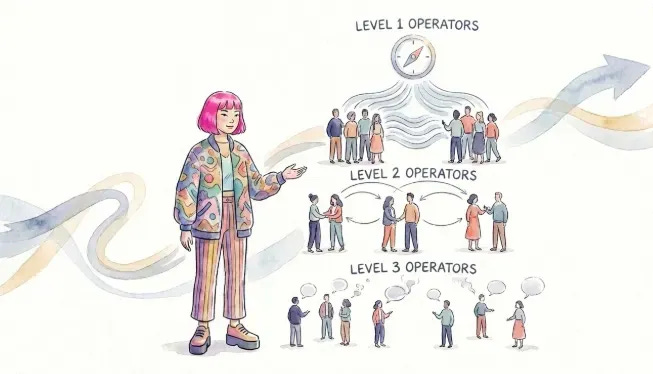
Level one is all about self-expression. My idea. My product. My ask. What’s important to me.
Picture someone presenting at a company all-hands. The level-one presenter turns up to report what the team did — the whole story framed around their own work. Within minutes, half the room has quietly drifted back to their inboxes.
Why?
Because they never made the leap from self-expression — “here’s what I shipped” — to the only question that earns attention: “why should anyone else care?”
They ticked the box (“I did this”) but planted no seed about what it means for other teams, or what anyone in the room could actually take away.
It shows up in my inbox, quite often too. I get cold emails from complete strangers that open with: “Hey, would love to grab a coffee and pick your brain.”
Wait, why the hell would I do that? Firstly, That person didn’t even bothered to call me by my first name. Think about this from the receiver end.
My immediate reaction: I don’t know you — and you want me to set aside time, get changed, get in a car, and drive 30 minutes — for what, exactly? It lands with a thud, because it’s built entirely around what you want, with nothing in it for me.
That’s the quiet cost of level one: you deliver the message, but you lose the connection — and with it, any shot at lasting impact.
Level two adds a second layer: impact on the other person.
If I say this, how will they react? What’s in it for them?
This is where communication stops being a broadcast and starts being an invitation. Instead of “here’s my idea,” it becomes “this might improve your sales funnel — I’d love your take.”
I see this with designers all the time. A good one spots that their work has ripple effects on another team, and instead of charging ahead, they proactively pull those people in — gracefully — so the idea gets shaped with them, not at them.
Level two operators understand that being right isn’t enough. You have to make room for the other person in the story.
Take a pause to think about that for a second!
Level three is a different game entirely. These operators aren’t trying to win — they’re trying to create the best outcome for everyone. And, counter-intuitively, that’s exactly how they end up where they wanted to go.
They can run through all three levels of analysis in an instant — input, likely reaction, outcome — and choose the move that speaks so directly to your needs that, without any prompting, you arrive at the same idea. It isn’t manipulation; it’s the opposite. It only works when the goal and mission is crystal clear.
What sets them apart:
They are system thinkers - instantly see the variations of a single input, and pick the one that does the most good and the least harm.
They go the extra mile on rigorous thinking, so by the time they put anything forward, it’s already a well-rounded direction that serves the bigger picture.
They play the long game. They can hold the full arc — now, next, and future — and they’re genuinely okay if the win isn’t theirs today, as long as everyone moves toward the goal.
The mental model underneath it looks like this:
Input → reaction → outcome → behaviour change → long-term impact.
Level one stops at input. Level three is already thinking about long-term impact.
And notice where the real work happens: before a word is said, shared, or presented. Level three isn’t quick wit in the moment — it’s rigorous thinking, done up front.
🙋🏼♀️ Hi, I’m Jac, a Business Designer and Strategy coach — Do Your Thing is bigger than design. It’s where I turn everyday observations into sharper thinking and fresh takes, to enable people to drive their impact through new perspectives.
Here’s a perfect story about Level Three Player Moves 👇🏽
My partner Toby once told me a story that stuck with me.
Toby was working with a young hotshot — the kind of person who’s convinced they already know everything and that you know nothing. One of their emails was openly dismissive of Toby’s suggestion.
The level-one move is obvious: fire back, prove them wrong, win the exchange. 🫨 But the result could be - fractured work relationship, takes longer to rebuild.
Toby did the opposite. He sat with it. He drafted the next reply slowly, designing it to do three things at once:
Make it clear the goal was a shared goal — that he was there to help, not to compete.
Plant just enough evidence that he’d actually done this before and knew what he was talking about.
Drop the seeds of the ideal idea that could get to the goal together — quietly — so the kid could pick up the hint and “come up with it” themselves.
The kid felt like the smart one at that moment. But here’s what Toby was really doing: turning the kid’s self-interest into a shared one — quietly moving him from “me versus you” to “we’re both here for the same goal, and you are the one with the great idea, congratulations”.
You can imagine life after that email makes working relationship much easier to deal with, not the opposite had you played the “Level one - shot back” card.
Yes, it’s about playing the long game. Because the lesson was never about who came up with the idea, or who won. It was about getting everyone to the best outcome — together.
So when you’re in a negotiation and someone needs to vent, let them. You don’t have to agree. You just have to tame the reactive animal in your head, let them talk, and show them you heard it. Then adjust.
Spending a little longer planning the conversation at the start can completely reshape where it ends up.
There’s one more level-three move worth naming: the best operators don’t just win the room, they turn the room into their megaphone.
No one does this better than Taylor Swift. She’s the ultimate example of turning fans into a distribution community — going direct to her audience, routing around the middlemen, and giving people something to belong to.
Her fans decode her clues, defend her online, and sell out stadiums before she spends a dollar on advertising. She doesn’t market to them; she hands them a story and an identity worth sharing, and they do the marketing for her.
The mechanism is simple but ruthless: give people an incentive they genuinely care about, and behaviour changes on its own.
Colleagues, partners, clients — same principle. When you make the mission genuinely theirs, they carry it for you.
Most of us default to level one under pressure. It’s faster, it feels safer, and it’s all about us.
But level three isn’t about being more clever. It’s about training your mind to be a multi-level thinker — to swiftly read the incentives other people actually value, and shape the narrative so everyone is rowing toward the same shore. It’s more generous, more patient, and, over time, far more powerful.
And here’s the part I love: this isn’t a gift you’re born with. It’s a muscle. Every conversation is a rep. Every all-hands, every tense email, every negotiation is a chance to pause and ask one quiet question before you speak
“What does the other person need to feel, so that what I want becomes what we want?”
Get good at that, and your influence will shift with lasting impact. You begin to pushing your ideas less and start pulling people toward a shared one. You start moving people towards a shared direction. And the outcomes you reach together grow bigger than anything you could have reached alone.
Level three is where true leaders operate.
Thanks for reading, til next time.
Jac 🫶🏾

How I can help you:
If you’re curious about how to uplift your communication game to a Level three operator, I built “AI Powered Strategic Design Accelerator.” to achieve exactly that.
Use this code to take $100 off as a subscriber: DoYourThing
Price will increase after JAN 2027
This 4-week live cohort “AI Powered Strategic Design Accelerator.” has been taken by 200+ designers (Alumni from top companies: Anthropic, Google, Linkedin, Doordash, Superhuman, Microsoft). Rated Top 7th Design Course in Maven.
Course syllabus covers strategic business acumen, strategy visioning, strategic communication, connecting design to business impacts.
Next Intake: OCT 2026 (50% SOLD OUT)
Educational expenses should be fully tax deductible for the financial year (check with your accountant)
No posts
Comments
Nothing yet. Say the first thing.
Sign in to join the conversation.