
Most designers I talk to are using AI every single day.
They’re synthesising research at 3x speed. Generating a dozen concept directions before lunch. Shipping working prototypes that used to take a week.
And then they write a portfolio case study that mentions none of it.
The AI layer is invisible. Buried. Or worse — dressed up as a footnote: “I used AI tools to support ideation.”
That’s not the portfolio that gets you hired right now. That’s the portfolio that gets politely declined.
But here’s what nobody’s saying out loud: this isn’t really about AI. It never was.
Great designers are adaptable. They think in systems. They’re builders with the agency to solve problems — not people who sit around waiting for the right prompt. They’re enablers. AI just made that more visible.
So let’s talk about four moves that actually land with hiring managers at the companies you want to work for.
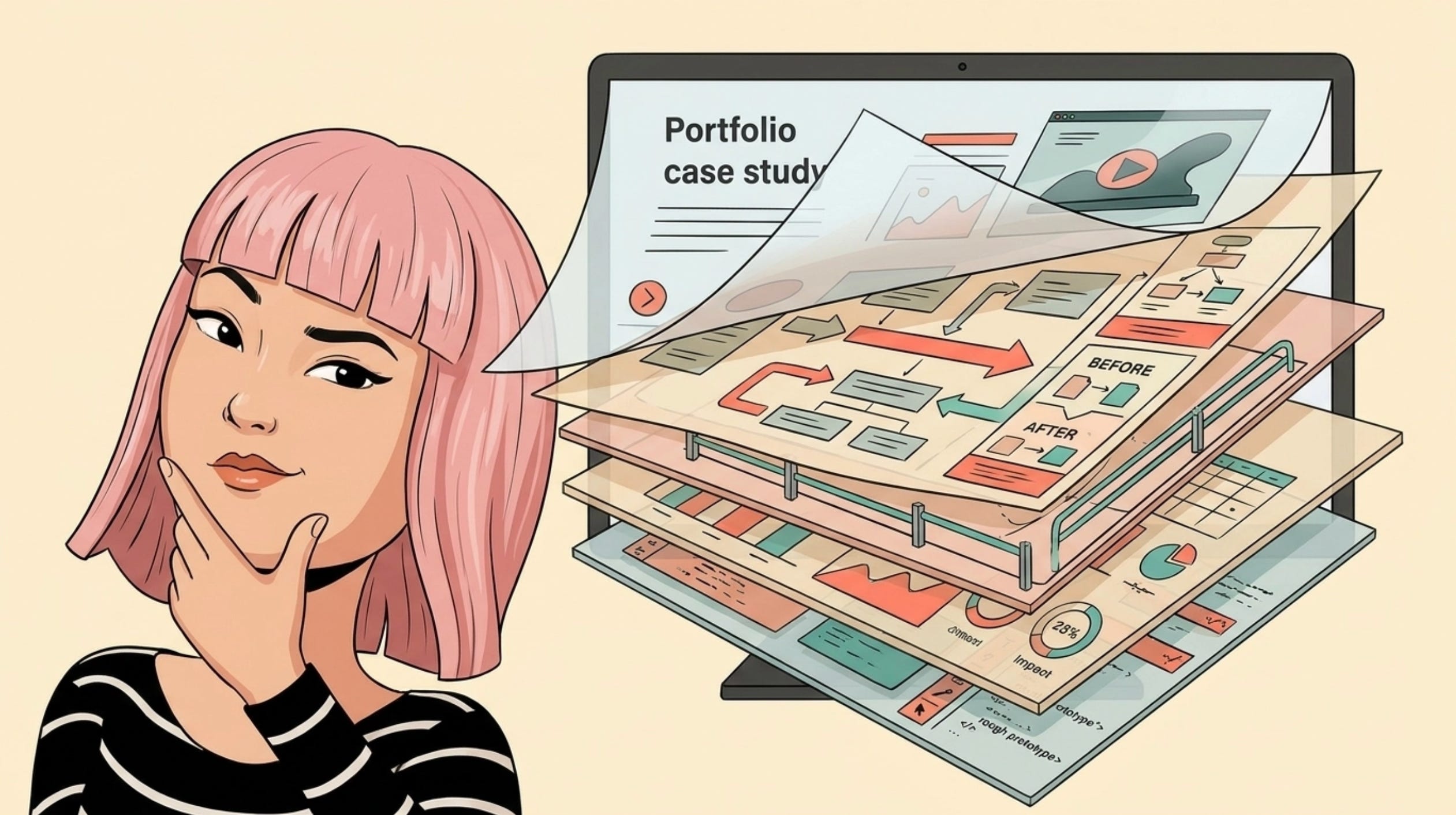
Nobody cares that you used Midjourney or ChatGPT. Sorry. I don’t make the rules.
What hiring managers actually want to see is how AI changed the shape of your process. Not that you used it — how it changed the order of operations, what you attempted that wasn’t possible before, and what you did with the time you got back.
Figma’s hiring data backs this up:
85% of designers and developers say learning to work with AI is essential to their future success. 58% of hiring managers still say visual polish matters, and more than 45% point to collaboration, systems thinking, and product strategy as top skills.
“When anyone can make things, teams need designers who will raise the bar higher.” — Figma
The AI isn’t the story. What it unlocked is.
Try framing it in three layers:
What AI accelerated — the production tasks: synthesis, first drafts, image exploration
What AI enabled — things you couldn’t do before, like testing 15 directions instead of 3
What you still owned — the judgment calls, the direction, what you rejected even when the output was technically fine
That third layer is what separates a senior designer from a prompt operator.
✏️
Your takeaway: Rewrite one case study with a before/after. “Before AI, we did X in three weeks. With AI, we did 3X in the same window — and reinvested the time into Y.” Make the unlock the headline, not the tool.
This is where senior designers separate from everyone else. And honestly, it’s the part that makes me sit up straight when I’m reviewing portfolios.
Knowing when not to use AI — or how to constrain it — is a judgment skill that can’t be automated. And it’s rarely shown in portfolios.
Stripe’s design team operates in a world of developer trust, financial infrastructure, and regulated complexity. Their hiring bar reflects it:
Designers who thrive there innovate within constraints like latency, token budgets, and model confidence — adapting UX flows to the realities of AI systems while maintaining usability and trust.
Beautiful screens with no evidence of how the system behaves when AI fails? That’s a red flag.
Or take Lovable’s perspective. They’re building at the frontier of AI-assisted product development, and their hiring philosophy is blunt:
A candidate who can prompt but can’t critique? Not senior.
Every company you’d want to work for has constraints — regulatory requirements, brand voice rules, accessibility standards, data privacy policies. AI doesn’t know your government client can’t surface probabilistic outputs without a confidence disclosure. You do. That’s the design work.
✏️
Your takeaway: For every case study, show one moment where you built the guardrails before you touched the tool.
What were the business goals?
What were the brand constraints?
What outcome were you driving towards?
“We mapped the failure modes first — what happens when the algorithm gets it wrong? What does a user see when we’re uncertain? I designed the uncertainty states and the fallback experience before I designed the happy path.”
Beyond AI fluency, this is the strategic design layer — knowing why this, why now, and what’s at stake if you get it wrong.
I need to say this with love: the Double Diamond is dead as a portfolio format. Nobody needs to see your sticky notes again. You following a framework thats given to you without your own critical thinking is the biggest red flag. It’s time to let those go.
The new case study structure is scannable, strategic, and outcome-oriented:
What was the measurable result?
What was the precise problem?
What constraints and trade-offs did you navigate?
Netflix’s design team thinks at scale — recommendation algorithms, content artwork personalisation, emotional pacing. Their hiring managers want to see measurable outcomes:
Three seconds. That’s what you’ve got.
And Airbnb’s perspective adds another layer. They’re not looking for “cool AI apps” with slick mockups. They want to see how you navigated the messy, probabilistic, unpredictable part of the product and made it legible to a real human being. The trust design — how you made an uncertain output feel reliable — that’s what matters.
If you don’t have hard metrics, make the inference explicit: “We estimated X based on Y.” That still signals analytical thinking.
✏️
Your takeaway: Restructure your case study opening.
First line = the outcome
First visual = the impact
Then earn the reader’s attention for the story of how you got there
If AI helped you get to a result faster or bigger, that’s your lead.
This is the wild card. And honestly? It might be the single highest-signal move available to a mid-to-senior designer right now.
Not a concept. Not a prototype sitting in Figma. A working experiment. Something that lived in the world for a week, got tested, and taught you something real.
Hiring managers at places like OpenAI, Notion, Anthropic, and Figma are looking for portfolios that scream “I know how to design with AI in mind.” A personal experiment — messy, honest, and real — can make you unforgettable.
But the experiment itself is only half the signal. The other half is what it took to get there.
You noticed something worth solving. That’s observation — a muscle most people never bother to train.
You cared enough to do something about it instead of just tweeting your hot take. That’s heart.
You moved your arse on a weekend to learn and actually built the thing. That’s agency.
No course teaches that. No prompt generates it. No manager can assign it to you.
That combination — the eye to spot the problem, the drive to care, the guts to act — is what every hiring manager is actually screening for when they say they want “self-starters.” They just can’t put it into words that cleanly. Your side project does it for them.
It could be a book club community app you built for your parents group, shared with the community to get real feedback. A personal finance bookkeeping flow you prototyped in a weekend. A rough research assistant you hacked together to help your team run faster synthesis sprints.
Document it simply:
What I noticed
Why it mattered
How I built it
What actually happened
What I’d do differently
✏️
Your takeaway: Block out one weekend. Build one AI experiment. Ship it somewhere — even if “ship” means a Loom video and a blog post. The experiment proves you can design. The fact that you did it proves something much harder to fake.
Speaking of going from “Designer to Builder” mode — if you want to go from idea to shipped AI product in days instead of months, I’m running a live cohort on exactly that. Claude Code for AI Product & Design Velocity teaches builders how to make outcome-driven, business-driven decisions with AI and build an on brand product — so whatever you build answers the “why this, why now” question before you write a single line of code. Use Substack only 50% Off code: 50BETA
The AI layer isn’t a section you tack onto the end of your case study. It’s the lens through which you tell the whole story.
The designers getting hired right now aren’t the ones with the fanciest AI tool stack. They’re the ones who can make the AI layer visible, specific, and unmistakably human. They show the workflow. They show the judgment. They show the guardrails. They show what they built.
And here’s the uncomfortable stat:
Design roles requiring AI skills grew 225% since 2024 — but only 5.8% of applicants are actually qualified. That’s not a skills gap. That’s an open door for anyone willing to walk through it.
Great designers have always been adaptable systems thinkers who build things and enable others. AI didn’t change that. It just raised the stakes.
Be the designer who sounds like they’ve actually done the work.
Because you have.
If this landed, you’ll probably like what I’m building next. Claude Code for AI Product & Design Velocity is a live course where designers and product people learn to make outcome-driven decisions with AI — and ship real products that answer the “why this, why now” question. Next cohort kicks off soon. Use 50% Off code: 50BETA
🥁 How can I help you:
–
Future-Proof Your Design Career With Business Acumen:
AI-Powered Strategic Design Accelerator (4 weeks)
Top 7th Design Course on Maven.
Alumni from: Anthropic, Google, Linkedin, Doordash, Canva
Take $100 Off: DoYourThing
—
NEW - Claude Code AI - Product & Design Velocity (2 weeks)
Build faster. Decide smarter. Ship with intent.
From finding the right opportunity to building an on-brand product to defending your decisions under real pressure.
50% Kick Off Cohort Code: 50BETA
No posts
Comments
Nothing yet. Say the first thing.
Sign in to join the conversation.