
Hi friend,
It has been… a minute. Three months into 2026 and I’m only now resurfacing in your inbox. If you’ve been wondering where I disappeared to — fair. Let me catch you up.
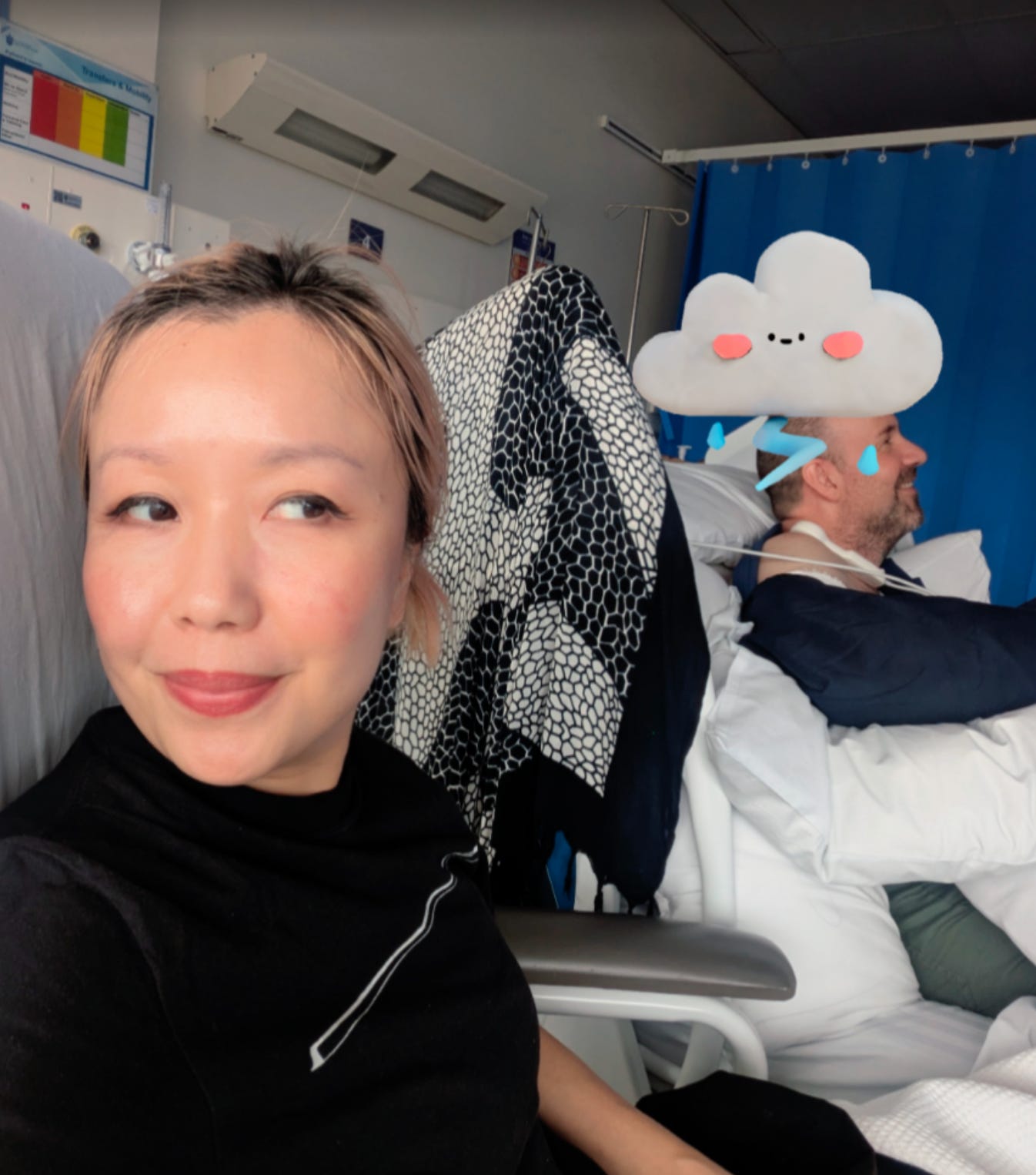
January was a hospital month. 🏥 My partner had a bad accident and broke both elbows. Both. At the same time. If you’re wondering how someone eats, sleeps, or does literally anything with two broken elbows — the answer is: they don’t. You do it for them. So January through February was a blur of emergency rooms, surgeries, and me becoming a very average but very dedicated full-time carer and grown an unbeatable layer of new strength.
He’s now in rehab and already back to light work, which honestly feels like a miracle. We’re getting there.
Meanwhile, in the background, things kept moving. Because apparently I don’t know how to sit still even when life is falling apart:
I updated about 70% of my course curriculum — and the March cohort sold out. (Cue quiet fist pump 🤜🏼🤛🏽 from the hospital waiting room.)
A design leader from Anthropic joined the course. Yes, that Anthropic. I may have screamed into a pillow.
I built my own AI teaching assistant in two hours. It’s live. It works. It answers student questions better than I do at 11pm. (That’s not a high bar, but still.)
New heights for AI Powered Strategic Design Course - all 5/5 reviews. I think my Ikigai lives right here.
Two exciting B2B collaborations are in the works. Can’t say too much yet, but here’s a hint: every organisation wants to invest in shifting their designers into business decision-makers. And they’re coming to us to help make that happen. 👀
I’m collaborating with a AI Product Lead to create a Claude Code for Product and Design Velocity Course - more on this at the end.
So yeah. It’s been a lot. But I’m back.
And I have tones of insights I’ve been wanting to write about for months!! I’ll be sure to slow drip them so you won’t get overwhelmed.
Get your cup of tea ready and let’s get into it.
Because oh boy… hasn’t the industry changed so much since we last spoke?!
How designers who encode their thinking will become the most influential people in the room
I want to start with something uncomfortable.
A few weeks ago, in one of my sessions, a designer said:
“I’m tired of being boxed into pixel pushers.”
“I’m tired of QA-ing with engineers to update a few pixels.”
This is still a familiar scene for many designers. You know it. The back-and-forth over spacing that no user will ever notice. The redlines.
Years of proving your value to people who think your job is just “surface level”.
If you’re a designer, you’ve probably felt this. Maybe you’ve said it yourself.
Here’s the thing: this isn’t new. But the stakes is shifting. 😎
I want to emphasis that the goal of this piece to help you see more value you can provide and the time to shift our mindsets is now and it’s exciting!
The execution layer has been democratised. Your PM is prototyping. Your engineer is designing screens. Your CEO is experimenting with vibe coding and proudly showing off something that looks… surprisingly decent.
I watched it happen in real time. A market manager — no design background whatsoever — shipped a working app. His business team loved it. A designer who had spent years doing things “the right way” watched it get celebrated. 🫨
That moment is happening in companies everywhere right now.
So the question that’s been uncomfortable for years is now unavoidable: if everyone can execute, what does a designer actually bring?
This is not doom. This is clarity.
Because the answer was always the same. It was NEVER the Figma file.
It was the hierarchy read that saves three rounds of user research. The cognitive load catch your PM missed because they were reading the feature list, not the screen. The accessibility flag. The “we’re solving the wrong problem” call. The “we’re building too much” instinct.
That kind of thinking is rare. That kind of thinking is the value.
One of my students put it perfectly:
“Thought partners, not decorators.”
Yes. Exactly. But here’s the problem — and it’s a big one.
Right now, all of that strategic thinking lives in one place: your head. It travels with you. It’s available when you’re in the room, in the review, in the meeting.
And when you’re not?
“Your judgment travels with you. When you leave, so does it.”
This is what I’ve started calling the augmentation problem. Not “will AI replace designers” — that’s the wrong question and frankly, I’m bored of it. The real question is:
How do you make your expertise available beyond your own presence?
How do you be in five places at once without burning out or becoming the bottleneck everyone resents but can’t work without?
The answer is not working harder. It’s not attending more meetings. (Please, not more meetings.)
It’s encoding.
“Encode your thinking.”
This is what augmentation actually means in practice. Not replacing yourself. Multiplying yourself. Your principles, your review criteria, your “things I always check” list — moved from your head into a system that runs without you.
I see three directions this can go:
1. Orchestrator of systems. You stop executing every output and start directing the systems that produce them. AI is your team. You are the creative director.
2. 10x your expertise into an organisational asset. Your taste, your judgment, your business fluency — encoded, scaled, made accessible. Not a bottleneck. Infrastructure.
3. Business operator specialised in design quality. You set the quality bar. You make the trade-off calls. You connect the design to the outcome. That is not replaceable.
I don’t want this to stay theoretical. Let me tell you about three designers who did this recently.
The one-hour review that now takes minutes.
A designer in one of my sessions had spent an hour manually reviewing a vibe-coded prototype against her design principles. Cognitive load. Information hierarchy. Accessibility. All the things she knew mattered. She also knew she’d have to keep doing this as more people in her company started building their own prototypes.
So she built an AI skill instead. Spoke her principles out loud. Let Claude organise them. Fifteen minutes later, the skill runs her review on every prototype. She doesn’t need to be in the room anymore.
Her standards are.
The full-day task that now takes ten minutes.
Another designer built a user research synthesis skill live in a session. She uploaded her interview transcripts and the skill produced colour-coded affinity clusters organised by theme and sub-problem.
Her reaction:
“This is insane. It used to take a full day.”
Ten minutes. That’s not a typo. And the day she just got back? That’s now available for the thinking that actually matters — not the sorting and organising.
The career strategy that compounds.
A third designer built something I didn’t expect: a personal career strategy skill. She runs it monthly. It researches industry signals, assesses whether her career bets are proving true, identifies blind spots, and surfaces what she might regret not doing.
Six months of outputs, then a quarterly pattern summary. Her strategic intelligence, compounding over time. Honestly? I’m a little jealous of this one.
This is the section most articles skip, but it might be the most important.
Augmentation is not just a personal productivity strategy. It’s a team influence strategy.
Design leaders have a structural problem: they know what good looks like, but enforcing it means being in every meeting, reviewing every output, becoming the gatekeeper everyone avoids eye contact with. That’s not influence. That’s a bottleneck with a title.
When everyone runs the same design check before a prototype goes forward, something shifts. It’s not the design leader’s opinion anymore. It’s the standard. Nobody’s the bad guy. The skill is.
“You don’t want to be a spoke in the wheel. But you can definitely influence how they’re doing it.”
Here’s a real example: five teams at one company are each building separate AI chatbots. None of them are talking to each other. All inconsistent. A designer trying to insert herself into every project? Exhausting and unscalable.
But a design component skill that every team deploys? That sidesteps the politics entirely. Her judgment runs on every build. Her name doesn’t need to be on every meeting invite.
That’s influence at scale. No drama required.
The designers with the most influence in the next two years won’t be the ones who fought hardest for a seat in every meeting. They’ll be the ones whose thinking became unavoidable. Embedded in the system. Running on every build. Scaling without them.
That’s not a threat to designers. That’s the job description finally catching up to what the best designers have always done.
They were never just making things look good. They were making sure the right things got built, for the right reasons, in the right way.
Now there’s a way to make that thinking travel further than one person ever could.
Encode your thinking. That’s where it starts and lands.
🫶🏾 If this resonated, I’d love to hear from you. Hit reply — I read everything.
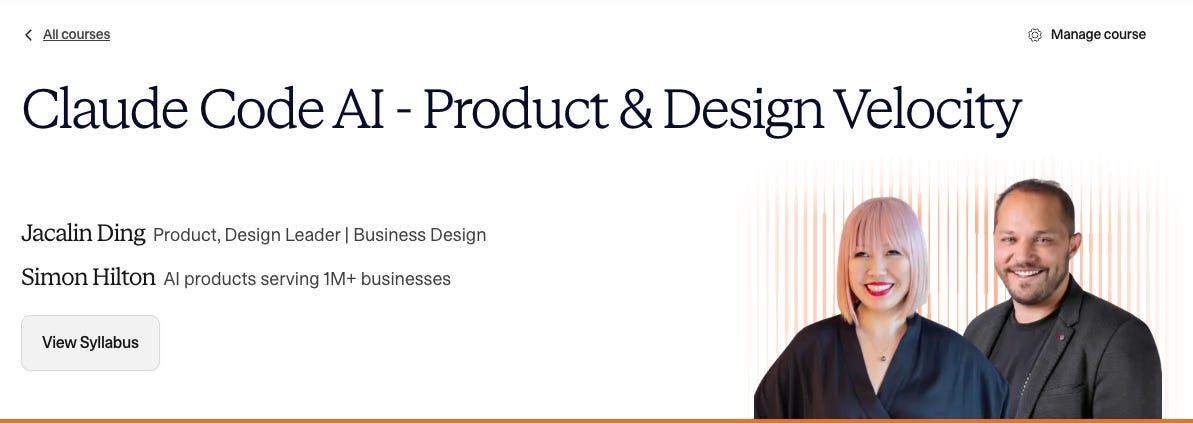
PS. if you’re keen to go from AI novice to AI native - launching a new Claude Code AI Product & Design Velocity course (50% off for readers) kick off on May 17 with Simon Hilton (VP of AI Product from MYOB) While every other course is teaching you to blindly produce AI outputs, this one teach you to evaluate, measure, defend and build product that drives business outcome.
Talk soon,
Jac ✌️
No posts
Comments
Nothing yet. Say the first thing.
Sign in to join the conversation.