
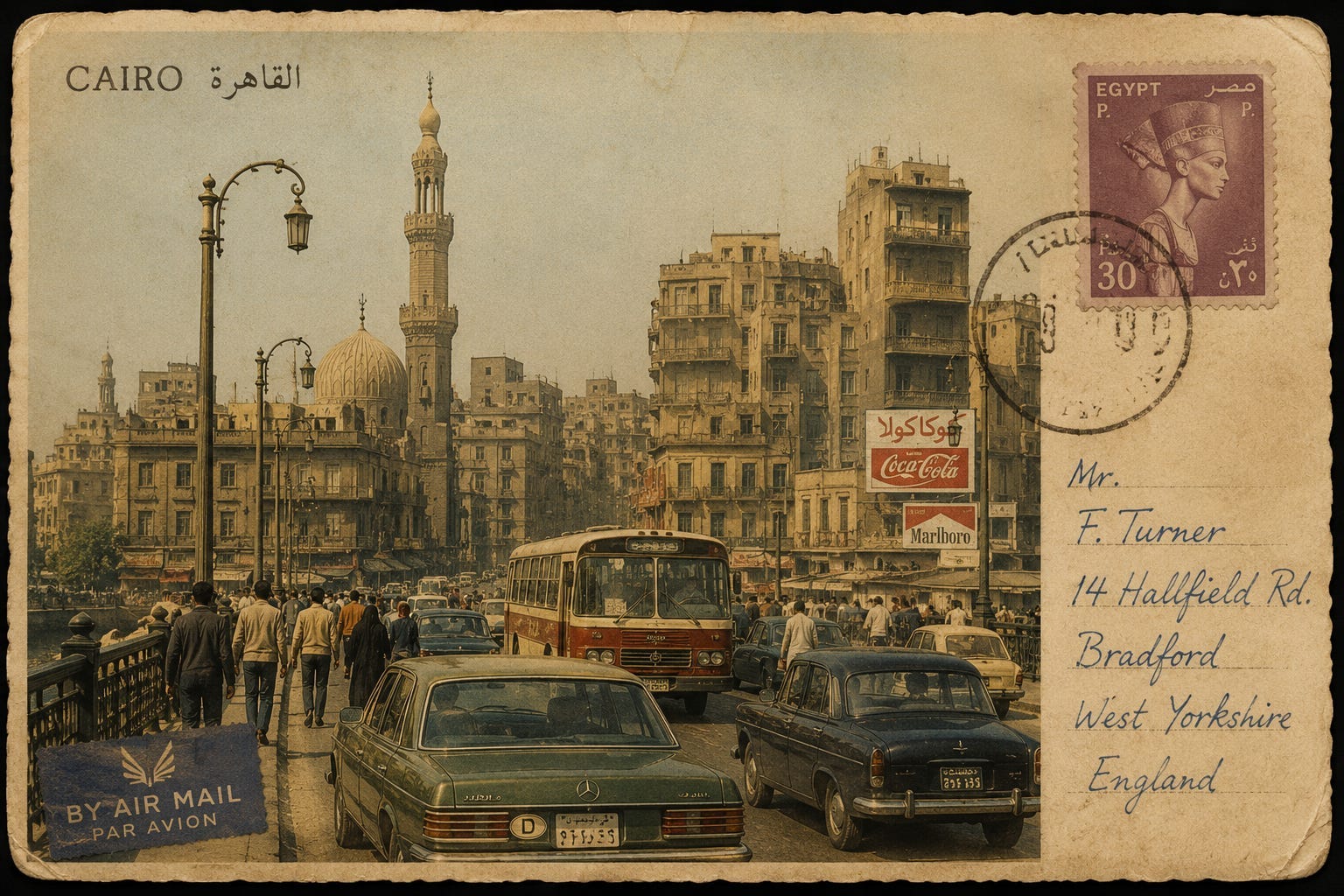
I found her, or she found me, but neither one cared. It’s a place in Cairo, at that hour, in the way. Dim intimate light. Polished dark wood. Cane-backed chairs. A teak sideboard. Silhouettes cut against the glow. It felt like things happened here without intention or premeditation. A tribal dedication to chance. It was too loud and too close and yet, exactly right.
Her high-beam eyes and pickpocket smile emerged out of the mist of Mahraganat music and drifted near me, amused and amusing at the same time.
There is a person behind all that. She sat down without asking. In Cairo at midnight, they told me, this is not rude. It is simply how space works at that hour. More absorption than invasion.
We talked about nothing for a while. She wanted to know where I was from, what I was doing, why I was alone.
Before she’d arrived I’d been observing. A little hash high. Isolating that piercing synth or that mesmerising mizmar. I hadn’t ever heard this music before, this Electro-Shaabi. Ordering my first drink, I’d asked some guy at the bar what it was called. Now I was knee deep in it, swaying.
Then she slid into the picture suddenly. People don’t usually start talking to you out of the blue at this hour unless they are drunk. People are more cautious when they are sober.
But she didn’t drink. She was her own drink. The dazzle.
I said I was staying with friends. She made a face that suggested she understood exactly what kind of friends. I said I was out to explore without them, remembering them leaning on sofas and smoking from bubbling pipes and sinking deeper into the raw wool kilim. I’m looking for something different, I told her, half truth, half bluster.
Her face registered something. Or changed from aura into professorial enthusiasm.
Something different? She smiled to herself. I have just the thing for you.
Just the thing for me.
She alleged to have zeroed in on what I needed before I did. And yet my suspicion dwindled as she told me about the Nadaha the way you tell someone about a dream, leaning forward, voice dropping, eyes bright with the pleasure of it. A delighted intimacy.
I wrote “Nadaha” down on a scrap of paper. I asked her to write it in Arabic script.
I pushed the scrap towards her. She trapped it with the edge of her left little finger, barely touching it, as though that was all the paper required. Her right hand found the pencil. I expected the point to drift left. Instead it touched down on the right-hand side of the page.
It was like watching a left-handed guitar player. Your eyes adjust their expectations. The world seems to almost go back to normal.
And then she was gone, as suddenly as she’d arrived.
I stayed, maybe waiting for her to return but staying away from hoping. I distracted myself by writing down some phrases a man at the bar told me, phonetically. The phrases would help me, he promised. Useful to every traveller.
I asked him if he believed in it when I showed him the scrap with Aisha’s writing.
He smiled inwardly. Nodded.
I believe, he said, that the khamsin is coming. And that you should go before it does, or not at all. Aisha knows. Better than most.
I’d just had that one little taste of Aisha, barely a crumb snatched up from the floor before anyone noticed. I couldn’t wait. I had less than a week before my flight back.
That was my first mistake, or my last piece of luck. I still don’t know which.
**
Getting there turned out to be easier than finding out how.
Everyone in Cairo knew where the villages were. Nobody seemed entirely convinced I should go.
The bartender drew me a map on the back of a cigarette carton. A taxi driver crossed half of it out and drew another.
Just get to Mounib, he said. After that you’ll figure it out.
Mounib was less a station than an argle-bargle about transport.
Hundreds of white Toyota microbuses sat beneath the overpass with their sliding doors open. Drivers and conductors shouted destinations into the dust. Fayoum. Beni Suef. Giza. Places I’d never heard of were being announced as though the entire city had been waiting all morning to leave for them.
I stood there with my backpack and my scraps of paper, failing to look like someone who belonged. Every few seconds somebody asked me a question in Arabic. I smiled apologetically and answered with one of the six words I knew. Most of them laughed. One man pointed me towards a microbus with half the seats already occupied by farmers carrying sacks of vegetables and two bewildered chickens.
Nobody asked for a ticket. We simply waited until there were enough human beings packed inside to make departure economically sensible.
The city thinned reluctantly. Apartment blocks gave way to unfinished concrete skeletons. Then came the desert road, flat and pale beneath a sky already beginning to whiten with dust. The khamsin had not fully arrived, but you could feel it warming up in some Mawwal of longing. The air had acquired weight. Even the horizon looked irritated.
Ninety minutes later the driver stopped in the middle of what appeared to be complete confusion and everyone except me climbed out.
I had reached Fayoum.
Or, more accurately, the point where Cairo became the past tense.
The chaos would change form, I sensed. Whatever lay ahead obeyed different rules.
The second leg of the journey happened without discussion. I walked through a dirt lot repeating “Fedemin?” to anyone who made eye contact. Eventually a man smoking beneath the tailgate of a pickup truck nodded once and jerked his thumb towards the open back. That was apparently all the conversation required.
The truck collected passengers the way rivers collect tributaries. A farmer climbed aboard carrying live ducks tied together by the feet. Two old women squeezed onto the bench opposite me with bundles of coriander balanced on their laps. A boy no older than twelve hung off the rear step until somebody hauled him inside.
Nobody paid until they got off. When my turn came I watched the old man in front of me hand over a few crumpled notes. I gave the driver what I thought was exactly the same amount. He didn’t even look at the money. He just nodded, as if I’d passed a small, unspoken examination.
The last part was by tuk-tuk. By then the road had become a track, the track had become dust, and the dust had become two wheel ruts threading between irrigation canals and mango orchards. We rode about as out of control as you can get in a tuk-tuk without tipping over. Stomach in mouth. Churn, repeat. Palm trees bent in the strengthening wind. Somewhere ahead, invisible behind the fields, was the village.
I remember thinking that Cairo had finally disappeared.
I was wrong. Cairo disappeared only after the first cup of tea.
Comments
Nothing yet. Say the first thing.
Sign in to join the conversation.