
have you ever stumbled across such a beautiful view that you felt it physically?
you walked around a corner on a street you’ve never been before and the sun hits the building in just the right way and something in your soul says “yes.”
or you’re driving around in the evening and the sky does that thing that it does maybe four times a year. the orange-purple blend. and it’s so beautiful you stop the car and just sit there like a stoner staring at gas in the air.
or you catch the face of a stranger across the room and before and you’ve had any conscious thought about them your heart is already racing.
it’s an odd sensation isn’t it?
because nothing is physically happening to you.
you aren’t getting food, or drinks, or sex, or any of the other basic needs.
all you’re doing is watching things receive light. photons hitting your eyes.
but your brain is giving you little bits of happiness as if you’ve just eaten a meal.
why does this happen?
why does seeing something beautiful provide the same stimulus as accomplishing something?
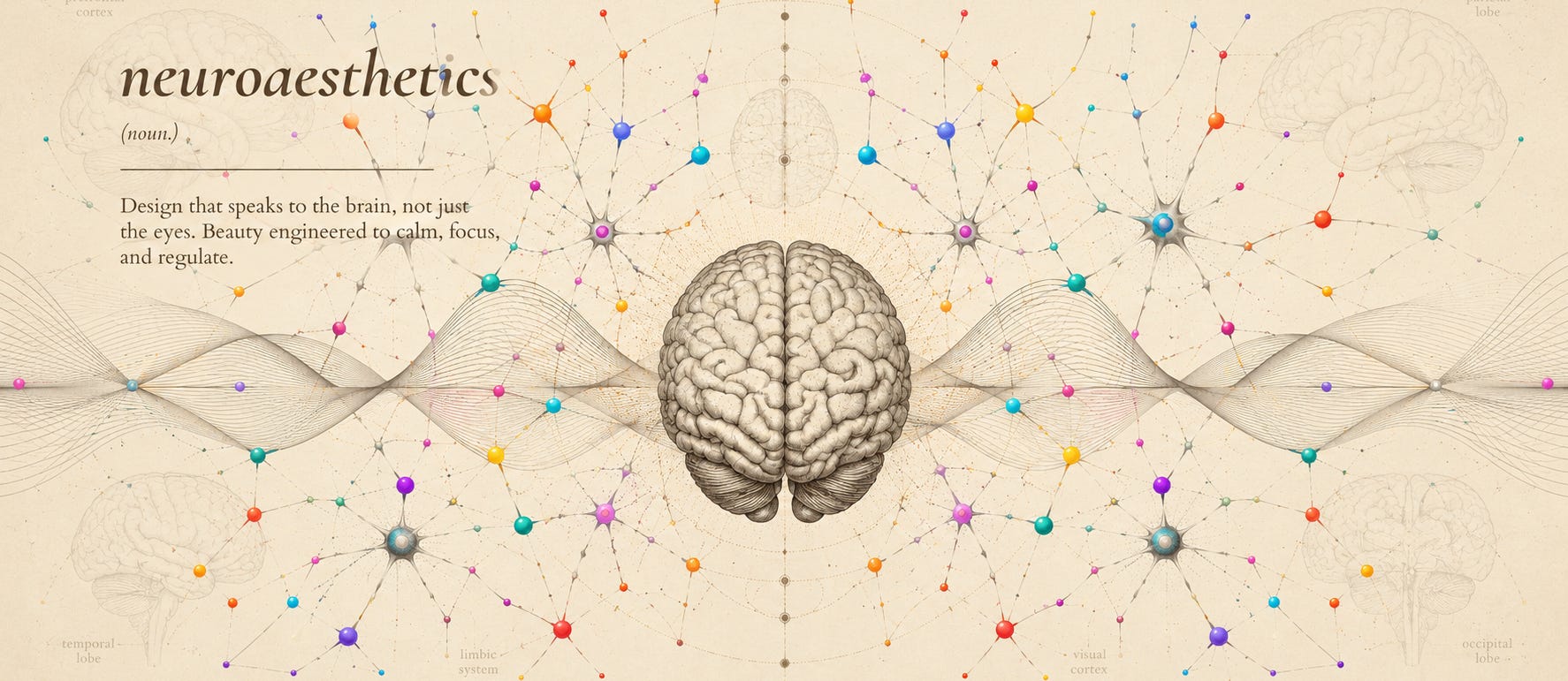
there’s a whole field to explain that feeling. it’s called neuroaesthetics.
it studies the space between beauty and the feeling of beauty.
and what they found out is going to change the way you look at the world forever.
beauty is not something that exists inside objects waiting for you to notice it.
it’s a value that we put on things.
and if you understand that and how to use it, then you understand why art moves you, why context can make you love something visually, why pretty people get far more attention, and why you can stare at mountains that terrify you and still not look away for hours at a time.
i love mountains, i’ve hiked almost every one near my area and some in the dolomites while in italy. i’ve always wonder why i had a pull towards them.
there is something about standing atop a mountain after hours of climbing, looking out over the earth and seeing the beauty of the plates that collide to make it all.
so i went a found out.
it’s 7:22 am as i write these exact words. couple of shots of espresso down the hatch.
beside me is my paper full of neuroaesthetics research with strange little patterns on the side that i have no memory of drawing,
it must have been while i was hypnotized researching,
anyways let’s get into this.
"Beauty will save the world." — Fyodor Dostoevsky
the first thing to understand is that when you look at something beautiful your brain doesn’t turn on some special art module.
there’s no little museum in your skull that only opens for pretty things.
in reality, your brain is using the same circuits for art and beauty that it uses for sex, drugs, food, and anything else you find yourself craving.
faces turn on the orbitofrontal cortex, ventral striatum, nucleus accumbens, and dorsal striatum. if those terms mean anything to you it’s because i’ve written about the reward circuitry before.
so your brain is basically a giant valuation system, and beauty is just another stimulus it wants to assign a value to.
now, what does that mean for us humans?
you see this at play almost all the time.
conventionally attractive people get rewarded disproportionately and systematically across a range of social contexts.
beautiful people are considered to have better personalities, to be more successful in their careers, to have happier marriages, and even to have better moral character all via the halo effect.
that’s not a value judgment coming from you as a person. it’s your valuation system putting these assumptions in your head.
the same exact circuits are responsible for assigning value to everything from the food you eat to the people you date, and beauty is something your brain has decided to value just as much as those other things.
and it’s not just people you see this in.
the beauty of the space you live in has an enormous impact on your willingness to stay there.
the sheer volume of people trying to hang out in spaces that are considered beautiful suggest that beauty is more than just a superficial preference and it’s actually a deep drive.
here’s where the science gets interesting, and where i think most explanations get it wrong.
you’ve probably heard the evolutionary explanation for art and beauty, that we like symmetry because it’s an easy marker for health.
done. neat little answer.
sure it’s true to some degree. but what’s more important is that making sense of something feels good.
the reason we gravitate towards things that are easy to predict is less simple than you might think.
what scientists have found is that when something is easy to understand, your brain actually creates a feeling of pleasure at the success of comprehension, and this has a lot to do with processing fluency.
researchers did an experiment where they asked people to evaluate three types of artworks. some with matching titles, some with nonsense titles, and some with no titles at all.
people found the matching titles more appealing, which makes sense.
but what’s interesting is that people who saw the matching titles had their smiling muscles flex more strongly than anyone else.
in other words,
giving a key that lets you make sense of something makes you happier and not just intellectually satisfied.
and if we’re getting pleasure from understanding the world around us, that might explain where some of our aesthetic preferences come from.
order is appealing because we find it easier to process, and ease of processing is linked to feelings of pleasure in the brain.
however that doesn’t mean that randomness is automatically ugly.
pure randomness is boring, it’s the static on the television that makes you want to change the channel.
perfect order is also boring though. too much predictability bores us, which is why pure patterns like grids are just as unappealing as random white noise.
what we’re looking for is something in between.
songs that have a strong groove but surprise you with interesting variations, paintings that have recognizable elements but put them together in a novel way.
all of these things challenge your brain and engage it, since it has to figure out what’s going on, but it isn’t overwhelming because there’s an underlying pattern your brain can use as a foothold.
the feeling you get from successfully making sense of something is connected to why understanding is so important to us.
you’re looking for a puzzle you can solve.

look around, at anything, really.
two eyes, two ears, two arms, two legs, a face that is split down the middle into two matching halves.
flowers, leaves, butterflies, snowflakes, the catalog goes on.
everything has some kind of regularity to it. it’s organized around symmetry.
so ask yourself, with a brain that evolved in a world full of these patterns, wouldn’t it make sense for us to be particularly attuned to them?
evolutionary psychologists argue that beauty is an indicator of health, and by proxy, genetic quality.
and they’re not wrong, but they’re also not telling the whole story.
this is the more complete version.
“evolutionary accounts propose that facial attractiveness may signal things like fertility, gene quality, and health. that's the hypothesis. but attractiveness is clearly influenced by a bunch of factors at once, some stable and developmental, some short-term and plastic.”
in other words, beauty is often an indicator of how fit someone is, but it’s not a perfect indicator. it’s complicated by a range of other factors, both related to long-term development and random fluctuating ones.
the same principles apply to your own perceptions of attractiveness as well, because you’re doing the same calculations your brain does, only unconsciously.
symmetry is generally good but it’s not actually as important as other indicators of developmental stability, and the reason you don’t consciously think about developmental stability is because your brain handles all of that for you.
you’re not sitting there calculating everyone’s attractiveness based on how symmetrical their face is, it’s already been done for you, and you’re simply reacting to the results.
which is actually how most of our perceptions work.
our brains handle all sorts of complex, multi-step calculations for us, and present the result as some automatic, intuitive “feeling”
researchers have an interesting theory about where aesthetic experiences come from.
they believe it comes from three systems interacting with each other, known as the aesthetic triad.
sensory-motor: perception and action, what you’re actually seeing, hearing, touching, feeling. plus, weirdly, your motor system, because looking at art that depicts action fires the same circuits you'd use to do it.
emotion-valuation: how much you like or dislike an experience, and the degree to which it impacts your emotional state.
meaning-knowledge: everything you know about the object, or the world in general, that might make you like or not like it. including cultural associations and memories.
now what makes these interesting is that when you experience beauty, it’s the interaction of all three.
not any one of them happening at once.
you don’t even have time to process what you’re seeing when you’re having an aesthetic experience, because sensory and contextual information begin interacting within 200-300 ms of seeing something, meaning before you’re even consciously aware of it
this suggests that your brain isn’t putting together a beautiful image and then evaluating it, it’s asking multiple questions at once.
what am i looking at? do i like this? what does this remind me of? what has this been associated with? what am i supposed to think about this? and am i motivated to do anything about it?
and then it puts them together in some strange cocktail and presents it to you as an aesthetic experience. all of that at once, and the output is a single feeling that arrives as, “that’s beautiful.”
to demonstrate this, researchers did a particularly neat experiment.
they showed people abstract art images while in a scanner, some of which they labeled as coming from a museum, and some as computer generated.
the images labeled as museum pieces were more aesthetically pleasing than the ones you know were computer generated.
but what’s interesting is that people who thought they were looking at museum art had increased activity in their medial OFC and ventromedial prefrontal cortex, the reward centers of the brain.
meaning that they actually found the images more pleasing on a neurological level.
the same pattern occurred when the same images were labeled as being from the museum of modern art as opposed to an adult education center.
when realistic portraits were labeled as authentic vs fakes, the authentic ones increased OFC activity as well.
so the next time you think about something as being intrinsically beautiful, you might want to consider that beauty was manufactured in your brain.
it wasn’t found in the object at all, because the frame around the object changed the way your brain reacted to it.
if beauty is a computation, and everyone has similar hardware, shouldn’t we all agree on what’s beautiful?
no.
take a case of judging attractiveness on a set of faces.
two people have the same opinion on average once every 2-3 times, which is between 10-25% variance between people.
one study put it at 50-50.
half of what you think is beautiful, is beautiful to all humans on earth.
pause here and think about this.
half of your taste is not universal taste.
think of it like a human aesthetic operation system but everyone uses different apps on top of it.
we get the same default biases from being primates with a certain brain structure, and then the thirty years of living and learning overwrite some of those defaults.
culture, memory, exposure, romantic partners, associations between things, status, repetition, trauma, luck.
all of these things and more can influence your taste and change it dramatically throughout your life.
your taste in art is dictated mostly by how much you’ve studied art.
people who haven’t studied art tend to favor surface features and content in the picture like color content or subject matter.
the more you study art, the less often you like representational art, and the more you are drawn to works that demonstrate structural stuff underneath.
eye-tracking studies have shown that art professionals and normal people look at different things when looking at pictures of art.
the picture remains the same, but the way an art amateur and art professional look at it is worlds apart.
so here’s a thought.
taste is not universal, but rather built up from learned perceptions of the world.
taste is not something you were born with. you learned to see things.
you developed more perception and the world got brighter and richer.
this is actually good news because it means your taste can be improved upon.
if you experience the world as bland it’s probably because no one has taught you how to see the beauty in it.
"The perception of beauty is a moral test." — Henry David Thoreau
i could go further and say that wanting beautiful things is actually a pretty strange thing for humans to do. if it were strictly about pleasure we’d only seek out pretty things like calm sunsets and pleasant music.
but clearly we don’t.
we seek out horror movies, sad songs, terrifying landscapes, art that disturbs us, stories that gut us.
we do ranges of things from wanting to achieve goals that bring us pleasure to avoiding things that cause us pain.
but the thing is those two aren’t always linked.
wanting and liking are often conflated, but they’re actually separate things.
most of the time, we’re using the same circuits for liking and wanting,, particularly when it comes to our reward system.
the ventral striatum, which drives us to seek out rewards, and the pleasure we get from achieving our goals.
in general the more we experience one, the more of the other we get.
but they’re definitely not the same thing.
especially when it comes to addiction, which can involve vicious cycles of wanting without liking.
deep aesthetic experiences may be a type of liking without wanting.
however, because of the strange way we think about them, they’re often conflated with other experiences.
philosophers like kant and shaftesbury have an interesting concept about art and beauty called disinterested interest.
sometimes when we look at something beautiful we don’t actually want to consume it, claim it, or interact with it.
we simply enjoy looking at it, and the pleasure we get from that has nothing to do with us getting anything from it.
“i once loved a flower so much that instead of picking it up, i let it be.”
if you think about it this way, beauty is a type of pleasure that exists outside of normal reward pathways and your ability to experience it is an extension of your ability to be interested in something without desiring to use it, consume it, or modify it.
which is a strange and wonderful power to have.
interest can be a type of motivation, but it doesn’t necessarily have to be the driving factor.
this also explains the strange pull we have towards things that aren’t beautiful, but provide us with a feeling of grandeur and scale.
the idea of the sublime.
the experience of the sublime seems to be it’s own thing neurologically.
researchers found that while the medial OFC was active for both beautiful and sublime scenes, scenes that were frightening didn’t produce as much activity in the medial OFC which is typically associated with value judgments of beauty.
the neurological response to the sublime is distinct enough that some researchers believe it to be a separate phenomenon.
it’s also why we have a strange relationship with sadness.
it’s widely accepted that sad music can be a particularly powerful aesthetic experience, that music with sad themes are both more common and more effective than their happy counterparts.
there’s something particularly interesting about the combination of sadness and beauty in an aesthetic experience.
research suggests that this is partially explained by the fact that sadness is not actually what people are seeking, but rather a context that makes certain emotional states feel safe and accessible.
so when it comes to art, aesthetics, and beauty, it’s important to remember that context is everything.
our basic motivations apply everywhere from sad music to scary movies to art that makes us think.
so this is what all of this comes to.
aesthetics are one of those places where perception, prediction, reward, memory, emotion, biology, and meaning meet as one.
we’re constantly evaluating everything in front of us, running complex calculations about its value to us, and storing those calculations as memories, rarely stopping to think about any of it.
and sometimes, when those calculations are particularly interesting, when the balance between prediction and surprise feels especially gratifying, we call the experience beautiful.
which means that the sunset, the building, the person you saw, weren’t inherently beautiful
you were.
or more specifically, the interesting combination of thoughts in your head were.
and the strange thing about that is, if you can upgrade your brain software and improve your ability to have these interesting thoughts, you can have more beautiful experiences.
you can be exposed to more information and notice more things around you, which leads to you encountering more interesting moments where prediction meets surprise.
which are then categorized by your brain as aesthetic experiences.
so go out and notice things, and seek things.
upgrade your ability to have beautiful experiences.
because the world is amazing and you’re already doing it.
so why not do it more?
ps. thank you for making it to the end. genuinely. most people don’t.
the forbidden files is reader-supported, which is the only reason it exists in the form it does. no sponsors or ads
and i keep the best work on the paid side. the full mechanisms, the protocols, the stuff that actually rewires how you operate instead of just how you think.
but i’ll be honest with you. most people aren’t ready for it. they’d rather collect insights than use them. read something, feel the hit, close the tab, change nothing.
if that’s you, no hard feelings. the free posts will keep coming.
but if you’re the other kind, you already know it. and you already know which side you belong on.
check out some premium posts:
No posts
Comments
Nothing yet. Say the first thing.
Sign in to join the conversation.