
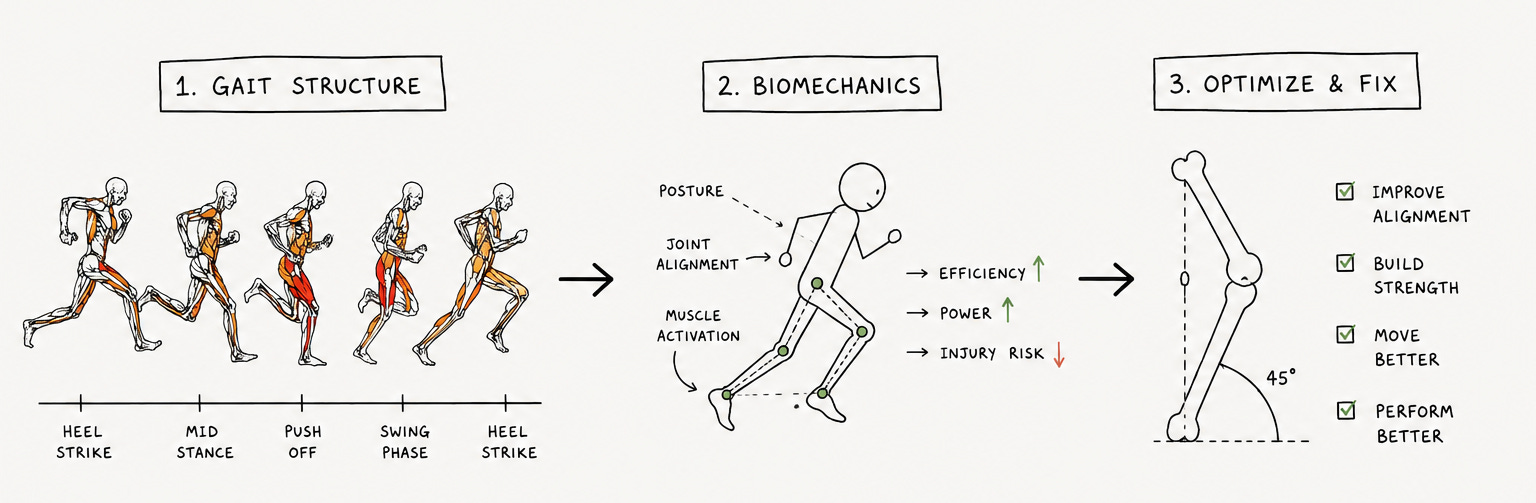
you take anywhere from 5000 to 15,000 steps a day. that means, on the lower end, that you repeat the exact same movement pattern nearly 2 million times every single year.
now, that’s a lot. but most of you aren’t really thinking about it, are you?
you’ve been walking like that since before you had any control over your body.
you’ve been running the same gait routine since before your prefrontal cortex was even mature enough for conscious thought.
and you’ve never really stopped to ask yourself “wait, how does this even work?”
and that would be fine if your program was flawless.
but it usually isn’t for 90% of people.
because whatever pattern you’ve been running or whatever patterns your body has adapted to has been written into your neural architecture by thousands of hours of repetitive, reinforcing practice.
thousands of hours of walking a certain way is thousands of hours teaching your nervous system exactly how to move.
and this is, again, all while you weren’t thinking about it at all.
your posture, your knee problems, your hip pain, your lower back pain, your foot pain, the way you hold your neck.
any of these might be side effects of a movement pattern you’ve practiced hundreds of times every day for a substantial chunk of your life without ever stopping to consider how it could be done better.

the way you walk is one of the most important things in the world. there is an optimal gait pattern.
look at the picture above.
all of the greatest athletes of all time move with straight feet, high inner ankle bones, and their heels trailing away to transfer pressure.
if you look at the average person walking today they have crooked feet, collapsed arches, and their heeling moving inwards as opposed to outwards.
this is literally a suboptimal way of walking. it wears down your joints and keeps you from being your healthiest and most athletic self.
the upside to all this is that the same principles can be used to change it.
which is why this post exists at all. a broad look into your gait, the relationships between your body’s parts and how they move, and some interventions that will allow you to write a new subroutine for your nervous system
so you can stop walking like that.
it’s 8:14 am. candles are flickering, music playing softly, the sun is rising.
i’ve just finished my morning run.
part of the reason why i’m writing this post is because since i started running regularly, i got exposed to a whole range of information relative to how my body works that i previously were completely oblivious to.
imbalances, rotational tendencies, points of failure, everything and anything that could possibly be found in the intricacies of your movement pattern will present itself when you start putting in the volume.
so let’s talk about it.

“Walking is man’s best medicine.” — Hippocrates
let’s begin with the neuroscience, since this is where the whole thing begins.
your brain is not consciously controlling all of your muscles when you walk.
it would fry itself trying.
since walking is a complex motor pattern and a coordination challenge, your brain is not in a position to calculate all of it’s movements and loads of each joint in real time
that’s why the process had to be automated in the first place.
through a motor program downloaded by the brain at some point during early development and it was fine-tuned on an ongoing basis to the point of becoming unconscious and automatic.
this is the same motor program that allows you to type on a keyboard while walking or eat while engaging in a phone argument with your friend
Comments
Nothing yet. Say the first thing.
Sign in to join the conversation.