
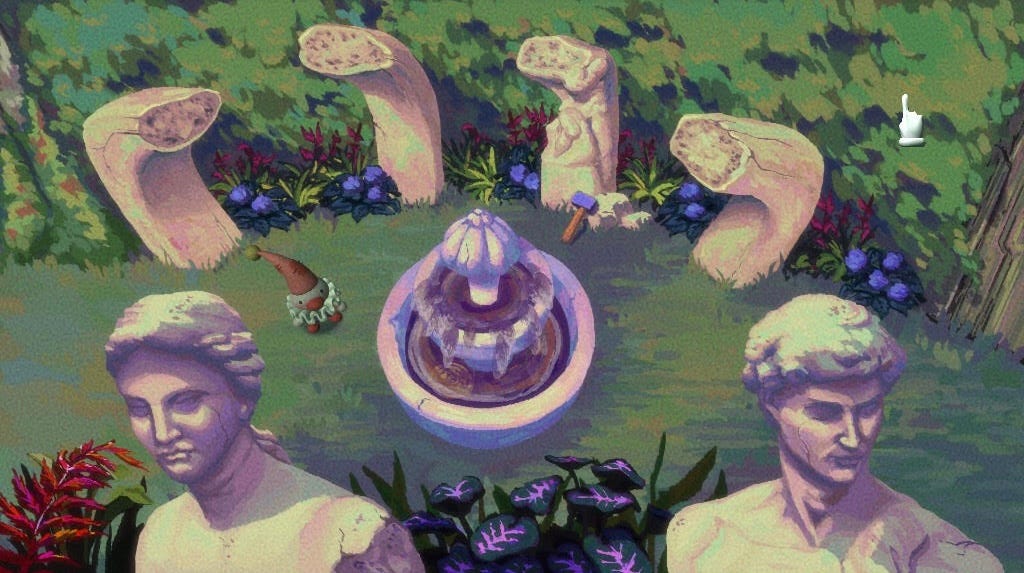
Poco is a point and click adventure game about a 2 inch clown that released on Steam for free on May 20th of 2025 to overwhelmingly positive reviews. I was fortunate enough to have the director Micah Boursier agree to an interview! I’m very happy with getting to know so much behind the curtain, have fun reading!
There will be story and gameplay spoilers ahead. If you haven’t played it yet, go play it!!
August: Where did the idea for Poco originate from and how much did it change when development started?
Micah: I actually feel that the core idea of Poco stayed pretty consistent throughout development, and didn’t have any dramatic thematic changes. The very initial idea for Poco came from a combination of things. The visuals came from a dream I once had, wherein I was decaying in a giant undergrowth and tiny clowns were present. The story arc and game concept came from me applying those visuals to a story I wanted to tell about a certain anxiety I’d noticed in myself and my peers entering an artistic career path… Starting out, I often worried that making art was almost a waste of time, like there were a whole slew of other careers that would be more valuable to society. There was also this concern that I might not be good enough to meet the high standards of others or the industry in general. I felt silly telling people about the path I’d chosen.
At its core, Poco is about an artist learning the true value of their art, and that they don’t need to meet the highest standards of their craft to bring people together. Clowning just happens to be the silliest art form.
August: How long was the development of Poco?
Micah: Because it was a sort of college thesis project, we followed the structure of our program and made the game over the course of one year. Our final year. The way it works is, those who have an idea for a project they want to direct have to put together a pitch, then pitch it to the class. Then, if the professors approve of the pitch, the students start grouping up into teams and get to work. It’s an animation/illustration program so the majority of pitches are for short films, and that’s generally what the schedule is geared towards… But occasionally folks like me will pitch a game.
So I was working on the pitch for like a month or two before the team formed and we got to work in May of 2024.
August: As a game that was for a college thesis project that had to be completed by May 20 of 2025, how was it scoping the game and balancing how much the team wanted to do with what could be done within the timeframe?
Micah: That’s correct, it had to be completed by the 20th. Scoping the game actually went remarkably smoothly. We had a very easily scalable plan for the game, starting small and gradually growing. In the initial pitch, the goal was for the game to be about half its final size, with only 3 homunculi, and like 20ish screens. When we started scheming on the characters, quests and maps, we came up with the final scope of the game, but we knew there was a chance it’d be too much. We designed and prioritized everything such that it would still feel like a complete game if we had to cut out some quests or characters in a worst case scenario… But luckily for us, we managed just fine and everything stayed in. In fact, our scope only grew during development, as we embellished the quests and added certain details. Whenever we had an idea that wasn’t absolutely necessary to the complete game, we’d add it to a list of stretch goals, and return to it later. That included things like the worm cop, the collectible secrets, and the honkable clown nose. Things that added a little more flavor to the game.
I would like to note that I’m making it sound like it was a breeze, but the only reason it went so smoothly is because we had such a dedicated team. It was a ridiculous amount of work for a single school year, but everyone pulled their weight for Poco. The enthusiasm was infectious.

August: How did the core team of Poco come together? I also saw the many volunteers in the credits, how did that come about as well?
Micah: So I briefly mentioned this before, but the project teams form organically after the directors pitch to the class. Basically, everyone who didn’t choose to pitch a project (or simply didn’t want to direct) had to choose a project to hop aboard as a core member. The Poco team basically just formed because the team was just drawn to the idea. It’s a small program too, so everybody basically knows each other. I was decently good friends with a chunk of my team before Poco, but a lot of them were classmates I knew but hadn’t interacted with much. Nobody joined just because they were friends with me, they all considered the choice of projects first. Now, after the project, we’re all great friends.
As for volunteers: it’s kind of a tradition in our program to open up the final projects to volunteers. They’re primarily underclassmen, with a few of them being folks from our year on other projects who just wanted to contribute. The volunteers usually just did something simple, like paint one background or animate one cutscene shot, but a few went above and beyond to do multiple, and a few only did a part. It’s basically just a nice way for people to help out on a project and get a little something to put on a portfolio. Plus, it cleared up a bit of time for us core members to really polish things.
August: What were the motivations to release the game for free?
Micah: There were several motivations. The first is that we wanted as many people to play the game as possible. I’ve developed two games in the past, one free (BirdGut) and one paid (The Multi-Medium), and the free game ended up getting way more downloads and interaction than the paid one, despite its lower general quality. I’m talking multiple orders of magnitude. We wanted people to see Poco, and we wanted to be able to recommend it to anyone with no barrier to entry. Also, for a project that’s going to go on our resumes as we enter the industry, it’s ideal to have bigger numbers and more positive reviews to show off.
But in the end, the biggest reason for me is that this may be the last time we can feasibly put out a free game. We’re doing it now as a part of school, and not to survive… so this is our last chance to make a game free just to get more eyes on it, which will hopefully carry over to whatever we want to do next. If we make paid games in the future, Poco will be a good way for people to dip their toes into our work and see if they like it. Hopefully those players will be interested enough to see what comes next.
We’re very grateful to those who donated to our kickstarter and ko-fi. They funded our applications to games festivals and events, and will go on to fund whatever we do next.
August: At the time of writing this question, Poco has 2,483 reviews on Steam with a 99% positive rating. Congratulations on the overwhelmingly positive reception! I wanted to know how much the team thought about player reception when making design decisions?
Micah: Thank you! We’re obviously very happy with its reception thus far.
Regarding forethought on reception… I mean, with any project that’s going to go public, you’re going to think about the reception to a certain extent. We thought a lot about how to make things clear or intuitive, or whether certain parts would be too easy or too difficult. And we wanted to make sure the story would get across. We just playtested the game between ourselves and our friends to make sure it all worked and made sense. But in regards to the actual subject matter, I feel like we made most of our decisions just based on what we personally thought would be cool or funny. If it makes the team chuckle, it’s going in. Those kinds of decisions weren’t really made with the public in mind.
August: Poco deals a lot with size and scale, were the fixed camera and painted backgrounds a choice to help convey that? How do you also think about framing when designing an area?
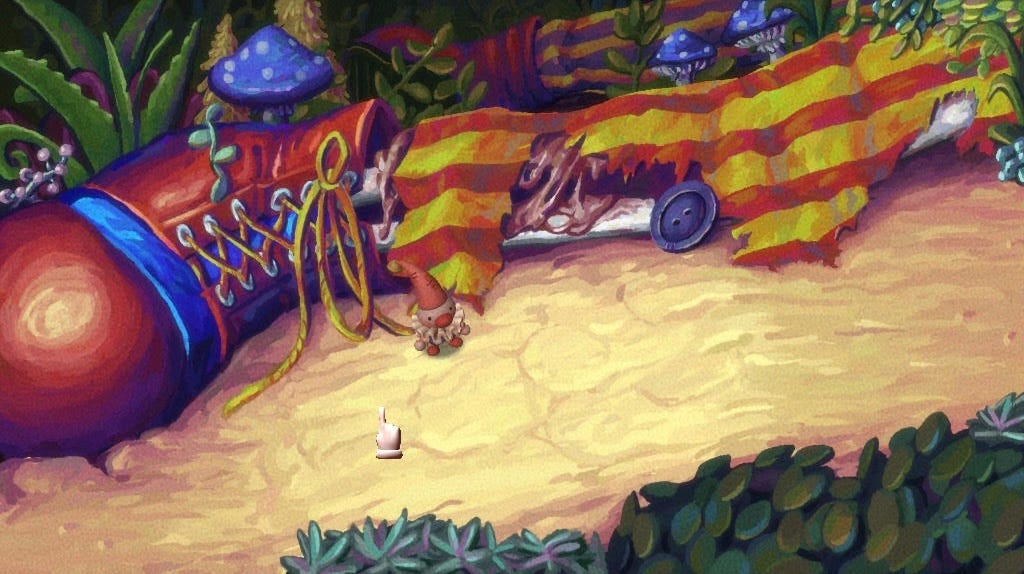
Micah: The fixed camera and painted backgrounds were a choice we made for a lot of reasons. We wanted painted backgrounds so we could cram as much detail into each area without having to model and texture things, and the fixed camera just made that easy, because then we only had to work with the one perspective and could paint like normal. But yes, another big aspect of that was that we could frame each screen however we wanted. We thought it would be fun to vary up the angle a little bit from screen to screen. Some are more top-down, while others are eye-level, some are closer and some are further. We made multiple thumbnails of each screen and carefully chose which composition and angle we felt was the best for each. Having that level of control over the look of each screen definitely helped to convey what we wanted exactly with each one. And scale is part of that.
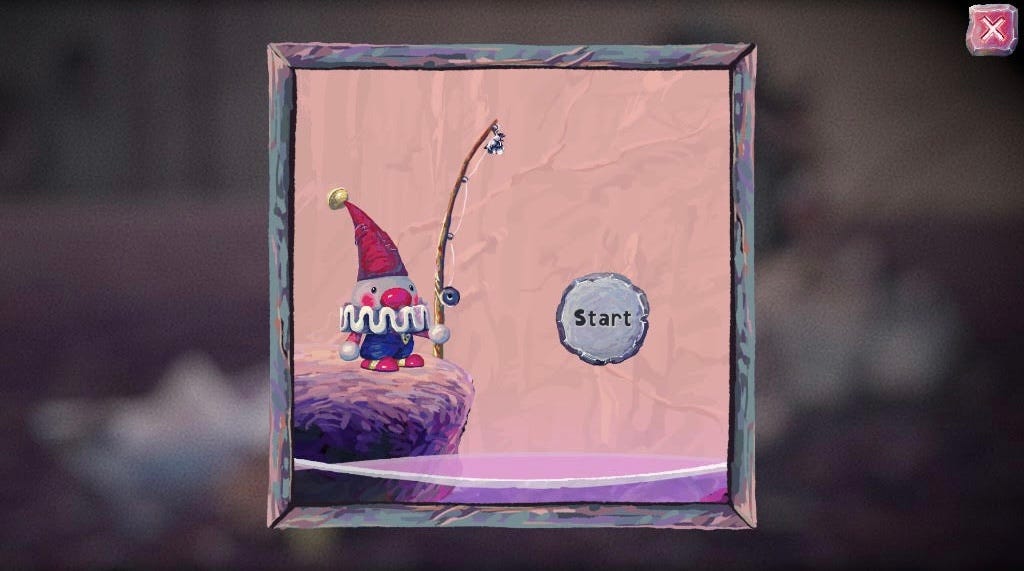
August: The mini games and puzzles are varied and distinct even though they all share the controls of moving the mouse and some involve clicking. What was the process for designing them with this chosen limitation?
Micah: Thanks! Those are all my doing.
The design for those was generally pretty fast and loose. Basically, we started off by designing all the quests, and we knew that we wanted there to be some minigames in there for variety, so we looked at the quests and decided which parts could involve a little more interaction. From there, given the context/end goal of the interaction, I would come up with a minigame that I felt would fit. Some are more like minigames, and others are just simple interactions to give the world a little more tangibility (like the mortar & pestle, the paint mixer, or the magnifying glass). With a lot of them, I would just think about simple arcade-y games I’d played or seen, and think about how I could theme them to fit the interaction. I would often doodle a handful of different ideas, and ask the team which they would prefer.
The limitation of the mouse-only controls wasn’t so hard to work around. Most of those simple arcade games work well with only one or two inputs. If you think about it, a mouse actually gives you a good amount of input to work with. X and Y position/movement, two buttons, and even a scroll wheel. I didn’t want to interrupt the flow of the game with constant pop-up tutorials, so it was important that every minigame was super simple and intuitive. Most players almost immediately figure out what to do without any prompt just because the controls are so simple and there’s only a few inputs to try.
August: I couldn’t help but notice the ties of all of the forgotten material possessions that make up the environment of the Below World and how that overlapped with the characters not realizing the relationships they have. Were the themes of loss and reconnection always at the core of the game?
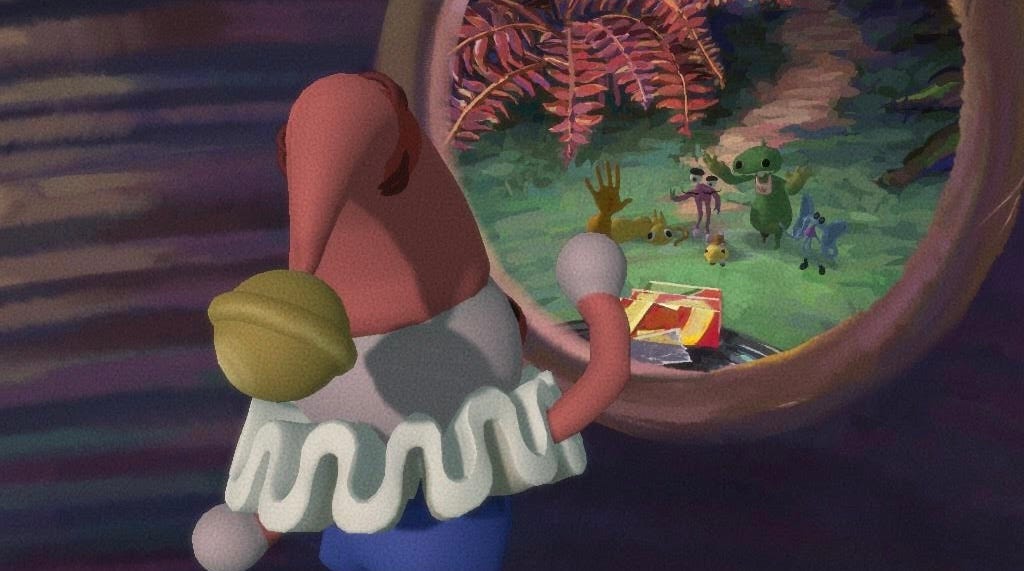
Micah: Yeah, those themes were very important to the story from the beginning. We baked that into the world and the homunculi and everything. The beetle band is another kind of heavy-handed example. It also ties in with the aforementioned themes of rejection, and the value of art (in bringing people together). The Below World is a kind of rock-bottom, where everything lost, broken, or unwanted ends up. It’s the landfill of the whole world. When Poco ends up there, it represents the ultimate rejection from their craft, and their whole being as a clown. The Homunculi are rejected as well. Being in that kind of state can really worm its way into your brain and cause a lot of harm. If you feel unwanted, or like you’re not good enough, you tend to expect certain treatment from others, or you isolate yourself. Each of the homunculi deal with that pain in a different way. Just by being there and being themself, Poco shows them that it’s all in their head, and that they really are valued. In doing so, Poco discovers that they are valued right where they are as well, with no need for the circus.
We hoped that people would play the game and realize that they are loved and valued too, though they might not realize it or might take it for granted. Otherwise, people would take it as a reminder to reach out to those they care about. Just generally to bring people together.
August: What were the most challenging parts of development and were they expected?
Micah: The toughest stuff was mostly technical. All of the creative decision-making work was usually delightful, and came together very smoothly. The challenges came with the execution, which was kind of expected. There’s two really big things in particular:
One was making the character rigs. All of the Homunculi have very unique anatomy and require very specific and unusual rigs and animation. That meant we basically made each one from scratch, without re-using any parts, and with no standardized skeletons. It was also especially difficult because we had to design the rigs in Maya in such a way that they would also work when exported as an FBX, and imported into Unity. Squishy, stretchy and bendy parts don’t usually translate very nicely in that process, so almost all of our characters had to be reworked after testing in Unity.
The other biggest challenge was in getting all the backgrounds to look cohesive. Because we had so many different volunteers and team members working on backgrounds, we had to put together a sort of style guide that people could follow to make sure nothing looked out-of-place. We also made color guides and maps to determine the flow of colors and flora between screens in different areas. We had a lot of meetings with the volunteers to give feedback and critique, to lead them in the right direction. I also ended up touching up almost all of the backgrounds personally.
Despite the challenges, I think it came together really nicely. The character animation turned out great, and the screens all feel like they belong.
August: What were the milestones that the team was most excited about hitting during development?
Micah: The big one is obviously the final release, but before that, the other major milestone was our alpha, which was when we first had a complete, playable version of the entire game, just with placeholder geometry for some of the characters, placeholders for many of the screens, and no extra bells and whistles. We didn’t have many other big deadlines or milestones and we just kind of kept our nose to the grindstone for the most part to get to that final release.
August: Are there any other things about the making of Poco that you would like to share with fans and fellow game developers out there?
Micah: Hmmm…
I think I’d just like to say that it’s been a real pleasure working on Poco, and it was a wonderful experience to grow closer with the whole team. It was my first time developing a game with a team, since I did the last two all by myself, and It was fantastic. I’m so glad to have shared it with my friends. If anybody out there wants to make a game, I’ll just say to do it! With friends! It’s great!
Poco was made with so much love and care from the whole team, and it fills us with so much joy to see the love from all the fans. Just like Poco, our art is bringing people together. Thank you all so much for playing!
August: Thank you so much for your time! I’m sure many fans are wondering, would the team want to return to the world of Poco for anything in the future?
Micah: Perhaps, perhaps… Too soon to day at the moment, but we definitely have more that we could explore in the world of Poco. There’s a lot of lore that you don’t see in the game.
No posts
Comments
Nothing yet. Say the first thing.
Sign in to join the conversation.