
Ninety seconds, no cuts. Onboarding, a cleanliness score, a before-and-after slider, a booking that takes half a minute, a chat that starts with AI and ends with a person, a one-tap reorder, and the crew’s side of the operation. All of it is the real demo at squeakycleanturf.com/app.
Dave cleans artificial turf for a living. He runs Squeaky Clean Turf out in the Phoenix Valley, which puts him in the category of business the software industry has never bothered to learn anything about: trucks, hoses, dog yards, customers who come back every couple of months if you treat them right.
A few weeks ago he sent me a text. I’ve read it maybe twenty times since.
“Imagine telling ppl when they book to download the app. It will push them to book again and buy product. The turf industry doesn’t think in terms of scale... I think the cleanliness loop. Between visits and knowing when to schedule. Photo and treatment log. Smell check-in. Very valuable data.”
I’ve sat through a lot of product pitches. I’ve written a few. Most of them, even the funded ones, don’t say as much as that text does. In four sentences Dave described a retention system: log every visit with photos and treatments, check in on the smell between visits, and let the system learn when a yard is due before the owner notices. He’d found the loop. He just didn’t have the software.
He asked how long a demo would take. I said give me until tonight.
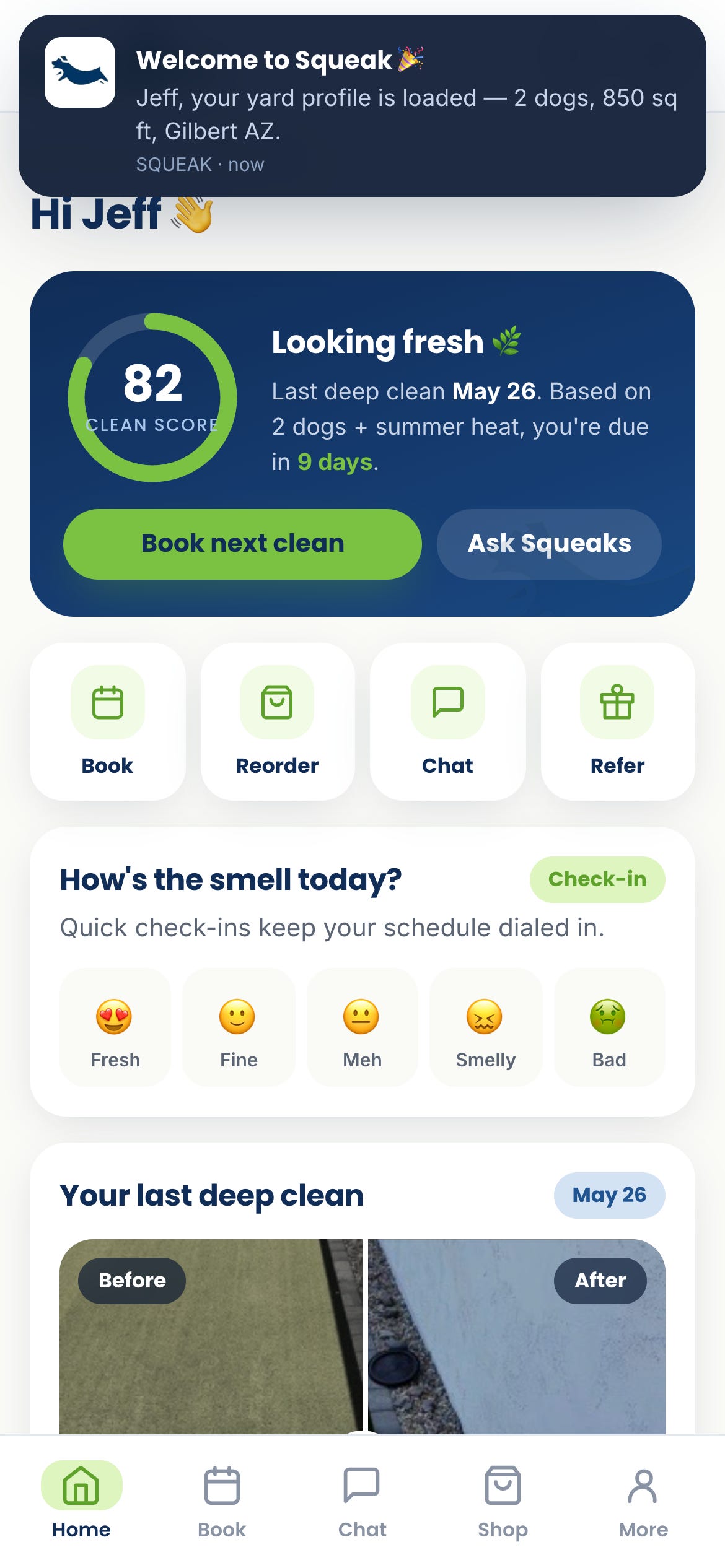
The app is called Squeak, and I want to be straight with you about what it is, because the honesty is part of the pitch. It’s a working demo running on mock data. Every screen functions, every button does something, and you can put it on your own phone this minute. But Jeff and his two dogs, the sample customer you’ll meet inside, are inventions. The real backend is phase two.
You open to a scoreboard, not a brochure. Your yard’s cleanliness score, when you’re due, and a button that asks a question only this industry would ask: how does it smell out there? Tap “Smelly” and the app moves your schedule up and offers you Thursday. That’s Dave’s loop, closing itself without anyone picking up a phone.
The screen that sells the whole thing is the before-and-after slider. Every visit gets logged with photos, the package, the tech’s name. The customer gets proof of what they paid for. The company gets a marketing asset it didn’t have to lift a finger to make, on every single job.
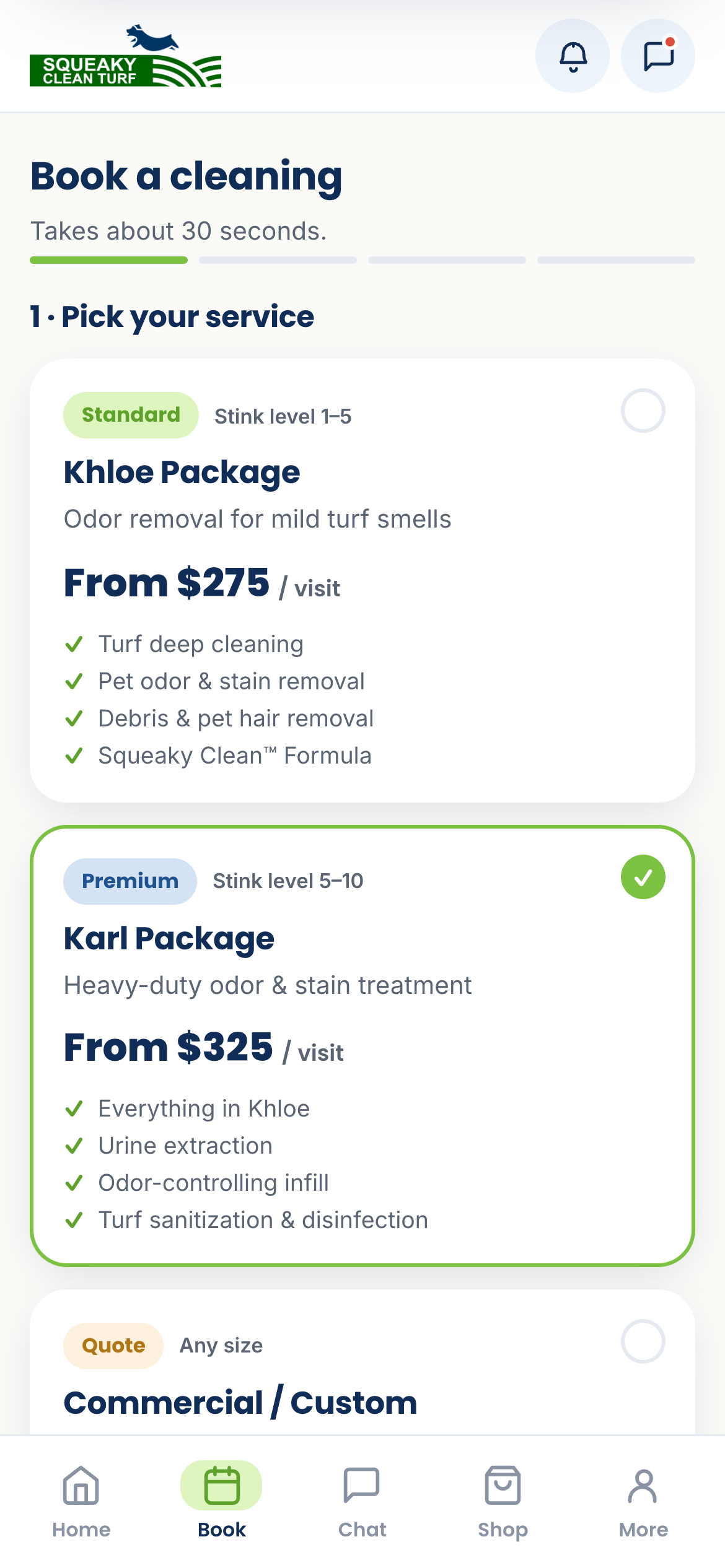
Booking runs about 30 seconds, and the numbers in it are real. The Khloe is $275 for mild odors; the Karl is $325 for the yards that have gotten away from people. Yard size and dog count move the quote, the arrival windows are live, and the confirmation drops a calendar file onto your phone like any airline would.
The chat opens with an assistant named Squeaks, who can handle pricing, products and the occasional smell emergency. Ask for a human and the thread hands you to one. In the demo that human is a scripted stand-in for Dalis; in production it’s the same inbox the company already answers.
The shop sells the same pet-safe formula the techs use, one tap from home, free shipping over $75. Go back and read Dave’s text. “Book again and buy product.” Those are the two biggest buttons in the app, because he told me they should be.
And the crew got a mode of their own, which I’d argue is the quietest and most important part. Today’s route. Navigate, call or message on every job. A treatment checklist, photo capture from the truck, a smell rating on arrival. When a tech marks the job complete, the customer’s loop updates on its own. The data Dave called “very valuable” gets collected as a byproduct of doing the work, which is the only way field data ever actually gets collected.
Squeak is a progressive web app. You open the URL, tap Share, then Add to Home Screen, and it lives on your phone like anything you’d download: icon, full screen, works offline. Nobody paid Apple $99. Nobody waited in a review queue.
I know the other road. Buddy, my Google Ads agent, is on Google Play and sitting in App Store review as I write this, and native is the right call when you need push notifications at scale or in-app purchases. But for a local service company that doesn’t yet know whether its customers will use an app at all? The web app is the honest first move. It cost an evening instead of a quarter. And if Squeak earns its spot on people’s home screens, the same code slides into a native shell later. Buddy took exactly that path.
Here’s the part I suspect you actually came for, because it’s the same lesson I keep learning on stage and in client accounts: the model is the easy 20% of this work. The other 80% is discipline, and nobody wants to talk about discipline.
I built Squeak with Fable, the agent I run inside Cursor. I didn’t write much code. What I did was direct. I handed it the brand, the text thread with Dave, and a clear picture of what I’d be willing to put in front of a client, and then I held it to that.
It started where any decent freelancer would: with the brand. The colors came off the live site’s design tokens. The logo is the real logo. The job photos are real Phoenix backyards. The packages and prices are the ones Dave actually charges. That’s why the demo feels like Squeaky Clean Turf instead of a template with the name swapped in. There isn’t a stock photo or a line of filler text anywhere in it.
Then it built the thing whole. Nine screens, a service worker, a manifest, state that actually holds. Bookings persist. Carts add up. The demo resets itself so the next pitch starts clean.
Then came the part everyone skips, which is exactly why it matters. The agent drove the app in a browser like a suspicious customer. It checked the price math on every package against every yard size. It opened the calendar file. It timed the chat handoff. It swept for broken images and console errors. It found three real bugs, one of them a blank first screen that would have greeted Dave the moment he opened the thing on his phone, and it fixed them and checked again.
Then it shipped through the same pipeline the website uses. Committed to GitHub, pushed live to Cloudflare by CI, tested again against the live URL. Even the video at the top of this piece came out of the agent, which scripted a phone-sized browser session, walked through the app like a thumb would, and rendered it in 4K.
A text thread at the start of the evening. A tested, deployed, filmed product at the end of it. Eighteen months ago I would not have believed that sentence, and I do this for a living.
A demo’s job is to make the decision easy, not to be the product. The real build is roughly 60 days, and it swaps the mock data for the systems Dave already runs: GoHighLevel for booking and messaging, Shopify for the reorders, a Cloudflare backend for the loop itself — the visit records, the photo history, the smell trends, and the predictive scheduling that turns “you’re probably due” into a booked job.
That last part is the moat, and it’s worth sitting with. Anyone can commission an app. What Dave saw in that text is that the loop produces data nobody else in his industry has ever collected: when yards turn, how fast, by dog count and season and neighborhood. His industry is being consolidated by private equity right now. The operator who walks into that conversation holding a dataset and the retention curve it drives isn’t selling a truck route anymore. He’s selling a system, and systems price differently.
Dave said it himself: the turf industry doesn’t think in scale. Neither does the barber, the pool company, the detailer or the landscaper, and until about a year ago they were right not to, because software at this fidelity cost more than a truck.
It doesn’t anymore. If you have a brand, a repeatable service and a reason for customers to come back, the app that closes that loop is now an evening of directed work and a URL. What’s left is the part that was always hard, the part no tool does for you: knowing, the way Dave knew, which loop is worth closing.
Open squeakycleanturf.com/app on your phone and poke around the public demo. And if you’ve got a loop of your own, you know where to find me at ahmeego.com or itallstartedwithaidea.com.
John Williams is the founder of AHMEEGO and the practitioner behind Buddy, an open-source Google Ads agent that runs on Cloudflare Workers. He’s building agents live on stage at Hero Conf San Diego, Sept. 15-16. — John Williams Founder, AHMEEGO™ | It All Started With A Idea LLC
📱 Get Buddy and the AHMEEGO apps: https://ahmeego.com/apps/
🌐 Website: https://ahmeego.com
✍️ Blog: https://ahmeego.com/blog 🛠️ Open source: https://github.com/itallstartedwithaidea 🤖 Google Ads Agent:
https://googleadsagent.ai
🎤 Catch me live: Hero Conf San Diego, Sept. 15-16
#AIAgents #GoogleAds #PaidMedia #BuildInPublic #PWA #LocalBusiness #SmallBusiness #AI #MarTech #Buddy #AHMEEGO
Comments
Nothing yet. Say the first thing.
Sign in to join the conversation.