
Recently someone on threads asked “What’s a movie everybody seems to love that you just cannot get into?” and I immediately knew my answer.
I know I’m going to get dragged for this and over the years many people have tried to get me to like Love Actually, but without fail, it never works. No matter how many times they try. No matter how many good things they say about it. Not even them sharing why they love it works (and I love watching things with people that they adore).
So when it came time for me to start my next rom-com, I knew I had to throw out my initial idea. It was time to understand why I don’t like it and dive headfirst into a Christmas rom-com favorite: Love Actually.
Because:
“If you look for it, you’ll find that love actually is all around.”

Love Actually starts in such a deeply moving way that makes me really want to love it.
It opens with a heart-warming montage of people being reunited with their loved ones at the airport. The scene is full of open expressions of joy, free-flowing affection and tender moments of intimacy that feel so deeply human.
“Whenever I get gloomy with the state of the world, I think about the arrivals gate at Heathrow Airport.”
It reminds me of a word I think about often: sonder, the profound realization that everyone around us has a life as vivid, complex and meaningful as our own.
It gave a name to a feeling I’ve had my entire life — and have often walking around New York City — and really captures this opening sequence.
And layered with Hugh Grant’s monologue, it’s the exact type of storytelling that reminds us what life is really about and how we get through the darkest of times: connection.
“General opinion’s starting to make out that we live in a world of hatred and greed, but I don’t see that.
It seems to me that love is everywhere.”
And it reminds us that love isn’t about the big milestones or the grand, romantic gestures, but instead about a collection of small moments that carry more meaning than they seem — and come together to build a life.
“Often it’s not particularly dignified or newsworthy, but it’s always there — fathers and sons, mothers and daughters, husbands and wives, boyfriends, girlfriends, old friends.”
And then its as if the movie decides to take a hard left turn away from this beautiful message and instead doubles down on questionable power dynamics, prescribed gender performances and over-the-top displays of public affection — all wrapped with Christmas-spirit-justified boundary crossing and tied neatly with a risk-taking-as-romance bow.
And leads us to ask ourselves: what actually is love and romance? And what have we just been told to believe should be?
In case you also haven’t watched this movie since Christmas in the past, here’s a quick recap (and a character list because there are so many of them):
Quick Summary
Set in London, the movie follows an ensemble cast with many separate, but loosely intertwined narratives as they navigate love and life in the five week lead-up to Christmas. Their storylines explore everything from difficulties dating and communicating to grief, infidelity and whether or not to stay in relationships that we know aren’t good for us.
Characters/Storylines to Know
(Note: I intentionally wrote their roles in this way because that’s how they’re treated/it highlights the power dynamics we will be exploring)
David the Prime Minister (Hugh Grant) and Natalie his staffer (Martine McCutcheon)
Jamie the writer (Colin Firth) and his housekeeper Aurélia (Lúcia Moniz)
Harry (Alan Rickman), his wife and David’s sister Karen (Emma Thompson) and his secretary Mia (Heike Makatsch)
Juliet the bride (Keira Knightley), her husband Peter (Chiwetel Ejiofor) and his best friend and best man Mark (Andrew Lincoln)
Recently widowed Daniel (Liam Neeson), his young stepson Sam (Thomas Brodie-Sangster) and Sam’s crush Joanna (Olivia Olson)
Sarah (Laura Linney), her office crush Karl (Rodrigo Santoro) and the brother she cares for Michael (Michael Fitzgerald)
John (Martin Freeman) and Judy (Joanna Page) body double and scene partners for sex scenes on film sets
Billy Mack (Bill Nighy) the aging rockstar and his long-time manager Joe (Gregor Fisher)
Colin Frissell (Kris Marshall) the single bachelor and his best friend Tony (Abdul Salis)
Rufus (Rowan Atkinson) the jewelry salesman, airport purchaser and overall Christmas angel
Memorable moments
Mark showing up to Juliet’s door with cue cards silently confessing his love for her
David dancing by himself to Jump (For My Love) in the Prime Minister’s residence
Harry trying to secretly buy his secretary a Christmas gift while out shopping with his wife and Rufus taking forever
Cultural impact
Love Actually inspired a series of movies with ensemble casts and loosely connected and intertwining plot lines like Valentine’s Day and He’s Just Not That Into You. It also became a Christmas classic and continues to be referenced and utilized in pop culture, especially the cue-card scene.
There are a lot of plot lines to follow and many of the characters make cameos in each other’s stories, but mostly their narratives exist fairly in isolation. Now that we (kind of) understand who we’re going to be talking about, let’s dive in.
A few months ago, I wrote about romance tropes and how Forbidden Love is one that I could never quite get behind (though I don’t judge people that do like it). There is a lot of that in this movie with so many of the love stories being between bosses and their subordinates, so admittedly that might be part of the reason I never liked Love Actually.
We spend so much of our lives at work and a big factor in relationships is proximity, so it’s no surprise that over 60% of adults say they have had some sort of workplace romance. It’s a completely normal part of our lives.
But the biggest issues arise when the relationship itself is a result of imbalanced power dynamics. Bosses and employees. Leaders and secretaries. Elected officials and their staff.
As much as we want to believe, love doesn’t exist in a vacuum. There are many factors that shape our relationships, even if they’re seemingly consensual.
The same connection in a different context can fundamentally change its meaning, even if we don’t feel or realize it.
Harry is Mia’s direct boss and responsible for her success at work. Jamie has hired Aurélia and she works for him in a remote cottage where it’s just the two of them. David is quite literally the most powerful person in the country and Natalie is not only a junior staffer, but is brand new to 10 Downing Street.
Love Actually asks us to see these relationships as romantic, two people that are defying all the odds and everything stacked against them, where love actually does conquer all. If they love each other, then that’s enough.
But we also have to ask ourselves how healthy it is if one person has this much power over their partners’ livelihood.
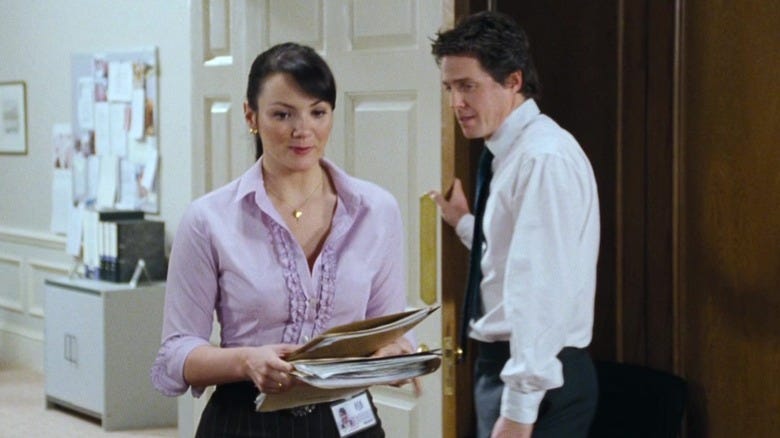
These workplace romances really beg the question: if things go badly, what happens to the person with less power? What can the person with more power do in response? Does this stop them from finding a comfortable, safe dynamic that actually works for both of them?
After trying to resist his attraction to Natalie, slowly pushing the boundaries of their relationship and seeing her in close quarters with the President of the United States, the Prime Minister asks his chief of staff if she can be “redistributed.”
“Don’t ask me why and…don’t read stuff into this, it’s just a weird personality thing.”
Natalie loses her position — one that I imagine was not easy to get — because of his infatuation with her and his jealousy after seeing her with POTUS.
Lisa A. Mainiero explored the concept of sexual hubris as part of workplace relationships, the mindset that allows people in power to abuse their power and status to pursue sexual encounters.
She argues that these powerful individuals often subconsciously develop a sense of entitlement and that the rules that everyone else must follow don’t apply to them.
It often leads to impairment of impulse control, distorted understanding of reality and dynamics and pushing the boundaries of relationships.
Many of us believe that it is, in fact, inappropriate for our elected officials to sleep with their staff (see: Monica Lewinsky), but in Love Actually, we’re meant to celebrate their love, rejoice in the moment they finally get together.
There don’t seem to be any implied consequences for the Prime Minister being caught on stage at a children’s Christmas concert kissing his staffer.
Instead we are to share in their excitement when we see her run into his arms at the airport as they reunite, the way we celebrated all of the beautiful moments of connection in the opening monologue.
But these questionable power dynamics aren’t just about the bosses’ relationships to the people that work for them. It’s also about the person with seemingly less power.
In the same study, Lisa A. Mainiero also discusses sexploitation, how the lower-status person in the dynamic can use sexuality to gain advantages and favoritism for themselves.
It’s often a way for people with less power to try and balance the power dynamic in a way that benefits them.
Harry is absolutely in the wrong for engaging in any kind of flirtation and sexual advances with his secretary. And we watch as Mia uses this to her advantage.
“When it comes to me, you can have everything.”
Not only does she curry favor in the workplace itself, but she also convinces him that he must get her a Christmas gift.
“I don’t want something I need. I want something I want. Something pretty.”
So he buys her an expensive gold necklace (while out shopping with his actual wife) and gives Karen a Joni Mitchell CD.
(God bless Rufus for being so extra with his gift-wrapping that Harry gets caught, Rowan Atkinson the comedic genius you are)

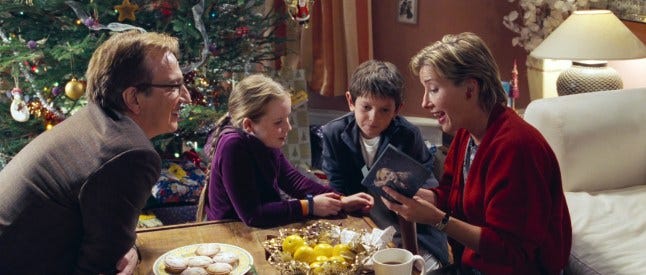
Then there’s Karen. Poor Karen who clearly has a sinking suspicion about her husband’s infidelity — especially after seeing them together at the company holiday party — and finds it confirmed when she opens her Christmas present.
Where the necklace she caught him buying should be, lies a simple CD and a card that says:
“I’m sorry I’m such a grumpy bugger.”
Up until this point, she could justify his actions to herself. When she questioned one of his other staff members about it, she was met with:
“I suppose it’s his job to dance with everyone isn’t it?”
In the face of the ultimate betrayal, Harry gets to sit back and pretend it isn’t happening. He gets to openly and intimately dance with his secretary in front of everyone.
He holds the power in the situation, so he gets to do whatever he wants.
Meanwhile, Karen has to confront the reality and decide what to do about it.
As much as the hopeless romantics in us want to believe this isn’t true, relationships require work. A lot of work.
And when both people aren’t equally committed to taking on that work, someone inevitably finds themselves carrying more of the responsibility.
And more often than not, that falls to the women.
In heterosexual relationships, women often take on more of the emotional labor, the mental effort and hyper-vigilance to keep the relationship functioning. It includes everything from monitoring their partners’ moods, anticipating what they want, managing conflict, doing the emotional repair and more.
There’s an expectation often put on women to be the caretakers and peacekeepers and sacrifice their needs for their partner.
And that’s what makes Karen and Harry’s relationship different from many of the others.
The imbalance isn’t necessarily about who has more systemic power and leverage. It’s about who is expected to carry the burden of the relationship — and the consequences of someone else’s actions.
Who gets to act and dismiss and pretend like nothing is wrong. And who has put on a brave face, accept the damage and decide whether or not things change.
Karen isn’t just holding her husband’s betrayal, but she’s also left bearing the burden of keeping their family together and functioning in the face of the worst possible thing.
So Karen masks her disappointment after opening the gift, quietly excuses herself and pulls herself together and continues the Christmas magic for her family.
One of the most fascinating relationships in Love Actually for me is the one between the writer and his housekeeper. It’s one where their version of “love conquers all” isn’t just about the power dynamics, but is also rooted in a significant language barrier.
Before any romance ensues, the nature of their professional relationship means that Aurélia has already taken on this prescribed caretaker role.
She quite literally cleans up after him and takes care of him. At one point, she even jumps into the lake when the pages of his manuscript fly into the water.
This heartbroken, successful writer has been wronged by his girlfriend and is met with a beautiful, warm and accommodating Portuguese woman that will do anything for him — and can’t really engage in conflict because they can’t actually understand each other.
And eventually he does learn Portuguese for her and runs out to find her to confess his love. Swoon.
But here’s the thing: he doesn’t just confess his love. He proposes. Instead of getting to know her and develop their relationship with mutual understanding, he immediately jumps to locking her down.
How romantic.
Peter Glick and Susan Fiske developed the Ambivalent Sexism Theory which includes the concept of benevolent sexism, how certain attitudes and behaviors toward women may seem positive on the surface, but actually reinforces and justifies rigid gender roles and gender inequality.
They discuss the beliefs that men must provide and protect women. It casts women as fragile and needing to be taken care of and it also says that men are incomplete without women.
Things that seem chivalrous on their surface actually reinforce specific roles and ideas of how men and women should be.
The problem isn’t whether or not they’re compatible or meant for each other. If anything I appreciate that he didn’t make a move until after she was no longer working for him.
The problem is that we are meant to see these “traditionally masculine” behaviors — the willingness to take significant action in pursuit of love — as the epitome of romance. And her willingness and amenable nature were treated as the pinnacle of femininity and love. Putting the burden of securing the relationship on Jamie and diminishing Aurélia’s agency in how it turns out.
The language barrier doesn’t just prevent them from really understanding each other, it also gives them both so much room to project and perceive each other in the ways they want their partner to be, rather than who they actually are. And one of the easiest ways for our brains to do that is by following familiar gender scripts around love.
For me, things would have been different if this confession and grand gesture was one that led to the development of love and these two people finally getting the chance to truly learn and understand each other.
But it wasn’t that. It was an automatic happily-ever-after that we should celebrate.
In this rewatch, I found another interesting trend emerging throughout many of the storylines: how time and time again Christmas was almost used as some sort of psychological permission structure to do things people may not have done before.
And look, I love Christmas. It really is the most magical time of the year, especially in New York City. And I too love to jump back into things like dating during that time because the joy of the season and glimmer of the decorations does feel like it makes it easier.
But I’ve never used it as an excuse for doing things I know might not be the best idea.
Jamie walks into his family Christmas with his excited nieces and nephews eagerly waiting his arrival and immediately turns around and flies straight to Portugal and confesses his love in his newly-learned, broken Portuguese.
“I know I seems an insane person because I hardly knows you…But it’s Christmas”
And Mark uses it as rationale for going to his best friend’s house, encouraging Peter’s wife to lie to her husband and declaring his love for her after they’re already married.
“Just because it’s Christmas (and at Christmas you tell the truth).”
The Fresh Start Effect is the idea that certain milestone moments in life serve as temporal landmarks that psychologically separate different versions of ourselves. It demonstrates how we are more likely to initiate changes in our behavior around these moments because our brains create a mental distance from past disappointments and failures — and allow us to reframe things.
Temporal landmarks create a mental separation between “before” and “after” and make change feel more possible. But this sense of energy often leads to impulsivity rather than rational thinking.
In Love Actually, it’s as though they use this holiday — and the perceived deadline — to finally act in the name of romance.
The person that was being cold to Juliet because it felt wrong to be secretly in love with your best friend’s partner was the old Mark. Christmas Mark takes bold actions and makes grand romantic gestures for the one he loves.
Suddenly it feels less risky. Because he’s not homewrecking, he’s embracing the spirit of Christmas and how you’re meant to be with the ones you love.
At Christmas, anything is possible.
(And I guess it pays off because Juliet runs after him and kisses him before returning to her husband.)
Love Actually celebrates these leaps of faith, these grand romantic, courageous moments of risking it all for love.
The confessions. The declarations. The chasing. The loyalty. The proposal.
But it rarely asks us to think about who has to deal with the consequences when you do.

The entire movie takes place in the five weeks before Christmas and culminates in this larger-than-life holiday moment, this deadline to say and do all the things that you didn’t in the time before.
I’ll regret it if I don’t.
Regret not pursuing Natalie. Not proposing to Aurélia. Not telling my long-time manager I care about him, even though I’m mean to him. Not chasing after my childhood crush in the airport. Not telling my best friend’s wife that I’ve actually been in love with her all along.
Embracing the Christmas spirit in Love Actually is about not letting yourself have any regrets — and not dealing with or considering the consequences.
But just like love doesn’t exist in a vacuum, neither do our actions.
The holiday magic doesn’t erase the very real problems in our dynamics and concerns in building new relationships.
The movie focuses our attention on the people who take these leaps of faith in the name of love, but rarely considers what happens to the person on the receiving end.
I really do believe what they said to us at the start: love actually is all around. But I also know as an adult that love isn’t always enough.
Building a life with someone else requires us to see things as they are — mess, conflict, consequences, life misalignment and all — and choose each other and choose to work through it all together every single day.
And that doesn’t make romantic gestures, risk-taking or Christmas magic automatically bad. It just means those things have to come with accepting the reality of what lies in front of us, instead of overlooking it all in the name of love.
I firmly believe that connection with other people — love in all its forms — really is the light that shines through the darkness of the world. That a beautiful life is a collection of all the small, meaningful moments where we find ourselves loved and seen.
And that’s why I love the opening montage so much. It just shows people in moments of pure joy and love as they find their way back to each other.
No defying the odds. Proving someone should be with you. Convincing them to love you. Determining persistence is passion. Pushing boundaries until it all works out.
It just is about two people in moments of connection that give our lives meaning.
But only when it’s honest and true and genuine — and with the right people at the right time in your life in the right way for who you are and what you need.
So while Love Actually asks us to believe in love that defies the odds, I implore us to ask ourselves:
Which of these odds are actually worth it?
Thanks for reading! Given that there are so many characters and so many plotlines, it was hard for me to deep-dive into all of them in this one piece. Let me know if you’re interested in a part 2 or if you have other movies you want me to unpack next.
This is part of my series deep-diving on “Classic Rom-Com Journey” and I would love for you to follow along for the rest of them. Check out the other two below:
No posts
Comments
Nothing yet. Say the first thing.
Sign in to join the conversation.