
Thirty-three years ago, I came to the former Yugoslavia as a young reporter trying to understand a war and to jump-start a career.
I was 23 years old and working as a foreign correspondent for the San Francisco Chronicle. The country was locked in a fierce war, and much of my reporting was done from the Serbian side. I interviewed Serbian politicians, soldiers, and civilians and tried to understand, and explain to American readers, how they saw a war that much of the outside world had already come to understand very differently.
Last week, Ali and I spent three days in Sarajevo and a few more in Montenegro. It was the first time I had been back to the former Yugoslavia in over three decades.
Since returning home, I have been reading through those articles I wrote then, along with old letters I sent from Belgrade, and it has been a bit unsettling.
I can see now how much I was influenced by the people around me at the time. My friends were Serbs. The people I spent my time with were Serbs. I heard their stories, their fears, their grievances, and their version of Yugoslavia’s collapse every day. And I guess I absorbed more of it than I realized. The people who let you into their homes, explain their fears, and become your friends inevitably become more comprehensible to you, while their enemies remain abstractions.
I think about that now when I read reporting about Palestinians and Gazans. These journalists there are immersed in Palestinian suffering every day, while October 7, the hostages, Hamas and the reasons Israel is fighting can become abstractions for them. That doesn’t make their reporting false, but my own experience taught me how easily proximity can shape what a reporter sees, and, more importantly, what he doesn’t.
I thought I was simply reporting what I saw in Serbia. Thirty-three years later, I can see how much where I was standing shaped what I believed.
I came to believe that the Western portrayal of the war as purely Serbian aggression was too simple. The Serbs weren’t the only bad guys. This was a civil war, I thought, with atrocities and victims on every side. Serbs had legitimate grievances and had suffered too. Much of that was true, and part of a reporter’s job is precisely to challenge a story that has hardened into conventional wisdom.
But reading those articles thirty-three years later, and then walking through Sarajevo and hearing the Bosnian side of the story, I have had to confront something uncomfortable. In trying to correct what I thought was an oversimplified narrative back then, I had moved too far in the other direction.
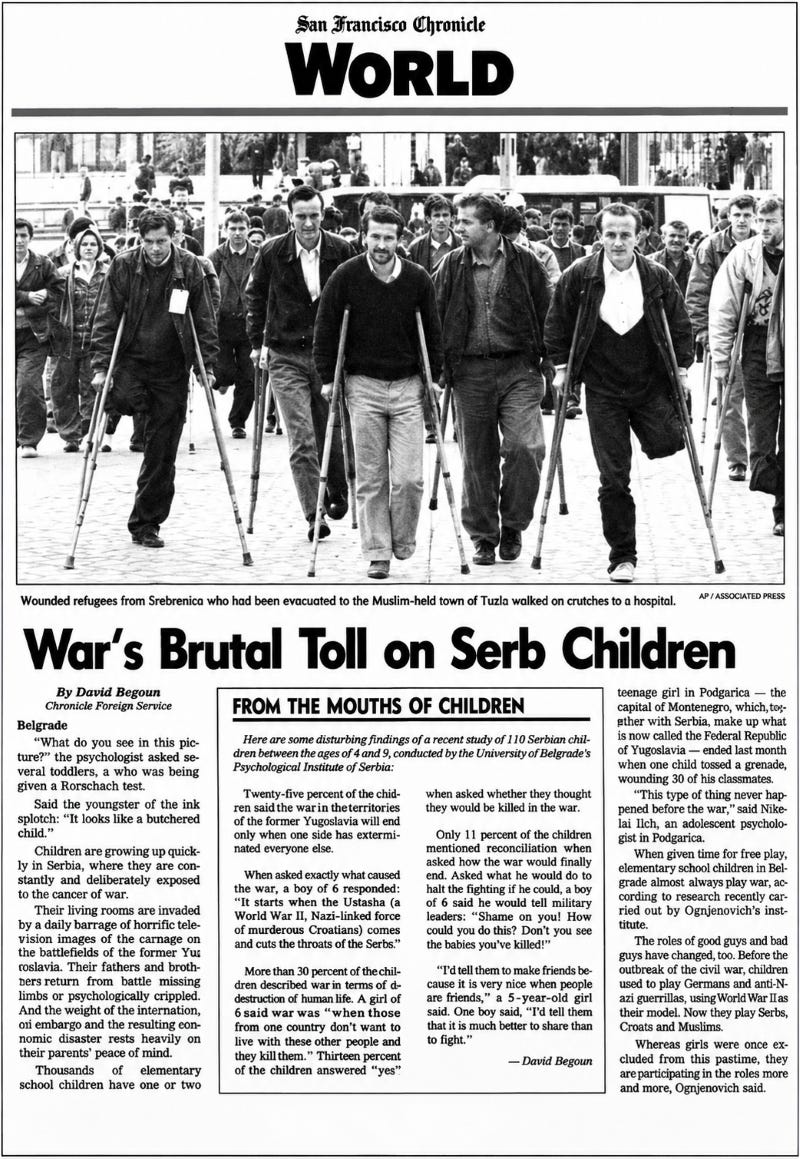
We know much more about that war now than we did in 1993. We know the scale and systematic nature of the ethnic cleansing carried out by Bosnian Serb forces. We know the details of the Serbian genocide of Muslims in Srebrenica. We know about the camps, the mass graves and the organized campaigns to remove non-Serb populations from territory claimed by Serb nationalists. There were atrocities committed by Croats and Bosniaks as well, and Serbian civilians also suffered terribly. But the evidence accumulated over the past three decades does not support the tidy moral equivalence I was inclined toward as a young reporter. The responsibility was not evenly distributed.
That realization began to haunt me as we explored Sarajevo.
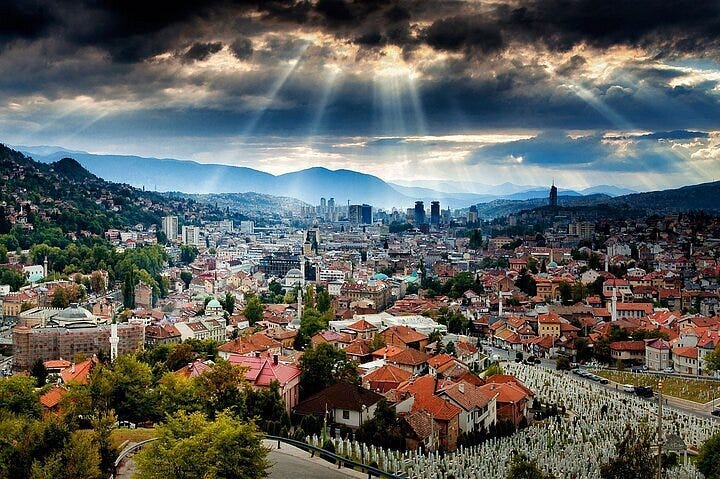
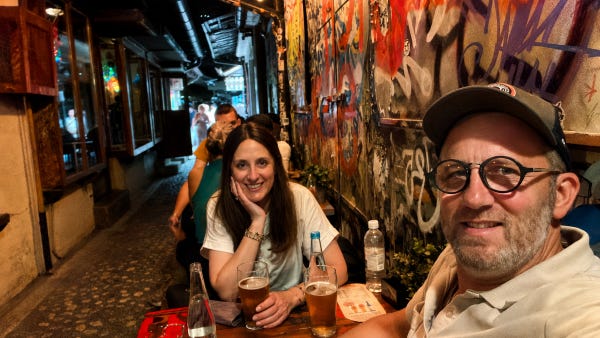
Today, cafes spill onto the sidewalks. Tourists crowd the old Ottoman market. Young people sit outside drinking coffee late into the night. We stayed at the Hotel Europe, an elegant old hotel just off the pedestrian street in the center of town.
And we were also starving most of the time.
There is essentially no kosher food to be found in Bosnia, so we arrived equipped for a minor siege of our own, consisting largely of tortillas, peanut butter, and rice cakes. Fortunately, coffee is plentiful and beer is kosher, which turns out to be enough to sustain two Jews wandering around Sarajevo for several days.
The signs of the war are everywhere.
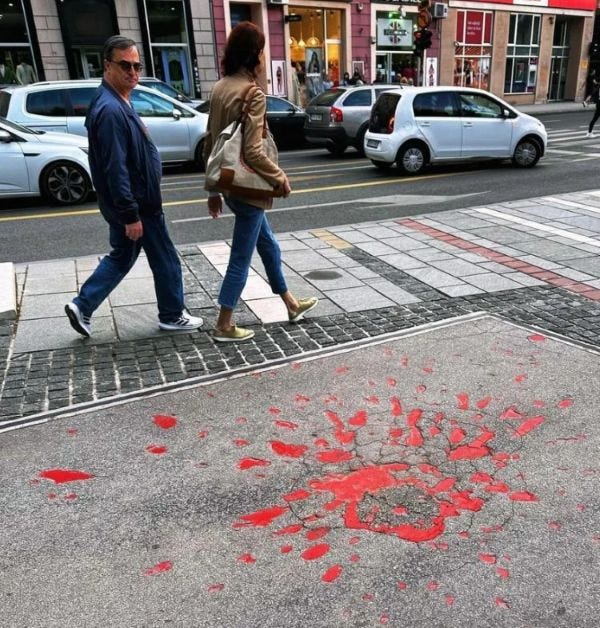
You see it first in the buildings. There are still facades pocked with bullet holes. On sidewalks around the city are the famous “Sarajevo Roses,” scars left by mortar explosions that were later filled with red resin to mark places where people were killed.
The siege of Sarajevo lasted 1,425 days, from April 1992 until February 1996, the longest siege of a capital city in modern warfare. Bosnian Serb forces occupied the mountains surrounding the city and shelled it from above. Snipers fired into its streets. Electricity and water disappeared for long periods. Food became scarce. Over 11,000 people were killed during the siege, including more than 1,000 children.
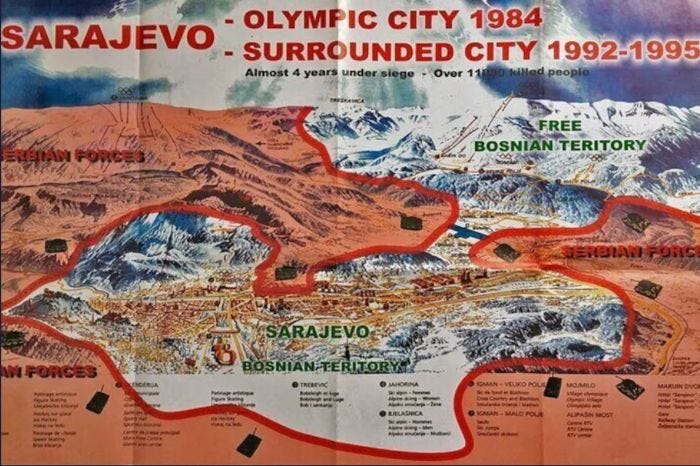
The numbers are terrible. But numbers don’t explain Sarajevo. You need to speak to people.
Thirty years later, the war remains embedded in the city in ways I hadn’t expected. People tell you where they were when a particular shell landed. They point out the streets they couldn’t cross because of snipers. They tell you which family members left and which ones never came home.
Equally striking is hearing people who weren’t alive during the siege talk about it. The war ended before many of them were born, yet they carry it with them, not simply as history, but almost as a living reality. Their parents lived through it. Their neighborhoods were shaped by it.
The Dayton Accords ended the Bosnian war in 1995, but they did not forge forgiveness or even reconciliation. They created a political structure elaborate enough to keep Bosniaks, Serbs, and Croats inside the same country without requiring any of them to agree very much about what had happened.
Bosnia today consists of two principal entities: the Federation of Bosnia and Herzegovina, with its Muslim majority, and Republika Srpska, mostly made up of Serbs, stitched together under a national government with a three-member presidency representing a Bosniak, a Serb, and a Croat. Oh, and then there’s the High Representative, an unelected foreign official appointed by the international community who can impose laws and even fire Bosnian officials. Because apparently three presidents still weren’t enough to keep the country together.
It works, if by “works” we mean that people are no longer killing each other. And everyone I asked, and I asked a lot of people, told me they don’t see the tensions boiling over into war again. The hell of war is too deeply embedded to think of returning to fight.
But that’s a far cry from reconciliation.
That distinction became clearer the longer we stayed. The war ended because eventually everyone agreed to stop fighting. It did not end because everyone arrived at a shared understanding of the war, much less forgave one another for it. Thirty years later, competing memories still live beside one another.
Bosnia’s Muslims are ethnic Slavs whose ancestors converted to Islam during centuries of Ottoman rule. There is something initially disorienting about meeting a completely Slavic-looking guy who tells you his name is Ahmed.
And that is where Israel entered the conversation.
It is difficult to spend much time in Sarajevo today without encountering Palestinian flags hanging from windows and storefronts. “Free Palestine” graffiti appears around the city. For many of the Bosniaks I spoke with, the identification with the Gazans is deeply personal. They don’t see Gaza as another distant Middle Eastern conflict. They see the Palestinian story through the prism of their own history.
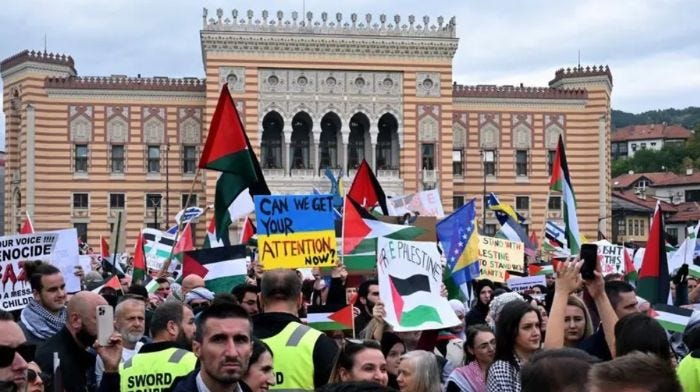
Ali tried to convince me to keep quiet and not to get into it with them. But I couldn’t contain myself. So, I had a long conversation about this with one young Bosnian Muslim, my tour guide, who’s name was Ahmed, and who knew his history remarkably well. He was thoughtful and articulate, and completely convinced that Gaza belonged to the same moral category as Sarajevo.
I told him I thought he was wrong, and that the comparison cheapened and diminished the very Bosnian story he wanted the world to remember.
Sarajevo was a innocent city attacked and surrounded by an army positioned in the hills above it. The civilians inside had not launched an October 7 massacre across the border into Serbia. There was no Bosnian equivalent of Hamas embedding its military infrastructure within the civilian population while holding hostages underground. The circumstances that produced the siege of Sarajevo and the war in Gaza are profoundly different.
He listened carefully and ultimately disagreed. He couldn’t see past innocent Muslim children dying. We went back and forth for quite a while, and neither of us converted the other.
I found myself in a strange position. I had spent several days trying to enter deeply into the Bosnian Muslim experience. I had listened to stories of people running from snipers, looked at photographs of murdered children and stood in places where civilians were killed while waiting for bread. None of the Palestinian flags made those stories less true, and none of the political opinions of the people telling them reduced my sympathy for what happened to them.
But the generosity did not necessarily travel in the other direction.
We naively tend to think that if I take your suffering seriously, perhaps you will become curious about mine. But people seem to understand other people’s wars through the wars they already know.
For Bosniaks, Sarajevo has become such a template. They know what it means to see Muslim civilians killed while much of the world watches, and to believe that powerful countries have abandoned them. When they see Gaza, many instinctively place it inside that history.
IIn 1993, I came to Yugoslavia carrying notebooks and a press credential, trying to figure out what Serbs believed and why they believed it. I was young enough then to think that if you collected enough facts and asked enough questions, eventually a war would make sense.
This time, I came with Ali, a few packages of tortillas and peanut butter, and no assignment other than to walk around and listen.
Sarajevo is beautiful now. The cafes are full. Children who were born after the war have children of their own. The call to prayer rolls across the old Ottoman quarter while church bells ring nearby. Tourists stand on the Latin Bridge and take photographs at the spot where an assassination helped set off another European war more than a century ago.
The city has moved on.
It has also not moved on at all.
Thanks for reading,
David
No posts
Comments
Nothing yet. Say the first thing.
Sign in to join the conversation.