
I hesitated before posting this because I’m allergic to “proud father” posts. I’m not looking for nachas comments or congratulations. That’s honestly not why I’m sharing it.
I’m sharing it because I want people outside Israel to understand what this photograph represents.
Look closely.
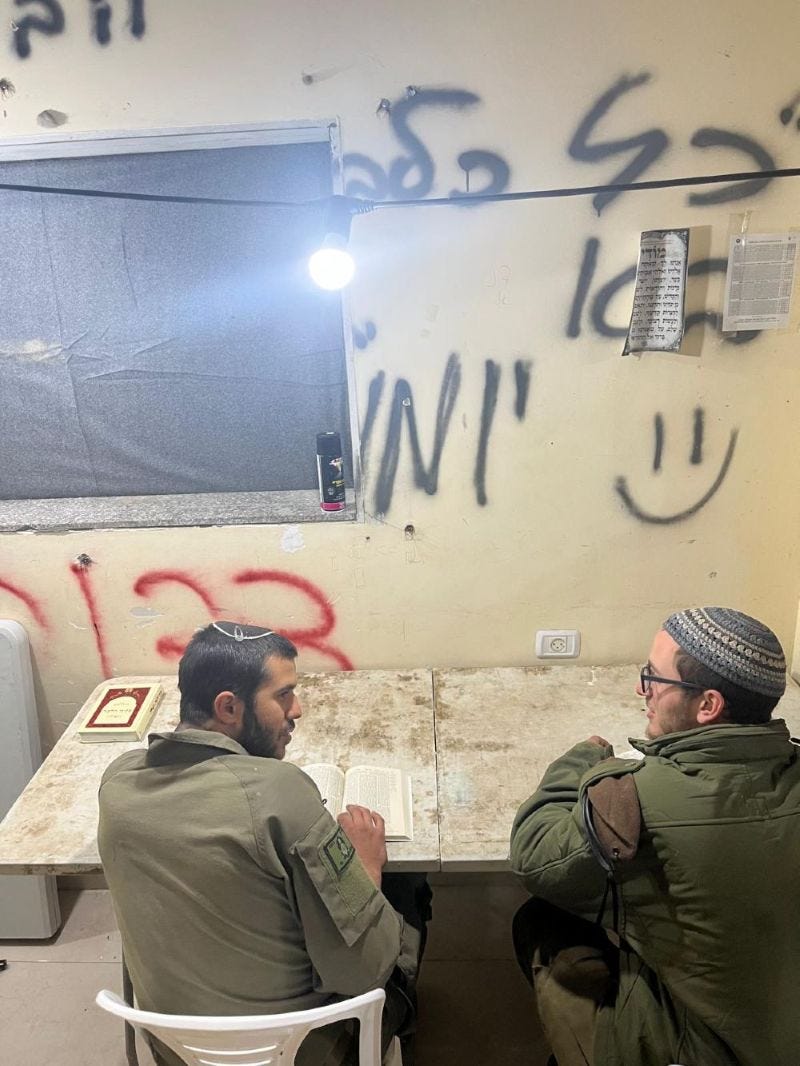
The room is dirty. The walls are covered with graffiti. A single bare light bulb hangs from the ceiling.
This picture was taken several months ago in Gaza. On the right is my son, Eliezer. Next to him is his best friend, comrade-in-arms, and study partner from yeshiva, Caleb.
Now look at the table.
That’s not a map, a laptop, or a deck of cards.
It’s a small volume of the Babylonian Talmud, printed specially for soldiers who can’t carry much with them into combat.
These two young men are combat soldiers who, for the past eighteen months, fought together in Gaza and Lebanon. Whenever they could steal a half-hour between missions, guard duty, or patrols, they opened that small volume and learned another few lines.
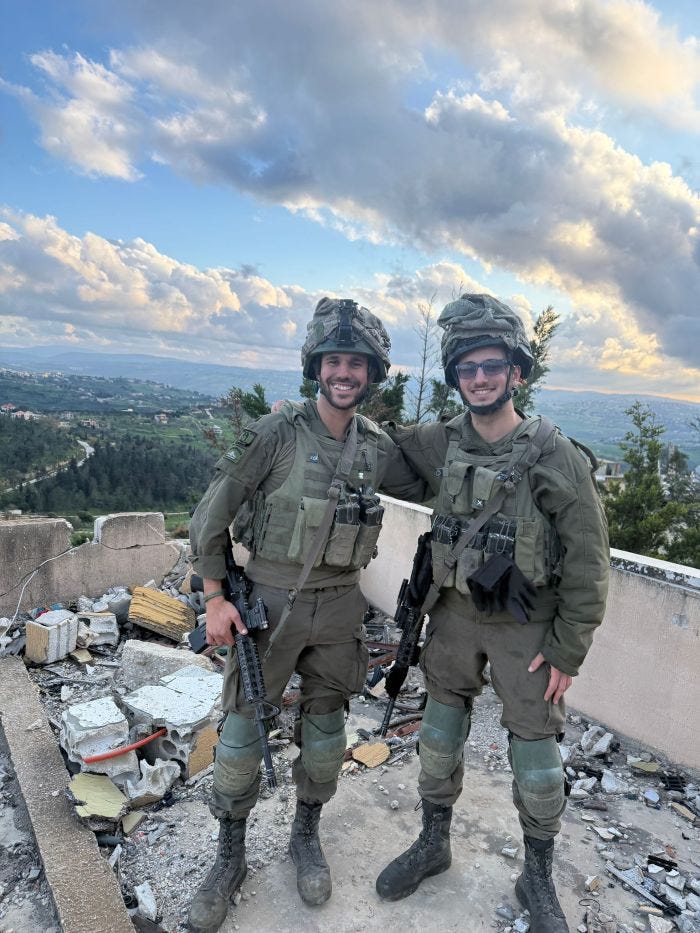
Last night they celebrated two completions.
The first was the completion of their military service.
The second was a siyum, marking the completion of that very Talmudic tractate they carried with them throughout the war. Here is a short clip of them completing it:
This week my wife and I were in Bosnia.
I’ll write much more about that trip another time because it deserves its own essay. We spent days trying to understand the siege of Sarajevo, the genocide at Srebrenica, and the stories of ordinary people who endured unimaginable cruelty. We visited museums and memorials. We listened to survivors. We confronted the reality of what happens when armies abandon all moral restraint and when political leaders teach young men that an entire people is less than human.
The images from Bosnia are still very much with me.
Perhaps that’s why this accomplishment by my son and his friend resonated so deeply with me.
Wars are fought by soldiers.
But what kind of soldiers?
History has shown us that soldiers can become instruments of unspeakable evil. They can be taught that murder, rape, torture, and ethnic cleansing are acceptable if the victims belong to the wrong people.
We confronted that reality at the Srebrenica Genocide Memorial Gallery. In July 1995, Bosnian Serb forces under the command of General Ratko Mladić entered the UN-designated “safe area” of Srebrenica. Dutch peacekeepers, lightly armed and vastly outnumbered, were unable to stop them. Over the next several days, the Bosnian Serb forces systematically separated the men and boys from the women, then executed more than 8,000 of them. Their bodies were dumped into mass graves, hauntingly reminiscent of Babi Yar and Ponary. The women and girls were expelled, and many were raped and abused. The massacre unfolded in less than a week and finally galvanized NATO to launch a sustained bombing campaign against Bosnian Serb positions.
Many of us remember those images on the evening news. It was only thirty-one years ago.
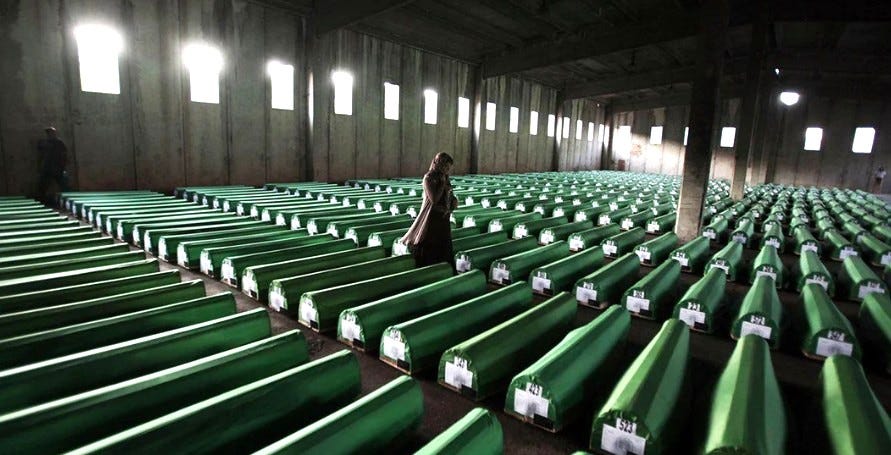
This left me thinking about the moral education of soldiers.
Good military training teaches a young man how to fight. It must also teach him what limits he must never cross and what kind of human being he is expected to remain. Srebrenica was just one of countless stories showing the depths of cruelty that soldiers can reach when morality, restraint, and the sanctity of human life are removed from their training and replaced by hatred and dehumanization.
Israel aspires to something radically different from its soldiers: that the same young man who carries a rifle should also carry a book that has spent centuries asking questions about justice, responsibility, restraint, the sanctity of life, and the moral limits of power.
Studying Talmud doesn’t suddenly make war beautiful. But it helps ensure that even when force becomes necessary, power remains accountable to something higher than itself.
When people ask me what makes Israel different, I think of photographs like this one of my son and his friend. Somewhere in the middle of a war, in a battered room lit by a single bare bulb, two combat soldiers are arguing over a page of the Talmud.
They completed eighteen months of military service and completed a tractate of the Babylonian Talmud at the very same time.
After spending this week immersed in the history of Bosnia, I couldn’t help thinking that perhaps one of the most important things any society can do is shape not only how its soldiers fight, but who they become as human beings.
Thanks for reading,
David
No posts
Comments
Nothing yet. Say the first thing.
Sign in to join the conversation.