
“Treatments all the hot girls get in NYC”
“Where all the hot girls go in NYC for wellness treatments”
“Every woman I know spends so much time and money on their health routines”
These were three videos the algorithm served me, back to back, at 9:02 am this morning. I had just woken up about an hour ago, not particularly thinking about myself at all- I was listening to my latest obsession (NoSo), I’d made myself a coffee, and was eating pancakes with some maple syrup and fruit. For the most part, it was a lovely summer morning. I put my phone away to get started at work, but after scrolling, I felt differently: slightly bad about myself, wondering if I needed a lymphatic drainage facial or a laser facial? Would I have time this weekend to book a treatment? Could I also be the elusive NYC hot girl with her impossibly healthy, glowing skin?
If this essay resonated with you, consider becoming a paid subscriber. It's how I keep this work going and appreciate your support!
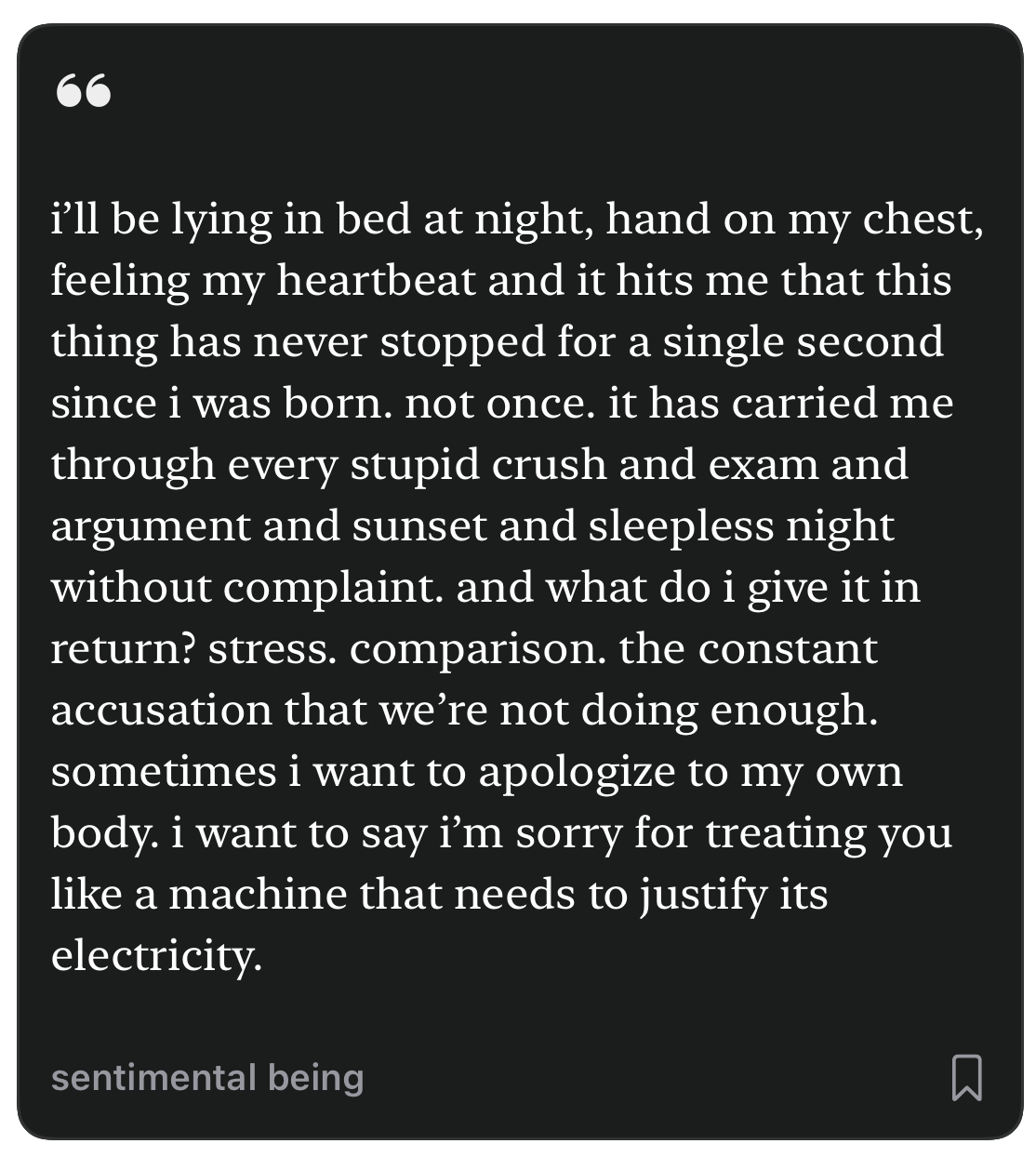
Researchers call this objectification theory: in a culture which persistently presents women’s bodies as objects to be assessed, women internalize this evaluating gaze. They learn to see themselves from the outside in. This habitual self-monitoring is associated with higher rates of anxiety, disordered eating, and depression. It also interrupts interoception: the body’s capacity to sense itself from within — to register hunger, fullness, fatigue, desire, discomfort.
Self-objectification, in other words, is the mechanism by which we become estranged from our own bodies. There is a difference between body-as-object and the body-as-subject. The body-as-object is experienced from the outside: evaluated, compared, managed, corrected. The body-as-subject is experienced from within: felt, sensed, listened to, trusted. The body, in the way we view it now, is not a subject we inhabit, it is an object we control.
This shift towards control of beauty is masked as health and wellness. The wellness industry promises something the beauty industry never could: interiority. Now, we pursue health, and not beauty; we lean on the language of healing — gut health, nervous system regulation, cortisol management, inflammation. These are terms borrowed from therapy and medicine, and this rebrand speaks to the exhausted, overstretched, self-neglecting person. And in doing so, it feels, briefly, offers them a reprieve: an genuine, positive, alternative to the old regime of self-punishment by crash diet and shame.
Where beauty once spoke through fashion editorials and advertising copy, wellness speaks through biomarkers, science, the body’s own interior logic. This is what cultural theorist Robert Crawford calls healthism — the ideology that positions health as a personal moral project, a duty, an outward reflection of inner character. When wellness absorbs beauty anxiety into its framework, it elevates that pressure of beauty to the level of a health obligation, and it doesn’t free us from the pressure to look good. The moral weight of that distinction is enormous - good vs. bad food, clean vs. dirty food, optimal vs. suboptimal markers, toxic vs. non-toxic. The shame that surrounds ordinary human bodies, aging, imperfection is packaged as being ‘good’. Just listen to Stephen Bartlett talking about how a mere 3 glasses of wine disrupted his optimal markers of health — but I wonder, was he enjoying himself in that moment? Was he feeling connected at that dinner? And, most importantly, does that not matter for health?
When we optimize our bodies as ongoing projects, we are not knowing ourselves. We are producing ourselves for an imagined observer.
The global wellness industry, valued at over $5.6 trillion, did not invent our anxiety about our bodies. That anxiety is older and more structural than any single market. But it did something effective: it reframed the acts of self-abandonment as acts of self-love. The 5am cold plunge, the elimination protocol, the layered morning routine — these are sold to us as gifts we give ourselves. To opt out is to be someone who doesn’t prioritize their health. Suddenly the morning is not for waking up gently but for ‘winning’. Sleep is not for sleeping but for tracking recovery scores. Food is not nourishment but a delivery system for macros, adaptogens, and longevity compounds stacked in precise sequence. The body has become a startup, and we are its reluctant (often failing) founders who are always behind on our metrics, and one upgrade away from the version that finally functions perfectly.
Language is a really important marker of shifts in society, and also internally — in how we talk about our bodies and lives. The language of wellness is: optimize, hack, stack, upgrade, perform. These are not words that reflect ‘care’; in fact, they are words borrowed from another discipline: Productivity Culture. The same unhelpful cultural framework that told us to rise at 5am to get ahead at work, is now telling us to rise at 5am to cold-plunge, lift, meditate, and journal before the rest of the world wakes up.
The body does not improve under continuous audit, it becomes afraid.
Research on the ‘quantified self’ movement (the practice of continuously tracking biometrics, sleep, steps, heart rate variability, glucose) suggests that while some monitoring can support health decisions, chronic self-tracking is associated with increased health anxiety, compulsive behavior, and a diminished capacity to respond intuitively to the body's own signals. When you need an app to tell you whether you slept well, you have outsourced your interoception and have replaced the body's intelligence.
There is an interesting paradox that occurs when we become obsessed with quantifying ourselves - and it’s called ‘The Cobra Effect’: the phenomenon in which the solution to a problem actively worsens it. In colonial India, the British government wanted to reduce the cobra population in Delhi. So, they offered a bounty for every dead snake. Enterprising locals responded by breeding cobras and collecting bounty. However, when the financial rewards ended, Delhi had more cobras than when it started. The reward which was meant to solve the problem increased it instead.
Quantifying yourself creates the same problem. Let’s take sleep tracking as an example. You begin tracking because you're sleeping badly and want to understand why. The tracking introduces a new variable — performance anxiety around sleep itself — and the metrics that were meant to resolve your exhaustion become one of its causes.
So what does genuine care look like, in a world that has colonized even the language of caring for yourself?
The answer is not aesthetic minimalism, performative anti-routines, disorganization, or a moral hierarchy in which the person with the 12-step regimen is worse than the person with none. The question is always about orientation and intention. The question we must ask ourselves is: do I feel good?, and yet we pursue the question: do I look like someone who feels good?
A pocket of actual love might look unglamorous by current standards.
Find the trigger, not the habit. Most of us don’t evaluate our bodies continuously; we do it at specific moments.
Identify one moment in your day when you shift from being in your body to looking at it from the outside. Getting dressed, a specific mirror, opening Instagram before bed. Pick the one that happens most consistently.
For three days, when you hit that moment, pause before the evaluation starts. You don’t need to stop it. Just notice that it is happening, and ask: what triggered this specifically — the mirror, the lighting, scrolling, the comparison?
On day four, change one small condition around that trigger. For example, a different mirror, or deleting the app from your home screen so you have to go looking for it, or getting dressed without checking. You are introducing a small interruption between the trigger and the automatic response.
Most of us have heard the term narcissism used so freely by now that the word has lost all of its meaning. Clinically, Narcissistic Personality Disorder is a specific and relatively rare condition involving grandiosity, a profound inability to empathize, and an excessive need for external validation. It is not, despite what the internet suggests, simply selfishness. The term itself comes from Ovid’s Metamorphoses: Narcissus, a young man of extraordinary beauty, who one day sees his own reflection in a pool of water and cannot look away. He wastes away beside the pool, unable to leave the image, until he dies and a flower grows where his body once was.
We've always read it as a warning against vanity. But I see another message in the story.
Narcissus did not love himself. He loved an image of himself; he was in love with a reflection. What destroyed him was not self-love but self-observation. He was not the subject of his own story; he was the audience of it. This is, I think, a far more useful way to understand what chronic self-monitoring actually does to us. The morning shed, the before-and-after, the biometric dashboard, the cortisol face, the sleep tracking — these are all versions of the pool.
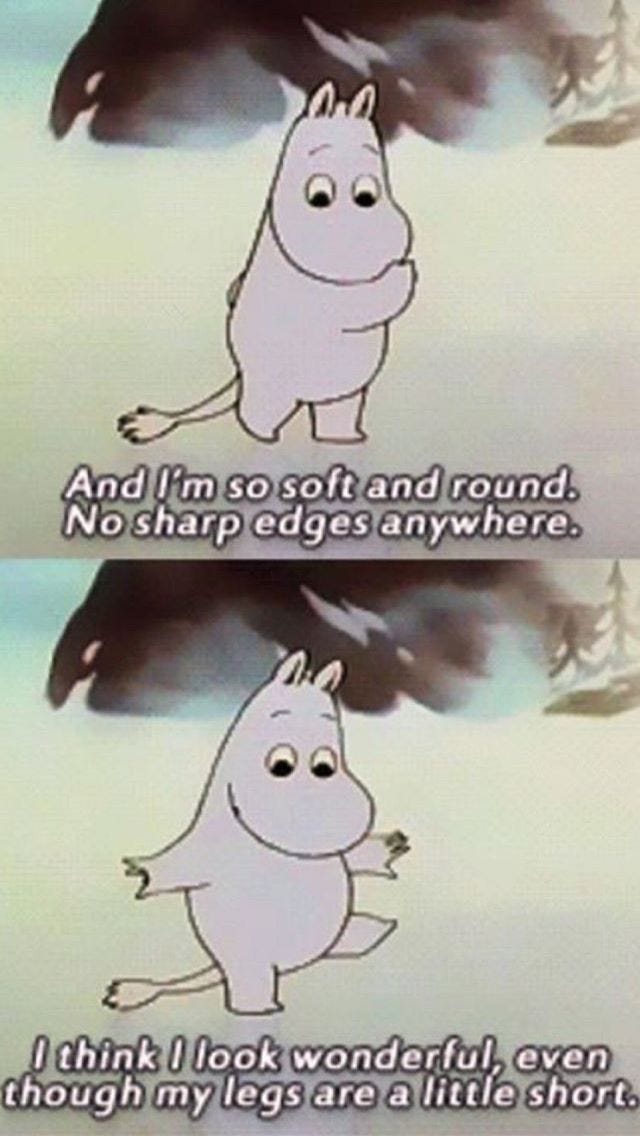
Invite joy into your life. Write down three moments from the last two weeks when you felt physically good: warm in bed before the alarm, a meal you had with a friend that was genuinely delicious, sun on your face.
Next to each one, note: was this planned, or did it just happen? And: was anyone watching, or did anyone know about it?
If you struggle to find three, write that down too. The body that has been fully converted into a project stops generating pleasure that isn’t attached to outcome. That absence is your sign to reflect on which of your habits are for you, and which are not.
The goal is not to abandon all routines or swing to the other end of having no structure at all. The goal is to build discernment; it is being able to ask ourselves: Is this for me, my actual body, my actual felt experience, or is it for the idea of me?
This is not a call-out — it is an invitation into yourself. Shame is, ironically, the industry's most effective retention tool: feel bad about how you look, feel bad about feeling bad about how you look, buy something to address the feeling bad. The way to break out of this loop is not to shame yourself, but to practice self-curiosity. Develop a genuine interest in what you actually want, what actually feels good, what your desires are, what you would choose if no one were watching and nothing were being optimized.
None of us are immune from being triggered by health and beauty content online. We are all, at different moments and to different degrees, susceptible to the pull of it. The desire to be beautiful, to be well, to be seen as someone who has it together, are not weaknesses to be ashamed of. They are what make you human. The work we have to do is to keep finding our way back: back to the body that existed before the scroll, before the comparison, before the trigger.
bell hooks wrote, in All About Love, that genuine self-care begins with a commitment to one’s own emotional growth as an ongoing and imperfect practice of truly knowing oneself. From the outside, it often looks like nothing at all. But it is the difference between a body that is managed and a body that is inhabited.
What came up for you reading this? I’d love to know, share your thoughts in the comments below.
That’s all for now! May your tables, health, and happiness be always in abundance. Live well + be well xx,
Israa
[My book, Toxic Productivity, is available everywhere books are sold. You can learn more about it here: link]
Cover image: Julianne S
Comments
Nothing yet. Say the first thing.
Sign in to join the conversation.