
Dear readers and subscribers,
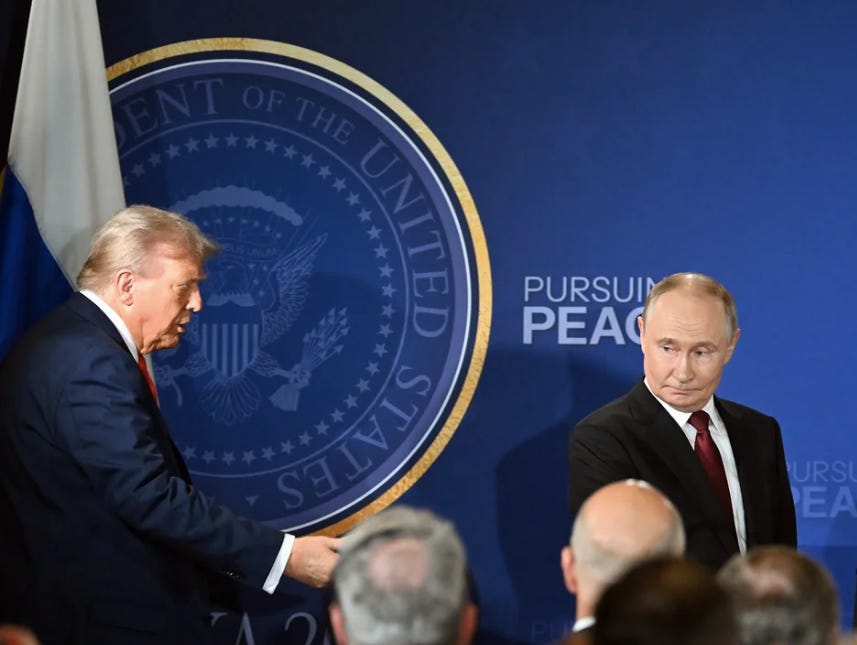
The meeting of the presidents of Russia and the United States in Alaska on August 15, 2025, was a sensation—both in form and content. So much was expected from it. Some, with great hope, others, with no less fear that Anchorage was doomed not to live up to expectations.
[NOTE: My article below, from last year, will take you back into it. —JBM]

The severity, depth, and scale of the conflict around Ukraine are such that it was obviously naive to count on a happy resolution at the first serious meeting. It is enough to recall the negotiations on ending the war in Vietnam, which lasted for years, although from the very beginning it was clear to the parties that the conflict had to be stopped somehow.
The question in Anchorage was about something else: whether the summit will become the starting point for the peace process. It didn’t. Nevertheless, instead of the usual sarcasm about the “spirit of Anchorage,” it is worth looking at what useful things this summit brought.
First of all, the meeting showed that the positions of the United States and Europe do not coincide. If Europe is set up for a military victory over Russia, the United States itself does not want to get involved in achieving this goal.
Of course, Trump’s insistence that Washington is a mediator, not a participant, is cunning. But participation could be much more intense, even taking into account the shortage of means of warfare found among the Americans.
The collapse of the transatlantic axis should not be expected, but the Atlanticism of the second half of the twentieth century will not survive.
If you want to support my work but don’t want to commit to a monthly or annual subscription, you can make a one-time or recurring donation by using PAYPAL or the “Buy Me A Coffee” buttons below. —Jerry B. Marchant.

Whether the new model of relations will be more profitable than Russia is the question. But Russia has long dreamed of seeing the end of the former NATO, and the chance of it is growing.
The consequences of Alaska also showed that America is not omnipotent. Trump could not achieve what he wanted from Europe and Ukraine then.
In this case, it played against Moscow, but the very fact of Washington’s limited capabilities should rather be considered positive.
The conclusion from both of these lessons is that the West, which can be usually seen as a single entity, is becoming more and more heterogeneous. Russia must be ready to develop and implement a much more complex, sophisticated, and flexible policy in the Western direction in order to use the growing differences there in its own interests.
Finally, Anchorage has become almost a reference for modern diplomacy, in which personalities are more important than institutions, and characters are more important than principles.
The last, and perhaps the main thing, is that there are no more magical agreements, the gentleman’s agreement lasts until another gentleman is met on the way.
What retains value is resilience, endurance, and reliance primarily on one’s own capabilities, as well as their sober assessment. Russia’s problem with Anchorage was that Trump was idiotic and perceived as an external factor that could qualitatively change the situation. He was incapable of playing this role, which reminded everyone that the conflict’s solution must come from within.
A year after Alaska, the Russian-European military confrontation has acquired clear prospects. In his internal logic, it will be necessary to look for ways to end the ongoing war and prevent the coming one, not counting on magical or exotic recipes or “deals” of any caliber—big or not so big.
Before you go, don’t forget to get me a BIG coffee. Is that a “deal”?
Thank you for supporting my work

Comments
Nothing yet. Say the first thing.
Sign in to join the conversation.