
There’s a photograph I found yesterday in a digitized newspaper archive that I can’t stop thinking about. It shows the Silver Bridge, December 16, 1967, one day after the collapse. You can see twisted metal hanging into the Ohio River, and in the foreground, someone’s Christmas shopping bag floating in the water.
What gets me isn’t the destruction. It’s that three months earlier, an engineer had filed a report about stress fractures.
Everyone knows the story. Mothman appears in 1966, people see a giant winged creature with red eyes, he supposedly predicts disaster, and then the Silver Bridge collapses in 1967, killing 46 people. It’s been called a prophecy. A warning. Proof of something beyond our understanding.
The bridge was already failing, engineers knew it, and the creature sightings stopped mattering the moment actual structural reports came in. So why do we still connect them?
I think the answer tells us more about how we process fear than about what anyone actually saw.
Let me walk you through what actually happened, because the timeline matters more than most people realize.
On November 15, 1966, two young couples were driving near an abandoned TNT plant outside Point Pleasant when they saw something they couldn’t explain. Roger and Linda Scarberry, along with Steve and Mary Mallette, reported a gray creature, around seven feet tall, with wings folded against its back and enormous red eyes.
They weren’t the first, but they were the first to go public.
Over the next thirteen months, more than 100 people in the Point Pleasant area reported seeing something similar. Descriptions varied, but the pattern was consistent: large, winged, human-shaped, red or glowing eyes. Some saw it flying. Others saw it standing. A few claimed it kept pace with their cars at speeds exceeding 100 mph.
The local press started calling it Mothman. The name stuck.
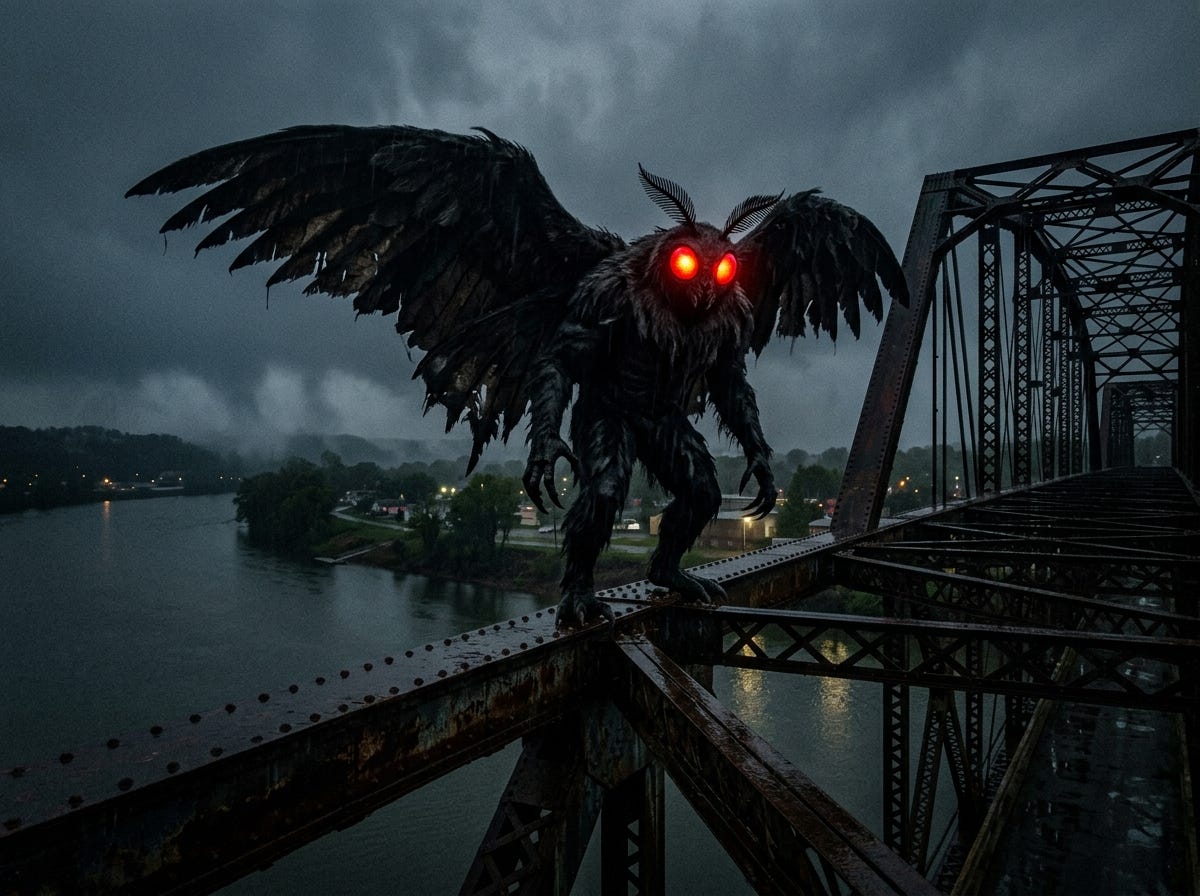
Then, on December 15, 1967, the Silver Bridge connecting Point Pleasant to Ohio collapsed during rush hour traffic. Forty-six people died. The bridge had been carrying Christmas shoppers. It fell in less than a minute.
Afterward, people remembered the sightings. They remembered that some witnesses had reported feelings of dread, premonitions, strange dreams. And they connected the two events.
The story became: Mothman was a warning. An omen. A herald of disaster.
But I’ve been looking at the engineering reports, and that’s where things start to unravel.
The Silver Bridge collapsed because of a single eyebar in the suspension chain. Eyebar 330, to be exact. It had developed a tiny crack, roughly 0.1 inches deep, caused by stress corrosion. The bridge had been built in 1928 and was designed with no redundancy. When that one piece failed, the entire structure went down.
Here’s what matters: that crack didn’t form overnight.
The bridge had been deteriorating for years. In fact, there had been concerns about its load capacity well before 1966. But West Virginia didn’t have the budget for a new bridge, and the old one was still standing, so it stayed open.
The National Transportation Safety Board later concluded that the failure was entirely predictable. It wasn’t a mystery. It wasn’t supernatural. It was a known engineering risk that got ignored until people died.
So if the bridge was already a disaster waiting to happen, what does that do to the Mothman narrative?
It means the collapse wasn’t predicted by a cryptid. It was predicted by physics.
And yet, people still tie the two together. That’s the part I find strange.
Several witnesses claimed they felt something was wrong in the months before the collapse. Nightmares, anxiety, a general sense of doom. After the disaster, these feelings were reinterpreted as psychic warnings.
But here’s a question I haven’t seen anyone ask: how many people in Point Pleasant had bad feelings that year and nothing happened?
This is textbook confirmation bias. We remember the hits and forget the misses. If you track a hundred people over thirteen months, some of them are going to have nightmares. Some are going to feel anxious. Some are going to have a vague sense that something bad is coming, especially in a small town dealing with economic decline, a chemical plant shutdown, and the stress of Cold War-era America.
When disaster actually strikes, those random fears suddenly feel prophetic.
I’m not saying people were lying. I’m saying human memory is constructive, not archival. We rewrite our own stories to make sense of trauma.
And trauma doesn’t get much clearer than watching a bridge full of your neighbors fall into a frozen river.
I don’t know. And I’m genuinely okay with that uncertainty.
But here’s what I think is worth considering.
The TNT plant where the first sightings occurred was a World War II munitions facility, abandoned since 1945. It had massive concrete domes, called igloos, used for storing explosives. The area was isolated, full of ruins, and known locally as a place teenagers would go to drink or dare each other to explore.
It was also a wildlife preservation area. Sandhill cranes, barred owls, and even large herons nested there. Some of these birds have wingspans over four feet. In low light, with adrenaline spiking, a large bird taking off near your car could look like a lot of things.
There’s also the possibility of mass suggestion. Once the Scarberry sighting hit the news, other people started looking for it. And when you’re primed to see something, your brain gets very creative with shadows, branches, and peripheral movement.
But here’s the thing: I don’t think every witness saw a bird. I think some people saw something they genuinely couldn’t identify, and in the absence of explanation, their minds filled in the gaps. That’s not dishonesty. That’s how perception works.
The problem is what happened next.
John Keel, a journalist and ufologist, arrived in Point Pleasant in 1966 to investigate the sightings. His book, The Mothman Prophecies, published in 1975, turned a local oddity into a global phenomenon. Keel didn’t just report the sightings. He wove them into a larger narrative involving UFOs, Men in Black, precognition, and interdimensional beings.
He also claimed that Mothman had communicated warnings to him personally.
Keel was a talented writer. He knew how to build suspense. But he also had a habit of blurring the line between documentation and storytelling. Some of the “witnesses” he quoted have since said their words were taken out of context or exaggerated. Others were never identified, making verification impossible.
His book became the foundation for how we understand Mothman today. And that’s a problem, because it replaces complexity with narrative.
The reality is messier. Some people saw something strange. A bridge collapsed for preventable reasons. Grief and confusion created a need for meaning. And a writer gave them a story.
That’s not prophecy. That’s pattern-seeking in chaos.
I came to Europe partly to get distance from the way American culture packages mystery. Everything has to be a conspiracy or a revelation. There’s no room for “I don’t know” or “this is probably explainable, but we lack the data.”
Point Pleasant haunts me not because I think Mothman was real, but because I think the fear was.
A small town was dying economically. People were anxious. And then their bridge, the literal connector to the outside world, killed dozens of their friends and family. The grief must have been unbearable.
In that context, Mothman isn’t a monster. He’s a narrative container for terror that had no other outlet.
And maybe that’s the real lesson. We don’t just see what’s there. We see what we need to make sense of what we’re feeling.
I’m not telling you what to believe. I’m just saying: if you’re going to connect a bridge collapse to a creature sighting, you should probably ask why the bridge was allowed to stay open in the first place.
That’s the real mystery.
And it’s one we could actually solve, if we wanted to.
If you’re interested in how we turn ambiguity into certainty, or how stories shape the way we remember disasters, I’ll be writing more on this. I’m also looking into a few European cases that follow similar patterns, folklore that might have started as something mundane and got mythologized over time.
Let me know what you think. I’m still figuring this out.
No posts
Comments
Nothing yet. Say the first thing.
Sign in to join the conversation.