
Irrational Analysis is heavily invested in the semiconductor industry.
Positions will change over time and are regularly updated.
Opinions are authors own and do not represent past, present, and/or future employers.
All content published on this newsletter is based on public information and independent research conducted since 2011.
This newsletter is not financial advice and readers should always do their own research before investing in any security.
Feel free to contact me via email at: irrational_analysis@proton.me
Lumentum reported yesterday and the call was ultra bullish.
Coherent’s call was crap and so were their numbers.
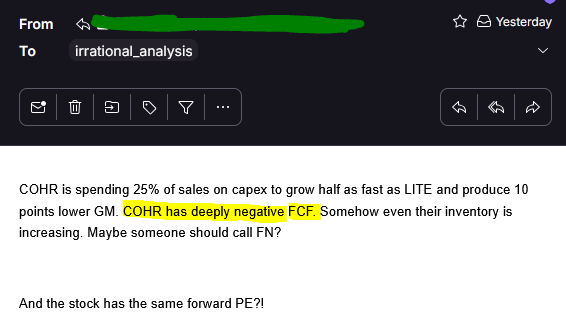
Guys the “higher revenue mix is transceivers” excuse is not enough to explain this mess.
Lumentum is RE-DESIGING LASERS TO BE SMALLER to improve yield and gross margins while Coherent financially self immolates in the greatest optics bull market since the telco bubble.
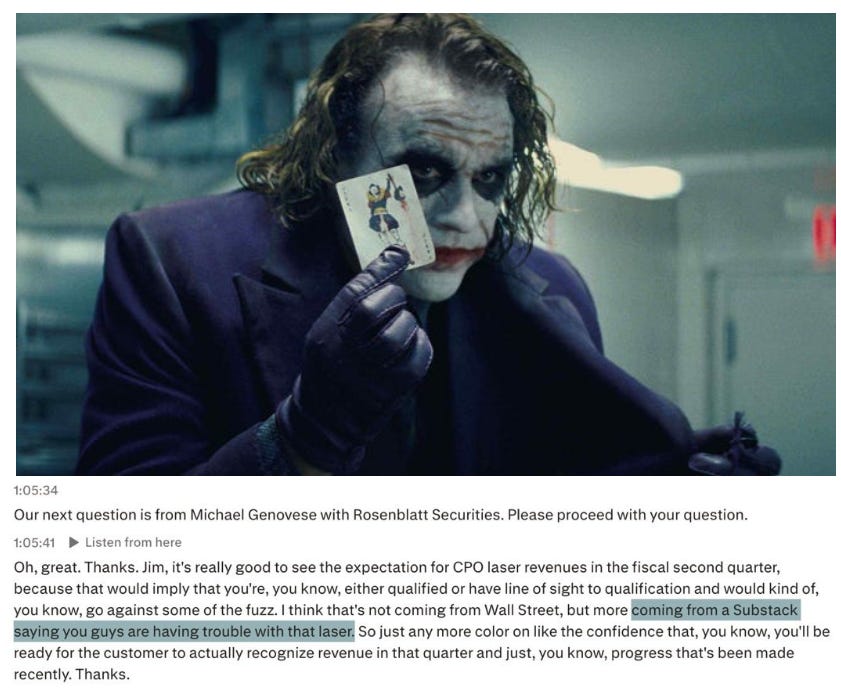

We are going to have extra fun today.
Earnings Call Transcript
6-Inch InP Conspiracy Theory
Lumentum Public CPO Laser Data
Practical CPO Laser Yield
Coherent can easily prove me wrong, but they choose to hide data BECAUSE THEIR CPO LASER IS GARBAGE.
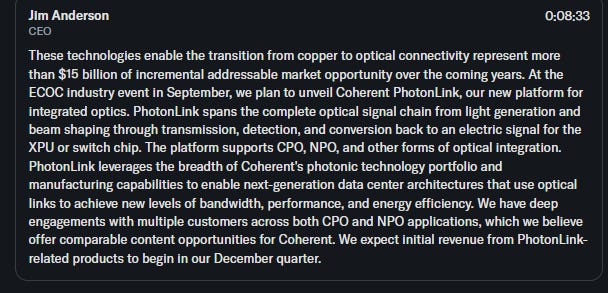
Is this PhotonLink thing the brand name for their VCSEL CPO/NPO? If so, very interesting and looking forward to the presentation.
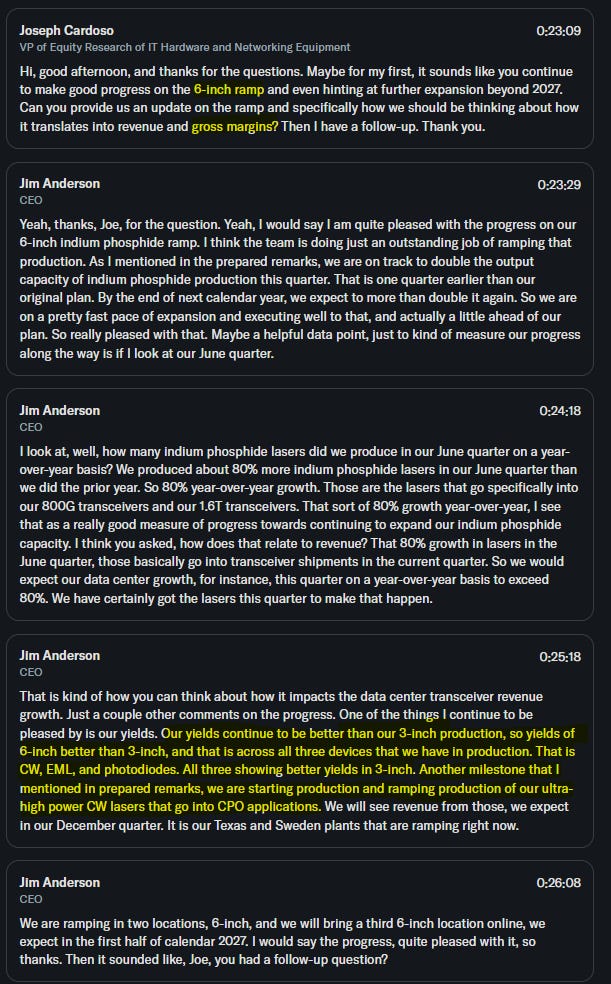
YIELD EML AT WHAT DATARATE?
YIELD CW LASER AT WHAT POWER CLASS?
This is honestly getting ridiculous. All the finance people are comparing Lumentum and Coherent on CapEx, FCF, gross margins, revenue growth and wondering what the hell is going on.
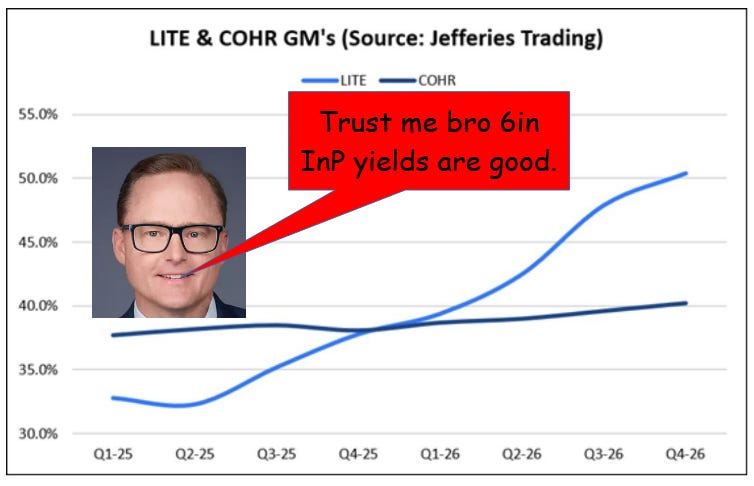
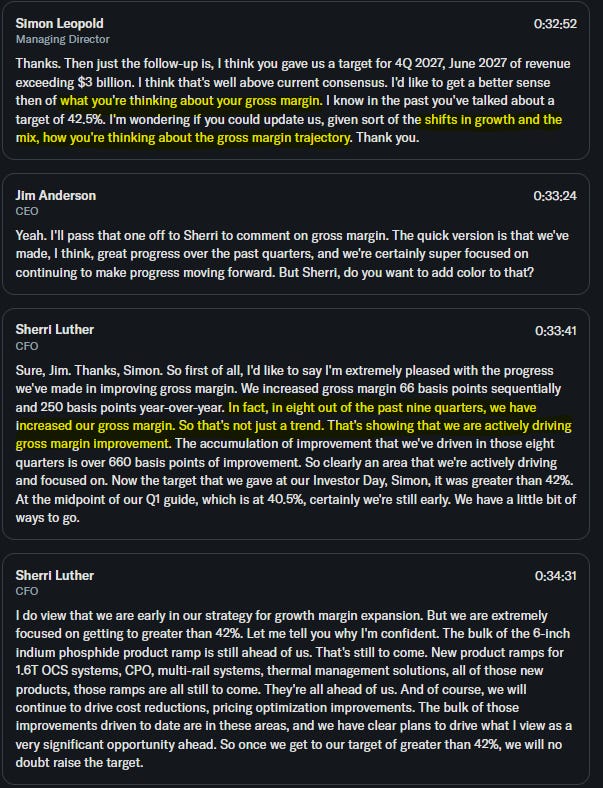
Well it looks like Lumentum is improving a lot more.
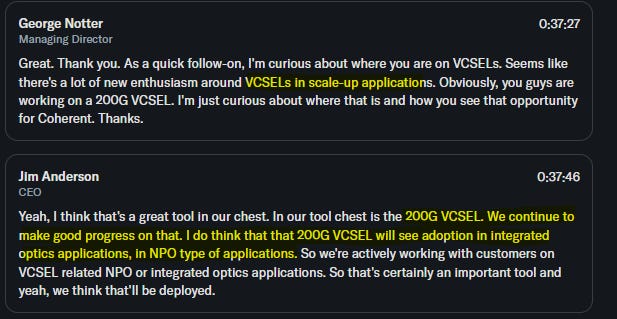
Idiot the optimal datarate for VCSEL NPO/CPO is 32G NRZ or 64G NRZ.
200G PAM4 on a VCSEL will not work from a reliability perspective. You fools are going to fail GR-468. Even if Coherent passes reliability, a VCSEL NPO/CPO system designed for 200G is stupid. The energy efficiency will be bad due to electrical driver complexity, FEC to mitigate crosstalk, and huge burden on Rx TIA sensitivity.
This nonsense is quite irritating. Coherent has great VCSELS, second only to Broadcom. If they build the system at the optimal datarate, it could be great!
Dummy the dream of CPO is direct-drive with UCIe or similar die-to-die SerDes that is clock-forwarded. Your engineers can accomplish this dream despite your total lack of understanding of how communication systems work.
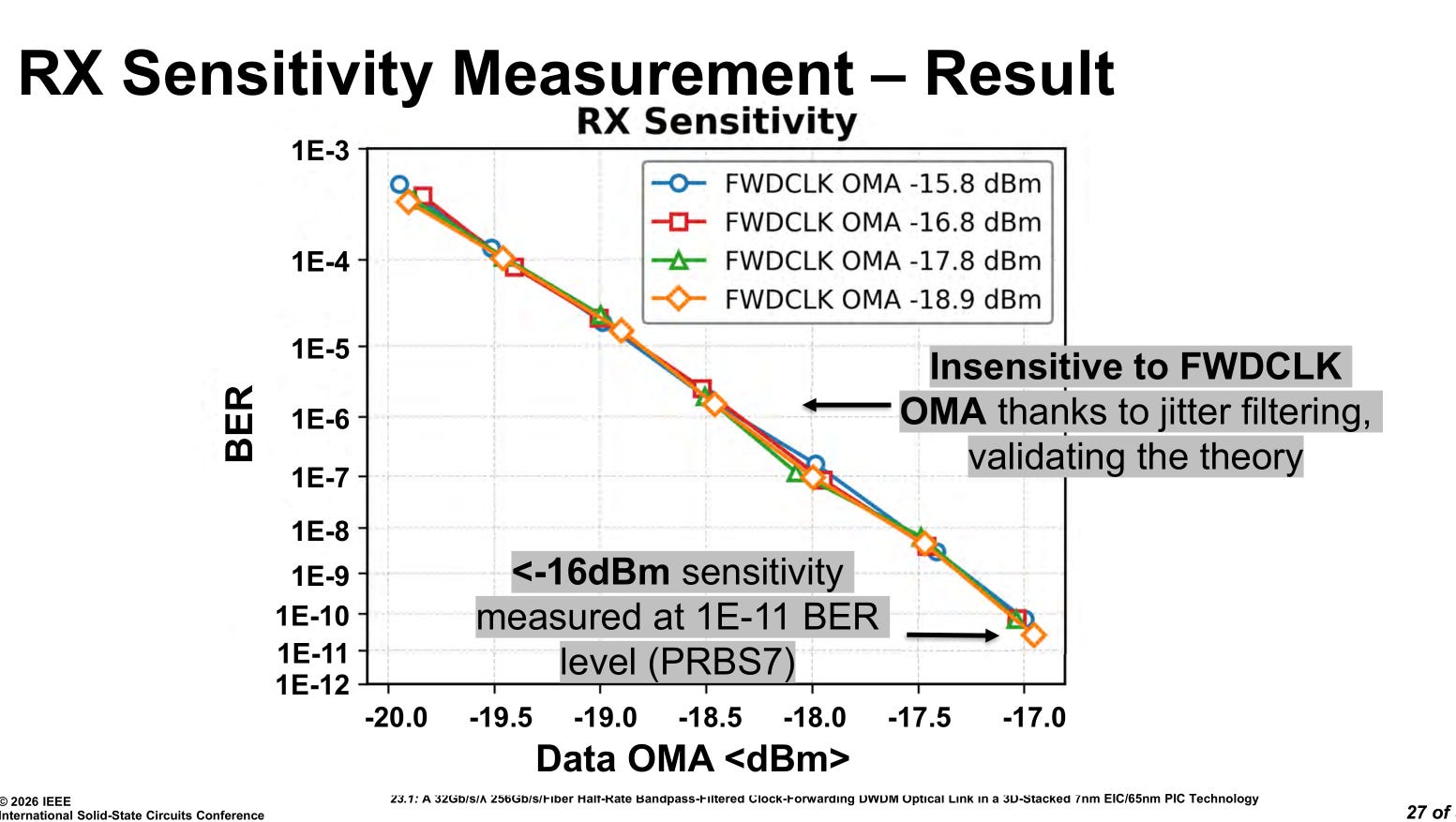
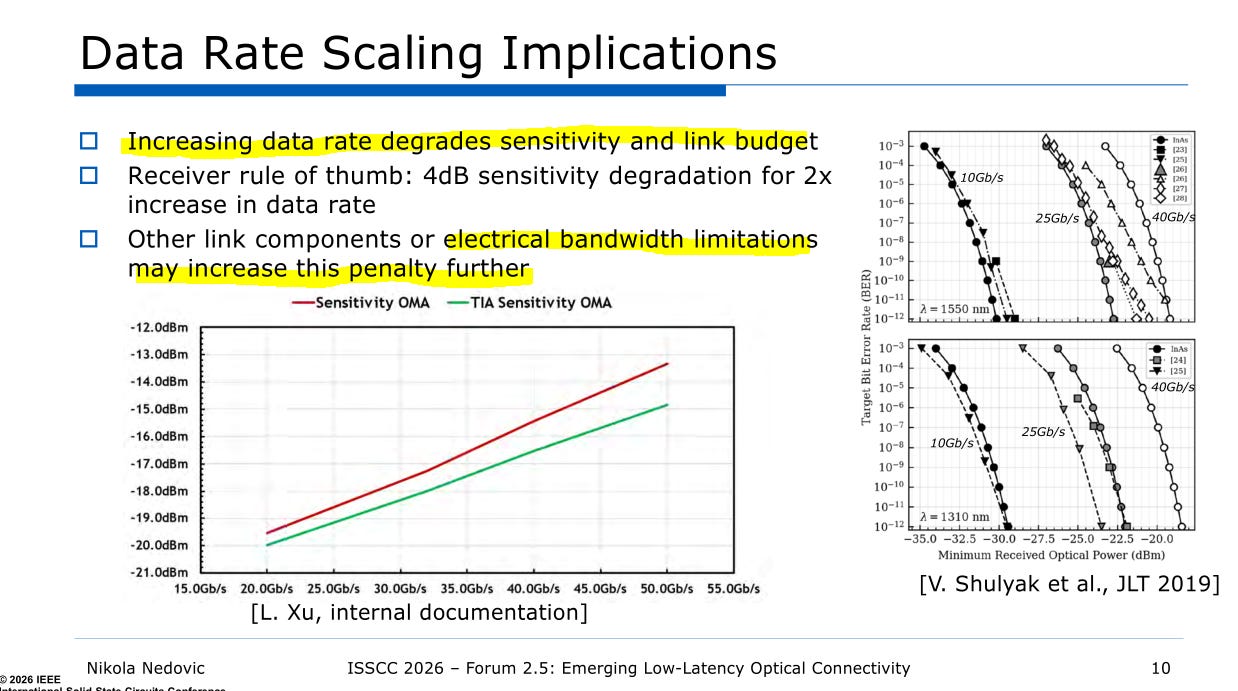
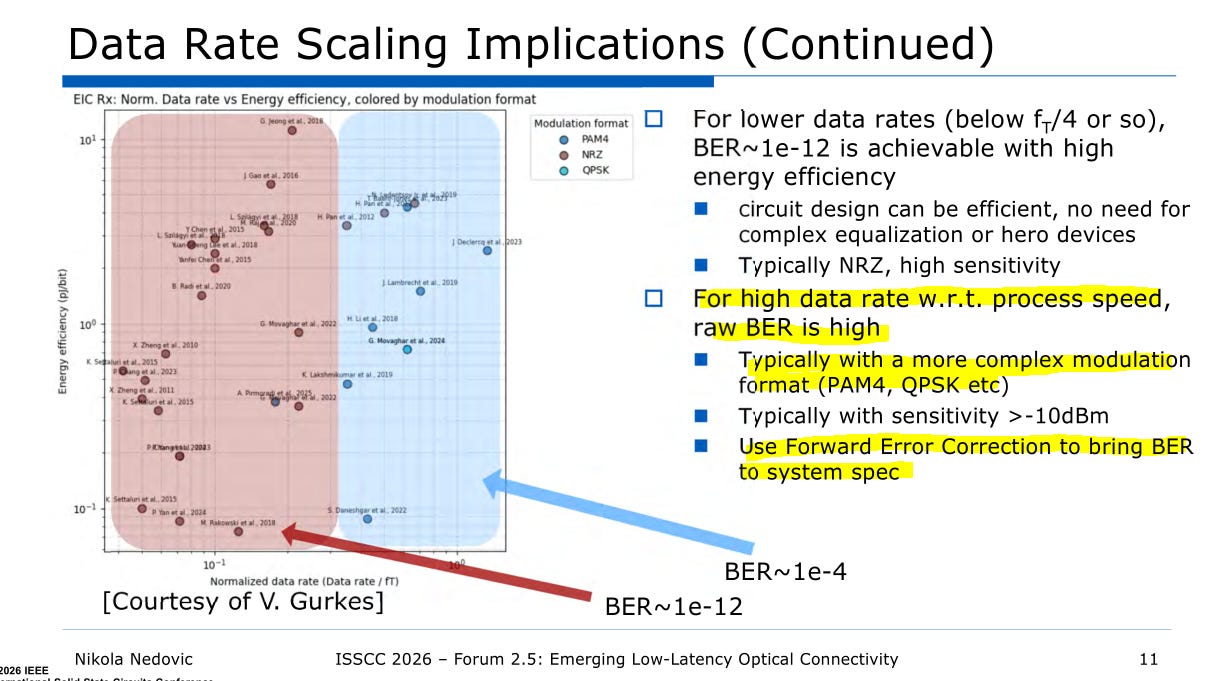
Everyone wants to cut power and latency by eliminating FEC.
You cannot eliminate FEC if each lane is running 200G PAM4!

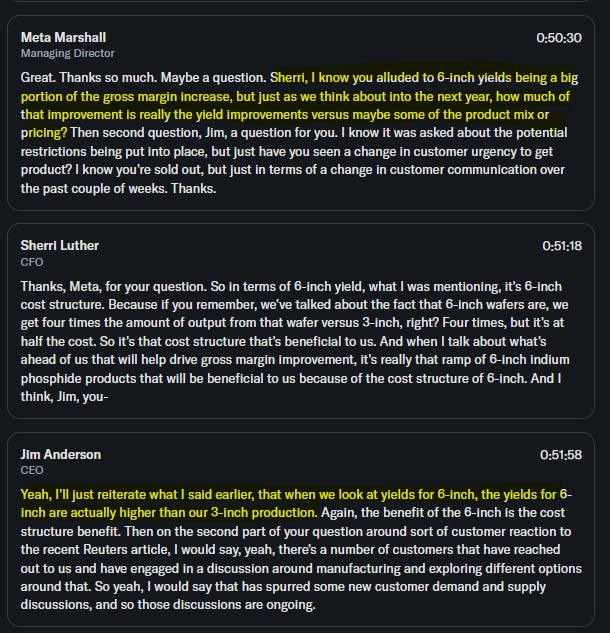
Every single finance person knows their yield is crap and is trying to ask the same question in a slightly different way.
THE ONLY WAY THE NUMBERS MAKE SENSE IS IF YIELD IS BAD.
Morgan Stanley guy intentionally asks a leading question.
“Is your miniscule gross margin expansion comparison [relative to Lumentum] because of mix shift or 6in yield?”
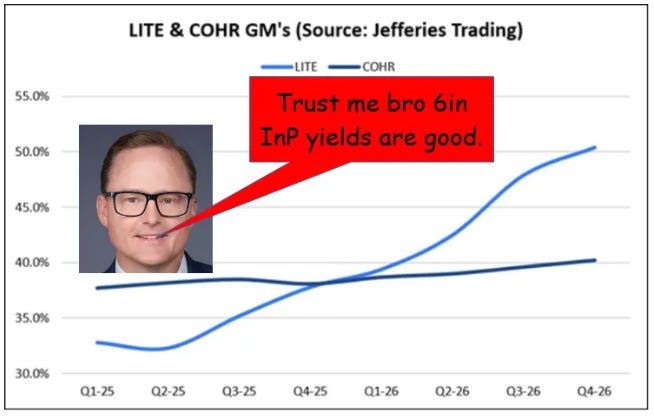
Re-posting this. How can we explain this chart?
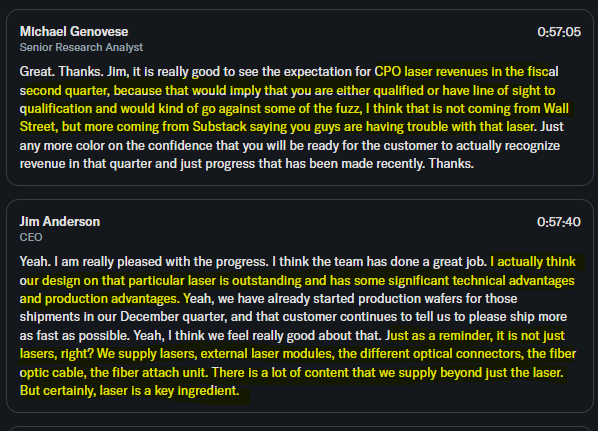
Their CPO laser is dogshit.
I like the cope comment at the end. WE SELL MORE THAN LASERS.
Yes you do. Lumentum is making 80% gross margins on their CPO laser but congrats Jim you get to sell isolators and FAU at like 30-40% margin.
Will torch this fool latter section.
Intuitively, 6-inch InP production should be higher yield. The tools are much better. New-generation Aixtron MOCVD reactors (for 6in) are higher performance. Instead of using ancient lithography tools from no-name companies, you can use a semi-modern ASML tool.
So…. why is their yield bad?
One conspiracy theory I want to throw out there is that maybe the 6-in InP wafers themselves have bad uniformity. For example, the best supplier (AXTI) does not have 6-inch InP wafers. That is still under R&D.
Amusingly, Coherent’s yield problems might not be their fault. Maybe it’s Sumitomo’s fault lol. Maybe once AXTI starts shipping good 6in InP wafers Coherent yield will finally go up.
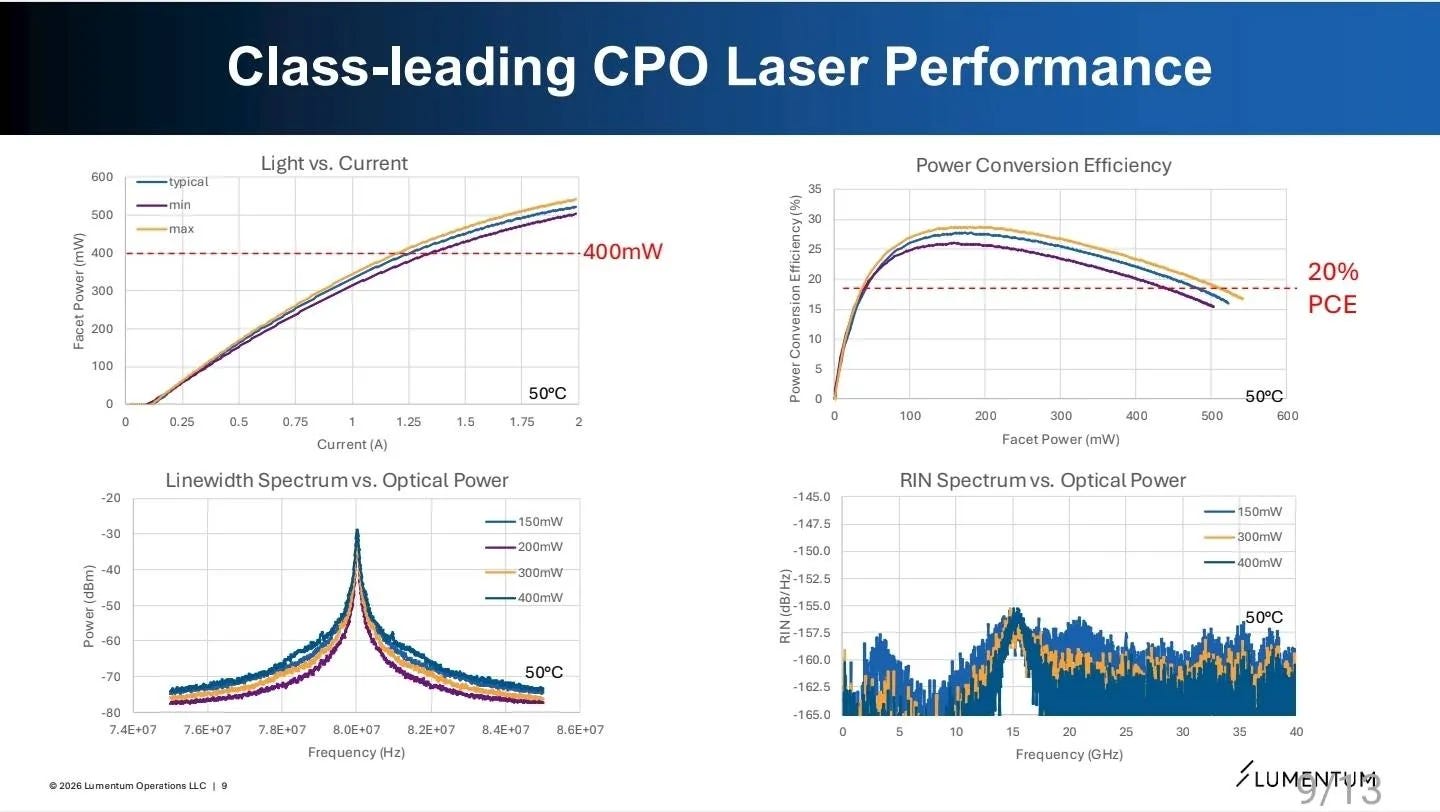
This data is beautiful and has almost all the details I am looking for.
Temperature is specified.
Temperature is at 50C which is frankly a pessimistic case. (more on this later)
Noise plots across power.
Process variation behavior of output power and power conversion effeciency.
Only thing missing is the raw phase noise plots. Lineshape is derived from phase noise and details are easier to read in the raw phase noise plot.
I am going to step-by-step walk all of you through each of these four plots. Maybe even Jim Anderson can accidentally learn something about lasers if he reads this.
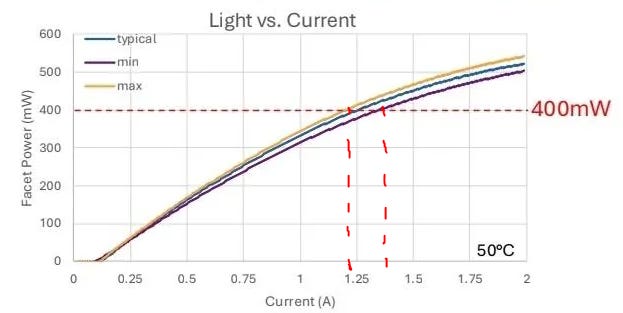
As you can see, the drive current needed to hit 400mW optical power varies quite a lot.
Minimum of 1.2 amp, max of lets say 1.38 amp.
Similarly, power conversion efficiency (electrical pow in / optical power out) varies due to process.
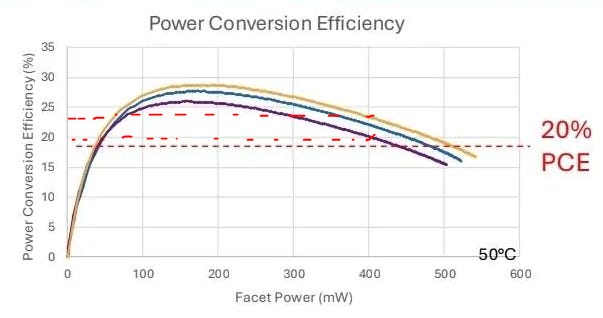
Range is from 21% to 24%. Also note that peak efficiency is at 150-200 mW optical output power. Will come back to this.
In general, people want 25-30% and Lumentum achieves this target at 40C. If you plot the same curves across temperature, lower temp gives higher power and higher efficiency.
For example, at OFC 2026, Lumentum’s live CPO ELSFP demo showed a module-level WPE (wall-plug efficiency) of 13% which is very good given the industry target is 10%. However, the live demo held the laser diodes at 30C and had aggressive (unrealistic) cooling. In a more realistic scenario (40C die temp, 50C liquid cooling coldplate temp) the WPE would probably be 10-11% which is still great!
Next we have noise.
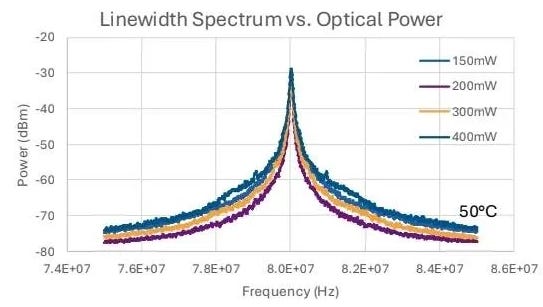
Linewidth is excellent. Want to point out something.
Notice how a middle-ish power (200mW, purple) is the best performing. While the lowest and highest powers (150mW, 400mW, both shades of blue) are tied as worst.
This is normal. If the power of a laser is set too low (relative to what it was designed for), the noise will be elevated. Just like how a middle-ing power is optimal for PCE, it is also optimal for phase noise.
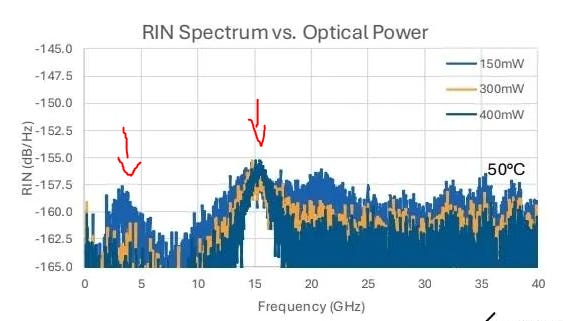
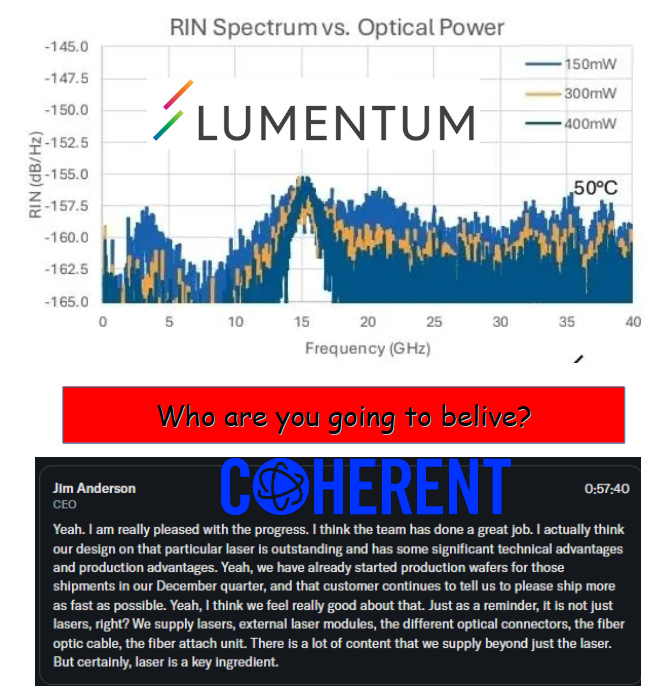
RIN is a laser spec defined as a single number. Integrate the above plot from 10 MHz to Nyquist frequency. Lumentum shows a RIN across power levels averaging less than -155 dBc/Hz which is EXCEPTIONAL. The general spec for CPO lasers is -145 dBc/Hz. Lumentum is literally over 10x lower noise than spec.
Typically, RIN plots look something like this.
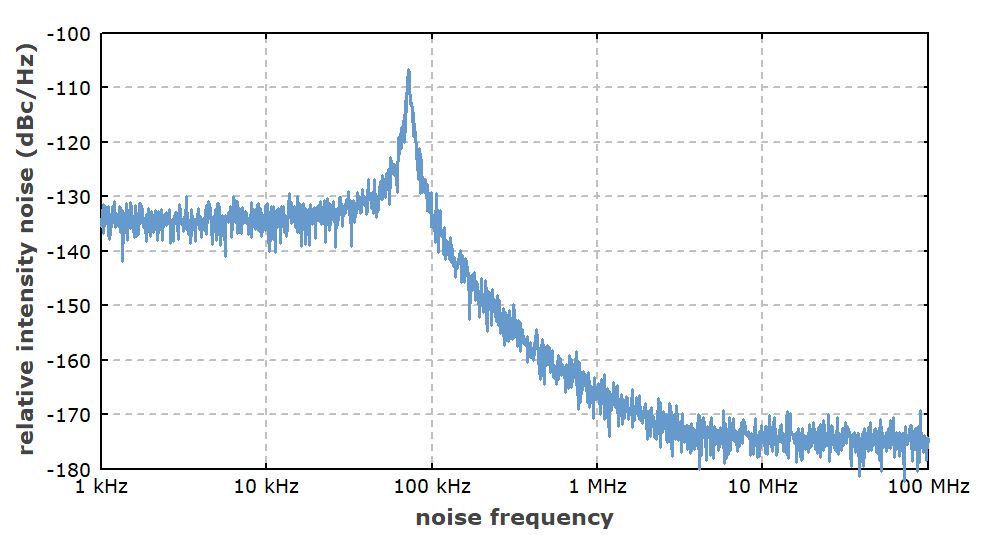
High noise at very low frequencies, following by a relaxation oscillation, then RIN is really good.
It looks like Lumentum’s laser has it’s relaxation oscillation at 3 GHz and something else at 15 GHz.
The 15 GHz noise is interesting. Not a problem just curious.
CPO lasers are nothing like traditional datacom transceiver lasers.
In a traditional CWDM transceiver, wavelength spacing is super lax.
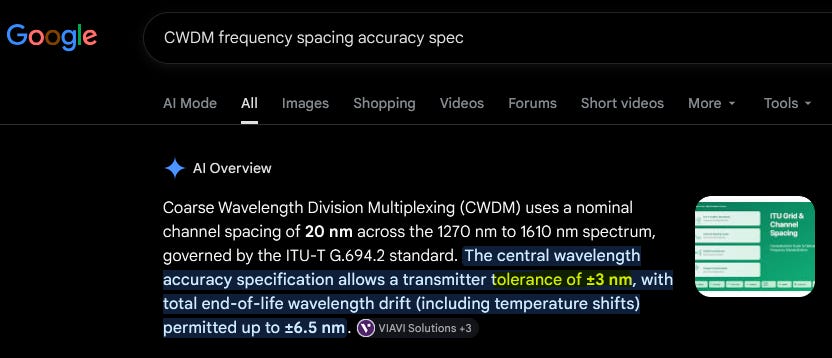
As long as the laser manufacturer is not completely incompetent, they will print lasers that pass this spec.
DWDM CPO systems are much more strict, requiring +/- 30 GHz spacing accuracy. This translates to around +/- 0.17 nm.
So what do you do if your laser (very high probability) is printed and ends up at the wrong wavelength due to InP process variation?
Thermal tuning. Change the TEC cold side temperature to shift the laser wavelength.
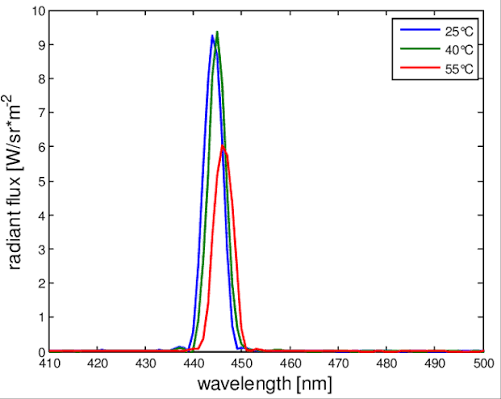
As a rule of thumb, a modern InP CW laser will shift around 0.1 nm per kelvin.
Here is an example.
You want to run a laser at 1311 nm at 40C die temp. Turns out, it is at 1309.9 nm. To tune the laser to the correct wavelength, you have to run it 11C hotter, thus operate at 51C. This is a huge problem.
The hot-side of the TEC is at 50C while the cold side is at 51C, so now the TEC is operating in reverse mode (heating) which is less effecient.
The delta between hot and cold side is very small so environmental shifts WILL cause the TEC to transition between heating and cooling mode, harming laser stability and noise performance.
Your laser’s optical output power and power conversion efficiency will be worse.
Thermal leakage due to the higher temperature will bleed into the drive and control electronics, adding electrical noise and eventually propagating into optical noise.
Picture for illustrative purpose. Don’t take the axis seriously this is not O-band.
CPO laser yield, especially at very high powers, is a nightmare. There are real competitive moats here.
IF I HEAR ONE MORE SPREADSHEET POD MONKEY BULLSHIT ABOUT HOW A FLOOD OF COMPETITION FROM CHINA AND ELSEWHERE IS COMING FOR LUMENTUM AND BROADCOM LASERS I SHALL SCREAM.
None of you fools know what this shit is. I bet you run my posts thru AI and still don’t understand it.
These are not just abstract numbers for me. I know how to measure all of this. Give me a CapEx budget of $100K (or $30K for rental), samples, and a few hours and I can fully characterize any of these CPO/NPO lasers. I know how amplitude noise effects optical communication systems. Do you fools know any of this shit? NO!
Jim Anderson has a very simple way to prove me wrong. The same plots, the same data that Lumentum PUBLICLY shared exist within Coherent. It would take at most one day to find this data, plot in in a pretty slide, run it thru legal team, and publish online publicly.
They are not going to do this.
There is a reason.
As a reminder, dB is in log scale.
So if one laser is -155 dBc/Hz and the other is -135 dBc/Hz, the second laser is 20 dB worse and thus 100x higher amplitude noise.

No posts
Comments
Nothing yet. Say the first thing.
Sign in to join the conversation.