
Recently, I had the pleasure of sitting down with Rae Alexandra, the author of Unsung Heroines: 35 Women Who Changed the Bay Area (City Lights, 2026), to talk about what led her to write the book. Each mini biography in the book illuminates the story of a Bay Area woman whose story has been lost or forgotten and includes a graphic image drawn by Adrienne Simms (all the graphics below are also by Adrienne). The book originated as a segment on KQED called “Rebel Girls from Bay Area History.”
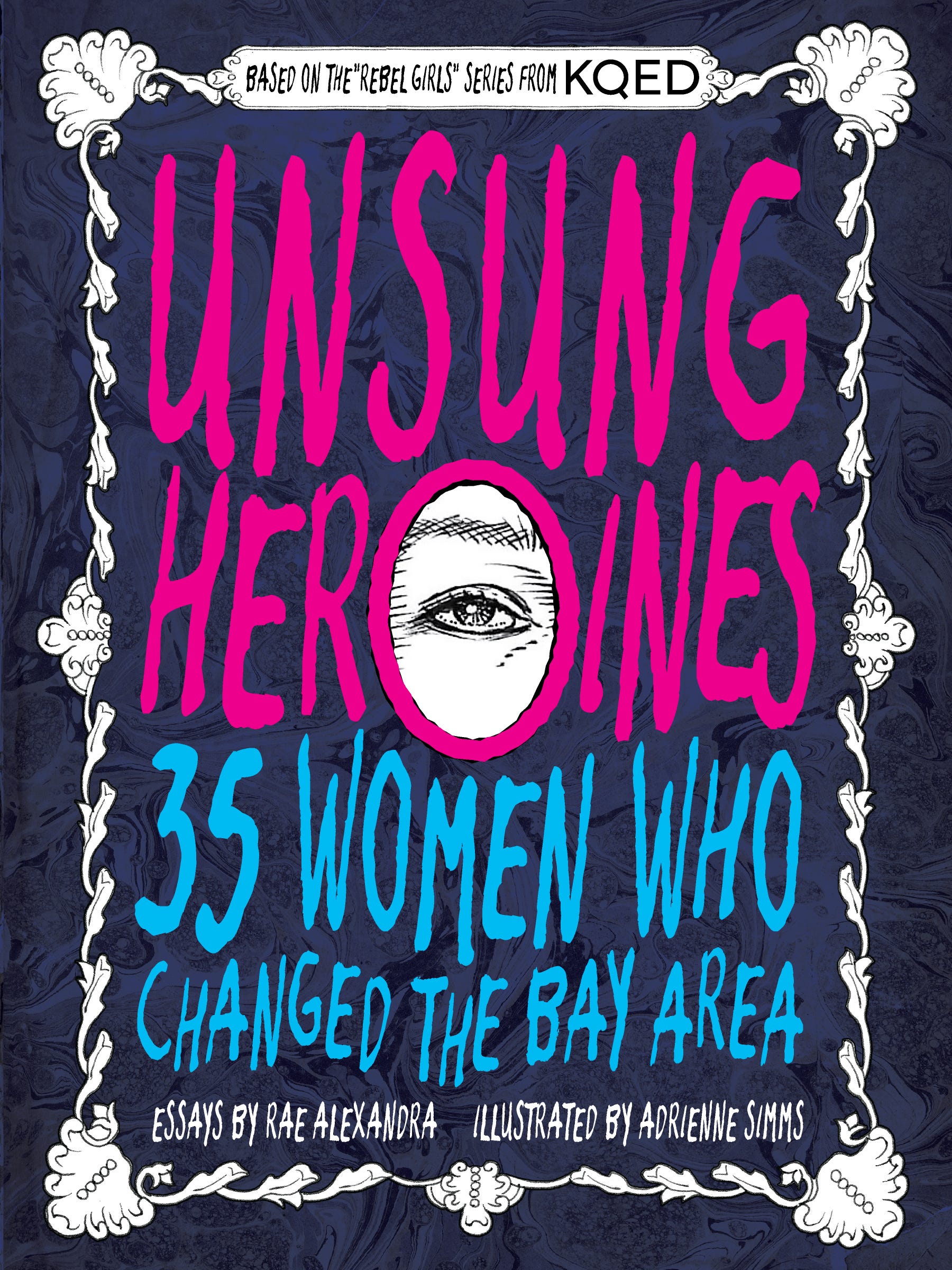
It was such a dream to sit down with someone like Rae, who is driven to the same work that I am. When I first read Unsung Heroines, I assumed I’d know all of the women she highlighted, but the truth was my first encounter with most of the women in the book was the first time I’d ever heard of them.
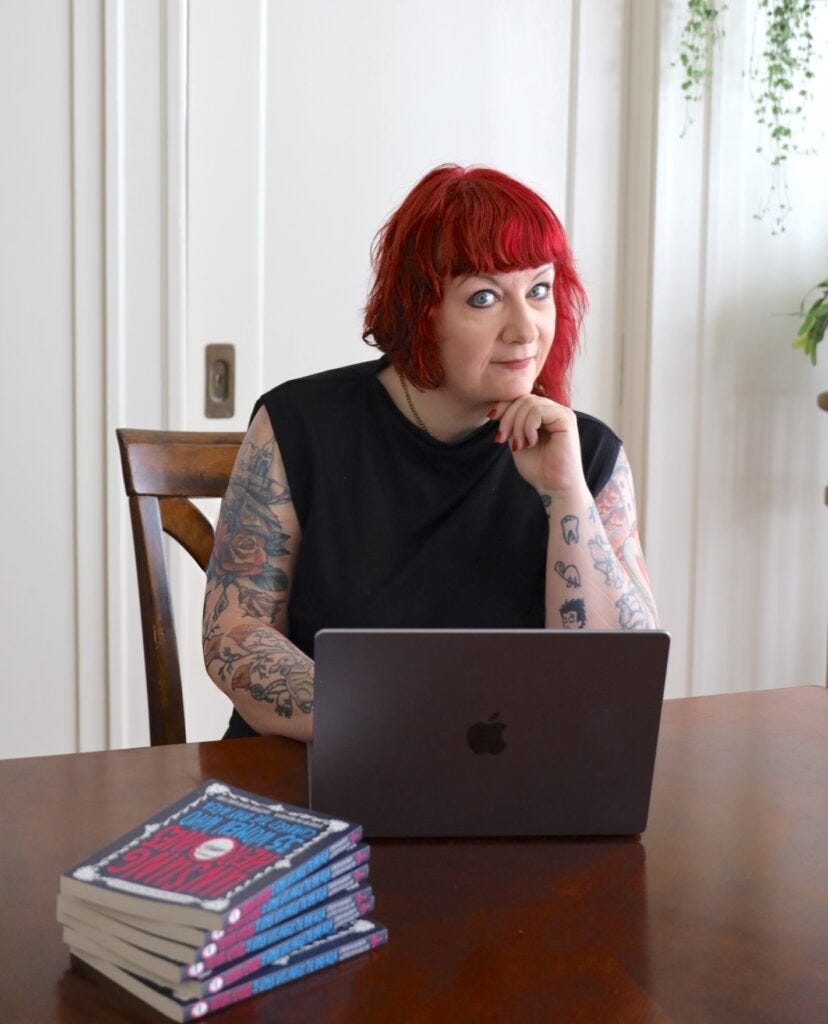
Rae Alexandra is an award-winning arts and culture writer with a passion for weird history, pop culture, and feminist causes. Born and raised in Wales, she started her career in London as a music journalist and worked for uproarious rock 'n' roll magazine Kerrang! for a decade. After moving to San Francisco in 2002, she also began contributing to alt-weeklies including SF Weekly and The Village Voice, before landing at KQED in 2017. Her love for all things Bay Area soon prompted Rae to pivot into researching and writing about local history. After 20 years living in San Francisco's Mission District, Rae recently relocated to Stockton, California.
Iris Jamahl Dunkle
Can you tell me a little bit about yourself and how you came upon writing this book, which is extraordinary; I love it.
Rae Alexandra
I started out as a music journalist. I was a rock journalist for a long time for a British magazine that was very unruly and very fun, like a weekly Rolling Stone, but more inappropriate.
Iris Jamahl Dunkle
Yeah, that sounds fun.
Rae Alexandra
And I did that for a long time, but as a woman, music industry stuff burns you, so I shifted into writing about pop culture, and that landed me at KQED in 2016.
In 2018, a study called “Statues for Equity” was done where someone went all around San Francisco and counted the number of statues that were women, and out of the 87 statues, only five were women, and that made me really angry. One of the reasons I moved to San Francisco is because I always thought that it was better than everywhere else. When I first started coming here in the 90s, especially coming from Wales. It was amazing to suddenly be in a place where everyone’s an artist, and everyone’s a punk, and everyone’s a feminist, and everyone’s pro-LGBTQ, and everyone’s open-minded, and everyone’s left-leaning, and I can get vegan food, I was like, this is Nirvana.
Iris Jamahl Dunkle
The 90s in San Francisco were great, weren’t they?
Rae Alexandra
I had this impression that it’s better in San Francisco than it was anywhere else. But the lack of women’s representation in the statues made me realize there was still work to be done. It was right before Women’s History Month, so I pitched writing five essays about cool women from the Bay Area who’d been forgotten, which was approved.
And then in 2020, there was a study by the Department on the Status of Women that came out in January, and it counted the percentages of things named after women in San Francisco (like street names, public art, etc.), and it turned out only 7% of street signs were named after women.
Iris Jamahl Dunkle
Wow. That’s terrible.
Rae Alexandra
Which is abysmal. And at that point, I went full Hulk. And I committed to writing an essay once a month about a woman who had been forgotten. Then, two months later, it was March 2020, and all of the libraries shut down. Really good timing.
Iris Jamahl Dunkle
Oh no.
Rae Alexandra
But, in the long run, I think COVID did me some favors. Because you know how everyone got obsessed with like sourdough and jigsaw puzzles and hiking and stuff? I just got obsessed with dead women. Everything that I was doing was about researching dead women.
Iris Jamahl Dunkle
That is how I live my life.
Rae Alexandra
I think COVID made me more obsessive. And it was hard at the time, but I look back on it now, and I think it did me some favors, because it meant that, because the libraries were closed, I just started, obsessively hoarding history books I could find. It started off with Bay Area things, and then it expanded to Northern California things, then it became Wild West things, and it just kept spreading out. Ultimately, the constraints caused by COVID were helpful because I couldn’t research things in normal ways.
Iris Jamahl Dunkle
Sounds like the pandemic shifted your perspective. Which is a benefit in this kind of work because the women you’re writing about are not in the typical archives.
Rae Alexandra
I would get a history book and turn to the index to see if a woman was mentioned more than twice, and if she was, I’d investigate her. Then I would check newspapers.com to see if I could find anything else about her there. That’s how I ended up finding someone like Mary Kelly, who has an amazing life story. A really dramatic life story, worthy of a movie, and I found her because she was mentioned a couple of times in a different book about the 1906 earthquake. And then when I looked her up on newspapers.com, I immediately found a story about her starting a riot at a flour warehouse, where they were keeping all the flour that had been donated for the refugees, but not distributing it properly.
Iris Jamahl Dunkle
That was the best story. So good.
Rae Alexandra
That newspaper report is so unintentionally hilarious, like, the reporter is so pissed off. He’s in the middle of it going, oh my god, these banshees, why? Because there’s a hundred women just fighting their way through. And there’s a section where he talks about his photographer getting hit in the head by a bag of flour. I got obsessed with finding women who had done enough to be mentioned somewhere, but no one had bothered to tell the full story.
Iris Jamahl Dunkle
Yeah, I loved that perspective and how it brought you to find women whom I’d never heard of before reading your book. I really like the diversity that you found as well.
Rae Alexandra
Thank you. It was very intentional from the beginning. And one of the reasons for that is that in public media, you are mindful about making sure that everyone is represented. KQED is very mindful about representing communities and making sure that we’re not just covering a bunch of white people.
Iris Jamahl Dunkle
We appreciate that.
Rae Alexandra
This wasn’t always the case. If you go back to even when I first started at KQED 10 years ago, it was a lot of old white men reviewing theater, and they’ve really actively tried to make shifts.
The other thing s that I have not sat in a history class since I was 14, thanks to a quirk of the British education system, you can drop certain subjects.
Iris Jamahl Dunkle
Seems like that was a benefit.
Rae Alexandra
Well, the reason I dropped history when I was in school is that I thought history was really boring. And the reason I thought history was really boring is that I was a Welsh person learning about English kings and queens and battles that were a thousand years ago: a bunch of dudes killing each other with bows and arrows. There’s nothing to relate to. And if there’s nothing to relate to, why would I care about this?
And so, once I was a couple of years into writing the original series, I started thinking about school kids. You want the kids to be able to find someone who feels like someone they would know, or that they feel connected to.
Iris Jamahl Dunkle
That’s awesome. How many essays did you write in total?
Rae Alexandra
There are 55.
Iris Jamahl Dunkle
Where do the other essays live (that didn’t make it into your current book)?
Rae Alexandra
They were originally published on the website “Rebel Girls from Bay Area History: kqed.org/rebelgirls.
There are audio segments for each of them, because I was also trying to allow for short attention spans. Not everybody wants to read massive history essays that don’t have enough images in them. So I turned them all into one-and-a-half- to two-minute audio segments at the top, so people can get through them fairly quickly. And then I managed to get 10 episodes onto PBS Learning, which is what the teachers use.
Iris Jamahl Dunkle
How did you choose these 35 stories for your book with City Lights?
Rae Alexandra
When City Lights got involved, they wanted the series to be specifically focused on the women who were lifelong activists. Who lived lives of service and dedication. Our end goal is to be able to get the book into middle schools and high schools.
Iris Jamahl Dunkle
That would be great!
Rae Alexandra
So, the essays all kind of got edited down to equal lengths – about 1000 words each – to make the book uniform and easily digestible. Online they are wildly different lengths. The goal is to make sure it’s informative enough for anyone, but it’s also quick enough that middle schoolers will get through it. So, one of the reasons certain women got eliminated from the original series to the book was because they were too risqué or they were too adult. Like Sally Rand, an early burlesque dancer who also raced airplanes in the 1930s.
Iris Jamahl Dunkle
But you kept Mary Mammon, the Chinatown nightclub dancer in!
Rae Alexandra
That’s because Mary Mammon is PG-13 compared to Sally Rand. And I was devastated that we had to cut Vicky Starr, who was one of the first topless transgender dancers in San Francisco. We were so close that she even had an illustration done by Adrienne Sims.
Elena Dumont is one of my favorites, but she got cut because she was a Wild West gambler who shot a couple of men. The first man was trying to rob her after she left her casino. And the second man was her husband, who tricked her and stole her life savings. He derailed her life for a long time, and she hunted him down, and she killed him, and even the sheriff was like, he had it coming.
Iris Jamahl Dunkle
I just want to say, if we cut all the men who’d shot people in the West, there’d be no history of the West, so…
Rae Alexandra
Correct, I agree.
Elena did take her own life in the end, because she was so far in debt and had turned into a bit of an alcoholic, but her story is epic. It should be an HBO series. When City Lights said we’re going to cut this one, it doesn’t fit with the others because it is tonally different and it’s twice as long as the others. And the publisher said, honestly, you’re obsessed with this woman. You should just write a whole book about her.
Iris Jamahl Dunkle
Oh, good. Are you going to do that?
Rae Alexandra
I’m going to try. It’s going to be a lot of research, and it’s going to have to go back to the town of Bodie, where she is buried in the churchyard (on the sinner’s side).
Iris Jamahl Dunkle
I’ve written a couple biographies, and it’s really fun; I can tell you. So of the stories that made it into the book, which one are you most attached to?
Rae Alexandra
Probably Delilah Beasley. It’s difficult, because with all of them I didn’t want to stop researching their lives. It’s like falling down research holes. You can just keep going and keep going and keep going.
Iris Jamahl Dunkle
Literally that’s the story of my life.
Rae Alexandra
I knew I was done with an essay when I felt like I was friends with her. So I feel like I’m friends with all of them, and I feel quite protective of all of them.
But Delilah, the reason Delilah’s special is because she was only the second woman that I wrote about. She was a Black journalist who wrote for Black newspapers, but she also had a column in the Oakland Tribune. It was the first time a Black journalist had a column in a major newspaper, which was quite controversial. She also spent a lot of her own time and money researching the Black pioneers of California, and putting together a book about it called The Negro Trail-Blazers of California (1919), which she self-published. But the thing with Delilah is the longer I went through this series, I would find another woman from something else entirely, and I would start researching that woman, and I’d be in the newspaper archives, and I would glance up just to see if there was a byline. And there were so many occasions where the next woman I was researching had been written about by Delilah.
Iris Jamahl Dunkle
That’s so cool.
Rae Alexandra
It was as if Delilah was the guardian angel of the whole series. She knew a lot of these women. She was writing about them, interviewing them, hanging out at conferences with them.
Iris Jamahl Dunkle
I love that. So what is your next step? Sounds like you’re going to work on a biography about Elena Dumont?
Rae Alexandra
The next book I want to do is about the bad girls. I would like to do an immediate follow-up book about naughty ladies. While doing research over the years, I’ve stumbled across women who were stunt pilots or motorcycle riders in motorcycle gangs. All of these interesting women, so I think if I take the bad girls out of the original Rebel Girls series and combine it with all these other women that I found, it will be like Unsung Heroines After Dark Edition. So that’ll be the next thing that I focus on.
Iris Jamahl Dunkle
Oh, wow.
Rae Alexandra
My writing voice is not that of a historian. It’s very clear that I’m not a historian. It’s clear that I’m having a nice time.
Iris Jamahl Dunkle
Which is good because that’s approachable and that’ll get people to read it.
Rae Alexandra
I tend to always go back to Charlotte L. Brown, because she is the woman who in the 1860s sued the railroad company in San Francisco for removing her from the bus. And I think she kick-started Mary Ellen Pleasant’s lawsuit that ended up in the Supreme Court. And the fact that nobody knows who this woman is, it feels very much like active erasure.
One of the things that really upset me when I was researching that story, they had all of the court documents at the California Historical Society library. And I had been trying desperately to find an image of her. Looking back on this, I was quite naive at the time, because I hadn’t been doing the series for very long. She was one of the earlier ones, and I didn’t realize that when it comes to 19th-century Black women, you’re probably never going to see them.
Iris Jamahl Dunkle
Yeah, that was amazing.
Rae Alexandra
You would think there would be documentation of this woman’s feat somewhere, but I was going through the court documents at the California in the library at the California Historical Society, and they were all just handwritten in pencil. And I got quite excited, because I thought, oh, she will have signed this somewhere. But it was her dad who signed it. She didn’t even get to sign it. Charlotte got a raw deal, and it feels intentional.
Anytime I need a little bit of motivation, I think about the erasure of Charlotte L. Brown.
Iris Jamahl Dunkle
I mean, that’s the thing about finding lost voices: they are everywhere. Every time someone talks to me about it, they’re like How do you come up with people to write about? And I’m like, I could write one every day.
Rae Alexandra
Yeah, and that’s it. I mean, this went from five to 55, but I still have a document on my desktop that is just like, “Future Rebel Girls?” I could do this forever. There are so many to choose from. And once the switch goes in your head to start looking on a daily basis, regardless of what you’re doing, that then… it just never ends.
Iris Jamahl Dunkle
Before I read your book, I assumed, given my background, that I would know who these women would be. I thought, I must know some of these names. But the truth was that I didn’t know most of them. That was such a great thing to experience as somebody who feels like I’m always looking for these types of women. So I really appreciate that.
Rae Alexandra
I think Big Alma is probably the only one who, I think she’s the best known: Alma de Brettville Spreckles.
Iris Jamahl Dunkle
Yes, I know her from studying Jack and Charmian London.
Rae Alexandra
We put Big Alma in because we were trying to figure out the last one, and I was like, we can have one who’s kind of known, like it might be a selling point.
Iris Jamahl Dunkle
I like the way you approached her, though. She’s not usually written about that way.
Rae Alexandra
I just thought she was a really fun gal, to be honest. Naked swimming parties, what are we doing? Like… Yeah, go on.
Iris Jamahl Dunkle
That’s funny. Yeah. And I love that you’re going to be making another book, that you’re moving your momentum in that direction because it’s so needed. Especially now.
Rae Alexandra
My gut is screaming at me; you must go do this now. It’s time. I’ve watched so many things collapse during my career, in terms of media, that I trust nothing is safe other than books. Books are the only constant. And here’s the thing, like as we move towards this, I would love to just talk about this for a second because AI inevitably comes up in so many conversations that I’m a part of about research.
Iris Jamahl Dunkle
These stories are not found on the internet, and sometimes not even behind the archival wall. They would be completely erased forever if that was the record.
Rae Alexandra
Yes. And when they do come up in AI, their stories are not accurate.
Iris Jamahl Dunkle
Yes, filled with hallucinations.
Rae Alexandra
Living in Northern California, we are more conscious of it than anywhere else because it’s on the doorstep.
Iris Jamahl Dunkle
It is. Yeah. And from the perspective of what we do, it’s such a big deal because it would eradicate the work that’s been done in this area for so long.
Rae Alexandra
100%. I had an event at the Mechanics Institute on Friday. Everything had gone swimmingly, and the event was delightful. So I’m signing some books at the end, and a man came over and said, oh, if you ever need some assistance with research, there are some AI tools that I can send you and I went. I’m going to stop you there. Sir, with all due respect, I don’t know if you work in AI or not. Why would I want to use the thing that’s going to put me and all of my friends out of jobs? Why would I want to facilitate that? I don’t care what you’re recommending. I don’t trust it. I think I was aggressive enough about it that he just started backing out of the room. And I was like, oh no, I was rude! I went home, and I was thinking about it, and I was like, was I rude? I was probably rude. Or at least said it in a way that could have been interpreted as rude. But I also don’t care, because I feel under threat, and how dare you think that the robots at this stage are going to assist me? Can you even imagine, like, over a librarian? Or an archivist?
Iris Jamahl Dunkle
No, I mean, that’s what people don’t understand: AI cannot do what human beings can do when it comes to unearthing what’s been lost.
Rae Alexandra
My god, if I think about the people who work in the archives, especially the African American Museum and Library in Oakland. The level of detail, and the level of assistance that they’re willing to give, and the fact that they’ll sit there, and they’ll scan a thing, and they’ll go and find a thing. You’re never going to get that from a machine. And it makes me furious that I even have to have this conversation at a book signing!
Iris Jamahl Dunkle
It’s really messed up. It’s all right. I’ve gotten a lot of weird comments at book signings.
Well, I’m really, really excited. I’m very appreciative of your meeting with me today, and also very excited about the work that you’re doing, and I’m really happy to showcase it on Finding Lost Voices. I’m especially looking forward to your Rebel Girls book! Will it focus on San Francisco?
Rae Alexandra
Yeah, there’s a lot of bad behavior in San Francisco, and a lot of lines were pushed.
Iris Jamahl Dunkle
Just look at the Barbary Coast. I mean, like during that era, there were so many amazing women that the only way they survived was to break the rules.
Rae Alexandra
A hundred percent.
Purchase Unsung Heroines: https://citylights.com/city-lights-published/unsung-heroines35-women-who-changed/
Visit the PBS Learning page (with lessons for classrooms) for ‘Rebel Girls’ is here: https://thinktv.pbslearningmedia.org/collection/rebel-girls/
Visit Adrienne Simms (the illustrator) website: https://www.adriennesimms.com/
Writing Accountability Group at the Sitting Room every Monday from 10-12 PST. The Sitting Room is located at 2025 Curtis Dr, Penngrove, CA 94951. If you are interested in joining virtually, just send me an email!
More events will be posted soon!
Comments
Nothing yet. Say the first thing.
Sign in to join the conversation.