
David Hockney (British, 1937-2026) died on June 11 at the age of 88. Even a quick survey of his long career demonstrates the artist’s wide-ranging curiosity about the subjects, materials, and history of art. For this memorial essay, I have chosen works to give a sense of the great diversity of the artist’s subjects and media.
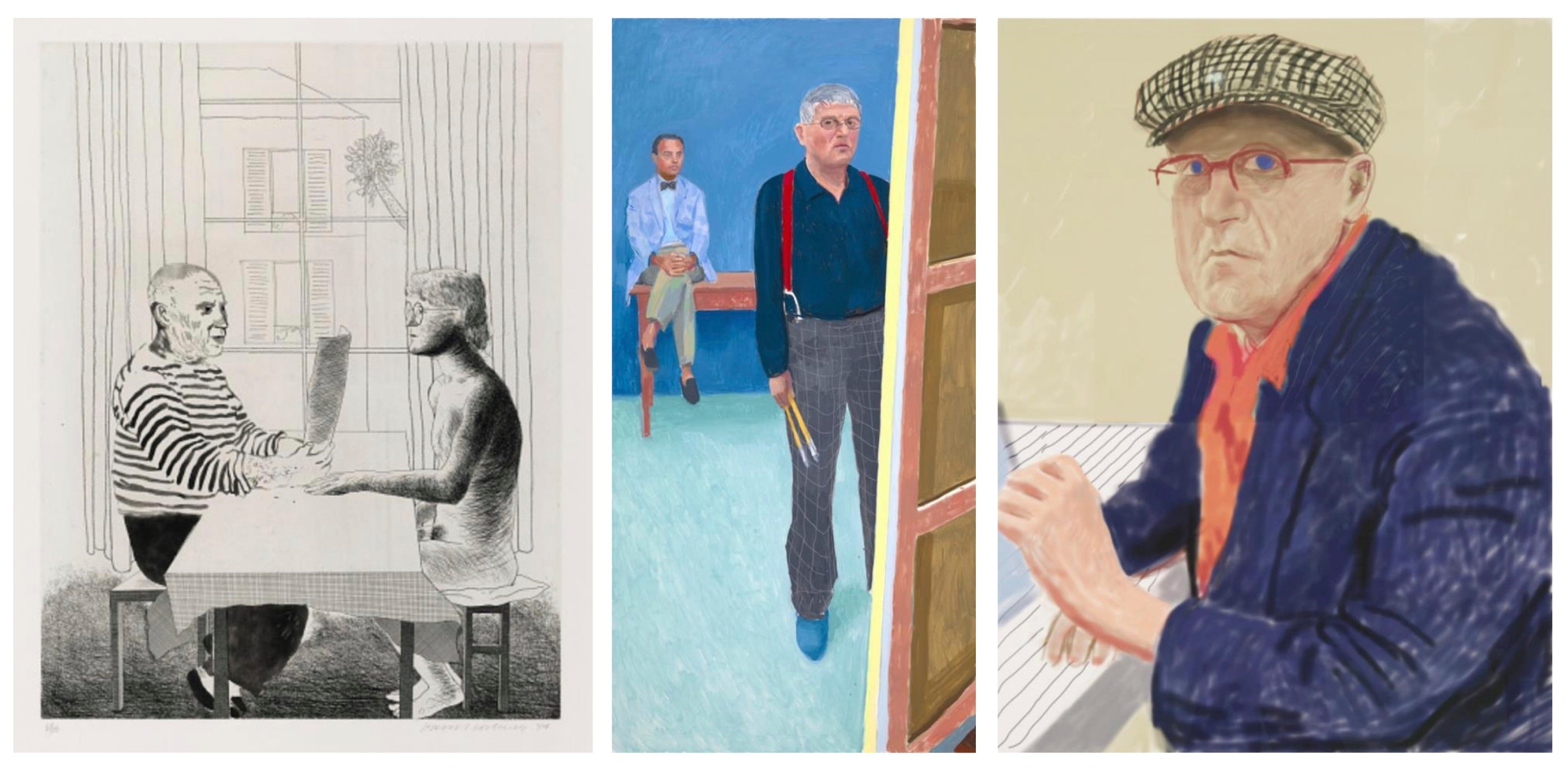
I’ve begun with three of the over 300 self-portraits the artist created in his lifetime. The idea of an artist using himself as a model and exploring how he changes over time has several art historical precedents. One of the most famous examples is Rembrandt van Rijn (Dutch, 1606-1669). For Rembrandt, capturing his own likeness during his early years allowed him to hone his craft without the cost of models. Later however, Rembrandt depicted himself again and again as he aged, conveying not only his physical reality but also his psychological truth. (For a discussion of these images click here.) From early in his career, Hockney also used his image to explore his mental and physical state.
The examples above range from 1973 to 2012 and are made using three of Hockney’s favorite methods: etching, oil painting, and digital drawing. He began working with printmaking as a student and worked with a variety printers and print studios over his long career. The earliest of these works was made during Hockney’s collaboration with Aldo Crommelynck (Belgian, 1931-2008), a master printer who had worked with many important early 20th century artists. For Hockney, the most important of Crommelynck’s earlier collaborations was with Pablo Picasso (Spanish, 1881-1973).
It was thrilling to meet someone who had such direct contact with Picasso and worked with him such a lot. Aldo Crommelynck taught me marvelous technical things about etching. – David Hockney
The etching depicts Picasso clothed in his favorite striped shirt opposite the nude, youthful Hockney. This work was created when Hockney was part of a project to create a print portfolio in which various artists would commemorate Picasso, who died while the project was underway. The title Artist and Model is a playful description of the work since the nude figure is the maker of the work but the convention of the artist and model theme would identify the clothed figure as the artist.
The 2005 self-portrait is one of a series of portraits the artist created in his California studio that year. For the series, Hockney painted directly on the canvas without preparatory drawing. The composition showing the artist partially obscured by a tall canvas is one he used in other self-portraits and is a reference to earlier paintings like Diego Velázquez’ Las Meninas (1656) and Francisco Goya’s Family of Charles IV (1800). The bright blue tones of this painting are found in many of the artist’s California paintings.
Whatever the medium is, you have to respond to it. I have always enjoyed swapping mediums about. I usually follow it, don’t go against it. I like using different techniques. – David Hockney
The third of the self-portraits was created using an iPad drawing application and printed using colored ink on paper. Hockney first experimented with computer drawing techniques in the 1980s though at that time he was often frustrated by the slow response time of the available technology. The iPad technology was as immediate as drawing with pen on paper while also allowing the artist to instantly apply the bright colors he loved.
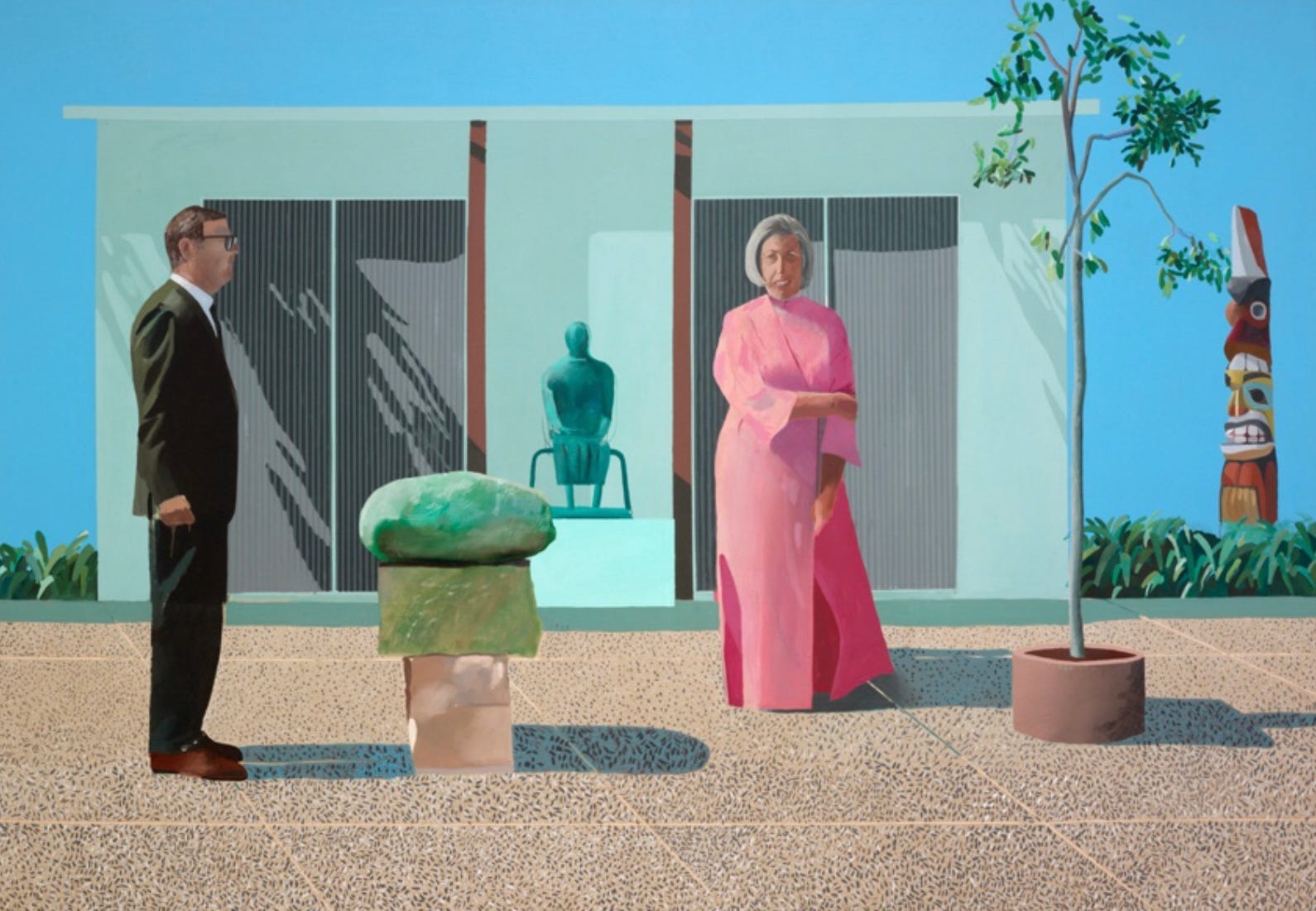
Hockney had moved to California sight unseen in 1964, eventually buying a home and establishing his studio there. He set out to capture the light and lifestyle of midcentury Los Angeles. American Collectors is a double portrait, nearly seven feet tall (2.1 meters) and ten feet wide (3 meters), but it is as much a portrait of a place as it is a depiction of two people’s likenesses.
There’s a Turnbull sculpture, a Henry Moore sculpture, other things, all part of them. The portrait, American Collectors (Fred and Marcia Weisman), wasn’t just in the faces, it was the whole setting … There’s the totem pole in the picture that looks rather like Marcia. So it’s a slightly different kind of portrait in that the objects around the figures are part of them. – David Hockney
The stillness of the figures makes them appear as sculptural as the pieces around them. The slightly stylized naturalism is typical of many of Hockney’s works. He was one of the artists who chose to turn away from the dominance of abstraction in art of the 1950s and 1960s. Hockney had experimented with expressionist abstraction as a student in the late 1950s and early 1960s but found it unsatisfying. He was trying to incorporate narrative and spatial qualities that weren’t suited to the style he was using. Gradually he recognized that a naturalistic approach would serve his goals better as this work shows.
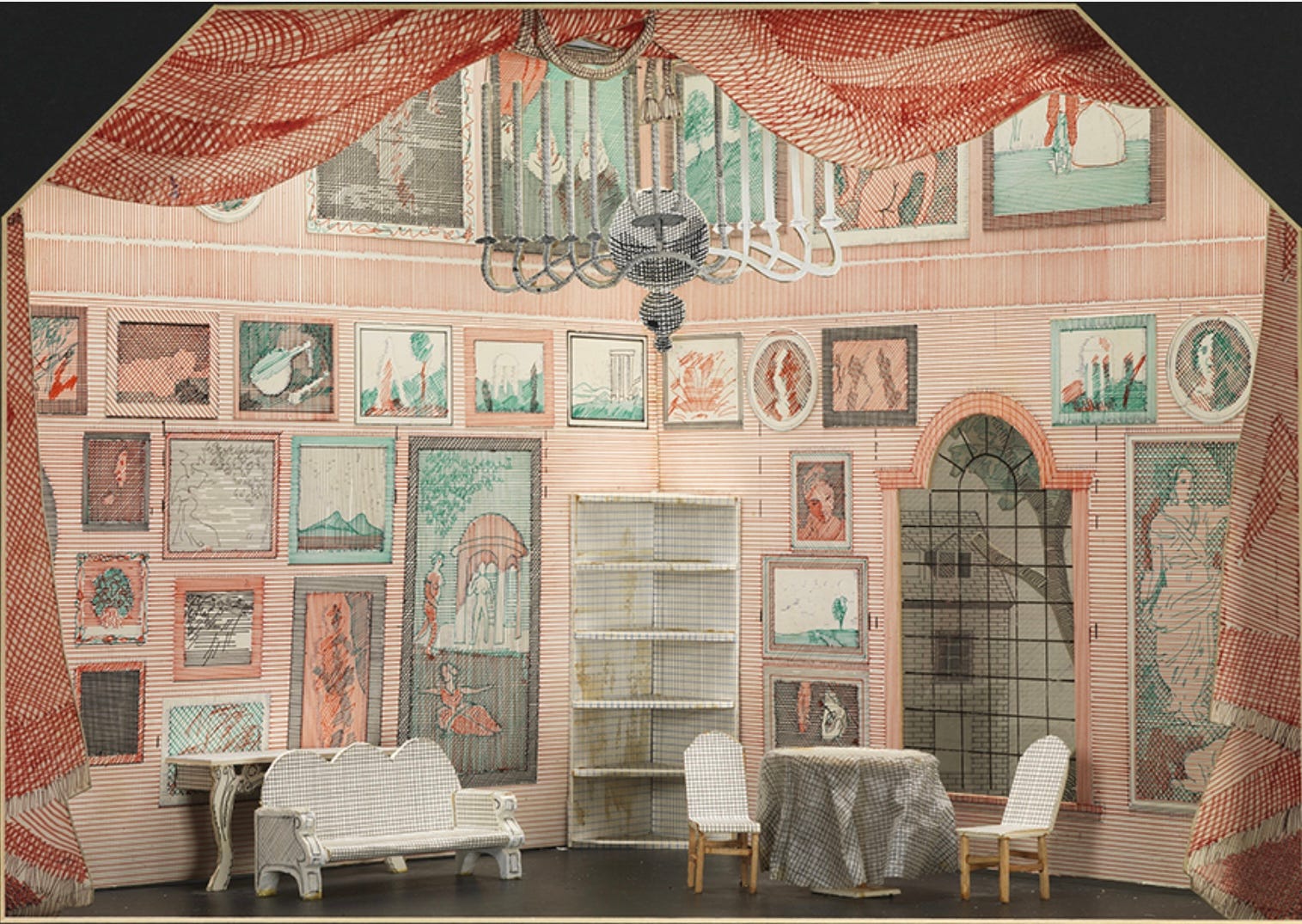
Theatrical producers sought Hockney’s collaboration from the mid 1960s on. Over 20 years, he created sets, costumes, and often lighting for ten operas. His 1975 designs for Igor Stravinsky’s opera The Rake’s Progress were the first to show that Hockney had the potential to be a powerful theatrical designer. The Rake’s Progress was written when Stravinsky took refuge from World War Two in the United States. The story is based on a series of paintings and prints created by William Hogarth (English, 1697-1764). In his designs for this production, Hockney used a stylized version of the hatching (parallel lines) and cross-hatching which create tone and texture in the engravings by which Hogarth’s series was widely disseminated.
In the video below, Hockney, director John Cox, and conductor Vladimir Jurowsky discuss a 2010 revival of the 1975 production.
The Rake’s Progress: An Introduction (6:14 minutes) Produced by Karen McCallion, David Fricker and Simon Yapp. © Glyndebourne Productions 2010
The Rake’s Progress came at a good time for me because it was a period when I was trying to figure out what to do in painting. So when this came along in 1974 it ended something for me and took me into something else… – David Hockney
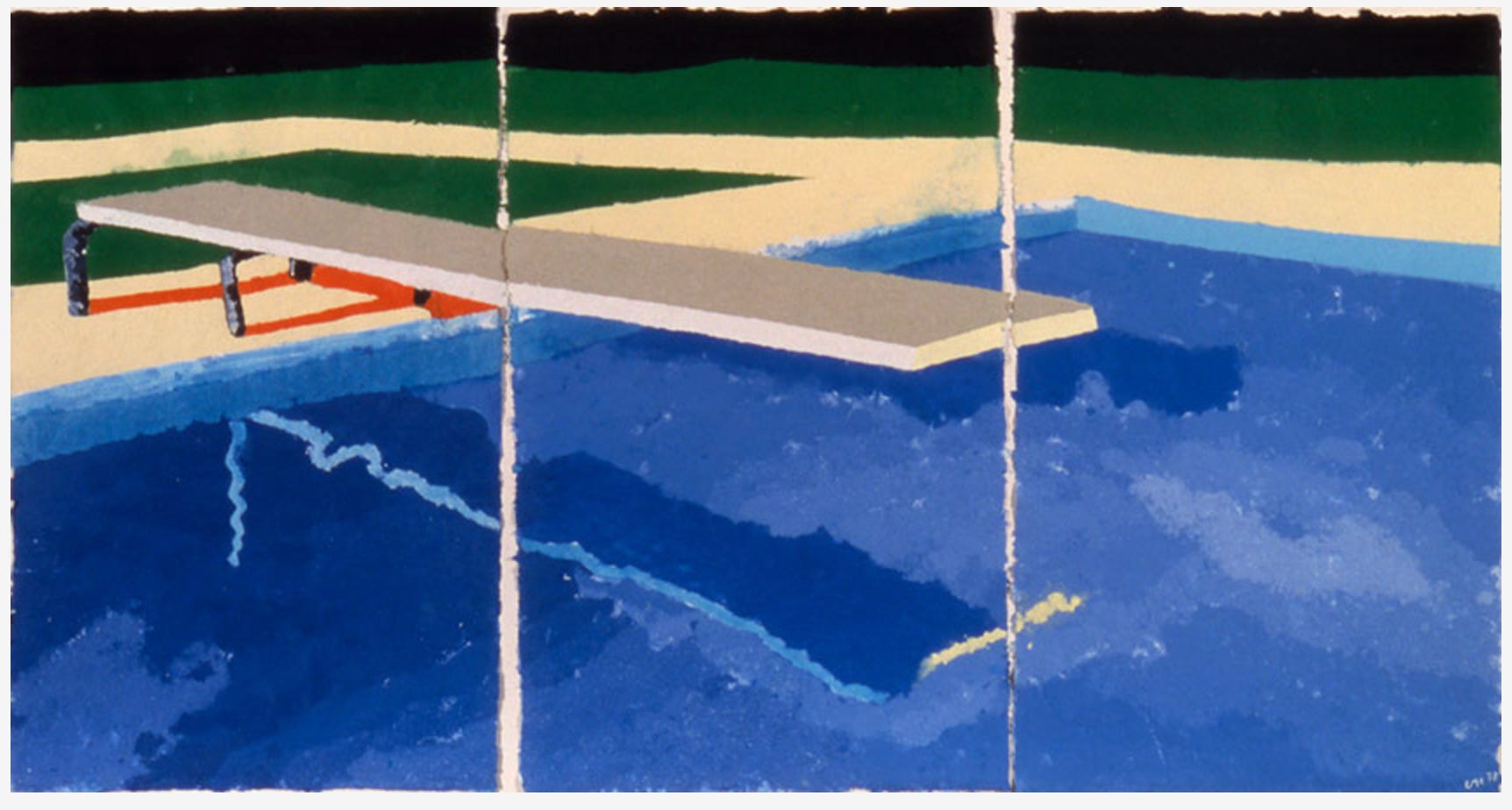
Hockney’s continued interest in printmaking led him to collaborate with his friend Ken Tyler (American, b. 1931), founder of Tyler Graphics Ltd. In the summer of 1978, Tyler introduced Hockney to working with colored paper pulp. Unlike the controlled technique of etching with which Hockney was familiar, this new method involved manipulating liquid colored paper and was more like painting. As often happened when Hockney discovered a new technique for art making, he immersed himself in the new medium. Describing it as “thrilling,” he and Tyler worked long hours, resulting in the series Paper Pools. The theme was a familiar one but the new technique and vivid color allowed Hockney to explore his fascination with water in a new way.
Have a question? Ask in the comments.
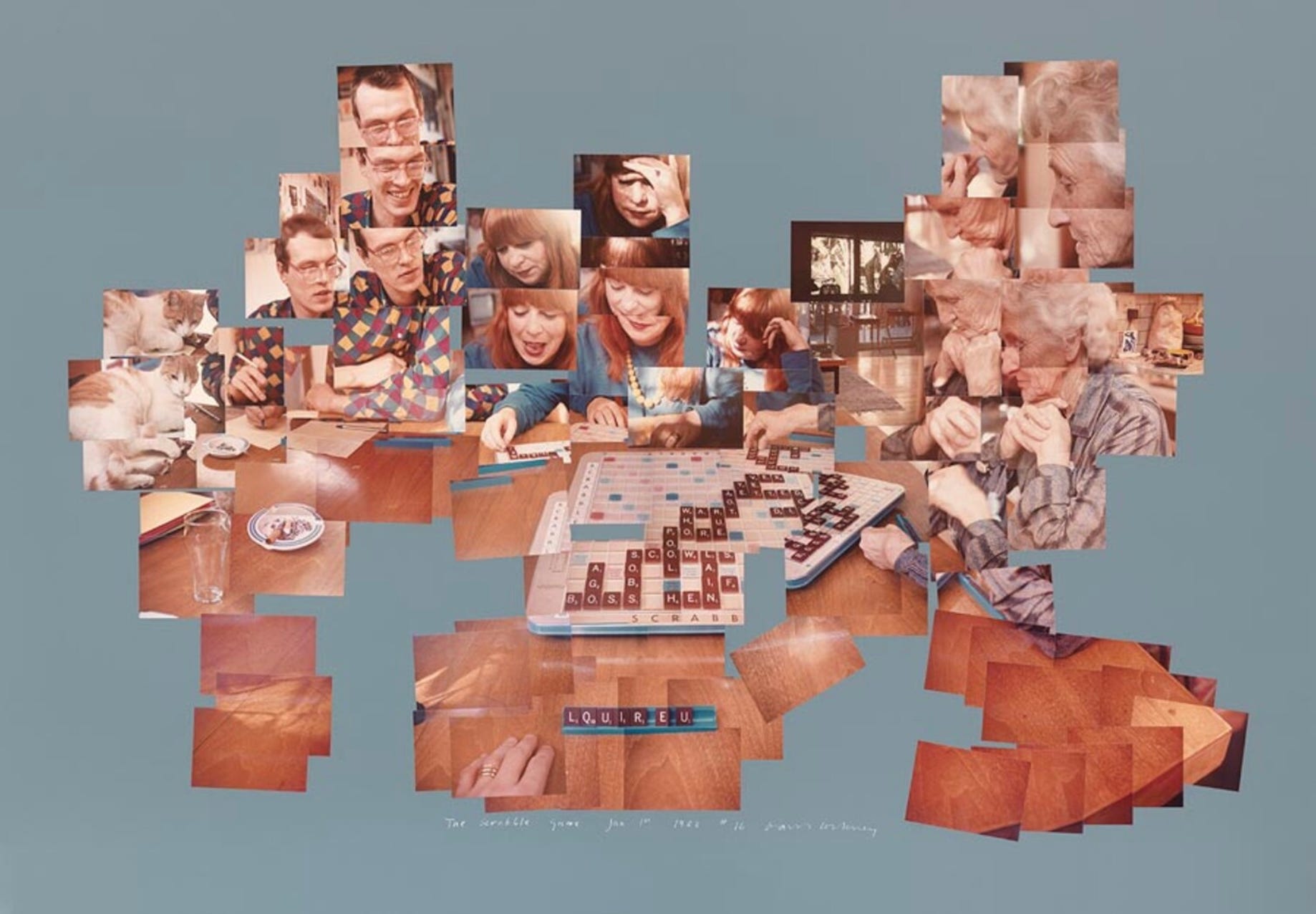
One of the artist’s lifelong interests was the nature of vision and how art can influence the act of seeing. Though he had used photographs for casual occasions and as preparatory studies, Hockney was not enthusiastic about photography’s potential to capture the world as he felt painting could, describing a photograph as “the point of view of a paralyzed Cyclops.” However, in the early 1980s, the artist took a series of photographs as reference images for a painting and realized they created a narrative of moving through the space. This realization led to the photocollages that Hockney termed “joiners.” The artist was so taken with this new process that he stopped painting for a while as he explored the possibilities of this new concept.
Within a week I'd done very complex things. I quickly discovered that I didn't have to match things up at all. In fact, I couldn't possibly match them, and it wasn't necessary. The joiners were much closer to the way we actually look at things, closer to the truth of the experience. – David Hockney
Though Hockney used them for landscapes and portraits, the joiners that I find most interesting are those like The Scrabble Game which capture the activities of one or more people and the setting surrounding them. In this composition, three opponents think, play, and respond to the game. The photographer even includes a tray of letters at the bottom of the composition, so that the effect the viewer is participating in the game in enhanced. By the end of the 1980s, Hockney felt he’d taken this technique as far as he could and he became involved his most complex theatrical designs yet.
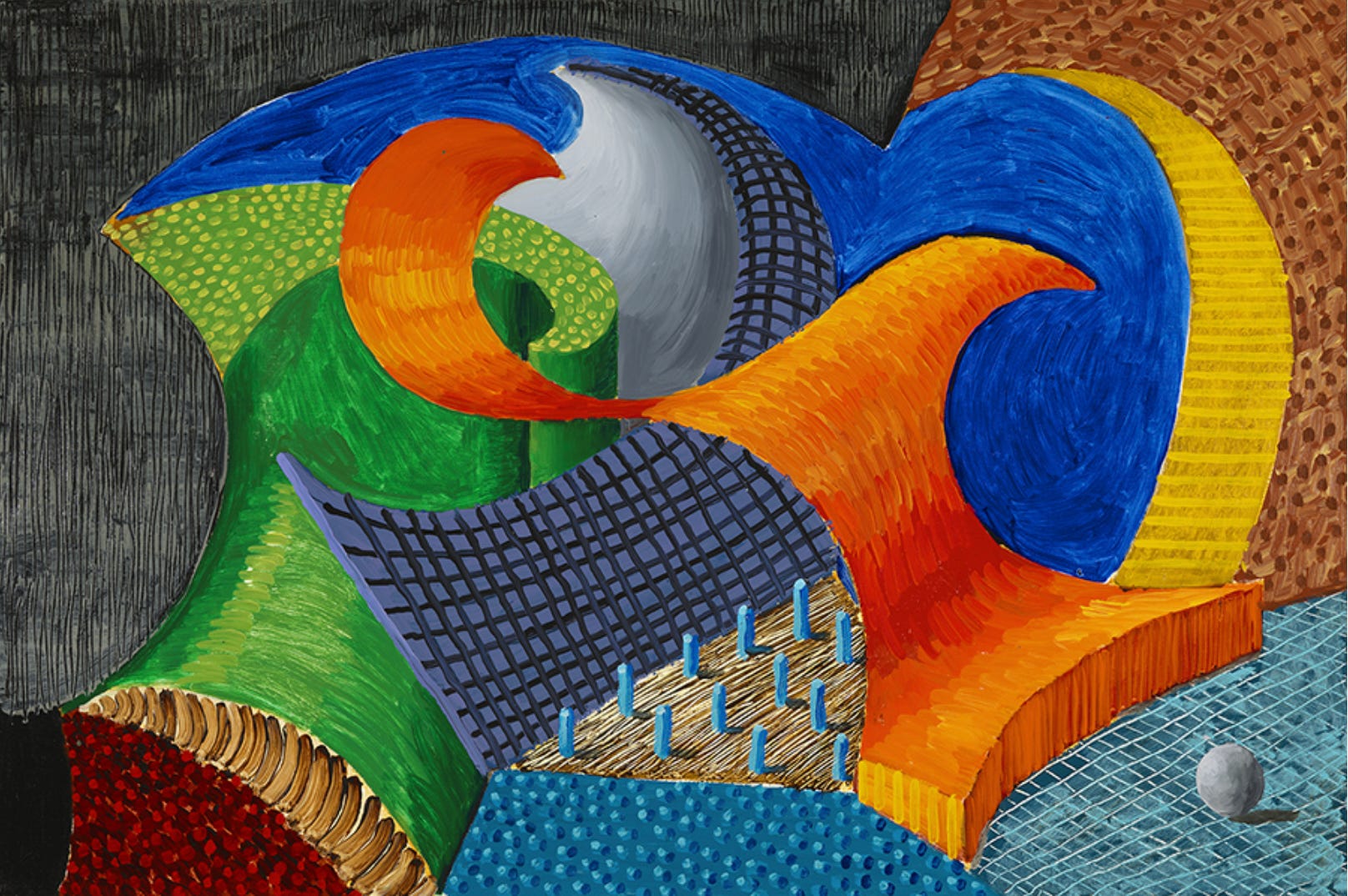
In 1992, Hockney’s last theatrical designs were completed (Puccini’s Turandot and Richard Strauss’ Die Frau ohne Schatten) and the artist was again ready to explore something very new.
When you stop doing something, it doesn't mean you are rejecting the previous work. That's the mistake; it's not rejecting it, it's saying, “I have exploited it enough now and I wish to take a look at another corner.” – David Hockney
The corner the artist looked around was quite different from everything that had come before. The Very New Paintings were completed in Malibu over the course of the year. They build on some of the set designs for his last operas, with sweeping architectural and landscape forms while at the same time incorporating stylized hatching, crosshatching, and other patterns to convey space and texture. I would never have guessed that Hockney had made these paintings if I came across them unexpectedly.
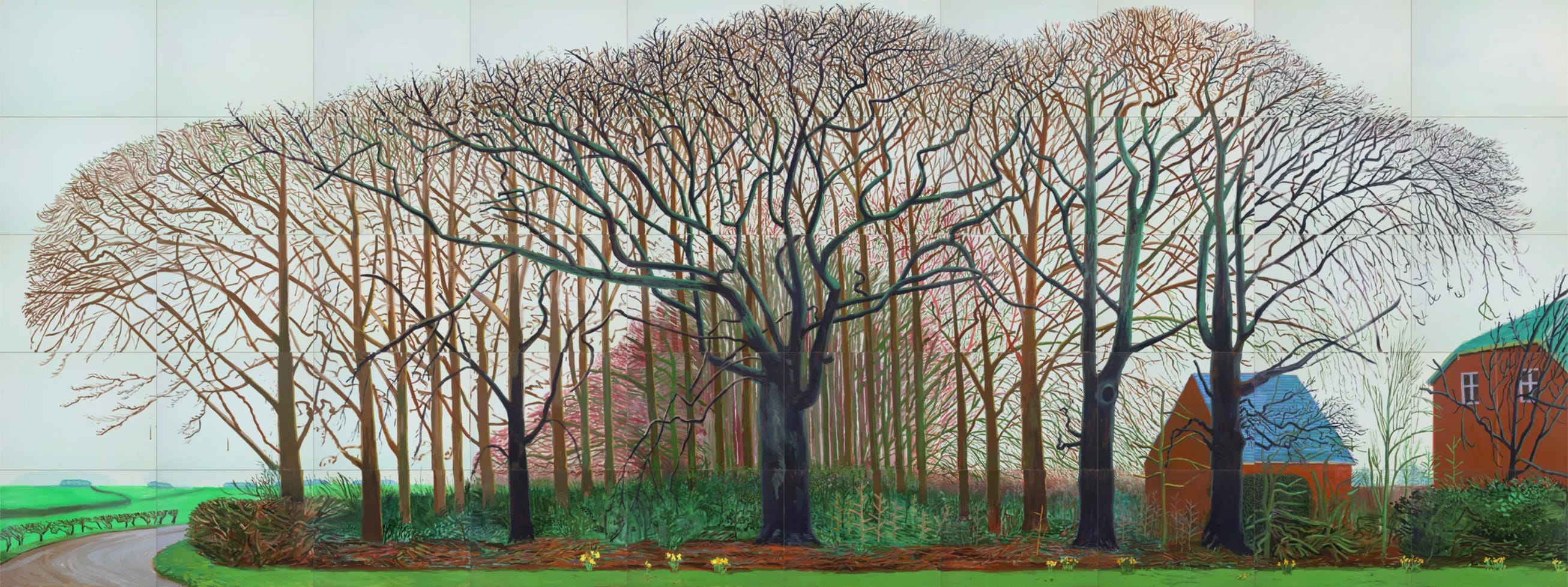
In his last decades, Hockney began working on vast compositions constructed from multiple canvases. He also experimented with digital photography, both still and moving, taking advantage of newer technology’s ability to stitch images together to make massive photomurals. Bigger Trees near Warter… completed in 2007 is the artist’s largest painting, 15 by 40 feet (4.6 by 12.2 m). It was executed in Yorkshire, often outdoors, over five weeks in Yorkshire during the winter of 2006-2007. The creation of this painting was also the subject of a documentary by Bruno Wollheim called “David Hockney: A Bigger Picture.” Wolheim followed the artist as he worked on the painting. The painting depicts the Yorkshire landscape, a theme Hockney returned to throughout his life, whether painted on site or from memory. The focus on trees of many works from this period reflects the artist’s belief that trees are the largest manifestation of life force visible to us. The artist donated the painting to the Tate in London in 2008 on the occasion of his 70th birthday.
I thought if I’m going to give something to the Tate I want to give them something really good. It’s going to be here for a while. I don’t want to give things I’m not too proud of... I thought this was a good painting because it’s of England... it seems like a good thing to do. – David Hockney
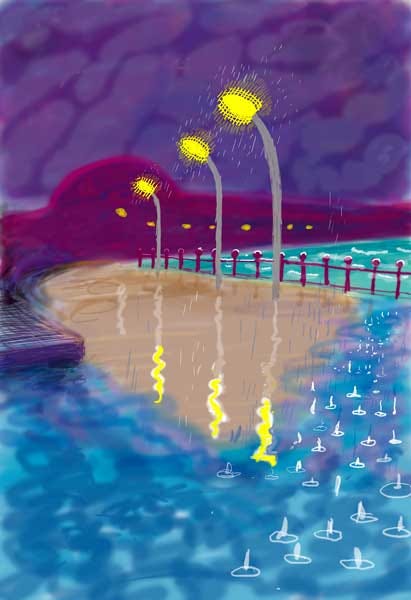
I close with one of Hockney’s iPad drawings, also an English landscape subject. The artist lived and worked between Los Angeles, London, Paris, Yorkshire, and Normandy at various stages of his career, though Los Angeles and Yorkshire were his preferred homes. Rainy Night on Bridlington Promenade (2008) is from early in the artist’s use of the iPad to create drawings. The masses of bright color are reminiscent of the Paper Pools but the greater control made possible by the digital platform permitted the artist to achieve line as well as mass.
What an artist is trying to do for people is bring them closer to something, because of course art is about sharing. You wouldn't be an artist unless you wanted to share an experience, a thought. – David Hockney
Summing up a life and career as eventful as Hockney’s is no easy task, and the many obituaries and appreciations that have been published since his death have done that far more clearly and completely than I could to do here. The artist created portraits, still life, landscapes, abstractions and theatrical designs. He worked in nearly every two dimensional medium that was available to him during his lifetime. Hockney believed that painting had the greatest power to express his experience of the world to the viewer but he was willing to reach beyond painting to explore possibilities in new media. David Hockney was undoubtedly one of the most important artists of our time.
Exhibitions:
“David Hockney: Works from the Collections of Jordan D. Schnitzer and his Family Foundation,” through July 26, 2026, at Portland Art Museum, 1219 SW Park Avenue, Portland, Oregon, USA. https://portlandartmuseum.org/event/david-hockney/
“David Hockney: The Moon Room,” through August 14, 2026, at Pace, 540 West 25th Street, New York, New York, USA. https://www.pacegallery.com/exhibitions/david-hockney-the-moon-room/
“David Hockney: A Year in Normandie and Some Other Thoughts about Painting,” through August 23, 2026, at Serpentine North Gallery, West Carriage Drive, London, England, UK. https://www.serpentinegalleries.org/whats-on/david-hockney-a-year-in-normandie-and-some-other-thoughts-about-painting-exhibition-serpentine-galleries/
“David Hockney,” October 7, 2027 to February 20, 2028, at Tate Britain, Millbank, London, England, UK. https://www.tate.org.uk/whats-on/tate-britain/david-hockney
Have a question? Ask in the comments.
Once again, thank you to all our subscribers and other readers. Remember that our subscriptions are always free. Please comment, like, and share. I’ll be back next week with more art to share.
Comments
Nothing yet. Say the first thing.
Sign in to join the conversation.